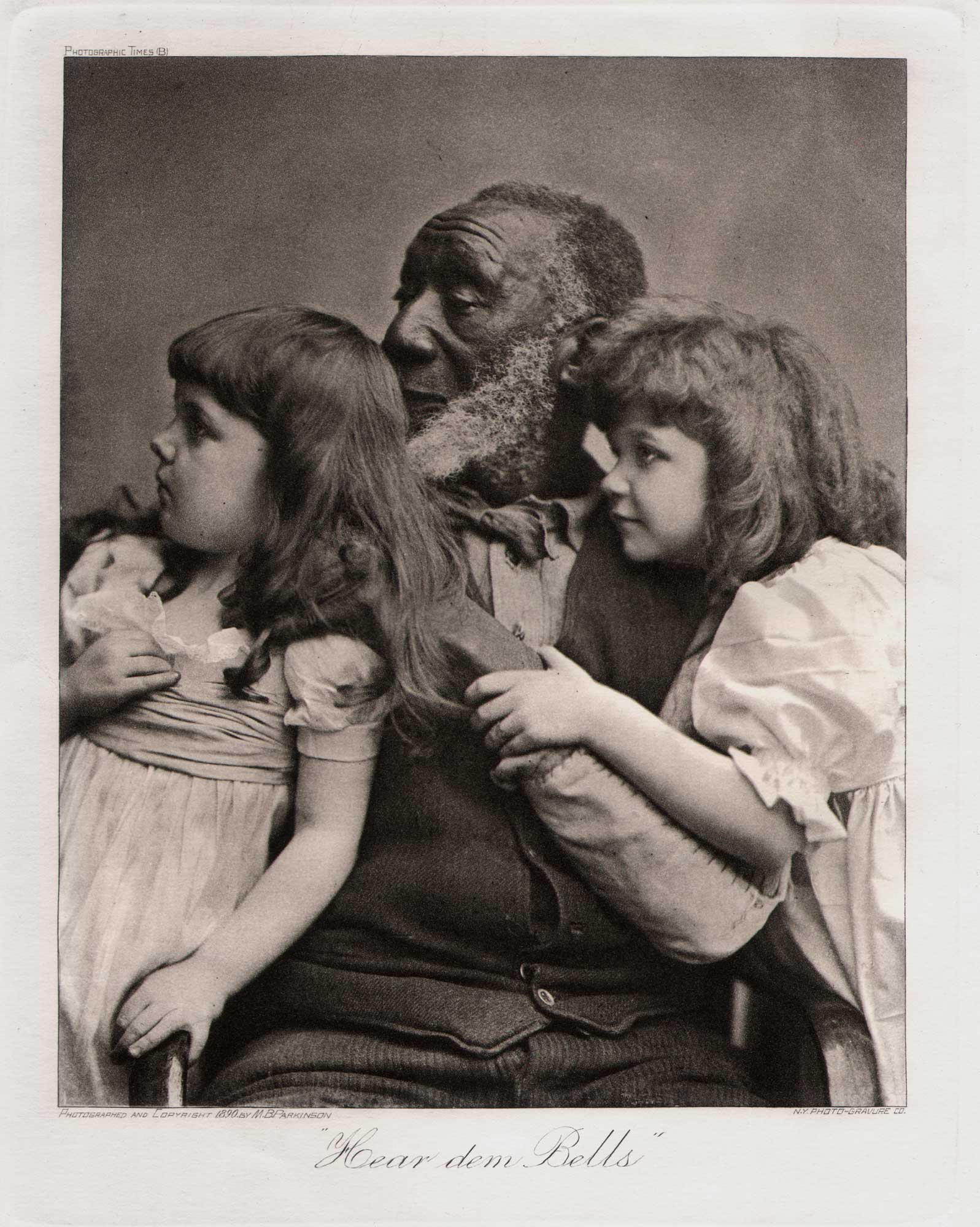
Hear dem Bells
Editorial comment for this plate:
” HEAR DEM BELLS.”
SOME time ago we presented our readers with a specimen of Mr. Parkinson’s attractive work, and made a half promise to follow it with another picture by the same artist. We are very glad to fulfill that promise now by sending forth the frontispiece which embellishes this number of THE PHOTOGRAPHIC TIMES.
“Hear dem Bells,” while a little different in the character of its subject from “Why Don’t You Lean On Me,” is equally as good in composition and in technical excellence. Like its predecessor, it is a copyrighted picture, and we are permitted to present it to our readers through the courtesy of Messrs. Luecker, Unger & Co., Mr. Parkinson’s publishers.
The title to this work is likely a reference to the negro spiritual, or jubilee song Hear dem Bells written in 1880 by D.S. McCosh. The lyrics follow (copyright, 1880, by The Chicago Music Co.) :
We goes to church in de early morn.
When de birds am a singin’ on de trees;
Sometimes dese clo’es am werry much worn,
But we wears dem out at the knees.
At night when de moon am a shinin’ bright.
And de clouds hab passed away,
Dem bells keep a ringin’ for de gospel fight
Dat will last till de judgment day.
Chorus.
Hear dem bells! don’t you hear dem bells?
Dey’s a ringin’ out de glory ob de lamb;
Hear dem bells! don’t you hear dem bells?
Dey’s a ringin’ out de glory ob de lamb.
De church am old and de benches worn,
De bible am a gittin’ hard to read;
But de spirit am dere, as sure as you’re born.
Which is all de comfort we need.
We sing and shout wid all our might
To keep away de cold;
Dem bells keep a ringin’ out de gospel light
Till de story ob de lamb is told. – Chorus.
All day we work in de cotton and de corn
Wid feet and hands so sore,
A prayin’ for Gabriel to blow his horn,
So we don’t hab to work any more.
I hear dem chariots comin’ dis way,
And I know dey’s comin’ for me,
So ring dem bells till judgment day,
And de land dat I’se gwine for to see.-Chorus.
A variant of Hear Dem Bells: What Was Slavery Uncle Tom?, was taken and copyrighted by Parkinson in 1890.
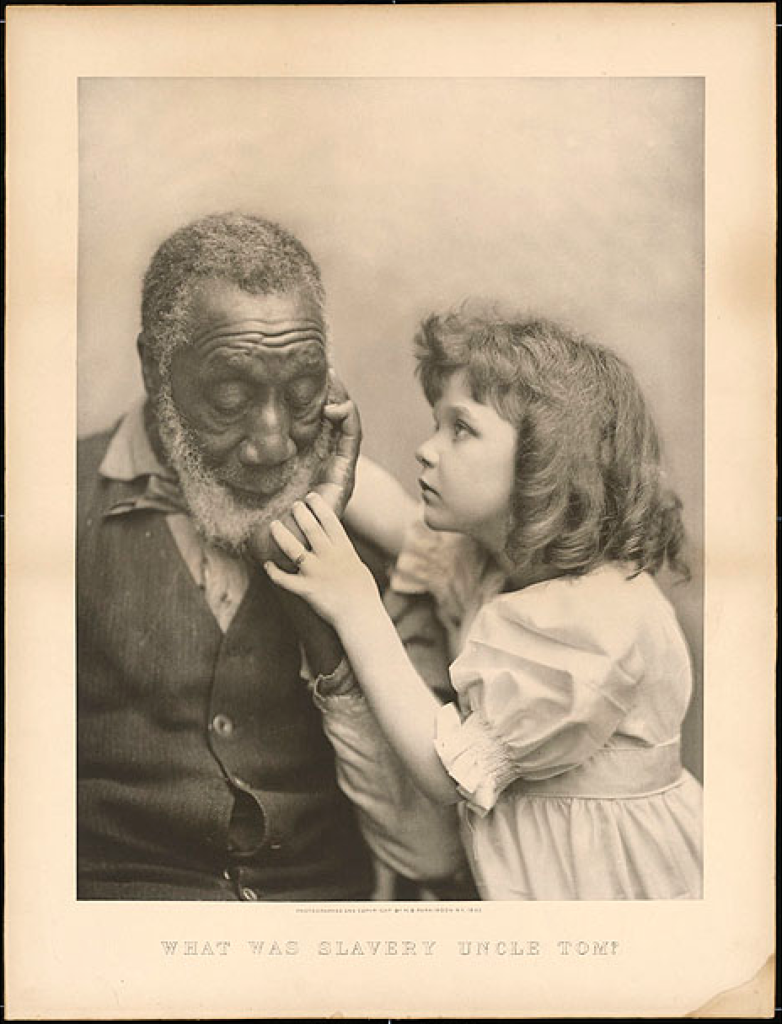
What was slavery, Uncle Tom? Call Number: Broadside S68 299 1890 Location: BARR-FLAT Under 17USC. Section 107, this single copy was produced for the purposes of private study, scholarship, or research. No further copies should be made. Copyright and other legal restrictions may apply. Special Collections, University of Virginia Library. Photograph by M. B. Parkinson (New York: 1890) Special Collections, University of Virginia
This version featured the same African-American gentleman and female child model on right. Issued as a broadside poster, (25 x 19″) a copy is held in the Special Collections division at the University of Virginia Library.
Morris Burke Parkinson (born: July, 1847-1926) worked for many years as a portrait photographer in New York City before moving to Boston in the very early part of the 20th century, where he maintained a portrait studio at 423 Boyleston street. He is perhaps best known for the two allegorical and widely reproduced photographs of four-year-old child model Josephine Anderson, depicted as Cupid Awake and Cupid Asleep.