Esther Chamberlain – Author & Artist
Esther Chamberlain was one of the first women in New York to make a profession of supplying illustrative advertising matter. – The Argonaut, July 17, 1905
In Esther’s portrait, Ben-Yusuf has posed her standing with eyes downcast against a neutral wall. She wears a stylish hat and holds a fur muff at her waist. The portrait suggests a woman of refined taste who is both demure and strikingly self-confident. In her dress and bearing, she is exemplary of one school of modern femininity. – Frank H. Goodyear III: Zaida Ben-Yusuf: New York Portrait Photographer, p. 144
Esther Chamberlain: 1877-1917
The following excerpt is courtesy Zaida Ben-Yusuf: New York Portrait Photographer, (2008) by Frank H. Goodyear III
At the turn of the century, New York City was the chosen destination for many career-minded independent women. Like Ben-Yusuf, Esther Chamberlain and her sister Lucia came as single women hoping to refashion their lives. As the nation’s busiest center for the arts and publishing- two fields increasingly open to women-New York City gave ambitious women the opportunity to make a mark.
In 1900, Esther Chamberlain traveled from her home in northern California and took up residence in Manhattan. Little is known about her upbringing on the West Coast, her lifedates, or the exact circumstances behind her relocation. Shortly thereafter, though, she set up an artist’s studio and began providing advertising illustrations for periodicals and newspapers. This type of commercial work was common for young, aspiring artists. During this period, Esther’s sister Lucia joined her in New York, where, beginning in 1902, Lucia became a regular contributor of short stories and verse to such popular magazines as Scribner’s, Ainslee’s, and Everybody’s.
In September 1903, the two sisters published their first joint work, a novelette entitled The Blue Moon, which contained a variety of autobiographical elements. The story explores the lives of two fashionable sisters who go to New York after the death of their parents. There they open and operate a popular restaurant. When each of them falls in love, though, they decide to give up this increasingly difficult enterprise. While portraying the two sisters as resourceful and independent, the Chamberlains ultimately equate success for women with a happy marriage.
Successful as The Blue Moon was, it was their full-length novel Miss Essington, published by the prestigious Century Company two years later, that transformed the Chamberlain sisters into minor celebrities in New York literary circles. The New York Times effusively praised this romantic tale set at a country house in Monterey, California, suggesting that it “indicates the influence of fresh air, and sky, and sea, among people who reflect the class we call the ‘smart set.”’
While the reviewer noted that the novel featured characters similar to those in Edith Wharton’s recently published The House of Mirth, “they are not exasperating in their long speeches of pessimism, and they do not find the would a place of disheveled ambitions.
Asked by the same critic why the “smart people you have written about … [aren’t] always unhappy,” Esther responded:
“We are a naïve lot out there on the coast. They have as much money as they want, many of them are quite as rich as the Newport millionaires, and we don’t mistrust people because they appreciate art or literature more than money. The wealthiest smart women in society in California entertain artists and writers just as well as they do society people.” 4 (“Do Our Story Writers Misuse the ‘Smart Set?” The New York Times-July 9, 1905) continues…
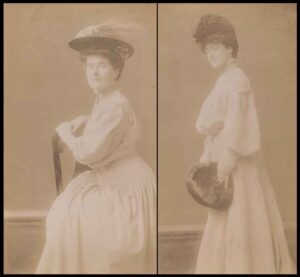
The sisters Lucia Chamberlain, left, and Esther Chamberlain were individually photographed by Zaida Ben-Yusuf at the same time. Each of these vintage gelatin-silver press prints include the name of their first joint novel: Mrs. Essington, published in May, 1905, on their versos. This indicates the portrait sessions may have taken place earlier than the commonly cited ca. 1908 date assigned by Ben-Yusuf scholars. Left: 15.6 x 9.0 cm; Right: 15.8 x 8.2 cm. Both: PhotoSeed Archive
✻ ✻ ✻ ✻ ✻
Zaida Ben-Yusuf: 1869-1933
From online Exhibition Introduction: Zaida Ben-Yusuf- New York Portrait Photographer
Zaida Ben-Yusuf (1869-1933) was a leader in the art of photographic portraiture in turn-of-the-century New York. She operated – for ten years beginning in 1897 – arguably the most fashionable portrait studio on Fifth Avenue, while at the same time contributing work to numerous publications and the period’s most important photography exhibitions. As a testament to her renown, she served as a spokesperson for the Eastman Kodak Company and was regularly profiled in newspapers and magazines. Yet the memory of her achievement as a photographer has largely vanished.
Born in London, Ben-Yusuf settled in New York in 1895. There she took up photography, first as a hobby and then two years later as a profession. Rather than falling back on traditional portrait conventions – painted backdrops and contrived poses – she sought inspiration from the leading artists and pictorial photographers of the period. Despite her young age and her recent arrival in America, she attracted to her studio many of the era’s most prominent artistic, literary, theatrical, and political figures. Seen together, these individuals represent a remarkable cross-section of a place that was rapidly becoming America’s first modern city. Yet, like many professional women, she encountered personal and economic difficulties that ultimately compelled her to abandon photography. Although she later pursued with equal ambition a career in the fashion trade, it is her photographic work – and the men and women she portrayed – that we aim to recover in this exhibition.