Woman with Revolving Carte-de-Visite Album
A woman seated in the studio of Glasgow commercial photographer James Whyte shows off an unusual revolving Carte-de-Visite album placed on a nearby table. The viewer itself is elaborately carved from wood, (mahogany?) and may be a bespoke item fashioned after earlier known designs. The comprehensive website Glasgow’s Victorian Photographers reveals this cdv dates to 1883, the only year Whyte’s studio was located at the address printed on the lower recto margin and verso of this card: 23 Jamaica St. in Glasgow.
The Whyte firm moved the following year to 37 Jamaica St., where it maintained a studio from 1884-1903, with another studio located from 1893-1897 at 75 Jamaica St., in 1902 at 64 Abbotsford Pl., and from 1904-1914 (but well into the 1920s) at 20 Union St. The studio became known as Whyte & Sons after 1906.
Photographicons, Graphotropes, & other Revolving CDV Viewers
As necessity is the mother of invention, the mass popularity of cdv’s beginning in the early 1860’s gave inventors plenty of opportunities to come up with new viewing devices. Below are four commercial examples of viewers from private collections, along with some background on each, courtesy of their respective owners and or sellers.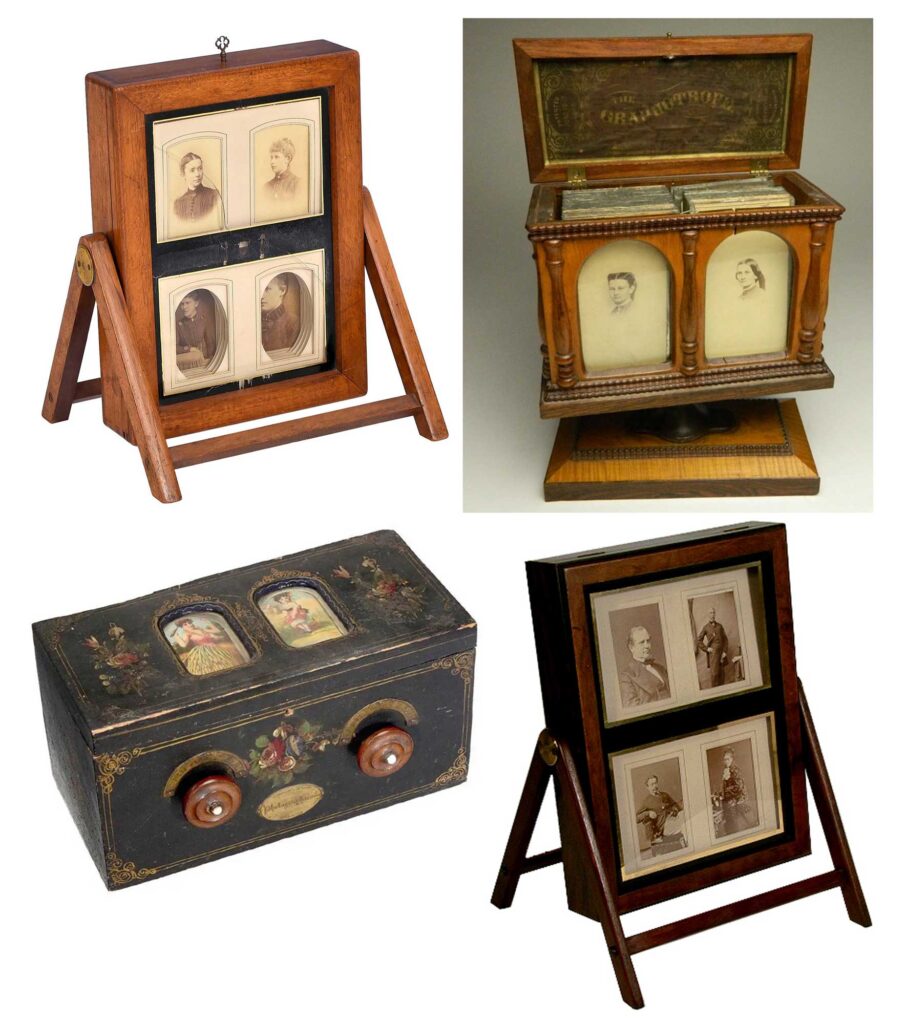
Top row, left to right: A(lbert). Foerste’s Patent Rotating Album, 1878 onwards
Changeable album for professional photographers, containing cartes de visite, one glass panel cracked, otherwise well-preserved, ht. 33 cm. – References: “Photographic Weekly”, 1878, p. 128: “… a speculative Yankee has constructed an album that has also found its way into Germany… from an elegant mahogany box that is supported by a trestle in its horizontal cross line and thus rotates circa its horizontal axis. The pictures are located, four at a time, under glass panes parallel to the front and back wall of the box, which contains fifty-two of them. With each rotation of the box, the two upper pictures slide down on wood rails, thus offering the viewer two new views. By continuing to rotate, all 52 pictures become visible one after the other; they cannot be soiled and cannot fall into the wrong hands against the will of their maker, since the box has a lock to protect the pictures from such afflictions.” – An interesting patent device in the history of photography. Credit: Lot #184: Auction Team Breker, 50997 Köln , Germany, November 09, 2024
”The Graphotrope” Carte-de-Visite Display
Manufactured by William Walker & Co., New Haven, patd. June 1866, walnut and maple viewing box with four glazed openings (two on each side) flanked by turned half columns and trimmed with ripple molding, hinged lid with floral relief and maker’s printed label inside stating The Graphotrope, Manufactured by William Walker & Co., New Haven, patd. June 12th 1866, viewing frame rotates on an iron pillar mounted to a raised plinth causing metal framed photographs to move from left to the right window, Mechanism not working. 8 1/2 x 7 x 3 3/8”. Credit: Lot #0351: Rachel Davis Fine Arts, Cleveland, OH, May 14, 2022
Bottom row, left to right:
1865: The Photographicon CDV Viewer: Charles Robinson
The photographic and Carte de Visite frenzy that followed Disdéri’s invention, spawned a slew of new devices designed specifically for viewing and storing small images. Robinson’s Photographicon of 1865 refers to a patented device designed for viewing cartes-de-visite, which were small photographic portraits popular in the 19th century. It was a tabletop viewer, often ornate, used to display and scroll through a collection of these photographs. The device, credited to a patent dated 11 April 1865, was manufactured by D. Millard and Company in Cincinnati, Ohio.
Entertaining Carte de Visites in the parlour created a need for viewing boxes. Robinson’s Photographicon of 1865 contained two roller drums with fifty printed paper CDV frames, mounted on a roll of linen. The handle was turned and the CDV came into view just like a Moving Panorama.
Some cases were decorated with porcelain or brass-domed buttons. Lids came with one or two windows for viewing. Patented 11 April 1865 (US Patent Nº 50498), Robinson’s Photographicon included directions on how to use the contraption. The Photographicon, described as a small oblong box with two four-inch-diametre cylinders, a cambric band to mount up to 100 pictures, and a knob to view them under glasses set in the top. The device is noted as a desirable alternative to albums for retaining and exhibiting photographs, and Charles Robinson received a diploma for it. Credit: Paul Burns: Pre Cinema History: Pre Cinema Historian, Author : The History of the Discovery of Cinematography. (1990) link with Photographicon opened and brass faceplate. Link to website, viewer discussed in chapter 13.
1870s (ca) Display album or revolving frame to hold 40 cartes de visite, in special card mounts (probably English)
As the “album” is revolved on the easel type stand a new set of images comes into view. Comes with the original key. Credit: Bryan and Page Ginns, Stereographica – Antique Photographica (#14 / 41) (Luminous Lint: LL/11129)
✻ ✻ ✻ ✻ ✻
Finally, another cdv courtesy of CraigCamera with a young girl-Mary Hilligoss, ca. 1865 displaying one of Charles Robinson’s Photographicons. (on its side however) The work was taken by Johnston Ross Tatman (1823-1898), at the Fine Art Gallery, Shelbyville, Indiana. (thanks to Paul Burns: Pre Cinema History: Pre Cinema Historian, Author : The History of the Discovery of Cinematography. (1990)