To The Student: Pictures of East Anglian Life
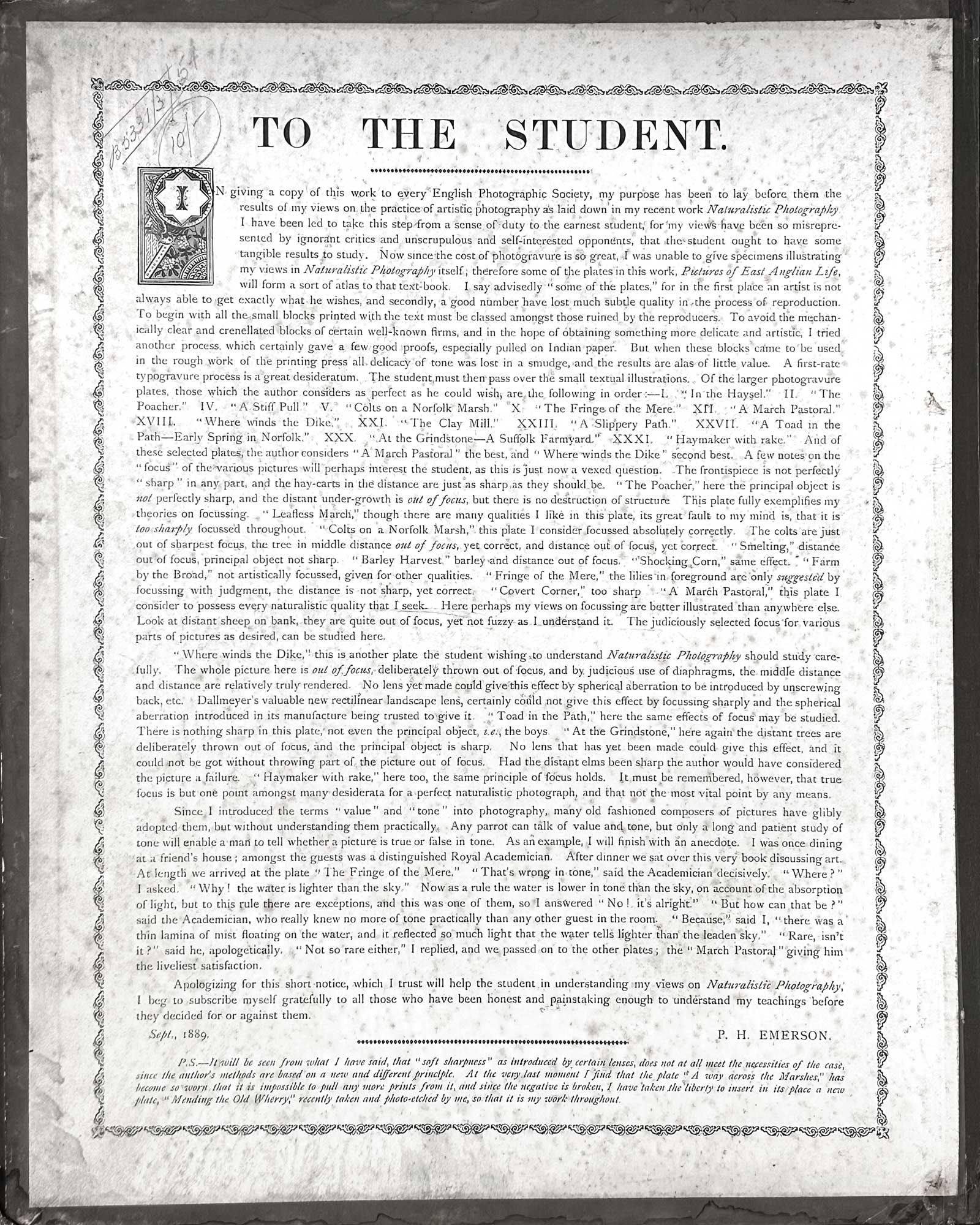
Penned by the artist in September, 1889 and pasted to the verso of the front cover of Pictures of East Anglian Life one year after publication, To The Student was intended to educate photographers on Emerson’s theories of selective focus for his 1889 volume Naturalistic Photography for Students of the Art, using this folio of photogravures as a companion volume: “I was unable to give specimens illustrating my views in Naturalistic Photography itself; therefore some of the plates in this work, Pictures of East Anglian Life, will form a sort of atlas to that textbook.”
TO THE STUDENT.
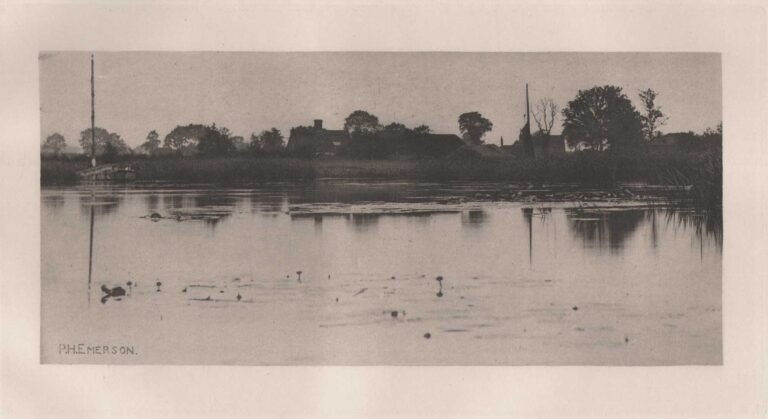
IN giving a copy of this work to every English Photographic Society, my purpose has been to lay before them the results of my views on the practice of artistic photography as laid down in my recent work Naturalistic Photography. I have been led to take this step from a sense of duty to the earnest student for my views have been so misrepresented by ignorant critics and unscrupulous and self-interested opponents, that the student ought to have some tangible results to study. Now since the cost of photogravure is so great, I was unable to give specimens illustrating my views in Naturalistic Photography itself; therefore some of the plates in this work, Pictures of East Anglian Life, will form a sort of atlas to that textbook. I say advisedly “some of the plates,” for in the first place an artist is not always able to get exactly what he wishes, and secondly, a good number have lost much subtle quality in the process of reproduction. To begin with all the small blocks printed with the text must be classed amongst those ruined by the reproducers. To avoid the mechanically clear and crenellated blocks of certain well-known firms, and in the hope of obtaining something more delicate and artistic, I tried another process, which certainly gave a few good proofs, especially pulled on Indian paper. But when these blocks came to be used in the rough work of the printing press all delicacy of tone was lost in a smudge, and the results are alas of little value. A first-rate typogravure process is a great desideratum.The student must then pass over the small textual illustrations.. Of the larger photogravure plates, those which the author considers as perfect as he could wish, are the following in order: I. “In the Haysel.” II. “The Poacher.” IV. “A Stiff Pull.” V. “Colts on a Norfolk Marsh.” X. “The Fringe of the Mere.” XII. “A March Pastoral.” XVIII. “Where winds the Dike.” XXI. “The Clay Mill.” XXIII. “A Slippery Path.” XXVII. “A Toad in the Path—Early Spring in Norfolk.” XXX. “At the Grindstone—A Suffolk Farmyard.” XXXI. “Haymaker with rake.” And of these selected plates, the author considers “A March Pastoral” the best, and “Where winds the Dike” second best. A few notes on the “focus” of the various pictures will perhaps interest the student, as this is just now a vexed question. The frontispiece is not perfectly “sharp” in any part, and the hay-carts in the distance are just as sharp as they should be. “The Poacher,” here the principal object is sol perfectly sharp, and the distant under-growth is out of focus, but there is no destruction of structure. This plate fully exemplifies my theories on focussing. “Leafless March,” though there are many qualities I like in this plate its great fault to my mind is that it is too sharply focussed throughout. “Colts on a Norfolk Marsh,” this plate I consider focussed absolutely correctly. The colts are just out of sharpest focus, the tree in middle distance out of focus, yet correct, and distance out of focus, yet correct. “Smelting,” distance out of focus, principal object not sharp. “Barley Harvest,” barley and distance out of focus. “Shocking Corn,” same effect. “Farm by the Broad,” not artistically focussed, given for other qualities. “Fringe of the Mere,” the lilies in foreground are only suggested by focussing with judgment, the distance is not sharp, yet correct. “Covert Corner,” too sharp. “A March Pastoral,” this plate I consider to possess every naturalistic quality that I seek. Here perhaps my views on focussing are better illustrated than anywhere else. Look at distant sheep on bank, they are quite out of focus, yet not fuzzy as I understand it. The judiciously selected focus for various parts of pictures as desired, can be studied here.
“Where winds the Dike,” this is another plate the student wishing to understand Naturalistic Photography should study carefully. The whole picture here is out of focus, deliberately thrown out of focus, and by judicious use of diaphragms, the middle distance and distance are relatively truly rendered. No lens yet made could give this effect by spherical aberration to be introduced by unscrewing back, etc. Dallmeyer’s valuable new rectilinear landscape lens, certainly could not give this effect by focussing sharply and the spherical aberration introduced in its manufacture being trusted to give it. “Toad in the Path,” here the same effects of focus may be studies. There is nothing sharp in this plate, not even the principal object, i.e., the boys. “At the Grindstone,” here again the distant trees are deliberately thrown out of focus, and the principal object is sharp. No lens that has yet been made could give this effect, and it could not be got without throwing part of the picture out of focus. Had the distant elms been sharp the author would have considered the picture a failure. “Haymaker with rake,” here too, the same principle of focus holds. It must be remembered, however, that true focus is but one point amongst many desiderata for a perfect naturalistic photograph, and that not the most vital point by any means.
Since I introduced the terms “value” and “tone” into photography, many old fashioned composers of pictures have glibly adopted them, but without understanding them practically. Any parrot can talk of value and tone, but only a long and patient study of tone will enable a man to tell whether a picture is true or false in tone. As an example, I will finish with an anecdote. I was once dining at a friend’s house; amongst the guests was a distinguished Royal Academician. After dinner we sat over this very book discussing art. At length we arrived at the plate “The Fringe of the Mere.” “That’s wrong in tone,” said the Academician decisively. “Where?” I asked. “Why! the water is lighter than the sky.” Now as a rule the water is lower in tone than the sky, on account of the absorption of light, but to this rule there are exceptions, and this was one of them, so I answered “No! it’s alright.” “But how can that be?” said the Academician, who really knew no more of tone practically than any other guest in the room. “Because,” said I, “there was a thin lamina of mist floating on the water, and it reflected so much light that the water tells lighter than the leaden sky. “Rare, isn’t It?” said he, apologetically. “Not so rare either,” I replied, and we passed on to the other plates; the “March Pastoral” giving him the liveliest satisfaction.
Apologizing for this short notice, which I trust will help the student in understanding my views on Naturalistic Photography, I beg to subscribe myself gratefully to all those who have been honest and painstaking enough to understand my teachings before they decided for or against them.
Sept., 1889 P. H. EMERSON
P.S.—It will be seen from what I have said, that “soft sharpness” as introduced by certain lenses, does not at all meet the necessities of the case, since the author’s methods are based on a new and different principle. At the very last moment I find that the plate “A way across the Marshes,” has become so worn that it is impossible to pull any more prints from it, and since the negative is broken, I have taken the liberty to insert in its place a new plate, “Mending the Old Wherry,” recently taken and photo-etched by me, so that it is my work throughout.