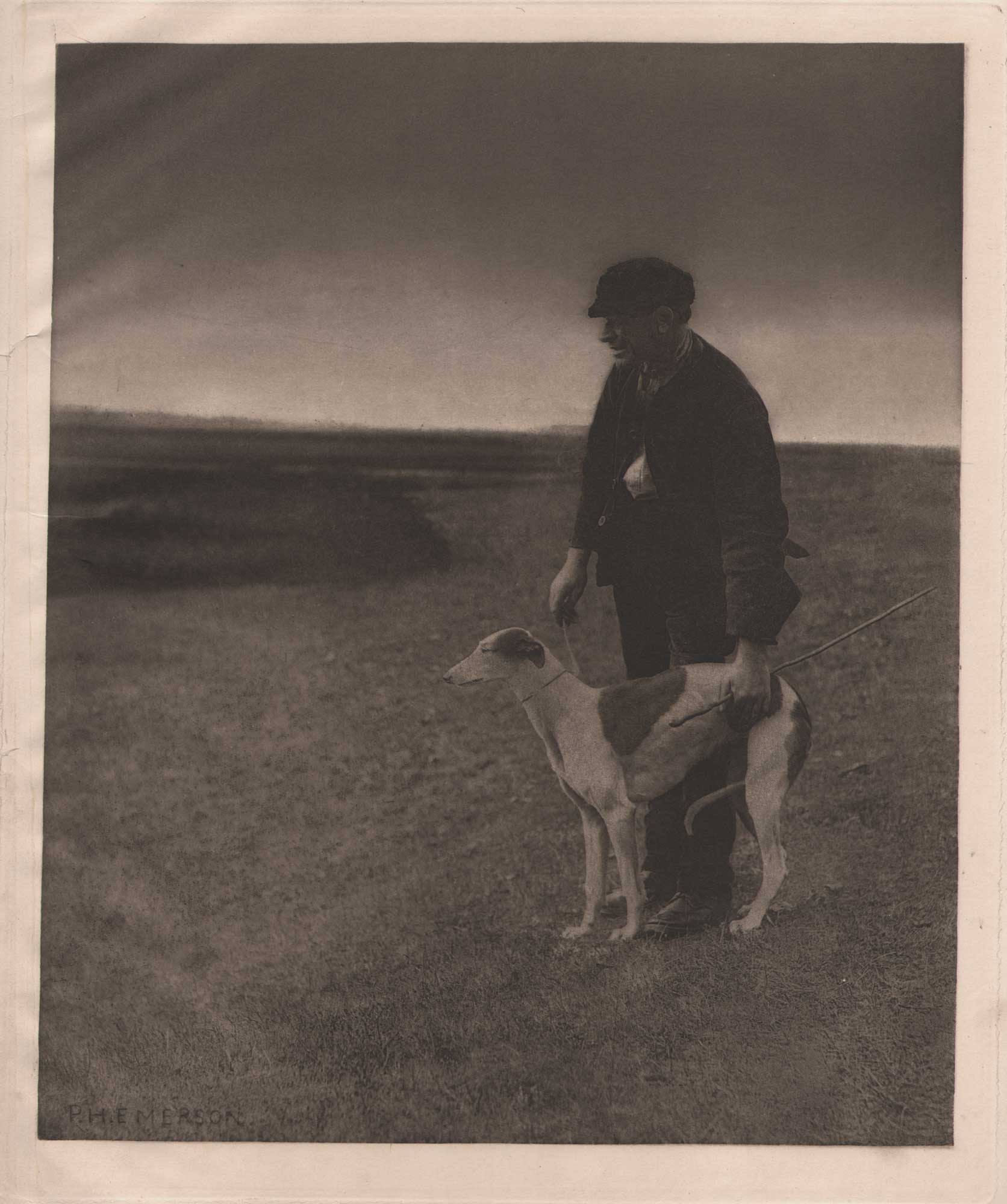
The Poacher—A Hare in View {Suffolk}
A poacher steadies his hunting dog described by the artist as “lurcher-half greyhound, half sheep-dog” before unleashing it to hunt prey. A lurcher is a mix of a sighthound and working dog, an old English term for a crossbred dog.
“The poacher’s face (pl. 11), as he prepares to slip his dog, is as successful as is the pale light of early morning in the sky and on the distant landscape.”⎯Review: The Academy, August 11, 1888, No. 849, p.79
“A few notes on the “focus” of the various pictures will perhaps interest the student, as this is just now a vexed question….”The Poacher,” here the principal object is not perfectly sharp, and the distant undergrowth is out of focus, but there is no destruction of structure. This plate fully exemplifies my theories on focussing.” ⎯ P.H. Emerson, Sept., 1889, To The Student
From Chapter IV: Poachers and Poaching
“Let us now study the poacher at work. It is a beautiful evening in early spring, the sun is just setting, and the air is alive with gnats and humming insects. The hedges are bright with “May,” and the newly born leaves rustle in the breeze. Along a secluded road some way from the village walks a tall man with quick gait; a sack is thrown carelessly over his shoulder, and in his right hand he carries a light stick, while beside him trots a lurcher-half greyhound, half sheep-dog. He is alone on the road; at times he raises his head and looks along the road before him, then walking very quickly, he crosses to a tree on the other side of the road, beside which there is a gate opening into a field; he stops and lights his pipe by the gate-post, then slowly strolls on, but now no dog is with him. All he said when he lit that pipe was, “Ovar, owd man,” and the faithful well-trained dog had required no other sign. The man walks slowly along the quiet road, which runs through a plantation. He sniffs the scent of the fir, and watches some pheasants as they run up the road and into the hedge with a contemplative eye. He stops and sits down a few minutes on a pile of stones, and talks to the old stone-breaker. They know each other; to watch them they might be talking of the coming election or the new doctor, but they are not. Slowly rising, he returns along the road and rests against the gate. Everything is quiet in the growing dark save for the harsh sound of a fight-challenging cock-pheasant from the coverts. “Are yow thar, owd man?” asks the idler at the gate, and the faithful dog walks quickly forward to the gate with a hare in his mouth. “Drop it, owd man,” says the idler, and taking the hare, he puts it in his sack. We do not wish to follow our friend too closely, lest he should resent our impertinence and ” mob” us in the dark; but in this harmless and unobtrusive way he spends many evenings, and exercises his dog on the farmers’ fields, and grateful is the farmer to him, as many a farmer has assured us. The hares destroy the crops, not so much by eating a quantity, as by nibbling many roots often a dozen or so each; they also tear the hearts from the clover-plants, and bite the young corn stems at the nodes, extracting the sweet juice and killing the plant. In this devastating feast the field rats take part, but not the rabbits. Our simple idler with the sack may not always find he can return and call in his straying dog at once, as we saw him succeed in doing; then all he does is to walk on, and return when he likes; for no matter how long he leaves the intelligent beast, he will lie perfectly still without uttering a sound until he hears his voice. Again, the dog does not always get a hare, but he will never return without something; he cannot afford to disappoint his master; so at times a rat is brought, more often a rabbit. No matter what is brought, the grateful master always rewards the dog with a few words of praise, and that is enough. One poacher told us his faithful dog had once nothing to bring but a rabbit’s tail, but he accepted the offering as if it had been “a golden ‘un!” Our friend, who is a lover of nature and a great naturalist, is fond of observing the ways of all wild beasts and birds, but especially interested is he in hares and rabbits, pheasants and partridges. There is perhaps something to account for his tastes. In the afternoon, at times, he wanders afield and searches for the runs of hares, and encircles the run with a wire noose. Later, the poor hare comes along with a bound, and jumps into the cold tightening embrace of the wire circlet. Our friend will loaf round later in the day and look at his snares. Hares are enterprising, and fond of feeding on the marshes as well. The poacher, too- for we are beginning to suspect that quiet man with the dog and stick–at times wants several hares to supply some greedy dealer. He must get them.” p. 60