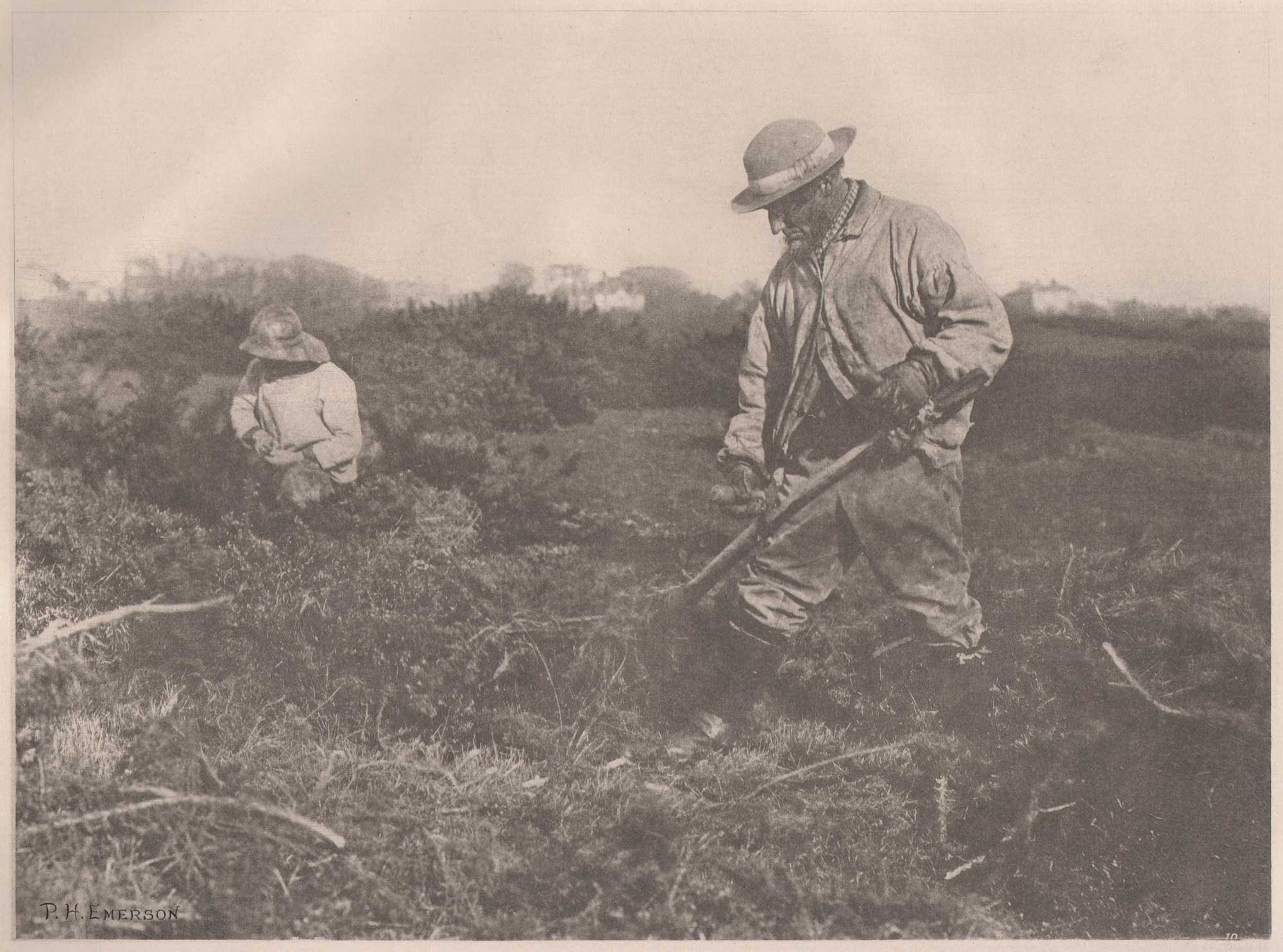
Furze Cutting on a Suffolk Common
From Chapter XIV: Furze Cutting
“NOWHERE have we seen furze growing in such luxuriance as on Southwold Common. In spring, when these prickly thickets of sombre green are ablaze with yellow flowers, its full glory is beheld. When we first saw this luxuriant blossoming, its splendour recalled to us the masses of scarlet and white and yellow of tropical flowers; but here, at Southwold, it is the denizen of bleak common and wind-cut field which blooms with all the luxuriance of torrid vegetation.
One day in early autumn we met the intelligent model shown in the plate. He was hard at work with his short stout scythe, cutting the hard wiry stems. We watched him at his work. The stroke is not at all that of the mower, a long, sweeping stroke, but a shorter, sharper stroke, more like the action of cracking a whip. The gorse or furze is generally cut in autumn, so that it may weather or “sare,” as our friend would say, in the autumn sun. He cuts it to keep it down, as otherwise it would soon cover the whole of the common. But even this plant has its uses, and in Suffolk it serves many of the uses to which reed is put in Norfolk. Thus it is required for making sheds for sheep and cattle, and for this purpose it is used green, as in that state it is more easily worked in between the wooden framework. In the green state it is also used for party-walls and the fencing in of cattle-yards, for which purpose it is preferred to anything else, as it keeps the yards very warm. It is used, too, for ” drawing in” to the hurdles during the lambing season. Again, it is employed for building up the river-banks. Bushes of furze are put between piles and the hollows in the bank formed by the tide, and these are then filled up with soft mud, a tenacious cement being thus made. The gypsies make a tea of the blossoms, which they assert is a powerful emmeno-gogue. The roots and stalks are used as faggots for kindling, and are “jobbed up” with the furze pole, an implement to be seen in the smaller plate. These small bundles, thus formed and tied up, are sold for a penny each, of which the cutter gets one halfpenny, the Corporation of Southwold one farthing, and the carter one farthing, and, as the furze-cutter said, “that make a penny.” There was no standard of measurement, we were told; that was just as it happened; he bound up the faggots by conscience. We should not object to his measurement ” by conscience,” for an honester man never breathed, but it is a system which we hope will not everywhere supersede the balance. Besides these penny bundles there are double-banded faggots, made by placing two bundles with their stems end to end, while the gorse-tops are at the opposite ends, the whole looking like a bundle of fasces sprouting at each end.” pp. 91-2
“Ulex (commonly known as gorse, furze, or whin) is a genus of flowering plants in the family Fabaceae. The genus comprises about 20 species of thorny evergreen shrubs in the subfamily Faboideae of the pea family Fabaceae. The species are native to parts of western Europe and northwest Africa, with the majority of species in Iberia.”—Wikipedia accessed 2025