Fencing in Suffolk
From Chapter XXI: Fencing
“OUR saplings of oak and elm and other trees, together with the thick undergrowth of the hedgerows, encroach so rapidly on the land, that every twelve years it is necessary to “fence.” as they say in Suffolk. In addition to this, reparative work is necessary to earth up the erosions made by rain and the holes burrowed by rabbits. It is the custom in this county to fence one-twelfth of the fences on the farm every year. The fences are originally made of whitethorn, which the landlord supplies, and which is cultivated in nurseries for the purpose. Fencing is done between the months of December and March. Two labourers, with their legs encased in gaiters and their hands in sheepskin gloves, are told off for the work. One is armed with a hook and the other with a long knife with a curved top, called in Suffolk a “bagging-iron.”
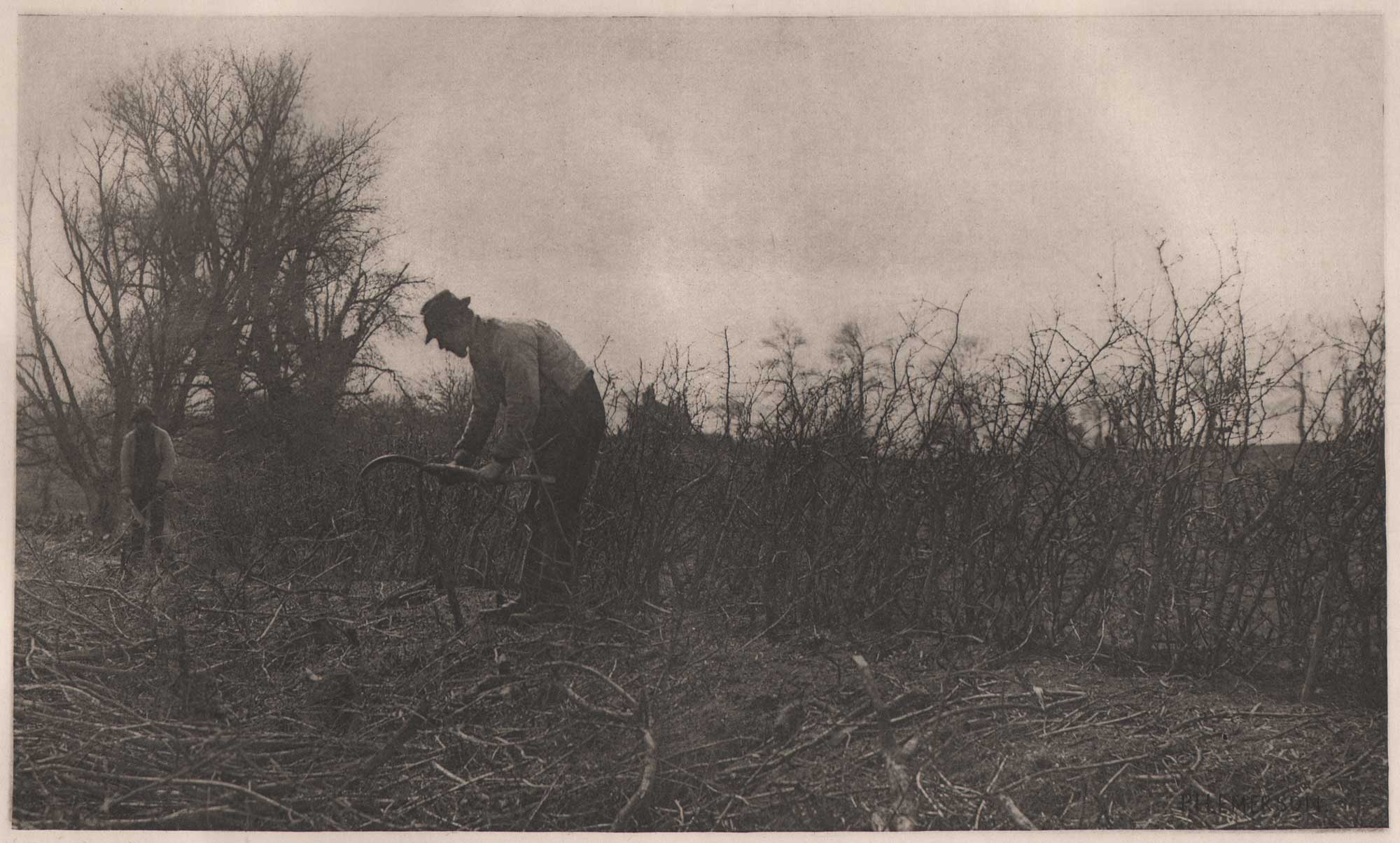
Our plate gives two fencers at work on a bleak March morning. The first operation is to destroy, and with the hooks they set to work cutting down saplings and brambles, and lopping off the tops of the whitethorn. The produce of this hedgerow-crop is then carefully sorted into three piles, one of which is composed entirely of brambles, the second of whitethorn, and the third of the branches and trunks of the various saplings growing in the hedgerow. The bramble-harvest goes to the labourers in compensation for the damage to their gloves and clothes, and is used by them for heating their ovens. The white-thorn (in Suffolk always called “spring”) is used for facing old fences or for making new ones, while the third pile goes to the farmer himself for faggots. These are tied up in bundles, each of which, should weigh five stone, but they are made up by guesswork and may therefore vary a little. These faggots he sells at twopence-halfpenny each per score, or threepence each if separately bought.
In the plate, one is trimming faggots while the other is cutting the whitethorn into lengths, and sticking them into the hedgerow to protect the roots of the “spring” just cut down. These stakes will last for two years, and by that time the whitethorn will have grown up strong enough to need no protection. After the staking is done, the men will dig out the ditches, which have gradually become filled up during the twelve years, and with the earth they dig out will bank up the crevices and holes made by rain and rabbits, and cover well the roots of the whitethorn.” p. 121