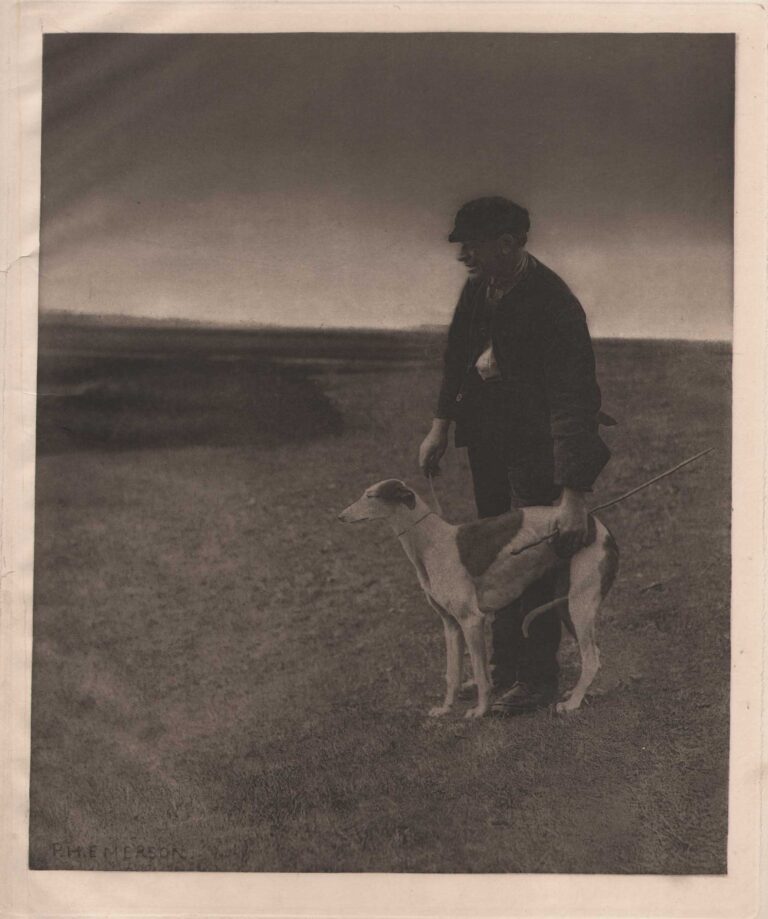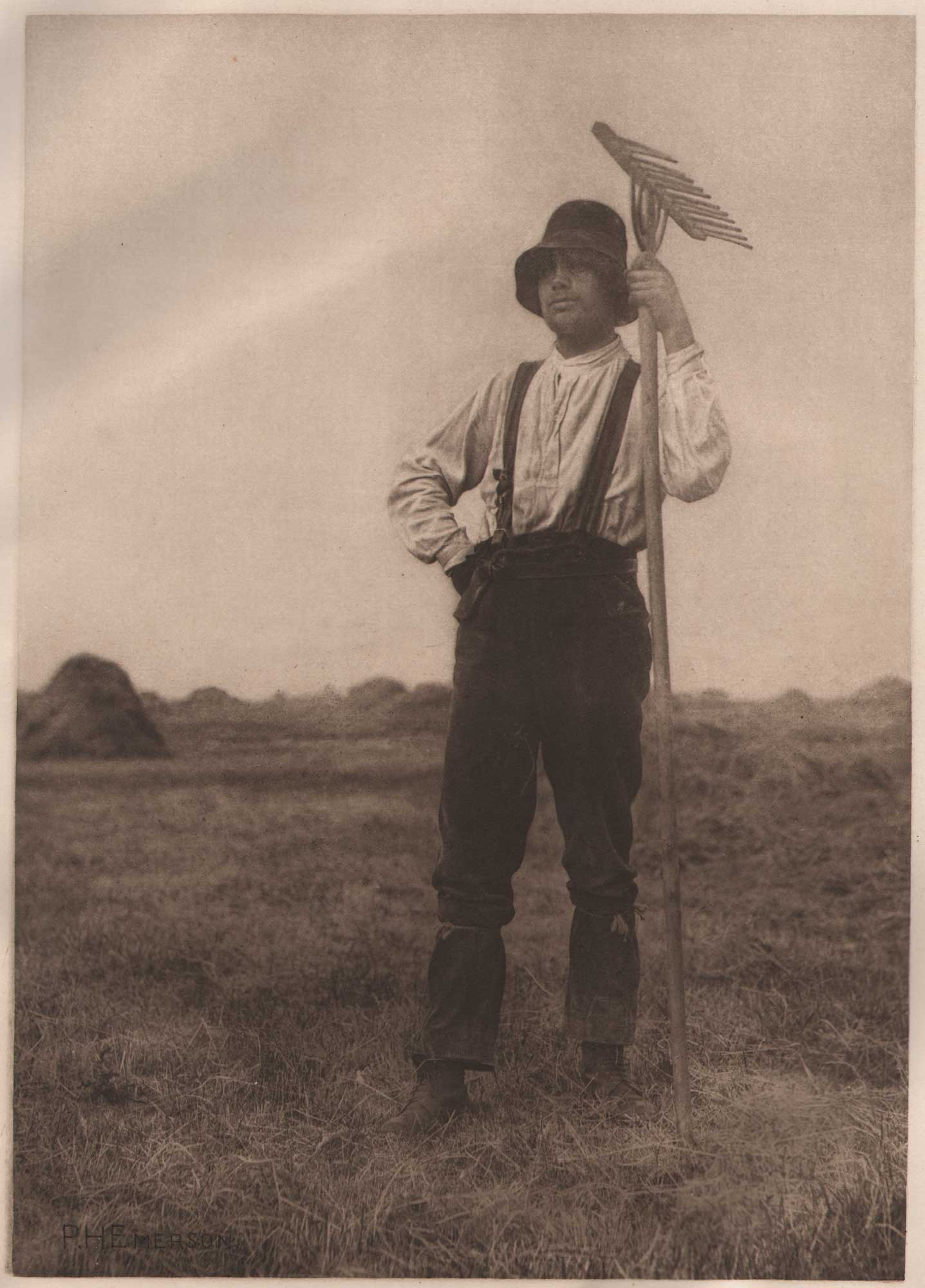
Haymaker with Rake {Norfolk}
“Haymaker with rake,” here too, the same principle of focus holds. It must be remembered, however, that true focus is but one point amongst many desiderata for a perfect naturalistic photograph, and that not the most vital point by any means.” ⎯ P.H. Emerson, Sept., 1889, To The Student
From Chapter XXVI: Peasant Types
“In the plate of the haymaker resting we have a specimen of the smaller dark type of peasant. The marsh-hay has been cut, and he has been sent with others on a threatening afternoon to rake it into cocks, lest the coming rainstorm should wet it during the night. He has nearly done his work, and is resting on his rake. Behind him the marsh is dotted with hay-cocks; before him, in the distance, stretches the broad, across which he can just see his cottage-home silhouetted against the sky. His face and the haycocks are softly lighted up by the setting sun, which is nearly clouded over by the coming storm.
Who can enter into his thoughts? Who can probe the workings of his simple mind?- Is he thinking of his young wife and baby at home? or of his brother long since gone to a distant colony? Is he meditating on the age in which he lives? on his own lot? What is he thinking of as he rests on his rake? We have often seen these hardy sons of toil in reverie, but have never yet been able to get a glimpse of their inner thoughts; for they always turn us off with a laugh, or by begging of us a pipe of tobacco. Perhaps, after all, they have no deep thoughts, but they look as if they had.” pp. 141-2