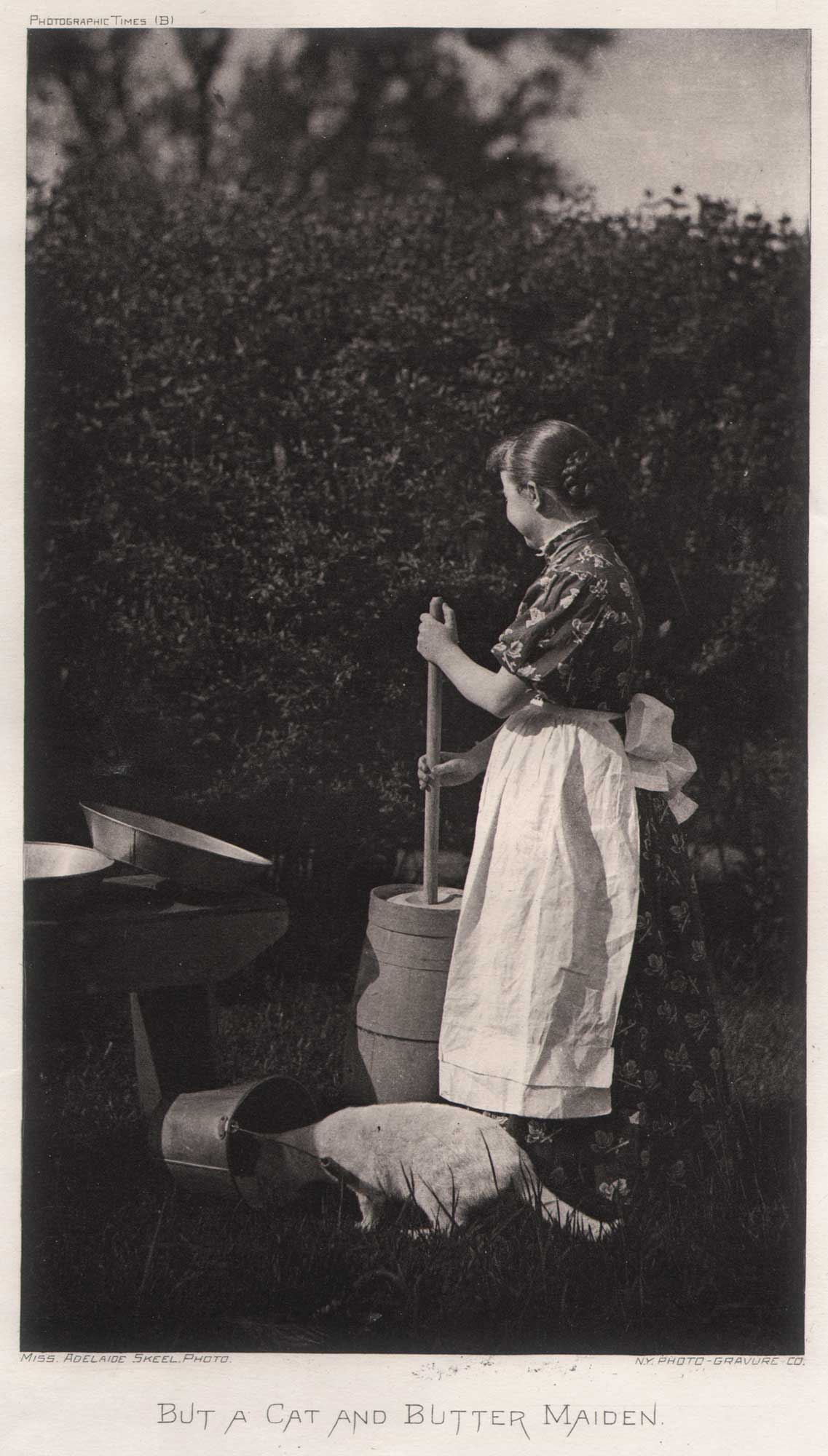
But a Cat and Butter Maiden
Editorial comment for this plate:
BUT A CAT AND BUTTER MAIDEN.
Our charming figure picture this week is from a negative by Miss Adelaide Skeel, of Newburgh, N. Y., who is well known to the readers of our magazine through the interesting contributions of her pen. Though we have shown from time to time in these columns reproductions from her negatives, illustrating her interesting stories and sketches, this is the first full-page picture which we have had the pleasure of presenting to our readers. In regard to the picture, “I can only say,” writes Miss Skeel, “that it was taken on a Carbutt special, against all portrait laws, in bright sunlight, late in the afternoon, with stop f/16; Morrison lens. I wanted to have a drop shutter view, but the drop was rheumatic and would not drop, so I used the small diaphragm mentioned above, and made a time exposure.
“Pussy could not be coaxed to lap milk off the top of the churn,” she continues, “being very realistic in her tastes, and finally posed herself at the overturned pail. I developed the negative with pyro, because I think eikonogen-but that “belongs to another story,’ as Kipping says.” (sic: should be Kipling)
Adelaide Skeel: 1853-1928
Obituary notice: Contemporary Notes, Vassar Quarterly, February, 1929, pp. 60-1
On November 29, 1928, Adelaide Skeel Kelley.
Again we are called upon to record the death of another of that brilliant group who made the Class of ’73 especially notable in the early days of Vassar.
Adelaide Skeel was the wittiest, most quaint and original member of her class. Hers was a spirit of unquenchable buoyancy and youthfulness; her ready wit flashed out in unexpected ways, but always without a sting, and her radiant personality gave a quaintly humorous touch to droll and common things.
The youngest of a large and gifted family, her girlhood was spent near Newburgh overlooking the Hudson River. She early showed unusual facility with her pen and, in college days her clever verses and amusing dramatic sketches were the delight of her classmates. The legends and traditions that clustered around her home appealed strongly to her imagination and after leaving college she wrote and published a historical romance called “King Washington, which has recently been republished. After a joyous girlhood fate had some hard blows for Adelaide, as one by one the family circle vanished, and the cherished home was given up, but she met these “chances and changes”, with her usual high courage and unquenchable youthful spirit. Under her gay and whimsical manner was a nature of great loyalty and unselfishness.
After years of public and private activities the end came peacefully in her sleep while yet her eye was not dimmed nor her natural strength abated. —M. G. Townsend.