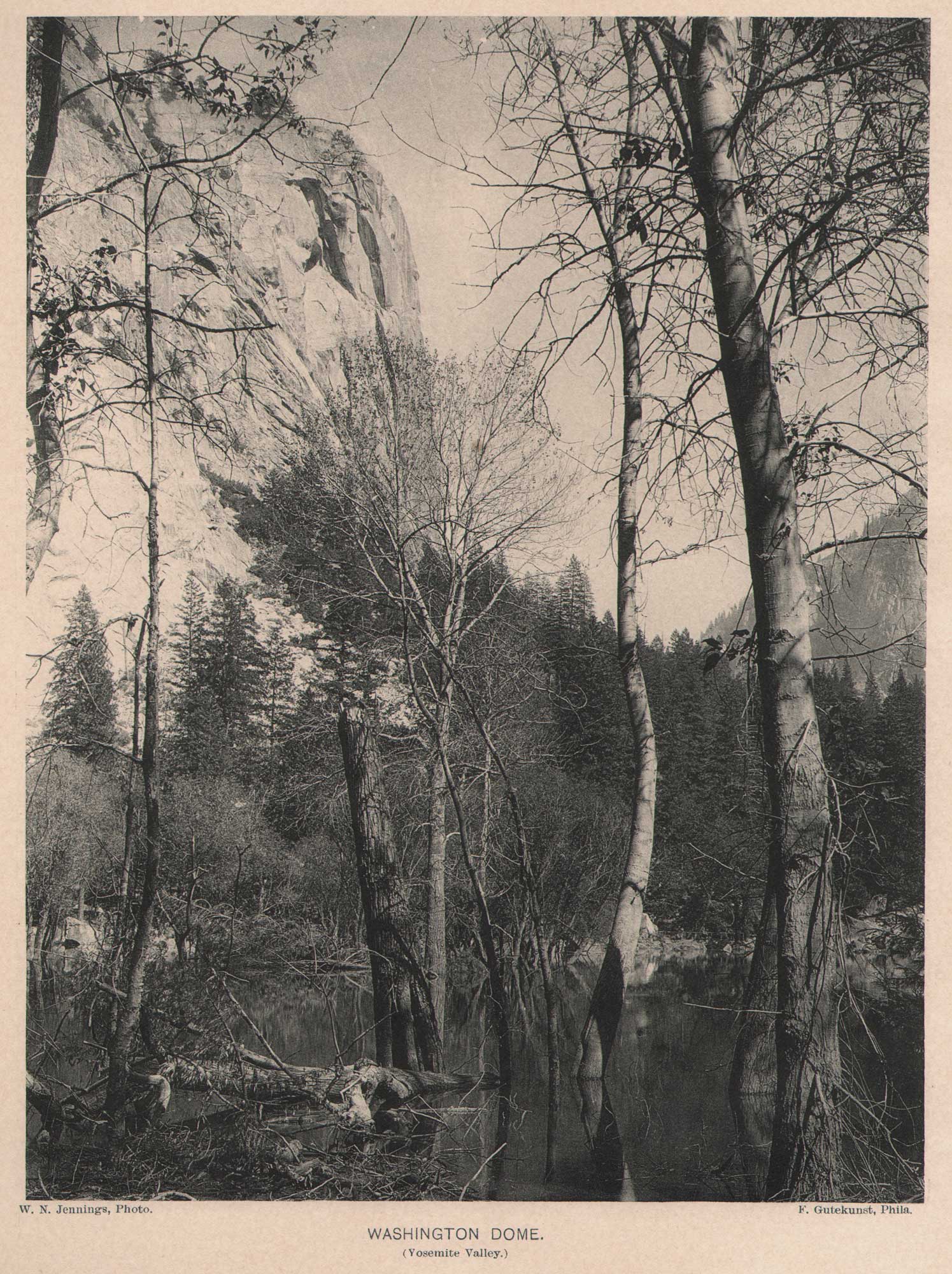
Washington Dome | Yosemite Valley
Editorial comment for this plate:
WASHINGTON DOME.
YOSEMITE VALLEY.
THERE is such picturesque profusion crowded into the Yosemite Valley that the camerist with limited time and material is really at a loss to know where to begin operations and what portion of the landscape to select for his view.
Grim granite cliffs loom up on every side with wild, fantastic outlines bathed in deepest azure; rivulets of melted snow leap boldly from rocky ledges, fling out feathery plumes and melt into misty spray long ere the ground is reached; the crystal waters of the Merced go bubbling and boiling through the Valley, a wealth of foliage lining either bank, halting here and there to give inverted pictures of the flower laden granite walls; the Mirror Lake, the “sleeping water “of the Indians, within whose depths there lies another Yosemite; and far beyond, bathed in glorious sunlight, melting in a sheen of purple, is the snow capped range of the Sierra Nevadas.
The photograph illustrating this number of THE TIMES was taken from the edge of Mirror Lake.
Washington Dome is a solid wall of gray granite rising to a height of 3,500 feet. The negative was on a Carbutt orthochromatic film (without color screen), and developed with pyro. In making views of distant mountains the color screen was used to great advantage.
W. N. Jennings.
William Nicholson Jennings: 1860–1946
William Nicholson Jennings was a photographer active in Philadelphia from the 1890s. He conducted experiments with color photography and artificial lightning, helping in the development of photographic flash. In 1890 together with Arthur W. Goodspeed he was photographing electric sparks and brush discharges at the University of Pennsylvania, and tried to use a Crookes tube. On February 22nd he noticed disks of unknown origin on one of his plates but nobody could explain them, and the image was forgotten. Only after the discovery of X-rays by Roentgen did Goodspeed and Jennings realize that this was an accidental X-ray photo.—Wikipedia (2026)
William N. Jennings was a member of The Photographic Society of Philadelphia and was elected a member of their board of directors at the November 8th, 1893 meeting because of the death of George M. Taylor.