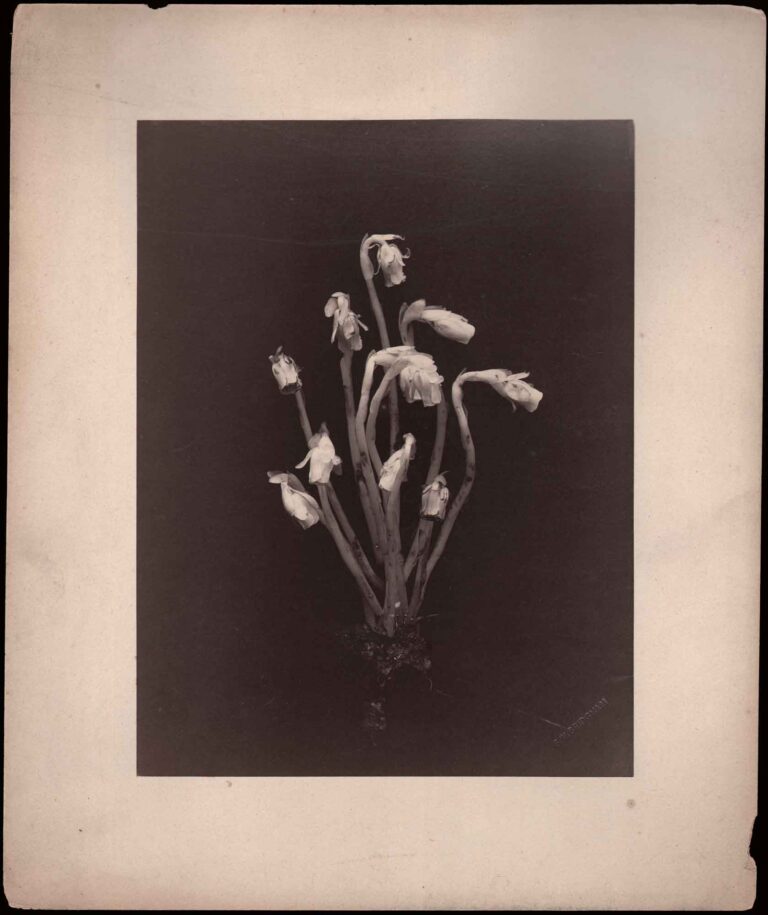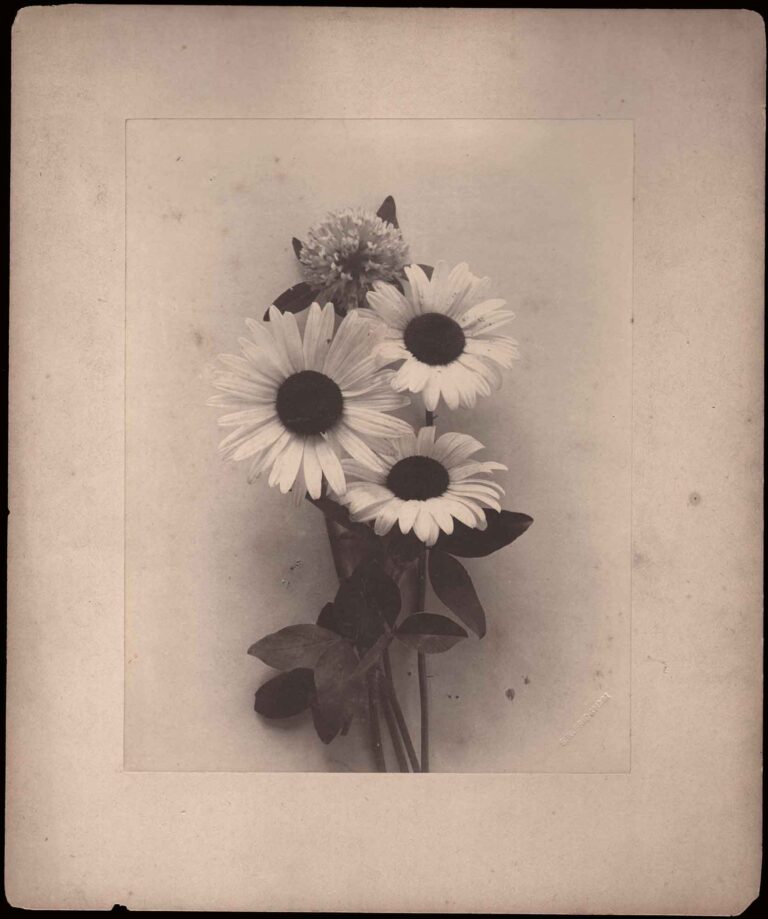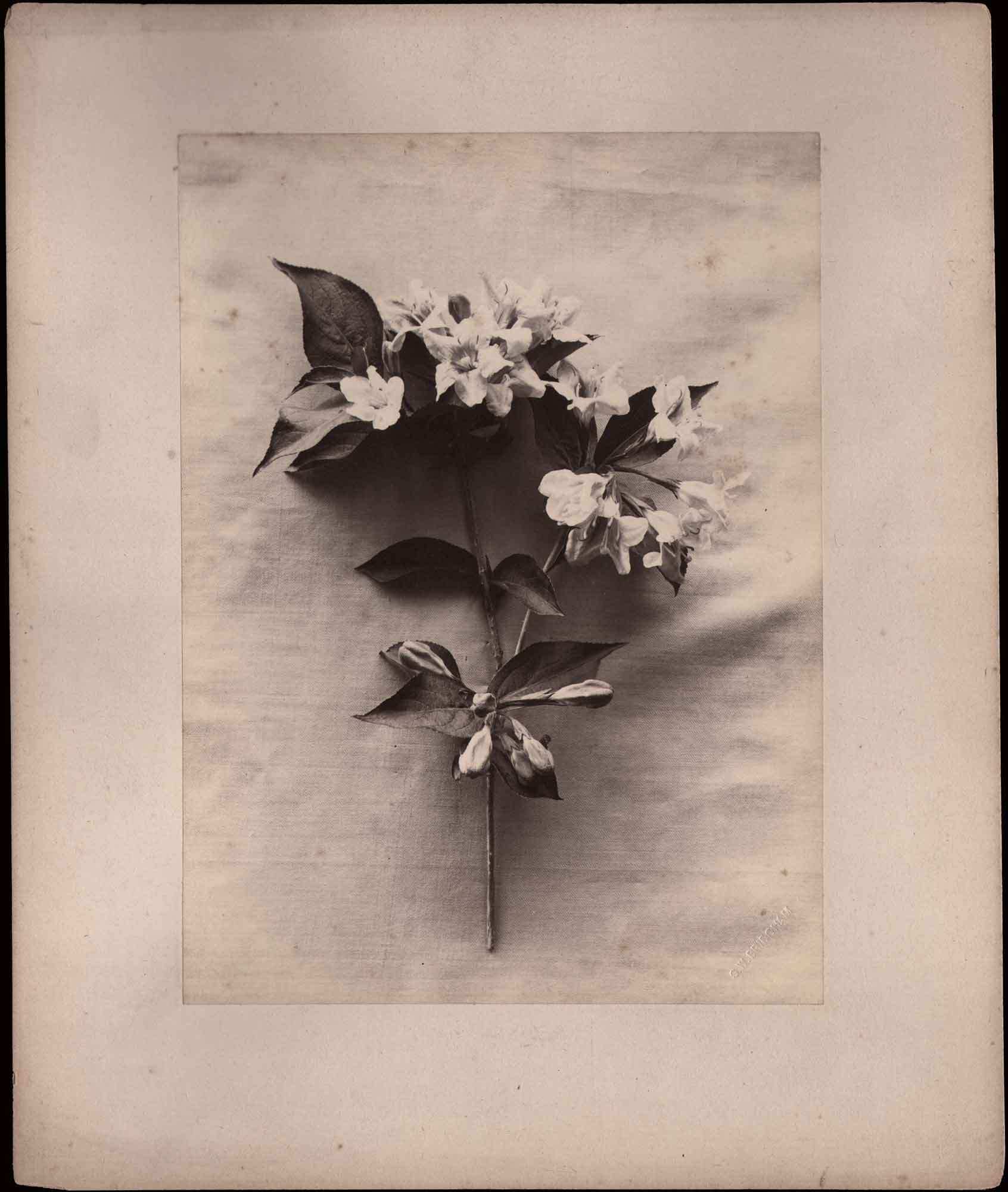
Branch from Wild Apple Tree
A spray of wild apple blossoms (possibly Pyrus Malus) photographed against a linen cloth background.
Samuel Willard Bridgham III: 1842-1915
S.W. Bridgham was a well-heeled amateur photographer most active in the 1890’s. He held the vice presidency of the prominent New York Camera Club in 1892 and later became its president by 1895. Plant and floral studies were of interest: in March 1891, Anthony’s Photographic Bulletin reported some flower studies from “the same camera” taken by Bridgham—part of recent efforts—“gave token of careful work.” Lengthy biographical details on Bridgham can be accessed at Wikitree. In respect to photography, the following are noted from secondary sources:
New York Times, April 21, 1890: Doings of Dry-Plate Men. — Amateur Photographers Now Engaged in Field Work.
“April has been an excellent month for photographing, and the amateurs have made good use of their opportunities to go out on excursions and ramble through the woods and hills near the city. …The exhibition of photographs at the rooms of the New-York Camera Club during the week was well attended. The committee who had charge of the exhibition were … S. W. Bridgham, ...”
New York Herald, Jan. 18, 1891, p. 24, Amateur Experts of the Camera Club. Photographers Among Society People Excel in a Popular Branch of Art. Mrs. Carnegie’s Landscape Work.
…”Samuel W. Bridgham is the animal photographer extraordinary to the club. This gentleman has won fame by reproducing a group of chickens, with a high fence for a background. Of course this picture was a snap shot, or instantaneous, one, and its development produced one of the finest pictures of fowls that have ever been made. …”
Popular Astronomy, May, 1895, p. 428: “some very perfect photographs of lightning were shown by Mr. Samuel Bridgham”. (event held at New York Academy of Sciences Second Annual Reception and Exhibit of Recent Progress in Science on March 13, 1895)
Unsourced, a genealogist also reports: “Bridgham apparently also traveled out West in the 1890s and photographed scenic areas, such as the Grand Tetons. Bridgham was active in the photography salons of the period and was often published in various photography publications, including the American Annual of Photography (1893 and 1907). Some of Bridgham’s work is held in the collection of the New York Public Library.”
The following biographical excerpt of Bridgham from: William Richard Cutter, New England Families, Genealogical and Memorial, New York, reprint: Clearfield Corp., Baltimore, 1996, p. 610.
Samuel Willard (3), son of the late Samuel Willard (2) and Eliza Ann (Fales) Bridgham, was born in New York City, November 11, 1842. He was prepared for college at private schools and entered Columbia College in the class of 1864. However, during his first year, in 1860, he suffered from a severe attack of typhoid fever, and was compelled to give up his studies for a time. In 1864. he again entered Columbia College in the “School of Mines,” and was graduated therefrom with the first class that went through that institution, in 1868. After his graduation he became a member of the firm of Hale, Bridgham & Harmer, mining engineers and chemists, with offices at No. 57 Broadway. New York City. Mr. Bridgham continued an active member of this firm for a period of about ten years. when the firm was dissolved, since which time he has been retired from active business associations. During the civil war, in the fall of 1861, Mr. Bridgham became a member of Company K, Seventh Regiment, New York State Militia, and served his time as an active member of this regiment, and after the close of the war he became captain and ordnance office on the staff of General William G. Ward, commander of the First Brigade, in which position he served for a number of years. On January 7, 1869, at the home of the bride’s parents in New York City, Dr. Henry C. Potter (later bishop of New York) officiating, Mr. Bridgham was united in marriage to Fanny Schermerhorn, born in Paris, France, July 21. 1846, daughter of the late William Colford and Ann E. H. (Cottenet) Schermerhorn, of New York (see Schermerhorn VIII).
Mr. and Mrs. Bridgham have no children. Socially, Mr. Bridgham is a valued member of various clubs, among them the Knicker-bocker, the Camera, the Athletic and the Metropolitan clubs, of New York City. He attends Grace Episcopal Church, of New York City, of which his wife is an active member.
Personally, Mr. Bridgham is the embodiment of culture and refinement, a man whose quiet and dignified, yet democratic manner, has always been a strong characteristic of his family. His politeness is inborn. consequently it is omnipresent. Few men in his position are as approachable, and as void of superfluous dignity, and whether in his home, or on the street, his manner is always the same–courteous and affable.
Tall in stature, with a well-rounded physique, he possesses an imposing presence and a commanding figure. His generosity is well known, although ever dispensed in a modest and un-ostentatious manner. He is a lover and patron of the fine arts as well as of standard literature, his large and comprehensive library affording him ample opportunity for literary entertainment. He is of a benevolent and charitable nature, and this disposition is shared by his wife to such an extent that their home is an abiding place of hospitality. Mr. and Mrs. Bridgham spend their summers at the old Bridgham farm in East Providence, Rhode Island, occupying the old Bridgham homestead which was erected in 1767, and at their summer home at Bar Harbor, Maine.