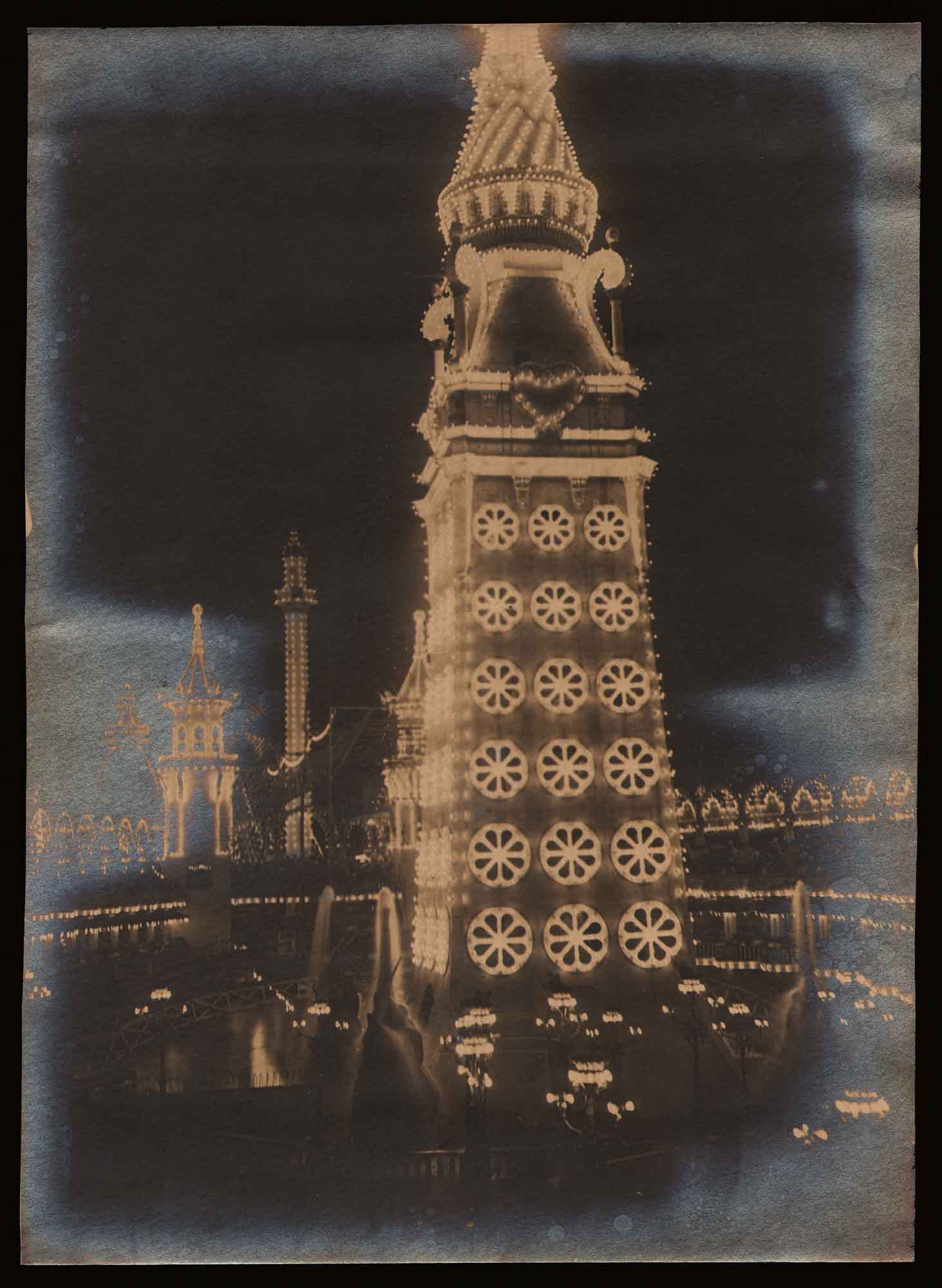
Electric Tower at Luna Park, Coney Island
“They have created a realm of fairy romance in colored light, so beautiful that the rest of Coney Island will have to clean up and dress up, if it is to do business,”— The New York Times, 1903
This is an early view of the Electric Tower illuminated at night at Luna Park, Coney Island. The photograph comes from an album of views by C.M. Shipman, with the last photograph dated 1904. This is the only Luna Park photo in the album.
“Initially set to open May 2, 1903, Luna Park would be delayed due to construction of the tower. As reported by the Sun,, management would open the gates the Saturday evening of May 16, at 8 p.m, simultaneously with the turning on of 250,000 electric lights in the tower and forty buildings within its inclosure.”—Memory Ln website
Luna Park was an amusement park that operated in the Coney Island neighborhood of Brooklyn in New York City, United States, from 1903 to 1944. …The park was initially illuminated at night by over 200,000 electric lights, installed on 132 towers and turrets; the lights changed color every second. … At the center of the park in the middle of a lake was the 200-foot-tall (61 m) electric tower that was decorated with 30,000 incandescent lamps. Each of the tower’s four sides had 48 illuminated circles. The tower was inspired by another at the Pan-American Exposition, which had been twice as tall and illuminated by thousands of lights. The lagoon around the tower was bordered by a wide, brightly lit esplanade; there was also a lighted terrace with benches next to the lagoon. Two circus rings were suspended over the central lagoon to keep customers entertained between rides, and aerial shows were performed over the lagoon. In contrast to Dreamland, Luna Park generally had narrow pathways. When the park was particularly crowded, patrons were sometimes “compelled to listen to the side show ‘barkers'” to avoid the overcrowded paths, according to the Brooklyn Daily Eagle.” —Wikipedia (2026)
Charles Melville Shipman: 1874-1947
Charles Melville Shipman, known as C.M. Shipman for his photographic work, was born July 13, 1874 in New York City and died on May 13, 1947 in Willoughby, Ohio, a northeastern suburb of Cleveland. Shipman was married to Clare (Cressey) Shipman. (1879-1944) They had two children: Mulford Cressey Shipman: (May 11, 1910-July 28, 1921) and Gretta A. (Shipman) Pallister. (1918-2014)
As an amateur photographer, Shipman’s name first appears in early 1896, when he was a member of the Brooklyn Academy of Photography, part of the department of photography at the Brooklyn Institute of Arts and Sciences. In their Spring print exhibition, (6th annual) he earned several ribbons for his portraits; a blue and yellow, noted in the June, 1896 issue of The American Amateur Photographer. (1.)
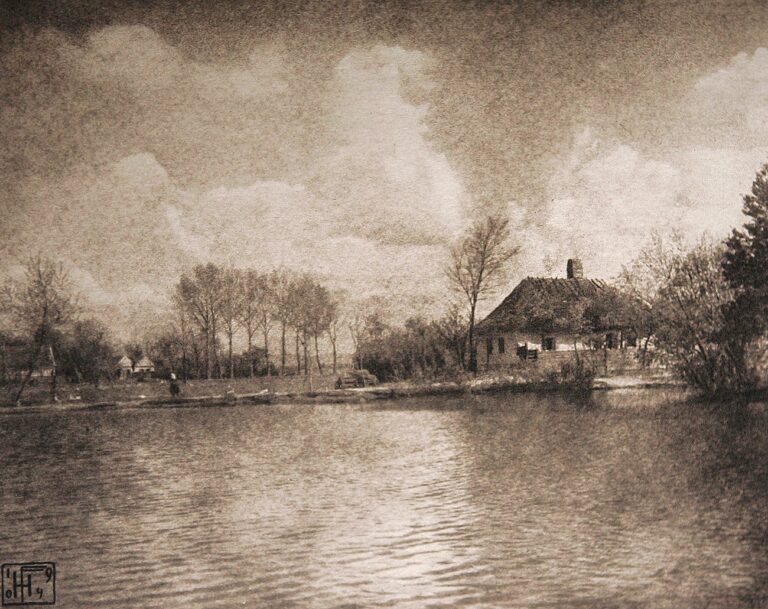
From at least 1903-05, Shipman was chairman of the Print Committee for the Brooklyn Camera Club. His early work from this period also includes genre and landscape views, with many examples compiled in an early album circa 1904 held by this archive. An additional later album held by PhotoSeed contains large hand-colored platinotype views of his son Mulford dating from 1913 compiled after his sudden death in 1921.
Regarding pictorial photography of this period, although he was not a member of the Photo-Secession, C.M. Shipman certainly soaked up its aesthetics, translating it to his own work. This is espoused by his being a subscriber to the journal Camera Work.
The Ohio Historical Society in Columbus, which holds an archive of Shipman’s written work as well as photographs from his involvement as a pioneering Ohio naturalist, provides the following background to his career:
Charles Melville Shipman was born in 1874 in New York City, the son of Charles and Mary Therese Britton Shipman. After earning a degree in chemistry from Hasbrouck institute, New Jersey, he worked for the Oakland Chemical Company in New York. Also while in New York, he married Clare Cressey, and was active in the Brooklyn Photographic Society and the Staten Island Museum. In 1917 he and his wife moved to Willoughby, Ohio, where he established the J.H.R. Products Company, a producer of chemicals used by the government during World War I.
After retiring in 1924, Shipman devoted his life to ornithology, nature photography, and conservation. He joined the Burroughs Nature Club of Willoughby, and for twenty years served as president. He also was president of the Cleveland Bird Club and Lake Erie Wild Flower Club.
During the 1920s Shipman studied and photographed bald eagles near Vermillion, Ohio, with Dr. Francis H. Herrick of Western Reserve University. Shipman used movie film and photographs he produced during these studies as well as some 3000 hand-painted slides in lectures he gave to nature clubs and school children. During his lifetime he produced over 100,000 negatives, mostly of wildlife, and received numerous prizes for his photography. (2.)
The University of Central Florida, which owns several travel albums of his photographs, each documenting a trip he made to Florida in 1908 and 1916, supplies the following additional life details:
Shipman was a naturalist with a particular interest in plant and bird life. He was a keen observer and documented his observations with photographs. Early on in his life, Shipman developed his interest in nature which was further encouraged by contact with Frank Chapman, Henry Fairfield Osborn, Theodore Roosevelt, John Burroughs, and Louis Agassiz Fuertes. He was also a member of the Brooklyn Camera Club and won national and international awards for his photographs. (3.)
The following are a known list of residential addresses for C.M. Shipman. During Shipman’s tenure there, the Brooklyn Camera Club was located at 776 Manhattan Ave.
1903-1907: 106 Lincoln Ave., Newark, N.J.
Shipman owned a home at this address while he was General Superintendent of the department of Public Works for the city of Newark, a job he held through 1916 before moving to Ohio. A fire at his residence in late 1905 published in the annual Newark city report from this year lists he had a tenant in the home, and hence the 1904 Brooklyn address where he actually lived.
1904-1905: 145 Milton Street, Brooklyn, N.Y.
1910: Richmond, (Staten Island) N.Y.
1917: moved to Willoughby, Ohio
In 1981, Shipman was posthumously inducted into the Ohio Conservation Hall of Fame.
1. p. 263
2. MSS 804 Charles M. Shipman Papers: at: Ohio Historical Society, Columbus, OH
3. excerpt: Floridiana: from: UCF Libraries Annual Report: 2009-2010: p. 47