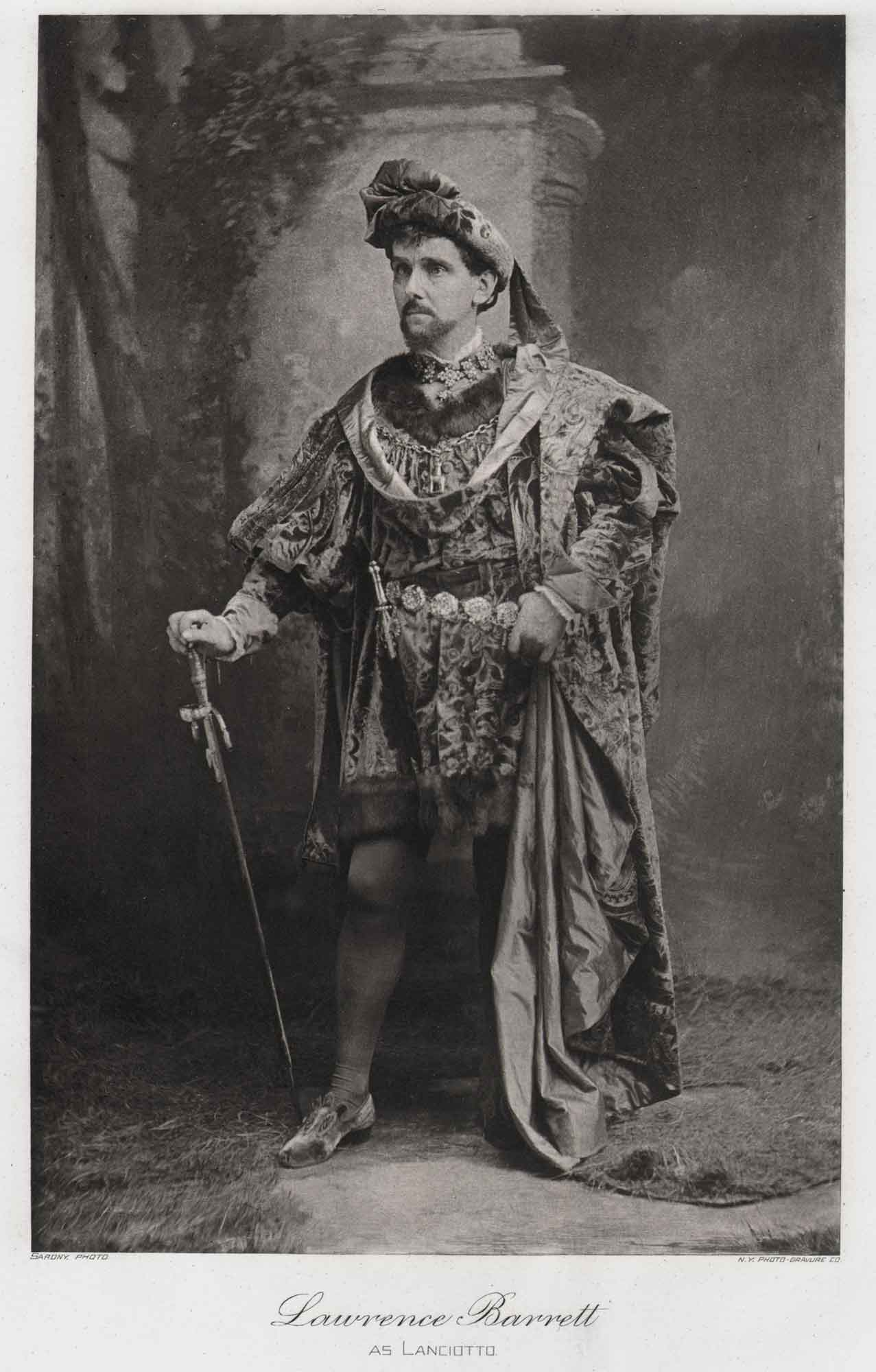
Lawrence Barrett as Lanciotto in Francesca Da Rimini
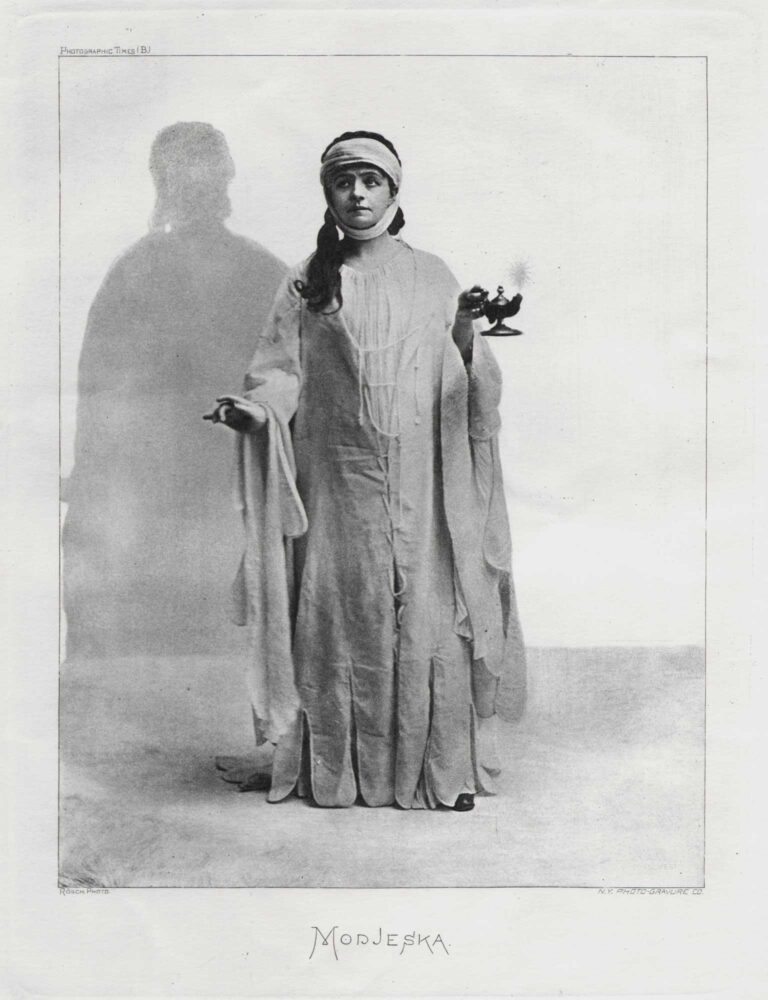
This portrait of American stage actor Lawrence Barrett in the role of Count Lanciotto in an 1887 production of the tragedy Francesca Da Rimini was published in Sun & Shade shortly after his death.
From Announcement in this issue of Sun & Shade: IN THIS number we begin the publication of a series of Portraits of the most noted of living American Actors and Actresses, which will be continued month by month, under the title of SOME PLAYERS,” commencing with Mr. Edwin Booth and Mr. Lawrence Barrett. It was our intention to issue only one portrait each month but the recent death of Mr. Barrett, (which occurred after we had started the series) makes it seem fitting to place his picture in the same number with his partner, Mr. Booth, on whose professional life, it is feared, the curtain has also fallen. (continues)
“Francesca Da Rimini (1855), a tragedy by George H. Boker. In hopes of putting an end to the long feud between Guelfs and Ghibellines, Lanciotto of Rimini is engaged to Francesca of Ravenna. Lanciotto is a spindly hunchback whose brother Paolo has often had to defend him from cruel jibes. The brothers love each other, so Lanciotto asks Paolo to go to Ravenna to bring back the bride. Paolo and Francesca fall in love, but at first both attempt to constrain themselves. The sight of Lanciotto, however, drives Francesca into the handsome Paolo’s arms. When the vicious jester, Pepe, reports the rendezvous to Lanciotto, Lanciotto kills him. In a jealous fury he rushes to find Paolo and Francesca in an embrace. He kills them, too, then stabs himself. Derived from an incident in Dante, the drama was only moderately successful at first. Fine revivals by Lawrence Barrett in 1882 and Otis Skinner in 1901 led to a further appreciation of its merits. —Synopsis from Oxford Reference; abridged, with original names of players from 1855 performance removed.
Lawrence Barrett: 1838-1891
Lawrence Patrick Barrett was an American stage actor. Barrett began his career in 1853 in Detroit and made his first New York appearance in 1856. Barrett enlisted for the American Civil War in 1862, but resigned in 1863. He later managed the California Theatre in San Francisco from 1868 to 1870 alongside John McCullough. Barrett performed a variety of roles, including Hamlet, King Lear, and Macbeth. He was especially known for his portrayal of Cardinal Richelieu in Edward Bulwer-Lytton’s drama. Barrett acted in London on multiple occasions and produced and starred in several plays. He frequently collaborated with fellow stage actor Edwin Booth, touring together and achieving immense success. Barrett’s health began to decline in 1890, and he died in 1891 during a performance of Richelieu.—Wikipedia (2026)
Napoléon Sarony (March 9, 1821 – November 9, 1896) was an American lithographer and photographer. He was a highly popular portrait photographer, best known for his portraits of the stars of late-19th-century American theater. His son, Otto Sarony, continued the family business as a theater and film star photographer.—Wikipedia (2026)
Sun & Shade: An Artistic Periodical
“Within the covers of Sun and Shade…We shall especially endeavor to encourage the artistic side of direct photography in all its phases,”—Ernest Edwards, president & publisher, 1889
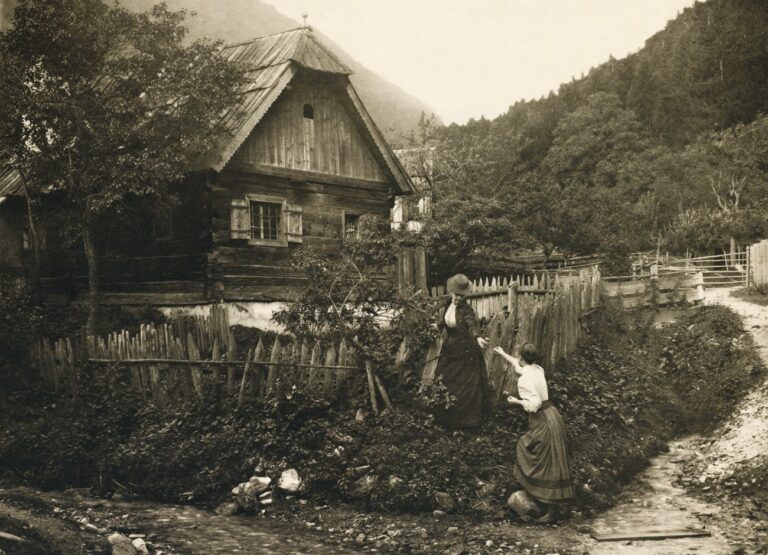
In July, 1888, the first issue of Sun & Shade: A Photographic Record of Events, was published in New York City by The Photo-Gravure Company. Essentially a high-class art periodical, each issue featured eight or more beautiful hand-pulled photogravures as well as plates printed in photogelatine, (collotype) and halftone. These were collected within a stapled, folio-sized magazine issued monthly. The subject matter included the work of leading amateur and professional photographers, as well as works of art—many from the galleries at The Metropolitan Museum of Art in Manhattan. The December issue—Christmas themed—featured a specially designed cover printed in green ink. Success was swift. The first issue sold 1000 copies “in a fortnight”. (1.) Within the first year, Sun & Shade quickly increased circulation to 4000 copies a month. With a public demand for reprinting earlier issues, this success lead to a rebranding, after which, beginning with the September, 1889 issue, the magazine was renamed Sun & Shade: An Artistic Periodical. The final issue was March, 1896, when financial issues to the parent company, spurred by the eventual May, 1896 bankruptcy of the N.Y. Photo-Gravure Company, forced its closure.
Sun & Shade would become the ultimate statement of the many skills and inquisitive mind of Englishman Ernest Edwards. (1836-1903) Essentially his own printed passion project, the magazine was fueled by his ongoing love of photography in the field (issues featured many plates by him over the years) and a deeply scientific mind which pushed the advancement of the state of photo-mechanical reproduction and fine printing.
The son of a clergyman from Bloomsbury in London, he initially made a name for himself taking photographic portraits of eminent people in his Baker Street gallery. (Charles Darwin sat for him several times) His love of the outdoors also bore fruit and he became an accomplished alpine photographer. But his real interest centered around photo-mechanical reproduction. In 1869, he took out a patent in England for his own rudimentary collotype process called heliotype. In the Fall of 1872, he moved across the pond along with his wife Charlotte, and became superintendent of Boston’s Heliotype Printing Company after selling the American rights to American publisher James Ripley Osgood. (1836–1892) Edwards ran the Heliotype Printing Co. there until the end of 1884. The following year the James R. Osgood & Co. went bankrupt, although not a result of the heliotype division.
Growing restless in Boston, he then moved to New York City, where he established a new firm in March, 1885: The Photo-Gravure Company, (subsequently renamed The New York Photo-Gravure Company) with offices in Manhattan and a leased printing factory in Brooklyn. In 1887, his company received perhaps the one commission it’s best known for today: the printing of 781 collotypes, which Edwards called photogelatine plates, making up the monumental publication:
Animal Locomotion. An Electro-Photographic Investigation of Consecutive Phases of Animal Movements, 1872-1885, with the landmark sequenced motion study photographs taken by British photographer Eadweard Muybridge.
Restructured in 1891 as the New York Photogravure Co., Ernest Edwards continued to advance the state of photo-mechanical printing during his final decade, with Sun & Shade publishing some of the earliest examples of his own invention by 1894: plates printed in a three-color process called chrome-gelatine, a variation of his heliotype process.
Quality Rather than Quantity
Even though it survived less than eight years in print, describing Sun & Shade in Ernest Edward’s own words is perhaps the best posterity for this important photographic periodical with an artistic heart. One year after its’ debut, he wrote the following, published in The Photographic Times for August 2, 1889:
“A year ago we commenced the publication of our novel venture in journalism Sun and Shade, a Picture Periodical without letterpress, almost as an experiment, with a modest list of less than fifty subscribers. To-day we are printing an edition of 4,000 copies monthly. A sufficiently convincing proof of the wisdom of our hope that there was room for us.
“In our rapid growth the wish has been indicated unmistakably for the higher grade of pictures, and of the higher class–always for quality rather than quantity. Following rather than leading such a wish, we feel that we make no mistake in marking the future career of the magazine to be rather that of an artistic periodical than a photographic record of events.
*Our efforts shall be directed in the future to make Sun and Shade an artistic periodical which shall be not only pleasing but educational in its broadest sense, Some of our plans may be briefly referred to.
“We shall reproduce the leading pictures in the great collection of the Metropolitan Museum of Art. Within the covers of Sun and Shade will be found from time to time, reproductions of the works of American artists. We shall especially endeavor to encourage the artistic side of direct photography in all its phases, And we shall supplement these special features with examples of sculpture, architecture, and industrial art. If in the future we receive as hearty a response to our efforts as we have received in the past, our task will be indeed pleasant and our road to success a royal one.” (p. 394)
- Notice: Sun & Shade: October, 1888. The August and September issues did not appear.