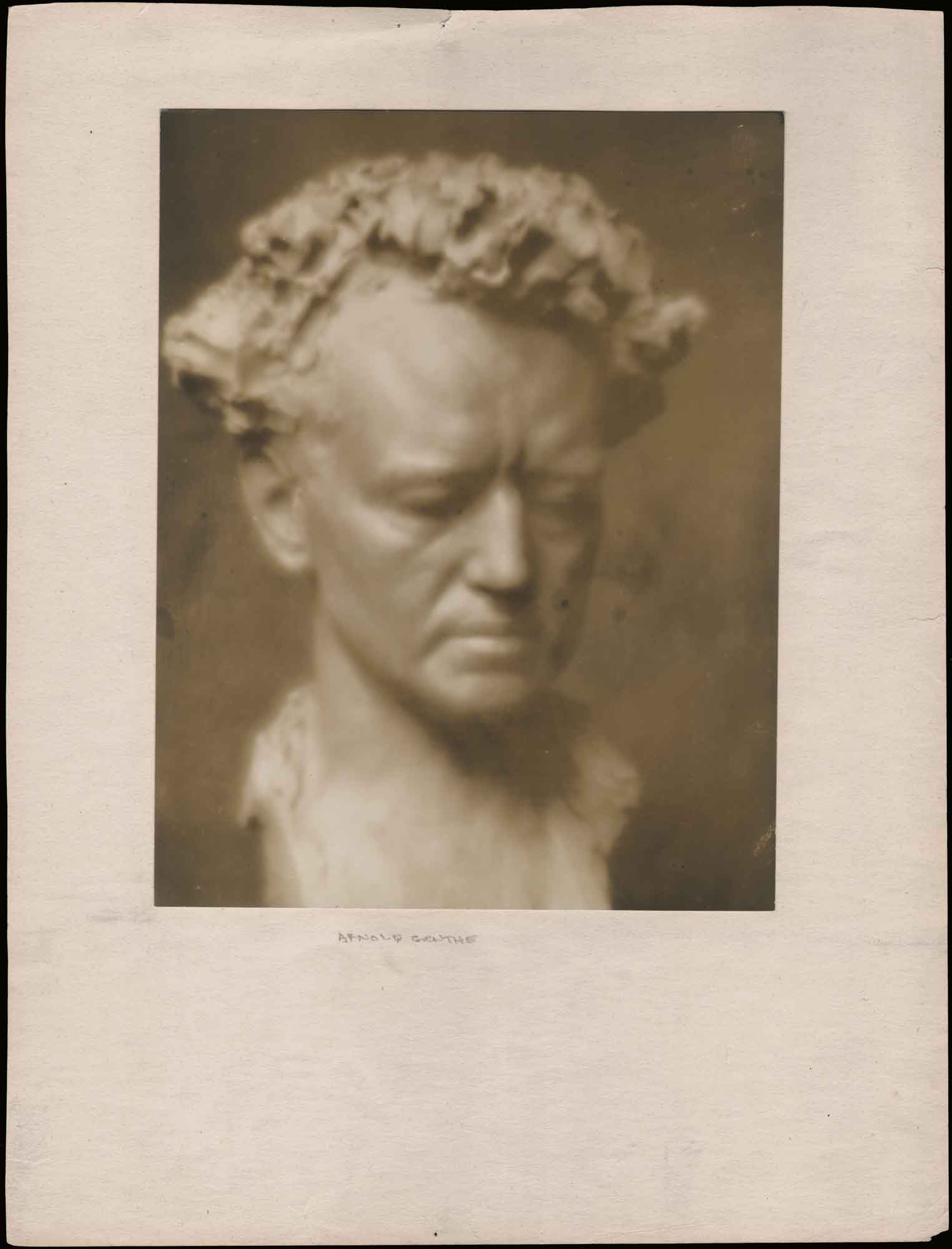
Bust of Photographer Arnold Genthe
This unusual sculptural bust of German-American photographer Arnold Genthe (1869-1942) shows the artist in a somber pose, looking downward. Surprisingly lifelike from a photographic perspective, the work is known to have been executed “from life” by Italian-American sculptor Cartaino Scarpitta (1887-1948) sometime in early 1913. The work in progress photograph seen here, which this website is attributing to the subject based on the tight framing and soft pictorialist aesthetic, was completed showing Genthe looking more directly at the viewer, and with the addition of a tie. This view (below) was published to accompany a lengthy profile of him by Will Irwin in Wilson’s Photographic Magazine, July, 1913.
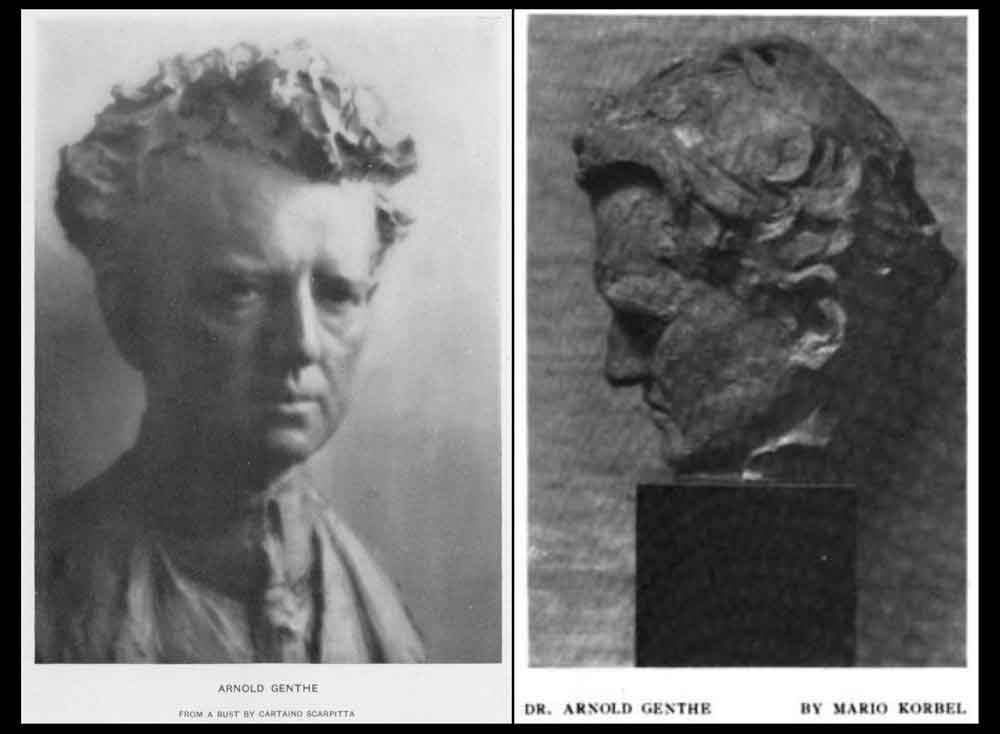
Left: Arnold Genthe From a Bust By Cartaino Scarpitta published in Wilson’s Photographic Magazine, July, 1913. Right: Bust of Dr. Arnold Genthe by Mario Korbel published in The International Studio, November, 1915. (source for both: web)
The bust was later exhibited in New York City along with others by Cartaino Scarpitta at the Erich Galleries in March, 1915. From the The New York Times, Tuesday, March 2, 1915:
Sculpture by Scarpitta.
At the Ehrich Galleries is an exhibition of portrait heads in sculpture by G. S. Cartaino Scarpitta. The artist is a Sicilian by birth, and early displayed the fluency of his native school. He received honors during his student years in his own country, and won a prize in a civil engineer’s competition over 2,400 competitors.
His style in sculpture is delicate and tender, and he succeeds best with feminine types. His bust of Mrs. Robert P. Huntington holding her dog in her arms is one of the most attractive in the exhibition. The head of
J. Pierpont Morgan is the only one not modeled from life. Other subjects are Prof. Franklin T. Baker, Dr. Arnold Genthe, Luis Mora, Tolstoy, and various angels and symbolic figures showing an imagination that soars quite beyond the reach of technical achievement.
Interestingly, another bust of Genthe, by Czech-American sculptor Mario Korbel, (1882-1954) was also exhibited in New York around the same time as the Scarpitta bust. Seen above, later published as a profile view in The International Studio, November, 1915, American Art News reported:
By Korbel and Goldbeck
Like Damon and Phythias, a pair of brothers in art, Mario Korbel, sculptor, and Walter Dean Goldbeck, painter, are making a joint display of their work to April 20 inclusive, at the Reinhardt Galleries, 565 Fifth Avenue….
Mr. Korbel (Goldbeck-sic) displays a number of strongly modelled busts and several figurines, the female ones imbued with much grace. There is one of Mr. Goldbeck in a fine painting frenzy, palette on hand. Mr. and Mrs. McCormack also are subjects for the sculptor, as are their two children, the particularly good “Marion Kaspar” is a fine child’s bust in marble, and Dr. Arnold Genthe, portrayed as deep in thought, is another of the subjects. —New York, April 10, 1915, p. 3
An art collector who photographed many artists, Genthe was also a frequent subject for other sculptors. From the Library of Congress in Washington, D.C., which houses the Genthe archive, another bust by American sculptor Brenda Putnam (1890-1975) done in 1933 (1.) was also photographed by Genthe.
Final Bust of Genthe by Lilly Rona: Executed around 1940, the whereabouts of the final known bust of the photographer are unknown, in addition to all the Genthe sculptures highlighted here. “Rona”, “A.L. Rona” and “Lilly Rona” were art signatures the Austrian-born sculptor Alice Lili Taussky (1893-1958) used for her work. The bust was mentioned in the 1940 issue of The Compleat Collector: A Monthly Discourse on the Fine Arts for Collectors, Dealers and Decorators, when shown that year at the Arden Gallery in New York City:
“The fine head of Arnold Genthe, the famous photographer, has been modeled with great depth of understanding and ranks with the best sculptural work produced today.” (p. 19) See this portrait of Genthe posing with bust at Artsy.
“Mme. Rona, whose maiden name was Alice Lili Taussky, took the name Rona as her art signature. She had done busts of many well-known people, including Arturo Toscanini, President Eisenhower and Mrs. Franklin D. Roosevelt. The wife of the late Prof. Felix Ehrenhaft, Mme. Rona had helped him in his work on the theory of pure magnetic current, which has attracted considerable scientific attention.”—Excerpt, 1958 NYT obituary
- Art Brevities. “Brenda Putnam, whose individual retrospective exhibition of sculpture is now at the Grand Central Galleries, will aid the fund for the benefit of needy artists by making a bust portrait of Arnold Genthe this evening at the Grand Central Galleries. Miss Putnam will undertake to do a life-size portrait within two hours, beginning of 8:30 P.M. An admission charge of $1 will be made, the proceeds to be contributed to the relief fund.”—The New York Times, Feb. 23, 1933