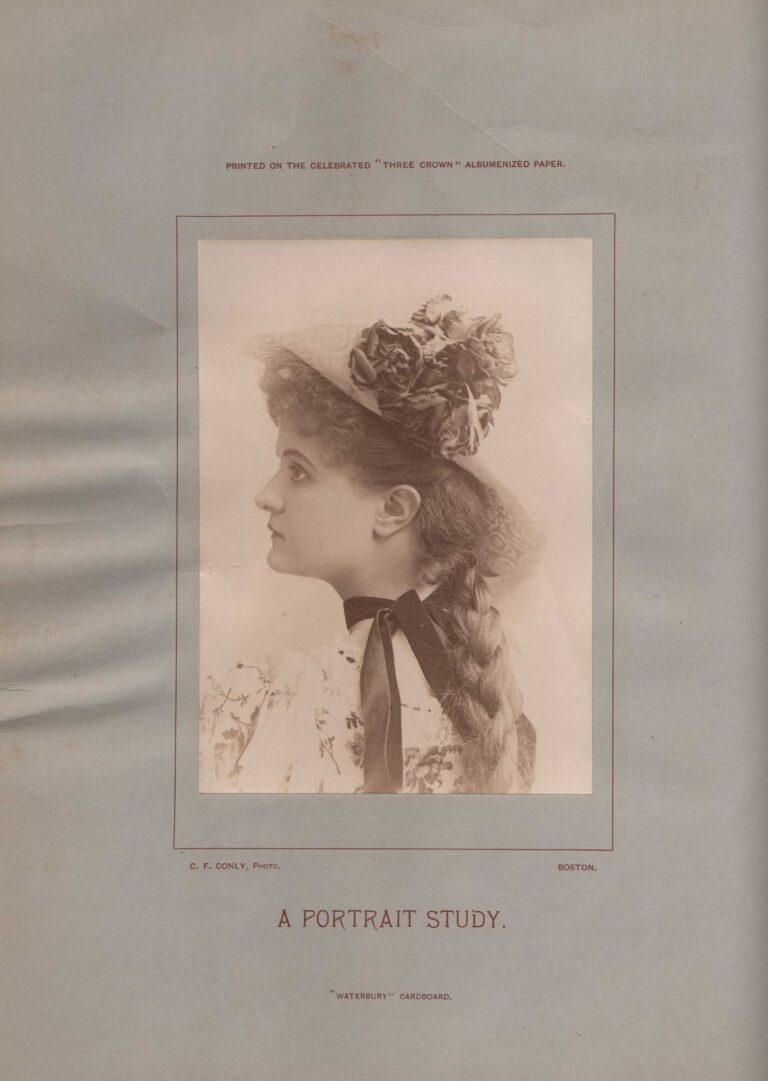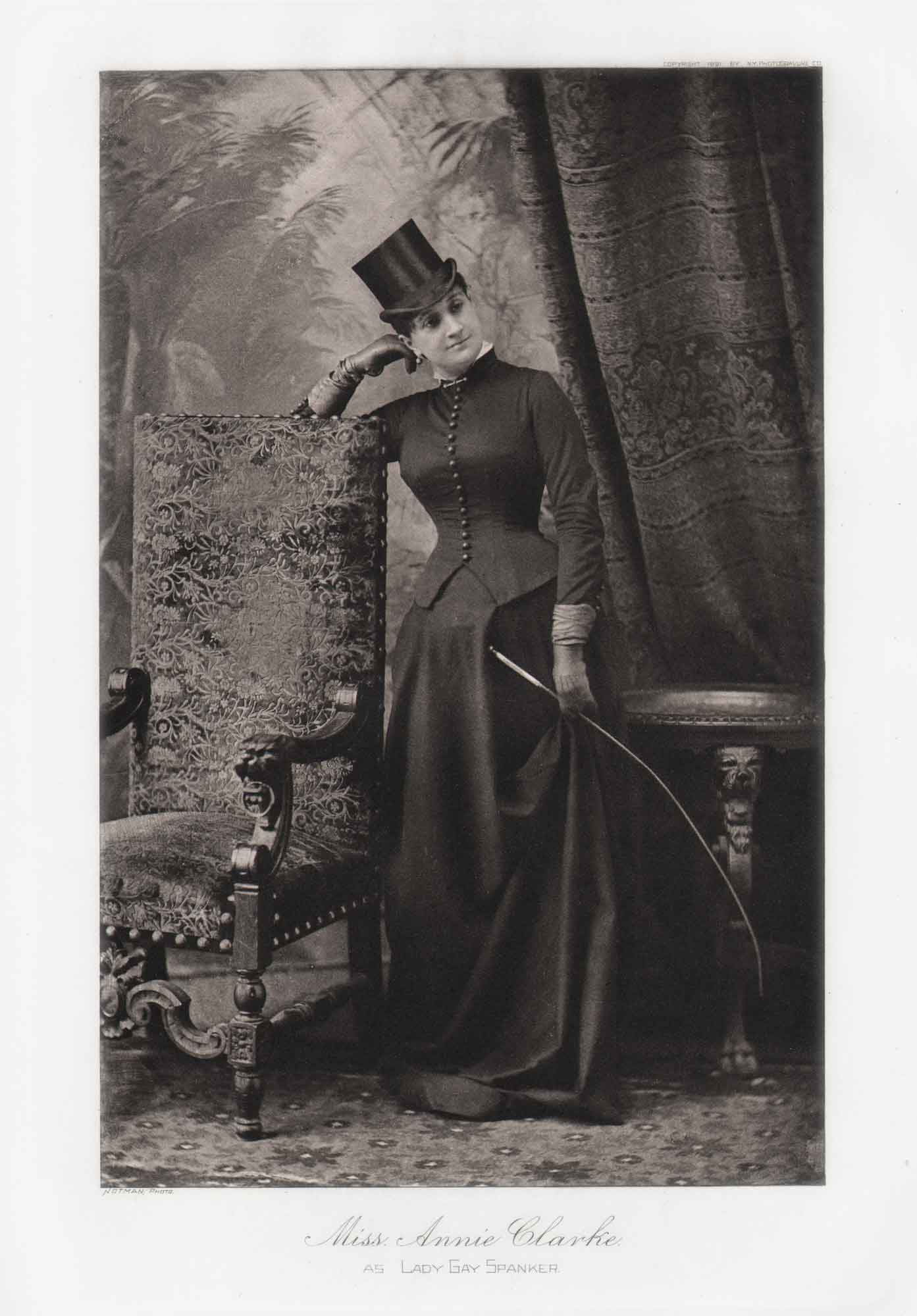
Miss Annie M. Clarke as Lady Gay Spanker
Annie M. Clarke was a stage actress affiliated with the Boston Museum Stock Company. The character of Lady Gay Spanker is described as a “horse-riding virago”, a leading role in the English five-act comedy London Assurance that premiered at the Theatre Royal at Covent Garden, London, in 1841. Clarke played the role to much acclaim over the years. A typical account from The Harvard Crimson, Dec. 4, 1879: “Saturday evening, Miss Annie Clarke takes a benefit as Lady Gay Spanker, in “London Assurance,”… The selection of Clarke as part of a series of leading stage actors and actresses featured in Sun and Shade was likely the result of its publisher Ernest Edwards encountering her on the Boston stage while he still worked at the Heliotype Printing Company in that city.
Annie M. Clarke: 1845-1902
The following biography and obituary for actress Annie Clarke was published in The New York Dramatic Mirror, May 31, 1902:
The Death of Annie M. Clarke
It is probable that of all the veteran actresses of the American stage none held a warmer or firmer place in the affections of a multitude of players and playgoers than Annie M. Clarke, who died of pneumonia at the home of Mrs. Agnes Stewart, No. 309 Michigan Avenue, Chicago, Ill., last Thursday morning, May 22. Miss Clarke, who for the past four years had been a member of Julia Marlowe’s company, was taken ill in Cleveland, O., on Tuesday, May 13. On that evening she went to the Euclid Avenue Opera House, where Miss Marlowe was appearing, prepared to act her role of Queen Catherine of Aragon in When Knighthood Was in Flower, as usual. She was, however, in no condition to play, and while making up fainted three times. After the performance Miss Clarke was taken to her apartments and physicians were summoned. They were unable to diagnose her illness, and she remained in her room until she went with the company to Chicago on Sunday, May 18. Upon arriving in Chicago Miss Clarke was conveyed to the residence of Mrs. Stewart, where her complaint was at once determined to be pneumonia. On Monday her condition seemed to improve somewhat, but on Tuesday it was known that she could not survive the malady. Oxygen was administered on Wednesday, and from then until her death at three o’clock Thursday morning she was kept alive solely by this means.
Miss Clarke was born in Boston in 1845 and went upon the stage before reaching the age of five. The exact date of her debut she did not herself remember. For years she was regarded in her native city as an actress almost without an equal, and it is an assured fact that no Boston actress ever exceeded her in the esteem and affection of the playgoers of that city. Miss Clarke’s adoption of a stage career was brought about through the interest taken in her by Adelaide Phillips, who in the early fortys was a member of the company at the historic Boston Museum. Miss Phillips procured her an engagement at the Museum, where she was first seen in a number of children’s roles and became an immediate favorite with the frequenters of the theatre. She made her first notable success as the Duke of York in Richard the Third in support of C. W. Couldock, who assumed the title-role. Following this she was seen as Polly in the original Boston production of Uncle Tom’s Cabin, as the child in The Silver Spoon, and also in a large number of other juvenile parts. Among the famous players who were her associates during her early days in the Museum company were Mrs. Saunders, the Thomans, Louis Mestayer, J. A. Smith, and William Warren, from each of whom she naturally gained much valuable advice and experience.
In May of 1856 she left the Museum and went to the Boston Theatre, where she appeared with Thomas Barry’s Stock company as one of the fairies in A Midsummer Nights Dream. After a season at this playhouse Miss Clarke went to the Howard Athenaeum, then under the management of Jacob Barrow. Her first part there was that of Amy in A Hard Struggle. She met with gratifying success in this and similar characters, until the theatre was acquired by E. L. Davenport, with whom she remained a short while. In this company Miss Clarke had an opportunity to study the work of such fine actors as George Jordan, John E. Owens, Harry Wallack, Julia Bennett Barrow, Fanny Morant, and Emily Thorne. About this time Charlotte Cushman’s attention was attracted to her, and from this great player she received any amount of hearty encouragement and advice. At this period Miss Clarke was a handsome, graceful and striking young woman, eminently adapted physically for the parts that fell to her.
In 1861 Miss Clarke made a brief tour of New England, returning the same year to the Museum. The theatre was then managed by E. F. Keach, and her first appearance under his management was as Euphemia Cholmondeley in Men of the Day. From this date her earnest, conscientious and talented efforts made her advancement rapid. Josephine Orton, who held the place next in importance to Kate Reignolds, the leading woman, left the company not long after Miss Clarke’s return to the Museum, and the management regarded the young actress with such favor that thereafter she was given Miss Orton’s roles. She played the line of parts falling to the juvenile woman of the company during the rest of Miss Reignolds’ stay and also while Kate Denin was leading woman. After Miss Denin left the company Miss Clarke was given her coveted position. Miss Clarke’s career at the Museum lasted until May 26, 1892, when she appeared as Suzanne in the second act of A Scrap of Paper and as Peg Woffington in the third and fourth acts of Masks and Faces, two of her most congenial roles. The occasion was a testimonial in her honor. During the many years intervening between her first appearance at the Museum and her final one, Miss Clarke took a prominent part in nearly all of the productions that have made the playhouse one of the most famous in the country. Her success in the hundreds of varied characters that she assumed while there is now dramatic history, and she proved herself an equally skillful exponent of tragedy, drama and comedy. While in Boston Miss Clarke acted with practically all of the most famous native players of the time, including Charlotte Cushman, E. L. Davenport, Edwin Booth, Lawrence Barrett and the other stars of their day, who at one time or another filled engagements at the theatres with which she was associated. It can also be said that there are few of the memorable plays of the past half century in which she has not been seen, as well as in nearly all of the classic comedies and tragedies. Perhaps her best-liked portrayals at the Museum were Lady Teazle in The School for Scandal, Lady Macbeth, Rosalind in As You Like It, the Queen in Hamlet, Lady Gay Spanker in London Assurance, Nancy Sykes in Oliver Twist, and Romeo in Romeo and Juliet.
After leaving the Museum Miss Clarke was a member of the Boston Grand Opera House Stock company in 1893 and of the Manola-Mason Comedy company. As the best years of her life were spent In Boston, Miss Clarke was not so well known in this city as she would otherwise have been. Her appearances here were as Madame de Thauzette in Denise with Olga Nethersole, as Mrs. Annie Dudgeon in The Devil’s Disciple, and as Frau Schmidt in The First Violin with Richard Mansfield, and in various roles with Julia Marlowe during the last four years of her life.
Miss Clarke’s death has caused profound regret and sorrow among her innumerable acquaintances, and apart from the personal loss felt by them It can be truthfully stated that the American stage has been deprived of one of the most versatile, conscientious and talented actresses in its history.
Miss Clarke’s remains were brought to Boston and cremated at Forest Hills on Sunday. Funeral services, conducted by the Rev. E. A. Horton, were held there and were attended by a large number of the late actress’ friends and acquaintances. Miss Clarke’s ashes will be buried in Mount Hope beside the grave of her mother.
William Notman: 1826-1891
William Notman was a Scottish-Canadian photographer and businessman. The Notman House in Montreal was his home from 1876 until his death in 1891, and it has since been named after him. Notman was the first photographer in Canada to achieve international recognition.—Wikipedia (2026)
Sun & Shade: An Artistic Periodical
“Within the covers of Sun and Shade…We shall especially endeavor to encourage the artistic side of direct photography in all its phases,”—Ernest Edwards, president & publisher, 1889
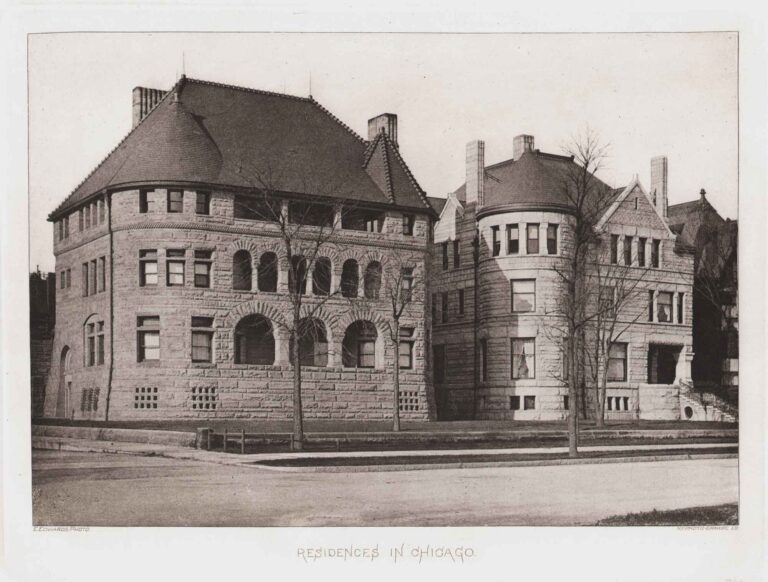
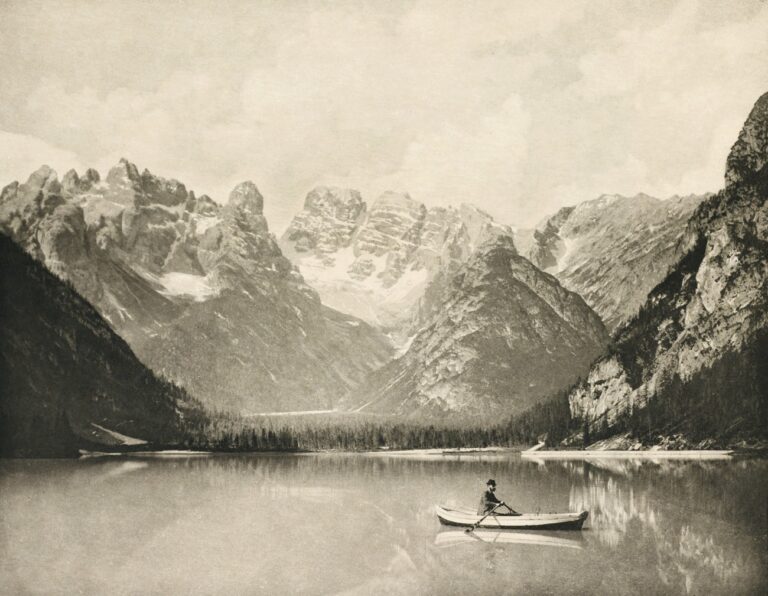
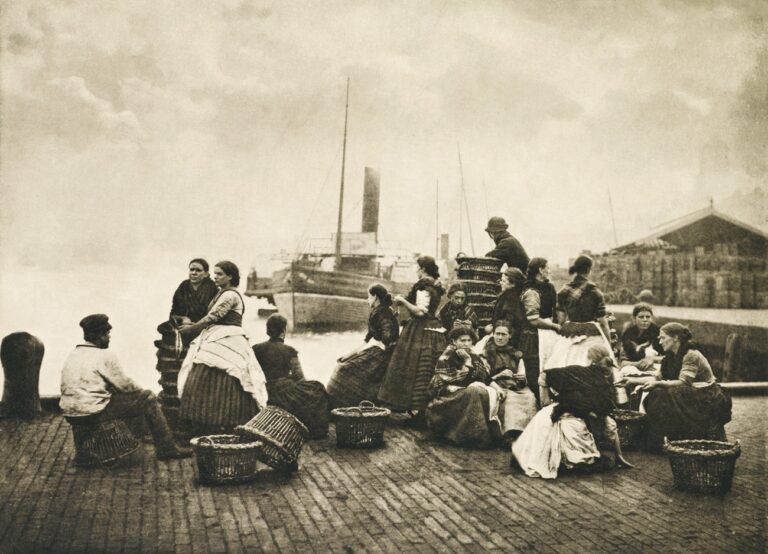
In July, 1888, the first issue of Sun & Shade: A Photographic Record of Events, was published in New York City by The Photo-Gravure Company. Essentially a high-class art periodical, each issue featured eight or more beautiful hand-pulled photogravures as well as plates printed in photogelatine, (collotype) and halftone. These were collected within a stapled, folio-sized magazine issued monthly. The subject matter included the work of leading amateur and professional photographers, as well as works of art—many from the galleries at The Metropolitan Museum of Art in Manhattan. The December issue—Christmas themed—featured a specially designed cover printed in green ink. Success was swift. The first issue sold 1000 copies “in a fortnight”. (1.) Within the first year, Sun & Shade quickly increased circulation to 4000 copies a month. With a public demand for reprinting earlier issues, this success lead to a rebranding, after which, beginning with the September, 1889 issue, the magazine was renamed Sun & Shade: An Artistic Periodical. The final issue was March, 1896, when financial issues to the parent company, spurred by the eventual May, 1896 bankruptcy of the N.Y. Photo-Gravure Company, forced its closure.
Sun & Shade would become the ultimate statement of the many skills and inquisitive mind of Englishman Ernest Edwards. (1836-1903) Essentially his own printed passion project, the magazine was fueled by his ongoing love of photography in the field (issues featured many plates by him over the years) and a deeply scientific mind which pushed the advancement of the state of photo-mechanical reproduction and fine printing.
The son of a clergyman from Bloomsbury in London, he initially made a name for himself taking photographic portraits of eminent people in his Baker Street gallery. (Charles Darwin sat for him several times) His love of the outdoors also bore fruit and he became an accomplished alpine photographer. But his real interest centered around photo-mechanical reproduction. In 1869, he took out a patent in England for his own rudimentary collotype process called heliotype. In the Fall of 1872, he moved across the pond along with his wife Charlotte, and became superintendent of Boston’s Heliotype Printing Company after selling the American rights to American publisher James Ripley Osgood. (1836–1892) Edwards ran the Heliotype Printing Co. there until the end of 1884. The following year the James R. Osgood & Co. went bankrupt, although not a result of the heliotype division.
Growing restless in Boston, he then moved to New York City, where he established a new firm in March, 1885: The Photo-Gravure Company, (subsequently renamed The New York Photo-Gravure Company) with offices in Manhattan and a leased printing factory in Brooklyn. In 1887, his company received perhaps the one commission it’s best known for today: the printing of 781 collotypes, which Edwards called photogelatine plates, making up the monumental publication:
Animal Locomotion. An Electro-Photographic Investigation of Consecutive Phases of Animal Movements, 1872-1885, with the landmark sequenced motion study photographs taken by British photographer Eadweard Muybridge.
Restructured in 1891 as the New York Photogravure Co., Ernest Edwards continued to advance the state of photo-mechanical printing during his final decade, with Sun & Shade publishing some of the earliest examples of his own invention by 1894: plates printed in a three-color process called chrome-gelatine, a variation of his heliotype process.
Quality Rather than Quantity
Even though it survived less than eight years in print, describing Sun & Shade in Ernest Edward’s own words is perhaps the best posterity for this important photographic periodical with an artistic heart. One year after its’ debut, he wrote the following, published in The Photographic Times for August 2, 1889:
“A year ago we commenced the publication of our novel venture in journalism Sun and Shade, a Picture Periodical without letterpress, almost as an experiment, with a modest list of less than fifty subscribers. To-day we are printing an edition of 4,000 copies monthly. A sufficiently convincing proof of the wisdom of our hope that there was room for us.
“In our rapid growth the wish has been indicated unmistakably for the higher grade of pictures, and of the higher class–always for quality rather than quantity. Following rather than leading such a wish, we feel that we make no mistake in marking the future career of the magazine to be rather that of an artistic periodical than a photographic record of events.
*Our efforts shall be directed in the future to make Sun and Shade an artistic periodical which shall be not only pleasing but educational in its broadest sense, Some of our plans may be briefly referred to.
“We shall reproduce the leading pictures in the great collection of the Metropolitan Museum of Art. Within the covers of Sun and Shade will be found from time to time, reproductions of the works of American artists. We shall especially endeavor to encourage the artistic side of direct photography in all its phases, And we shall supplement these special features with examples of sculpture, architecture, and industrial art. If in the future we receive as hearty a response to our efforts as we have received in the past, our task will be indeed pleasant and our road to success a royal one.” (p. 394)
- Notice: Sun & Shade: October, 1888. The August and September issues did not appear.