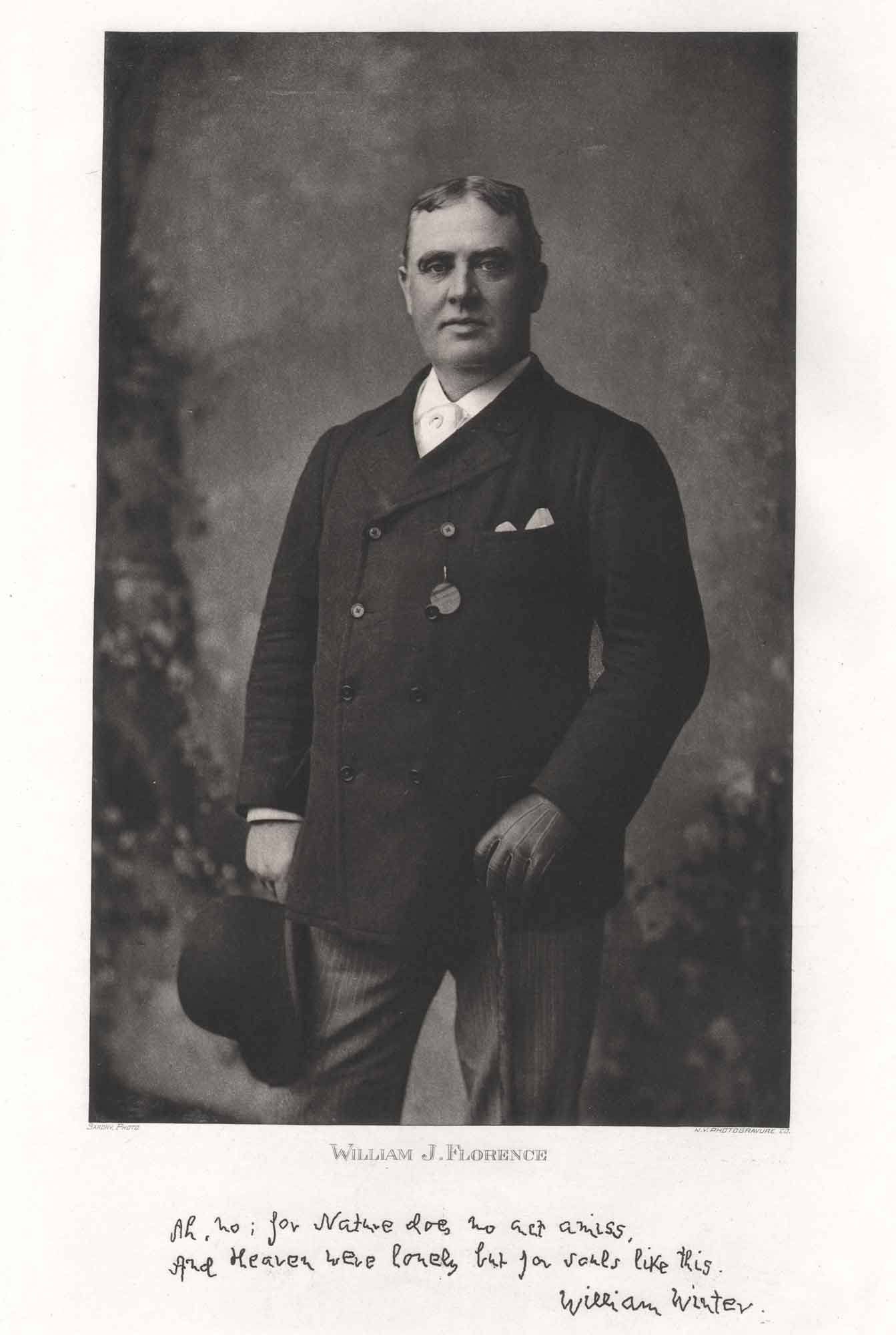
William J. Florence: American Actor, Songwriter, & Playwright
The following commentary appeared on the index page for this photo of William Jermyn Florence by Napoléon Sarony: “Born in Albany, N. Y., July 26th, 1831. Died in Philadelphia, November 19th, 1891. When quite a young man Mr. Florence joined the Murdock Dramatic Association with which he was connected for some years. His first professional appearance was in Richmond, Va., as Peter in “The Stranger.” After making his mark as a versatile comic actor, he essayed tragedy in Providence, R. I. playing Macduff to Booth’s Macbeth, but soon returned to eccentric comedy making marked successes in Irish parts. His career is so well known that no mention of it is necessary here. He died regretted by friends and strangers. Every newspaper in the country published loving, tender tributes to his memory.
We print one from KATE FIELD’S WASHINGTON.
“When a valuable life goes out too soon for public weal, it is folly to indulge in the respectable slang of the period, and refer to mysterious dispensations of Providence. Death has its reasons easily learned by those who go to Nature, yet these reasons are poor consolation to those who have looked their last on a dead friend or a favorite artist.
No actor in America has won his genial way to more hearts than William J. Florence, whose sudden taking off leaves a void not easily filled. The man was honest and loyal, quick in his sympathies and generous in his help. The citizen did not forget the country to which he owed fame and fortune. The actor mounted every round of the ladder legitimately, and never stood higher in public esteem than since his return to old English Comedy. There have been few sweeter and more artistic performances than the Ezekiel Homespun of my old friend, and that I shall not hear again the kind and manly voice which made Coleman’s ploughboy live once more, is a personal as well as a dramatic loss. Like all faithful actors, he pursued his profession when discretion should have kept him housed; but rather than disappoint the public, many an actor risks life itself. William J. Florence did not realize how ill he was until too late to avert the coming of that messenger who sooner or later summons all, too often finding us unprepared for the unknown journey. Were every soul as free from guile as that of Florence the Comedian, the world would be fairer to live in and Heaven more easily attained.”
Mr. William Winter, the well known dramatic critic, was most felicitous in his loving and graceful tributes to the dead actor’s memory. He sent us his autograph copy of the verses he wrote about his friend and permitted us to use the closing lines, which we have engraved under Mr. Florences’ picture. It is a distinction to have deserved those lines, and it is no less a distinction to have written them. It is a curious fact that many journalists wandered around the same thought expressed in those two lines, but it was left for Mr. Winter to give it its beautiful setting. We give the poem in full:
By Virtue cherished, by Affection mourned, By Heaven hallowed and by Fame adorned, Here Florence sleeps, and o’er his sacred rest Each word is tender and each thought is blest. Long, for his loss, shall pensive Memory show Through humor’s mask the visage of her woe, Day breathe a darkness that no sun dispels, And Night be full of whispers and farewells, While patient kindness, shadow-like and dim, Droops in its loneliness, bereft of hit, Feels its sad doom and sure decadence nigh, For how should kindness live, when he could die! The eager heart, that felt for every grief, The bounteous hand, that loved to give relief, ‘The honest smile that blessed where’er it lit, ‘The dew of pathos and the sheen of wit, The sweet, blue eyes, the voice of melting tone That made all hearts as gentle as his own. The Actor’s charm, supreme in royal thrall, That ranged through every field and shone in all-For these must Sorrow make perpetual moan. Bereaved benighted, hopeless, and alone? Ah, no; for Nature does no act amiss, And Heaven were lonely but for souls like this.”
William J. Florence: 1831-1891
William Jermyn Conlin, better known by his stage name William J. Florence, was an American actor, songwriter, and playwright. Florence awarded the ribbon of the French Societe Histoire Dramatique. He was also co-founder with Walter M. Fleming of the Shriners, a Masonic Order.—Wikipedia (2026)
Napoléon Sarony (March 9, 1821 – November 9, 1896) was an American lithographer and photographer. He was a highly popular portrait photographer, best known for his portraits of the stars of late-19th-century American theater. His son, Otto Sarony, continued the family business as a theater and film star photographer.—Wikipedia (2026)
Sun & Shade: An Artistic Periodical
“Within the covers of Sun and Shade…We shall especially endeavor to encourage the artistic side of direct photography in all its phases,”—Ernest Edwards, president & publisher, 1889
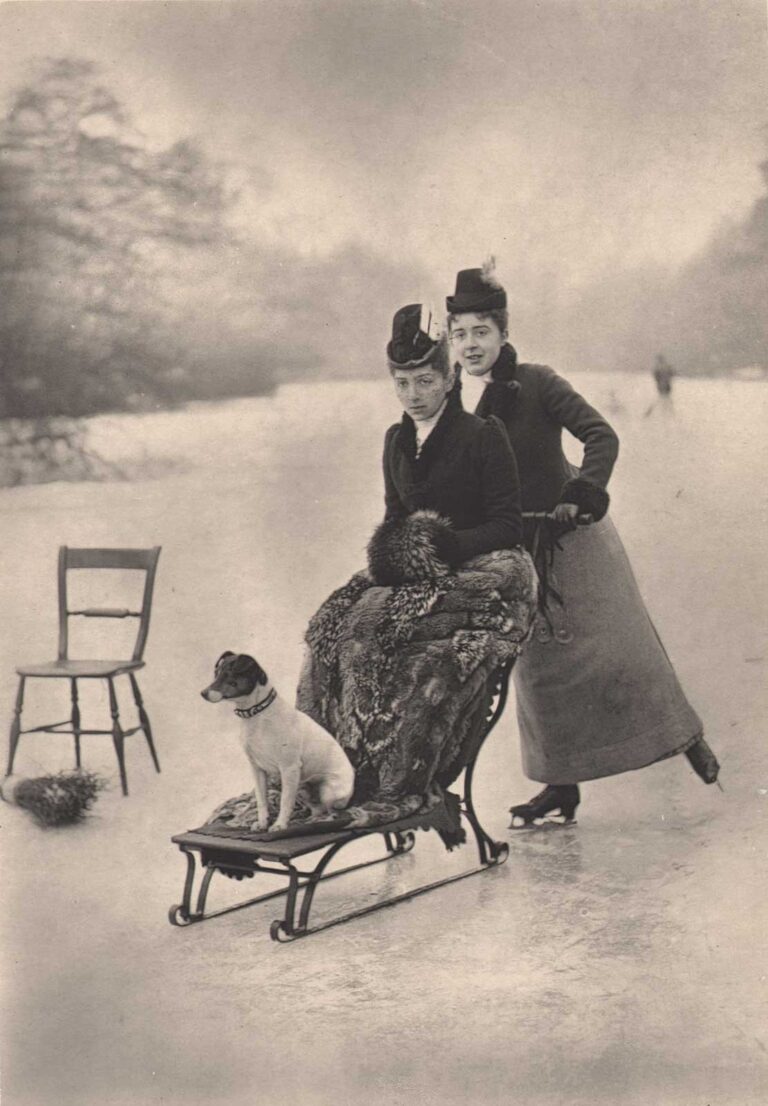
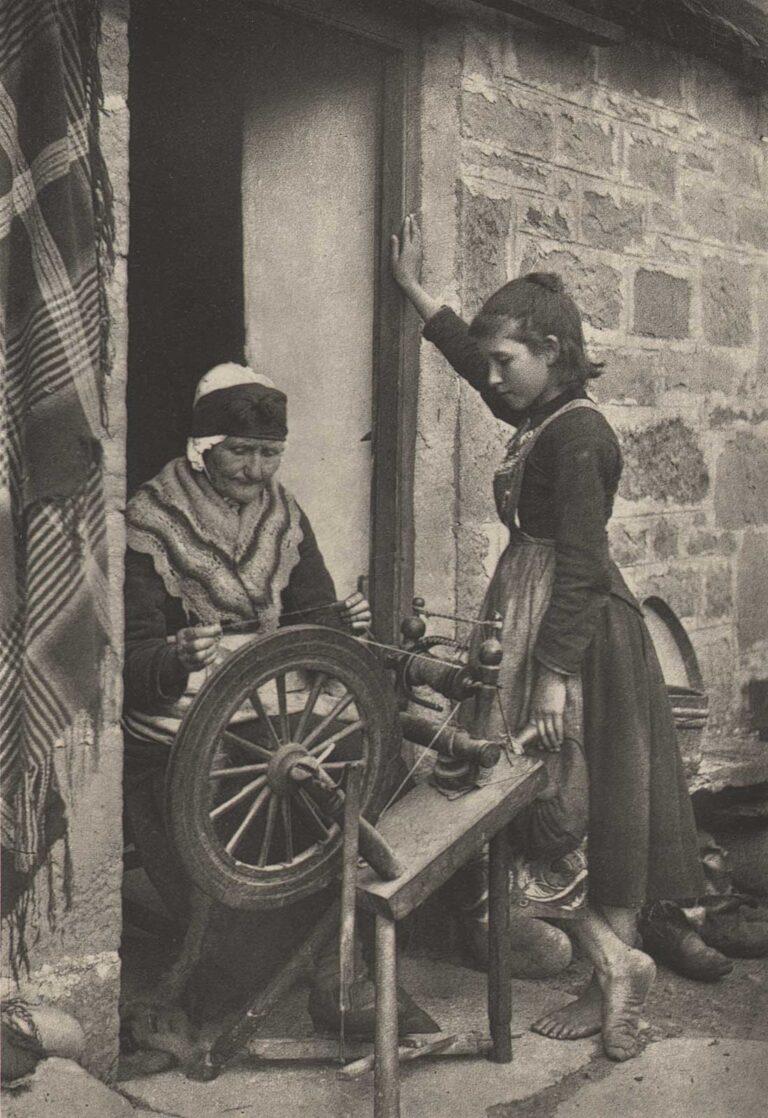
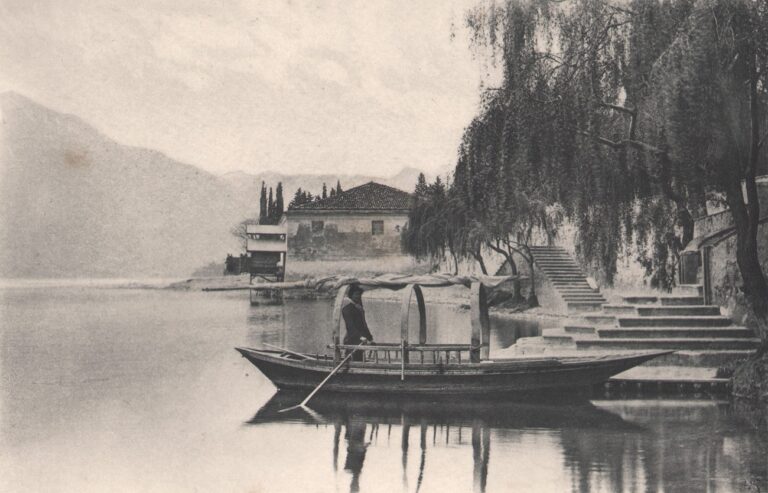
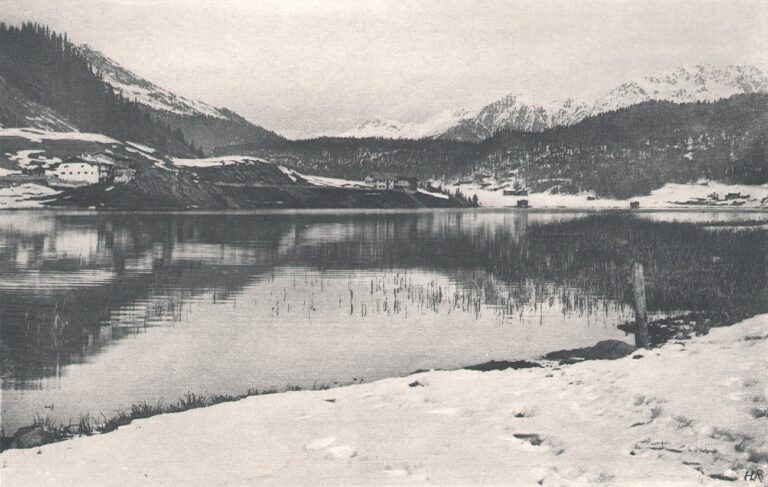
In July, 1888, the first issue of Sun & Shade: A Photographic Record of Events, was published in New York City by The Photo-Gravure Company. Essentially a high-class art periodical, each issue featured eight or more beautiful hand-pulled photogravures as well as plates printed in photogelatine, (collotype) and halftone. These were collected within a stapled, folio-sized magazine issued monthly. The subject matter included the work of leading amateur and professional photographers, as well as works of art—many from the galleries at The Metropolitan Museum of Art in Manhattan. The December issue—Christmas themed—featured a specially designed cover printed in green ink. Success was swift. The first issue sold 1000 copies “in a fortnight”. (1.) Within the first year, Sun & Shade quickly increased circulation to 4000 copies a month. With a public demand for reprinting earlier issues, this success lead to a rebranding, after which, beginning with the September, 1889 issue, the magazine was renamed Sun & Shade: An Artistic Periodical. The final issue was March, 1896, when financial issues to the parent company, spurred by the eventual May, 1896 bankruptcy of the N.Y. Photo-Gravure Company, forced its closure.
Sun & Shade would become the ultimate statement of the many skills and inquisitive mind of Englishman Ernest Edwards. (1836-1903) Essentially his own printed passion project, the magazine was fueled by his ongoing love of photography in the field (issues featured many plates by him over the years) and a deeply scientific mind which pushed the advancement of the state of photo-mechanical reproduction and fine printing.
The son of a clergyman from Bloomsbury in London, he initially made a name for himself taking photographic portraits of eminent people in his Baker Street gallery. (Charles Darwin sat for him several times) His love of the outdoors also bore fruit and he became an accomplished alpine photographer. But his real interest centered around photo-mechanical reproduction. In 1869, he took out a patent in England for his own rudimentary collotype process called heliotype. In the Fall of 1872, he moved across the pond along with his wife Charlotte, and became superintendent of Boston’s Heliotype Printing Company after selling the American rights to American publisher James Ripley Osgood. (1836–1892) Edwards ran the Heliotype Printing Co. there until the end of 1884. The following year the James R. Osgood & Co. went bankrupt, although not a result of the heliotype division.
Growing restless in Boston, he then moved to New York City, where he established a new firm in March, 1885: The Photo-Gravure Company, (subsequently renamed The New York Photo-Gravure Company) with offices in Manhattan and a leased printing factory in Brooklyn. In 1887, his company received perhaps the one commission it’s best known for today: the printing of 781 collotypes, which Edwards called photogelatine plates, making up the monumental publication:
Animal Locomotion. An Electro-Photographic Investigation of Consecutive Phases of Animal Movements, 1872-1885, with the landmark sequenced motion study photographs taken by British photographer Eadweard Muybridge.
Restructured in 1891 as the New York Photogravure Co., Ernest Edwards continued to advance the state of photo-mechanical printing during his final decade, with Sun & Shade publishing some of the earliest examples of his own invention by 1894: plates printed in a three-color process called chrome-gelatine, a variation of his heliotype process.
Quality Rather than Quantity
Even though it survived less than eight years in print, describing Sun & Shade in Ernest Edward’s own words is perhaps the best posterity for this important photographic periodical with an artistic heart. One year after its’ debut, he wrote the following, published in The Photographic Times for August 2, 1889:
“A year ago we commenced the publication of our novel venture in journalism Sun and Shade, a Picture Periodical without letterpress, almost as an experiment, with a modest list of less than fifty subscribers. To-day we are printing an edition of 4,000 copies monthly. A sufficiently convincing proof of the wisdom of our hope that there was room for us.
“In our rapid growth the wish has been indicated unmistakably for the higher grade of pictures, and of the higher class–always for quality rather than quantity. Following rather than leading such a wish, we feel that we make no mistake in marking the future career of the magazine to be rather that of an artistic periodical than a photographic record of events.
*Our efforts shall be directed in the future to make Sun and Shade an artistic periodical which shall be not only pleasing but educational in its broadest sense, Some of our plans may be briefly referred to.
“We shall reproduce the leading pictures in the great collection of the Metropolitan Museum of Art. Within the covers of Sun and Shade will be found from time to time, reproductions of the works of American artists. We shall especially endeavor to encourage the artistic side of direct photography in all its phases, And we shall supplement these special features with examples of sculpture, architecture, and industrial art. If in the future we receive as hearty a response to our efforts as we have received in the past, our task will be indeed pleasant and our road to success a royal one.” (p. 394)
- Notice: Sun & Shade: October, 1888. The August and September issues did not appear.