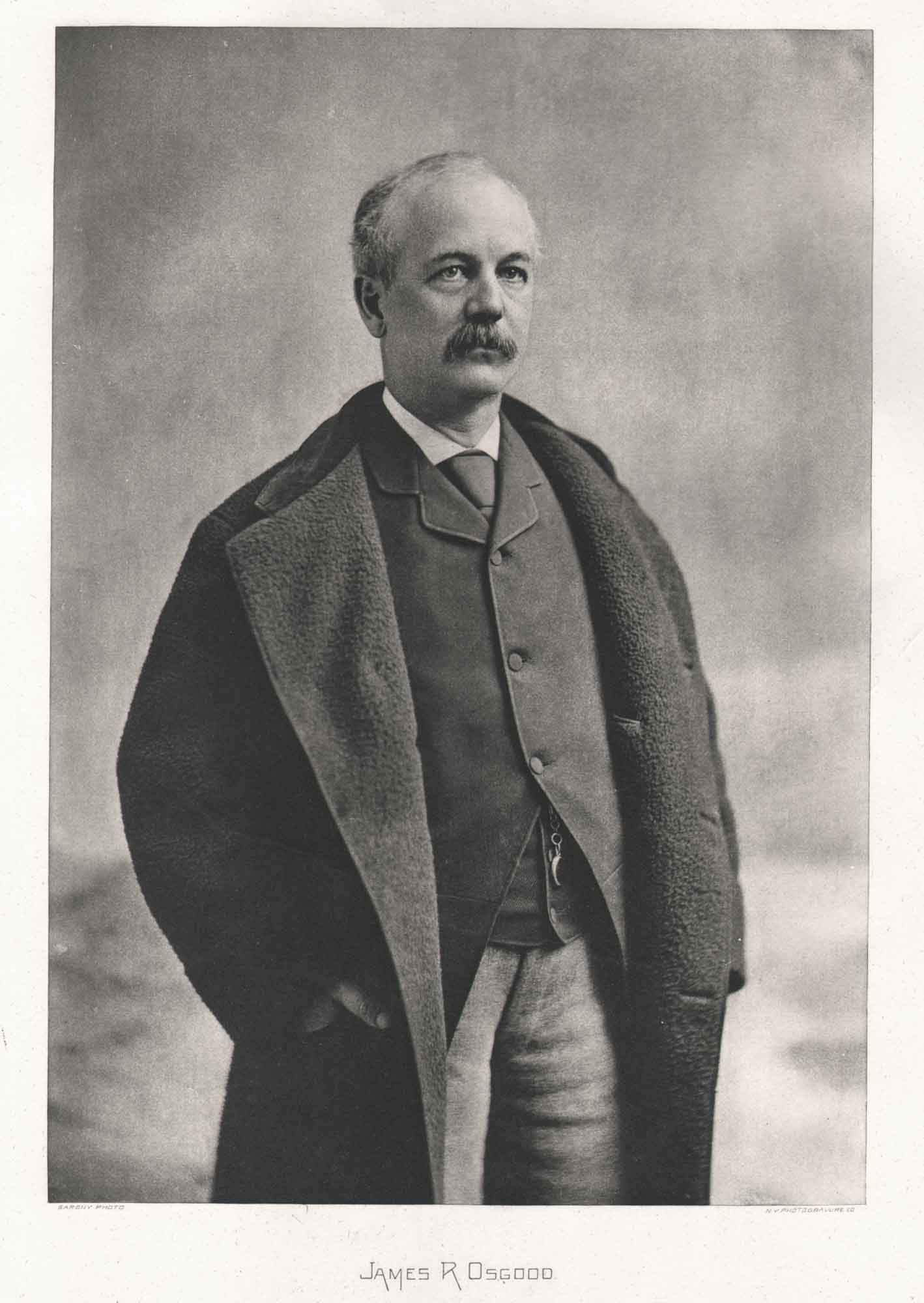
James Ripley Osgood—American Publisher
The following commentary appeared on the index page for this portrait of American publisher James Ripley Osgood by Napoléon Sarony: “Mr. Osgood, who died in London, England, on the 18th of last May, was born in Fryeburg, Maine, on February 22d, 1836. He came of sturdy stock. “Old Put,” General Israel Putnam, was one of his ancestors, as were also Judge Judah Dana, and Chief Justice Howard of Maine. He graduated from Bowdoin College, the Alma Mater of Longfellow, Hawthorne and Franklin Pierce. He was intended for the law, but his literary taste drew him to Boston, where he entered the famous publishing house of Ticknor & Fields, to which he was soon admitted as partner. After more than twenty years of prosperity, circumstances compelled him to leave Boston and take up his residence in London, where he started afresh, with Mr. Clarence McIlvaine. They acted as the English agents of Messrs. Harper & Bros., and in addition thereto they commenced publishing the works English writers, and were gradually drawing to their house, in Albemarle Street, the highest names in English literature. We cannot do better than reproduce here the printed words of Mr. W. R Ware, the editor of the American Architect:
“With a deep sense of personal loss we have to record the death of one of the most generous and lovable men we have ever had to deal with, one with whom long years of intercourse produced no slightest uncomfortable friction, one whose captious criticism was not to be expected, one whose mind was open to suggestion and prompt to detect the desirable from the undesirable. Generous, discriminating just in his dealings with those whose lot it was to serve in his employ, the death of James Ripley Osgood will bring real regret to scores of men, of almost every nationality, who were at different times in the service of the publishing house of James R. Osgood & Company and of the Heliotype Printing Company. Mr. Osgood, at the time that business reverses obliged him to leave Boston and take the position of Harper & Brothers’ London representative, was one of the best known and most influential citizens of Boston, for he had the happy gift of great social tact, while his sterling good sense and his acknowledged business capacity gave him an enviable standing both in the social and business worlds, and it was an unkind turn of the wheel of Fortune that compelled him to die an alien in a foreign land. In spite of the weight brought upon him less by advancing years than by the anxieties attending his reverses in business Mr. Osgood, with characteristic perseverance, had succeeded in establishing recently an independent publishing house in London under the style of James R. Osgood, McIlvaine & Co., which at once won for itself standing and recognition in the already crowded book world of London. It is a satisfaction to us that in all the changes through which he passed between 1876 and 1885 Mr. Osgood and the American Architect, one the creator of the other, were loyal one to the other. His belief in the future possibilities of the journal was to us a comfort and an unfailing support, and it is a gratification to all concerned to know that events have proved it was not misplaced.”
Had Mr. Osgood’s instincts been as keen as a trader as they were as a publisher and scholar, he would have been, at his death, in possession of great wealth, and the finest list of books of any publisher in the world. Open hearted, generous treatment of authors was one of his great characteristics. Perhaps no publisher who ever lived was on such cordial, intimate relations with the great writers on both sides of the Atlantic, for his wide reading and culture enabled him to meet them on their own level.“
Napoléon Sarony (March 9, 1821 – November 9, 1896) was an American lithographer and photographer. He was a highly popular portrait photographer, best known for his portraits of the stars of late-19th-century American theater. His son, Otto Sarony, continued the family business as a theater and film star photographer.—Wikipedia (2026)
Sun & Shade: An Artistic Periodical
“Within the covers of Sun and Shade…We shall especially endeavor to encourage the artistic side of direct photography in all its phases,”—Ernest Edwards, president & publisher, 1889
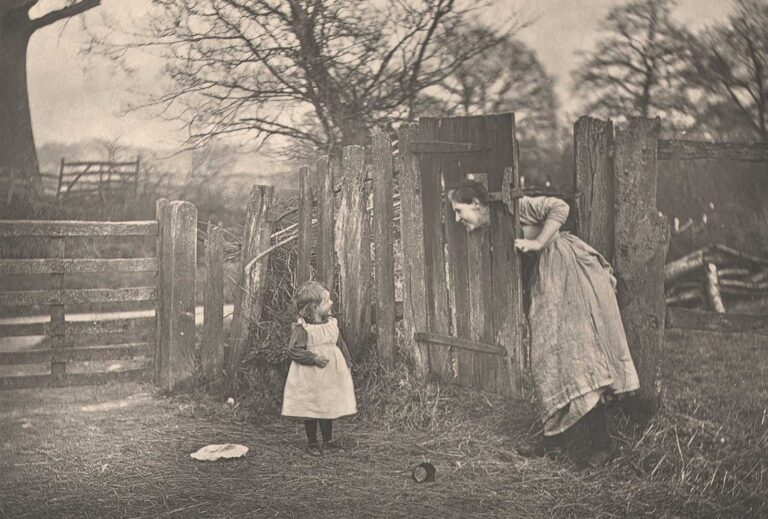
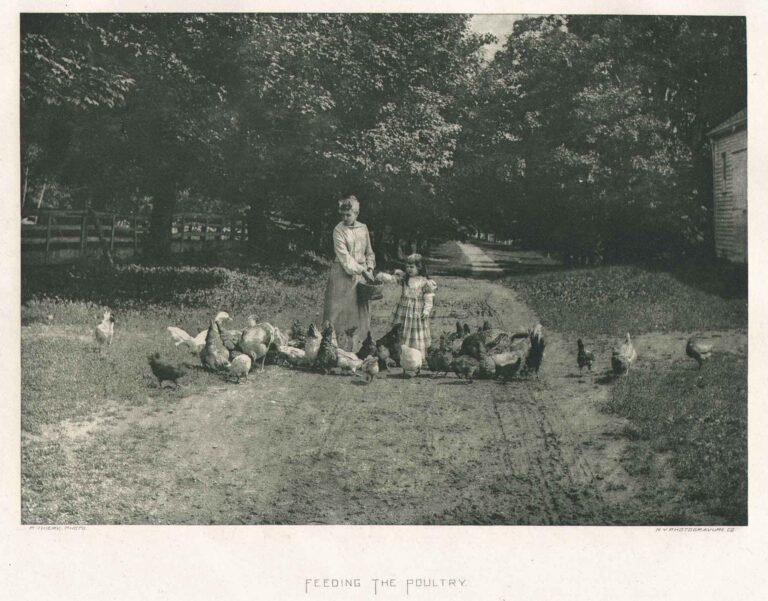
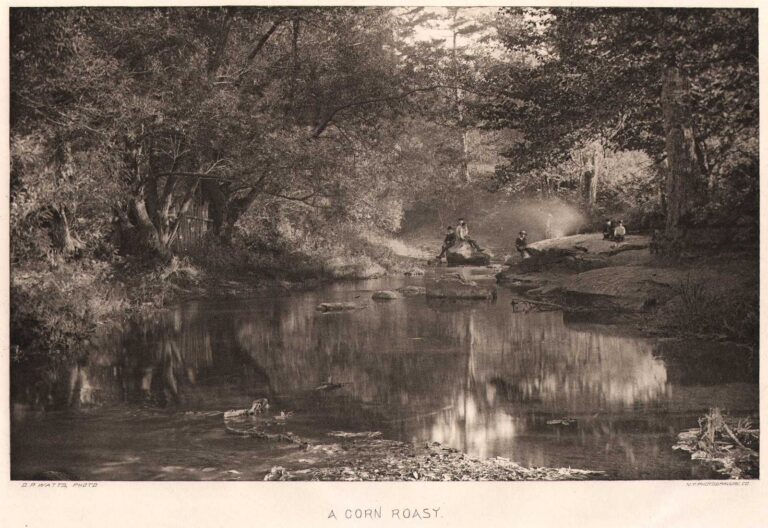
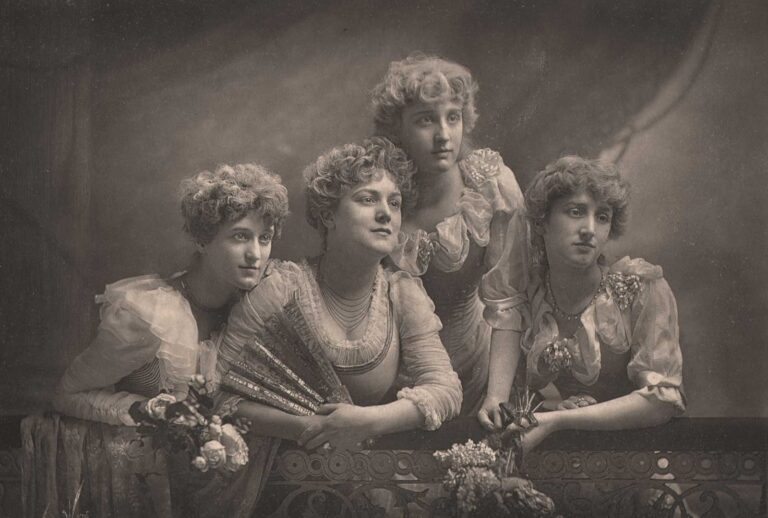
In July, 1888, the first issue of Sun & Shade: A Photographic Record of Events, was published in New York City by The Photo-Gravure Company. Essentially a high-class art periodical, each issue featured eight or more beautiful hand-pulled photogravures as well as plates printed in photogelatine, (collotype) and halftone. These were collected within a stapled, folio-sized magazine issued monthly. The subject matter included the work of leading amateur and professional photographers, as well as works of art—many from the galleries at The Metropolitan Museum of Art in Manhattan. The December issue—Christmas themed—featured a specially designed cover printed in green ink. Success was swift. The first issue sold 1000 copies “in a fortnight”. (1.) Within the first year, Sun & Shade quickly increased circulation to 4000 copies a month. With a public demand for reprinting earlier issues, this success lead to a rebranding, after which, beginning with the September, 1889 issue, the magazine was renamed Sun & Shade: An Artistic Periodical. The final issue was March, 1896, when financial issues to the parent company, spurred by the eventual May, 1896 bankruptcy of the N.Y. Photo-Gravure Company, forced its closure.
Sun & Shade would become the ultimate statement of the many skills and inquisitive mind of Englishman Ernest Edwards. (1836-1903) Essentially his own printed passion project, the magazine was fueled by his ongoing love of photography in the field (issues featured many plates by him over the years) and a deeply scientific mind which pushed the advancement of the state of photo-mechanical reproduction and fine printing.
The son of a clergyman from Bloomsbury in London, he initially made a name for himself taking photographic portraits of eminent people in his Baker Street gallery. (Charles Darwin sat for him several times) His love of the outdoors also bore fruit and he became an accomplished alpine photographer. But his real interest centered around photo-mechanical reproduction. In 1869, he took out a patent in England for his own rudimentary collotype process called heliotype. In the Fall of 1872, he moved across the pond along with his wife Charlotte, and became superintendent of Boston’s Heliotype Printing Company after selling the American rights to American publisher James Ripley Osgood. (1836–1892) Edwards ran the Heliotype Printing Co. there until the end of 1884. The following year the James R. Osgood & Co. went bankrupt, although not a result of the heliotype division.
Growing restless in Boston, he then moved to New York City, where he established a new firm in March, 1885: The Photo-Gravure Company, (subsequently renamed The New York Photo-Gravure Company) with offices in Manhattan and a leased printing factory in Brooklyn. In 1887, his company received perhaps the one commission it’s best known for today: the printing of 781 collotypes, which Edwards called photogelatine plates, making up the monumental publication:
Animal Locomotion. An Electro-Photographic Investigation of Consecutive Phases of Animal Movements, 1872-1885, with the landmark sequenced motion study photographs taken by British photographer Eadweard Muybridge.
Restructured in 1891 as the New York Photogravure Co., Ernest Edwards continued to advance the state of photo-mechanical printing during his final decade, with Sun & Shade publishing some of the earliest examples of his own invention by 1894: plates printed in a three-color process called chrome-gelatine, a variation of his heliotype process.
Quality Rather than Quantity
Even though it survived less than eight years in print, describing Sun & Shade in Ernest Edward’s own words is perhaps the best posterity for this important photographic periodical with an artistic heart. One year after its’ debut, he wrote the following, published in The Photographic Times for August 2, 1889:
“A year ago we commenced the publication of our novel venture in journalism Sun and Shade, a Picture Periodical without letterpress, almost as an experiment, with a modest list of less than fifty subscribers. To-day we are printing an edition of 4,000 copies monthly. A sufficiently convincing proof of the wisdom of our hope that there was room for us.
“In our rapid growth the wish has been indicated unmistakably for the higher grade of pictures, and of the higher class–always for quality rather than quantity. Following rather than leading such a wish, we feel that we make no mistake in marking the future career of the magazine to be rather that of an artistic periodical than a photographic record of events.
*Our efforts shall be directed in the future to make Sun and Shade an artistic periodical which shall be not only pleasing but educational in its broadest sense, Some of our plans may be briefly referred to.
“We shall reproduce the leading pictures in the great collection of the Metropolitan Museum of Art. Within the covers of Sun and Shade will be found from time to time, reproductions of the works of American artists. We shall especially endeavor to encourage the artistic side of direct photography in all its phases, And we shall supplement these special features with examples of sculpture, architecture, and industrial art. If in the future we receive as hearty a response to our efforts as we have received in the past, our task will be indeed pleasant and our road to success a royal one.” (p. 394)
- Notice: Sun & Shade: October, 1888. The August and September issues did not appear.