A June Morning
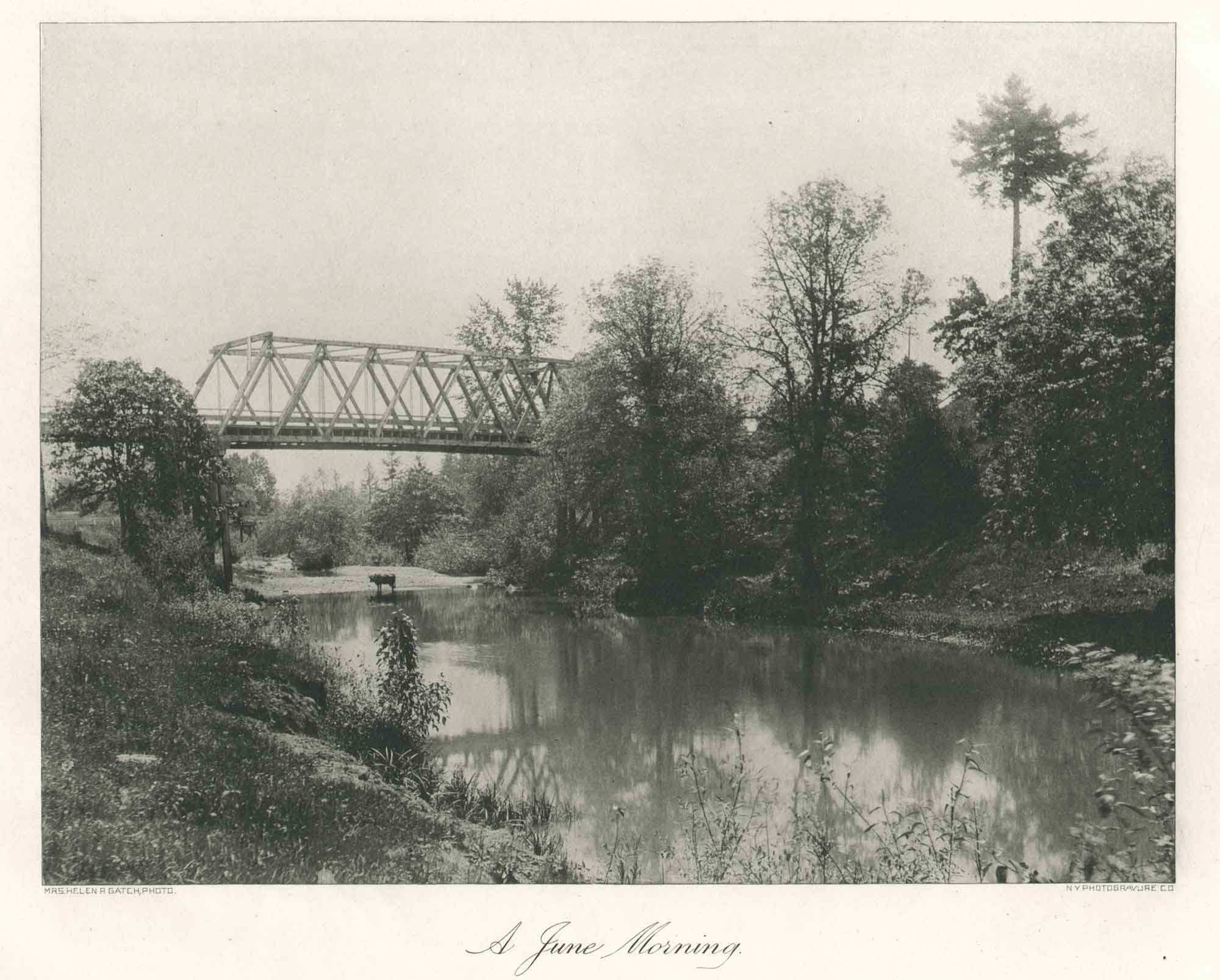
The following commentary appeared on the index page for this photo: “We have already presented to our readers specimens of work by Mrs. Carrie R. Gatch. (sic) No explanation is needed of this beautiful bit of work, which fully carries out its title of “A June Morning.” The composition and arrangement of the picture is very pleasing, and may be considered a good lesson for amateur photographers.”
Helen Plummer Gatch: 1861-1942
The following online citation for the American amateur photographer Helen Plummer Gatch appears on the Oregon Historical Society Research Library website:
“Helen Plummer Gatch (1861-1942) was born in Alton, Illinois, to Dr. Orlando P.S. Plummer, who moved to Portland, Ore. with his three daughters in 1864 after the death of their mother. As a young woman, Helen taught school before her marriage to Claud Gatch (born 1859), a banker who served as mayor of Salem, Or. from 1893-1896. They had two children, Orytha “Ryth” (born 1886) and Thomas Leigh “Tam” (1891-1954).
Helen Gatch, an ambitious amateur photographer, used her domestic life and her children as subjects for her pictorial photography, but also appears to have done documentary photographs during the 1890s, including one of the Oregon Insane Asylum in Salem. Although she did not construct stage sets for her photographs as other pictorialists did, Gatch used composition, costuming, and titles to pictorialize her subjects and to produce Dutch genre images. One example is “Romeo and Juliet” (Oregon Historical Society negative number CN004533), made in 1891, showing Ryth and Asahel Bush, Jr., playing Shakespeare at the Bush family home in Salem. This image was frequently reproduced and exhibited. Gatch used prominent Salem homes and friends as sets and models for her pictorial photography. She also photographed at the family summer house on the Oregon Coast near Newport.
Gatch made her mark at the local, regional, and national levels with winning contest entries and acceptance of her work into salons at San Francisco and Philadelphia. She joined the Salon Club (which opposed the Photo-Secessionists) and was involved in the organization of the Federation of American Photographic Societies in 1904. Her work was shown in the first American Photographic Salon later that year in New York, and it came to Portland the following year as the first show at the new Portland Art Museum. Gatch served on the committee for the second American Salon and on the jury for the third. She also was active in the Oregon Camera Club.
The Gatch family moved to California in 1912, and Helen died in Oakland on January 11, 1942.” (1.)
1. Helen Plummer Gatch photographs collection, Org. Lot 32, Oregon Historical Society Research Library. (accessed: 2012)
Sun & Shade: An Artistic Periodical
“Within the covers of Sun and Shade…We shall especially endeavor to encourage the artistic side of direct photography in all its phases,”—Ernest Edwards, president & publisher, 1889
In July, 1888, the first issue of Sun & Shade: A Photographic Record of Events, was published in New York City by The Photo-Gravure Company. Essentially a high-class art periodical, each issue featured eight or more beautiful hand-pulled photogravures as well as plates printed in photogelatine, (collotype) and halftone. These were collected within a stapled, folio-sized magazine issued monthly. The subject matter included the work of leading amateur and professional photographers, as well as works of art—many from the galleries at The Metropolitan Museum of Art in Manhattan. The December issue—Christmas themed—featured a specially designed cover printed in green ink. Success was swift. The first issue sold 1000 copies “in a fortnight”. (1.) Within the first year, Sun & Shade quickly increased circulation to 4000 copies a month. With a public demand for reprinting earlier issues, this success lead to a rebranding, after which, beginning with the September, 1889 issue, the magazine was renamed Sun & Shade: An Artistic Periodical. The final issue was March, 1896, when financial issues to the parent company, spurred by the eventual May, 1896 bankruptcy of the N.Y. Photo-Gravure Company, forced its closure.
Sun & Shade would become the ultimate statement of the many skills and inquisitive mind of Englishman Ernest Edwards. (1836-1903) Essentially his own printed passion project, the magazine was fueled by his ongoing love of photography in the field (issues featured many plates by him over the years) and a deeply scientific mind which pushed the advancement of the state of photo-mechanical reproduction and fine printing.
The son of a clergyman from Bloomsbury in London, he initially made a name for himself taking photographic portraits of eminent people in his Baker Street gallery. (Charles Darwin sat for him several times) His love of the outdoors also bore fruit and he became an accomplished alpine photographer. But his real interest centered around photo-mechanical reproduction. In 1869, he took out a patent in England for his own rudimentary collotype process called heliotype. In the Fall of 1872, he moved across the pond along with his wife Charlotte, and became superintendent of Boston’s Heliotype Printing Company after selling the American rights to American publisher James Ripley Osgood. (1836–1892) Edwards ran the Heliotype Printing Co. there until the end of 1884. The following year the James R. Osgood & Co. went bankrupt, although not a result of the heliotype division.
Growing restless in Boston, he then moved to New York City, where he established a new firm in March, 1885: The Photo-Gravure Company, (subsequently renamed The New York Photo-Gravure Company) with offices in Manhattan and a leased printing factory in Brooklyn. In 1887, his company received perhaps the one commission it’s best known for today: the printing of 781 collotypes, which Edwards called photogelatine plates, making up the monumental publication:
Animal Locomotion. An Electro-Photographic Investigation of Consecutive Phases of Animal Movements, 1872-1885, with the landmark sequenced motion study photographs taken by British photographer Eadweard Muybridge.
Restructured in 1891 as the New York Photogravure Co., Ernest Edwards continued to advance the state of photo-mechanical printing during his final decade, with Sun & Shade publishing some of the earliest examples of his own invention by 1894: plates printed in a three-color process called chrome-gelatine, a variation of his heliotype process.
Quality Rather than Quantity
Even though it survived less than eight years in print, describing Sun & Shade in Ernest Edward’s own words is perhaps the best posterity for this important photographic periodical with an artistic heart. One year after its’ debut, he wrote the following, published in The Photographic Times for August 2, 1889:
“A year ago we commenced the publication of our novel venture in journalism Sun and Shade, a Picture Periodical without letterpress, almost as an experiment, with a modest list of less than fifty subscribers. To-day we are printing an edition of 4,000 copies monthly. A sufficiently convincing proof of the wisdom of our hope that there was room for us.
“In our rapid growth the wish has been indicated unmistakably for the higher grade of pictures, and of the higher class–always for quality rather than quantity. Following rather than leading such a wish, we feel that we make no mistake in marking the future career of the magazine to be rather that of an artistic periodical than a photographic record of events.
*Our efforts shall be directed in the future to make Sun and Shade an artistic periodical which shall be not only pleasing but educational in its broadest sense, Some of our plans may be briefly referred to.
“We shall reproduce the leading pictures in the great collection of the Metropolitan Museum of Art. Within the covers of Sun and Shade will be found from time to time, reproductions of the works of American artists. We shall especially endeavor to encourage the artistic side of direct photography in all its phases, And we shall supplement these special features with examples of sculpture, architecture, and industrial art. If in the future we receive as hearty a response to our efforts as we have received in the past, our task will be indeed pleasant and our road to success a royal one.” (p. 394)
- Notice: Sun & Shade: October, 1888. The August and September issues did not appear.