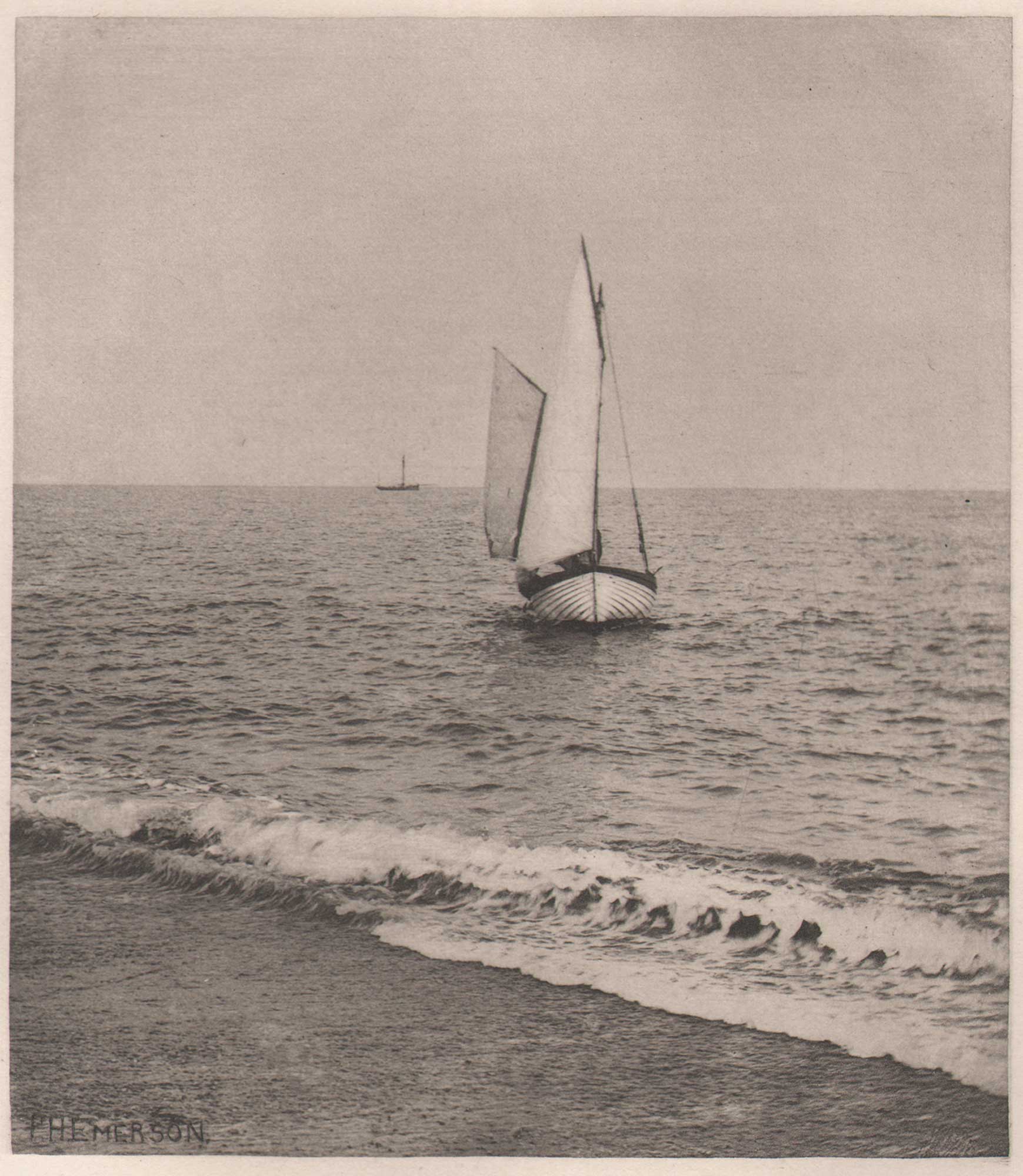
A Suffolk Shrimper “Coming Ashore”
From Chapter XXII: Southwold Shrimpers
“THESE two plates represent shrimpers, or trawlers, as they are called, when, instead of catching shrimps, they go in search of soles. Such boats, though varying in size, are all of similar build. They are open boats, and measure from fifteen to twenty feet on the keel, having a beam of from six to eight feet. They are clinker-built of oak, and copper-fastened, costing on an average a sovereign a foot for the hull, £2 for the rigging and mast, and £5 for the sails. So that a boat measuring eighteen feet, without fishing-gear, costs £25; with fishing-gear complete, the cost would be £60. They are lugger-rigged, having a lug foresail and mizzen, the latter being fastened to an outrigger. The sails were formerly always made of duck, but calico is now frequently used. These sails are worked for one year to get the “dress” out, and in the second year they are steeped in boiling “cutch” (a resinous gum imported from abroad), to preserve them from mildew, which would quickly destroy them if they happened to be left folded and unused for a few days together. Formerly oak-bark was used as a preservative, but it has now become too expensive. We have been told that a suit of sails, if worked throughout the year, is only reckoned to last two years. For ballast they carry strong canvas-bags filled with shingle, which weigh about twenty-eight pounds each, each boat carrying from seven to fifteen of these bags.
January and February are par excellence the months for shrimping, provided the weather be not too cold or rough; extreme cold keeping the shrimps “off, and causing them to lie buried in the sand. The shrimps caught at Southwold are almost always those known as “browns;” rarely do the fishermen have a catch of “pinks.” The fishermen say the browns live in the sand, the pinks on the rocks. The former are the larger, and have a much finer flavour; and never do we remember any shrimps so delicious as those caught in Sole Bay. There is a tradition in Southwold that shrimps are not to be caught during east winds, and accordingly the fishermen never go off after them during the prevalence of those winds.
The tackle required is a shrimp-net and gear, which consists of a strong beam, measuring from thirteen to sixteen feet in length, at both ends of which are fastened iron lute-heads. From these lute-heads two ropes, called bridles, are attached to the shrimp-rope, which bears the whole weight of the tackle, and is fastened to the boat. From lute-head to lute-head, parallel to the beam, runs a rope called the beam-head’s spring. This forms the upper boundary of the net’s mouth. From lute-head to lute-head also hangs a rope called the ground-rope, which is weighted with lead, and hangs down in a semicircle when the tackle is suspended in the water. Thus the mouth of the net is formed by the beam-head’s spring and ground-rope. To these ropes is attached the shrimp-net, which is made by the fishermen themselves of hemp-twine. The net is thirteen score of meshes wide, and measures from sixteen to twenty feet from beam to poke.” p. 123