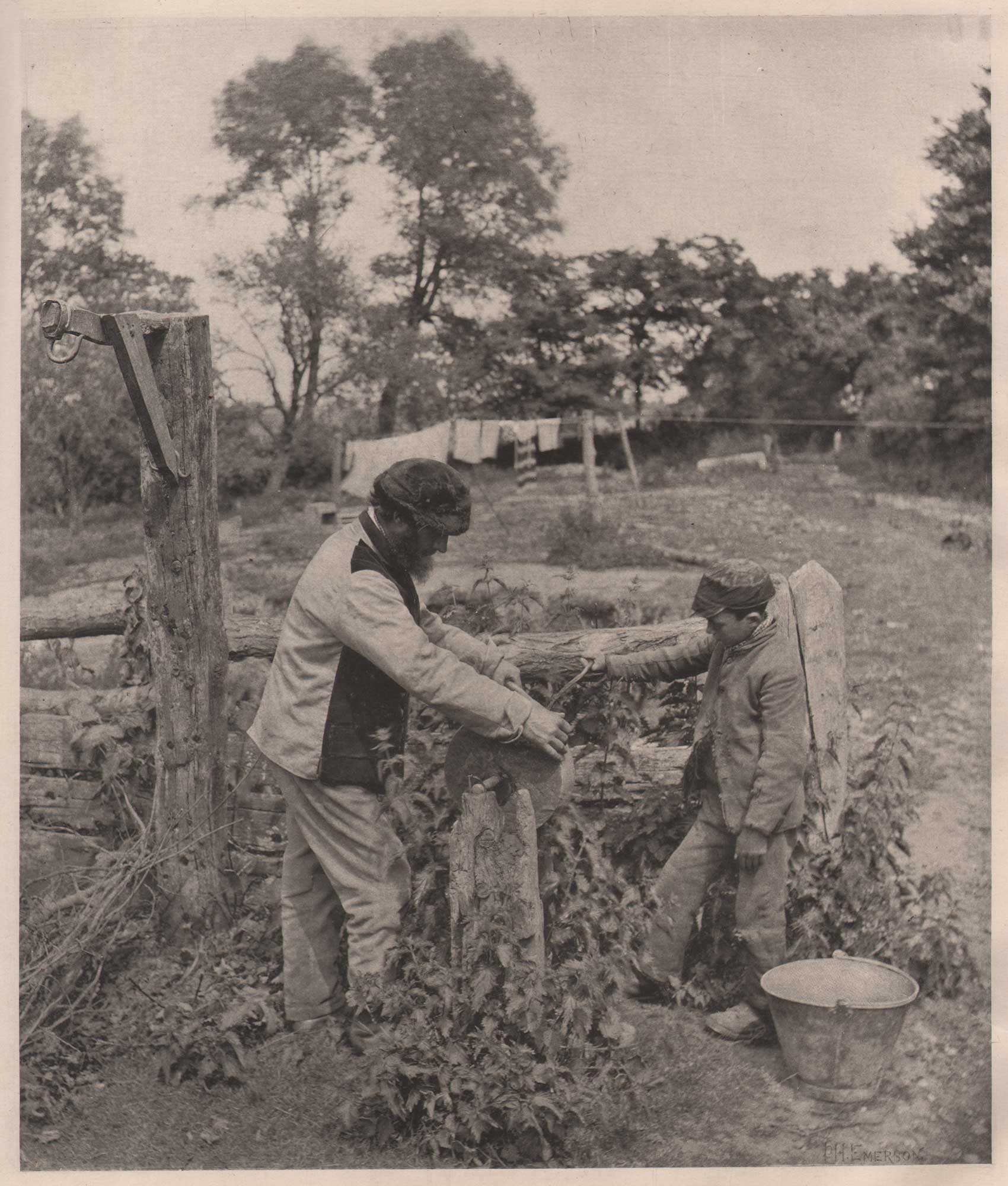
At the Grindstone—A Suffolk Farmyard
“At the Grindstone,” here again the distant trees are deliberately thrown out of focus, and the principal object is sharp. No lens that has yet been made could give chis effect. and it could not be got without throwing part of the picture out of focus. Had the distant elms been sharp the author would have considered the picture a failure.”⎯ P.H. Emerson, Sept., 1889, To The Student
From Chapter XXV: The Grindstone
“A SUFFOLK peasant is here sharpening his “bagging-iron” at the common grindstone, which is being turned by his son. Near the boy is the bucket with which the well-water was brought to make the dry stone work. All around is a crop of nettles, the only produce of the poor soil. To the left rises a pole with a hook, euphoniously called the “hog-pole,” that is, the pole from which pigs are hung to be dressed and cleaned when killed. Beyond the fence stretches the orchard, where the linen is drying and bleaching in the sweet pure air. To the right is a gateway, through which winds a path leading down to the marshes. From the distant hedgerow rise the tall elms, beautiful in form and delicate in touch. Here the peasant is quietly but determinedly sharpening his weapon with which to fight the ever-encroaching bramble, whitethorn, and blackthorn. He does not hurry, but performs his task with quiet, solemn dignity, pressing his weight on the steel blade as the boy with opposing force turns the grindstone.” p. 136
…“The man sharpening the bill-hook is an average specimen of the Suffolk peasant-slow in movement, but still no fool; shrewd, and with a truly Scotch love of money. He once told us of a great struggle he had over half-a-crown. We had taken a plate of stacking corn, he being the topmost figure on the rick-which is a position of honour. He begged hard for a copy of the picture, and we gave him one, which he took into the village to get framed. While it was at the framemaker’s a lady saw it, and taking a fancy to it, offered him half-a-crown for it. He owned it was a tremendous temptation, and, from his account, it must have been a hard struggle; at length, however, vanity gained the day, and he refused the not over-generous offer.” p. 137