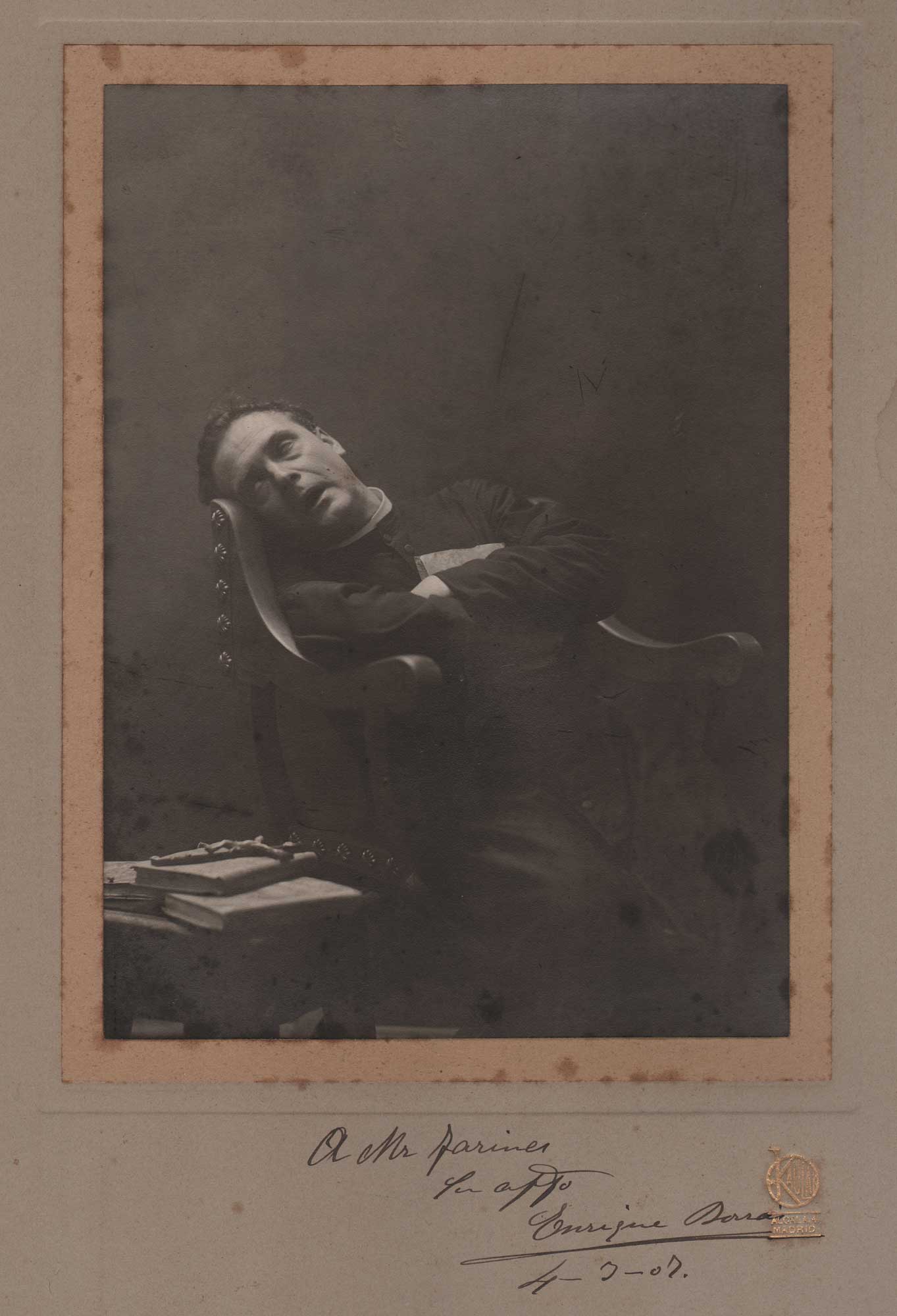
Death of the Mystic: Catalan Actor Enrique Borrás
Catalan actor Enrique Borrás (1863–1957), one of the most important figures in late 19th-century Spanish theater, is shown in the role of Father Ramón in the 1904 play “El Místico”, (The Mystic) during the final scene in which he dies. It was written in 1904 by Santiago Rusiñol, (1861-1931) a Spanish painter, poet, and playwright. The drama in four acts premiered at Madrid’s Teatro de la Comedia (Comedy Theatre) on December 3, 1904.
Inscribed by Borrás in 1907 but most likely taken in late 1904, this studio portrait of the actor is by Antonio Cánovas. Better known as Kâulak, (1862-1933) he was considered by his contemporaries, and later by historians, scholars, and researchers, as one of the great Spanish artists of the first third of the 20th century. Although principally engaged in commercial portrait photography, he’s known today as a member of the first important generation of Spanish pictorialist photographers.
The following is an excerpt on Borrás in his role in El Místico, by critic E. Contreras Y Camargo, writing in the January, 1905 issue of El Teatro: (The Theatre)
“Enrique Borrás, the great actor who, through his extraordinary merits, has conquered one of the top positions in the art world in a very short time, delivers one of his most brilliant performances in The Mystic.
The character of Father Ramón finds a perfect interpreter in Borrás, perhaps because the actor has been able to study the character from real life and certainly because he has managed to identify with his way of being with the intuition and artistic sensibility that characterize this remarkable actor.
Throughout the play he is convincing and moving, but it is in the final scene that his truly prodigious abilities shine.
What causes astonishment is in the third act, when, suffering from heart disease and mortally wounded, he shows the dejection of his body overcome by illness in a heroic struggle with his invincible spirit.
At the moment of agony and death, greater perfection could not be asked for.
That dramatic scene, exquisitely performed by Borrás, deeply impressed the spectators.
Rosario Pino gave the role of Marta all the sensitivity and delicacy that the character requires. Later replaced by Miss Roca, this distinguished artist had the opportunity to demonstrate her excellent qualities, which have earned her the warmest praise.
Working with the dedication that distinguishes the artists of the Comedia, it can be affirmed that all those who have taken part in the interpretation of The Mystic have contributed to offering an excellent overall performance.
Balaguer, in the role of the Bishop, convinced the audience with his impeccable portrayal, his attitude, and his diction. He knew how to give the character the dignity appropriate to the office, without resorting to the emphasis frequent in other actors who have played the role.
Mrs. Caro played the role of the priest’s mother with great skill, bringing something new and unique to the role.
José Vico, as the libertarian Miguel, was restrained and discreet. González gave great prominence to the Bishop’s secretary, and Messrs. Liri, Gonzalvez, Mora, and Sala, in the roles of Father Juan, Don Andrés, the bell ringer, and the poet, also deserved sincere praise. The artistic direction of the Comedia has staged the work with exquisite appropriateness.
The premiere of The Mystic can therefore be considered one of the most important literary events of the current season, not only because it is a work of true merit, but also because it was presented with the honors it deserved.” (p. 8)
Antonio Cánovas del Castillo y Vallejo (Kâulak) : 1862-1933
Antonio Cánovas, better known by his pseudonym Kâulak, was a Spanish photographer, art critic, editor and amateur painter. His uncle was prime minister Antonio Cánovas del Castillo, assassinated in 1897 by an anarchist, hence his use of a pseudonym; the meaning of which is unexplained, although the word appears to be of Basque origin.
Founder of the Kâulak studio in 1904 , his salons were frequented from the outset by Madrid’s high society, including royalty.—Wikipedia (2026)
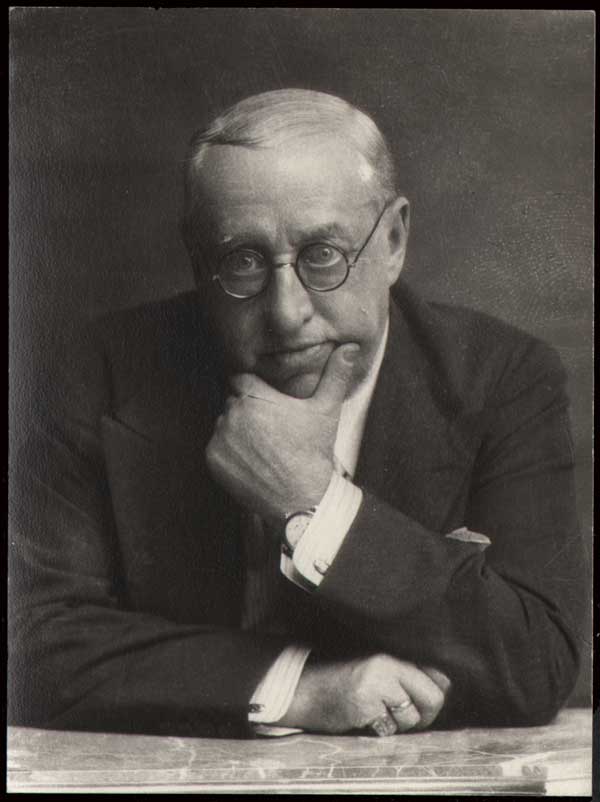
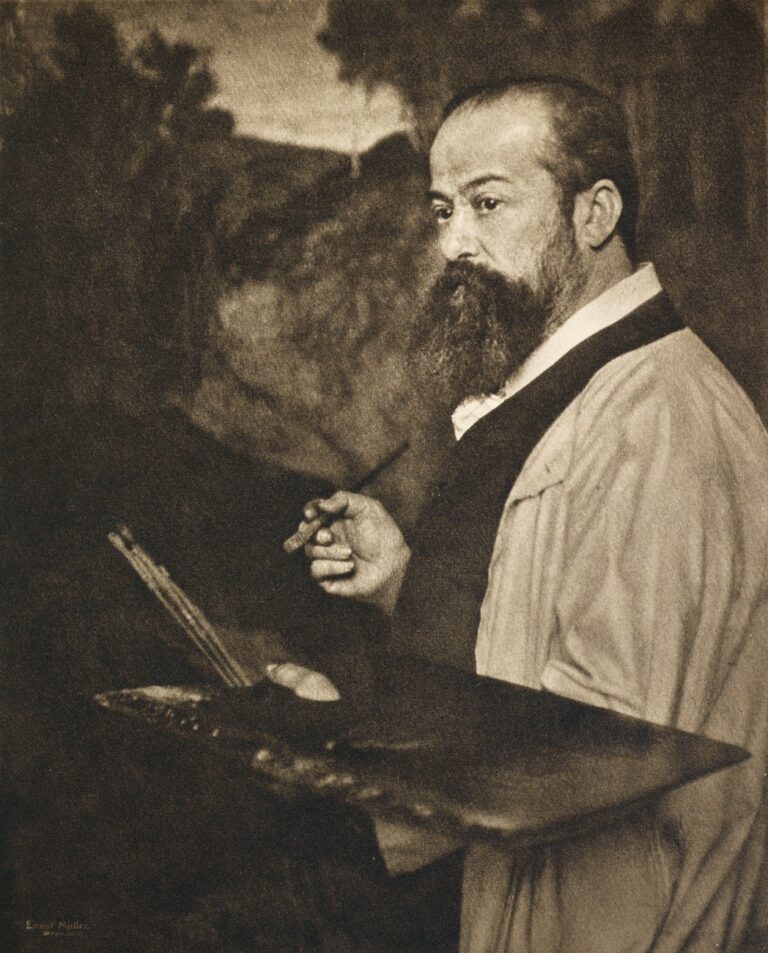
“Kâulak Self-Portrait”, ca. 1920-25, Antonio Cánovas del Castillo y Vallejo, Spanish, 1862-1933, vintage gelatin silver print. Dedicated in blue ink on verso to Spanish photographer Juan Pando Barrero (1915-92): “Contodo afecto a Juan Pando ol cieto de Kaulak” (With all affection to Juan Pando from Kaulak.) From: PhotoSeed Archive
Kâulak’s Legacy, by Juan Miguel Sánchez Vigi (2018-excerpt)
“Kâulak was considered by his contemporaries, and later by historians, scholars, and researchers, one of the great Spanish artists of the first third of the 20th century, and one of the classics of the first generation of pictorialists. He produced an extensive body of work characterized by portraiture, both in his amateur period (1895-1904) and as a professional artist in the gallery (1905-1933). His pictorialist compositions reflect the artistic current of the time, although it was with portraiture that he most fully developed his creativity, a specialty he practiced regularly and studied with interest. From the magazine La Fotografía , between 1901 and 1913, (1.) he energized photographic culture, and for this publication he wrote numerous articles on photographic art and specifically on portraiture, explaining its value compared to drawing and painting, as well as its importance as a genre. He theorized about how to create portraits, establishing composition, lighting, and expression as essential criteria.
Kâulak’s vision of photographic art in general contributes new information to the history of photography, and by extension to the history of art, regarding the perceptions of the artists themselves, which were sometimes ambiguous or contradictory. He divided art into two levels, fine arts and plastic arts, placing photography in the latter because he considered it inferior to architecture, painting, or sculpture—considerations that are certainly controversial, probably due to his training as a painter and, consequently, the influence that painting had on his work.
Regarding portraiture, besides considering it the quintessential genre, he coined two original terms: visuality or photogenicity, and spontaneity or the author’s responsiveness to the model’s behavior. Both terms allow us to understand his working methodology and, by extension, that of portraitists in the first third of the 20th century , based on composition and gesture. Finally, and as a complement to Kâulak’s contribution to the culture of the image, we must point out that during his long career as an amateur and professional, he amassed an extraordinary archive of portraits, largely preserved in the National Library of Spain (negatives and positives), which transcend the topic discussed here and allow for new avenues of research related to society, anthropology, fashion, and psychology, among other subjects.” (2.)
- The publication continued in 1914 under the ownership and direction of Antonio Prast & Rodriquez de Llano.
- Sánchez Vigil, Juan Miguel. 2018. «Kâulak and the Photographic Portrait. Visuality and Improvisation». Archivo Español De Arte 91 (363):269-84.