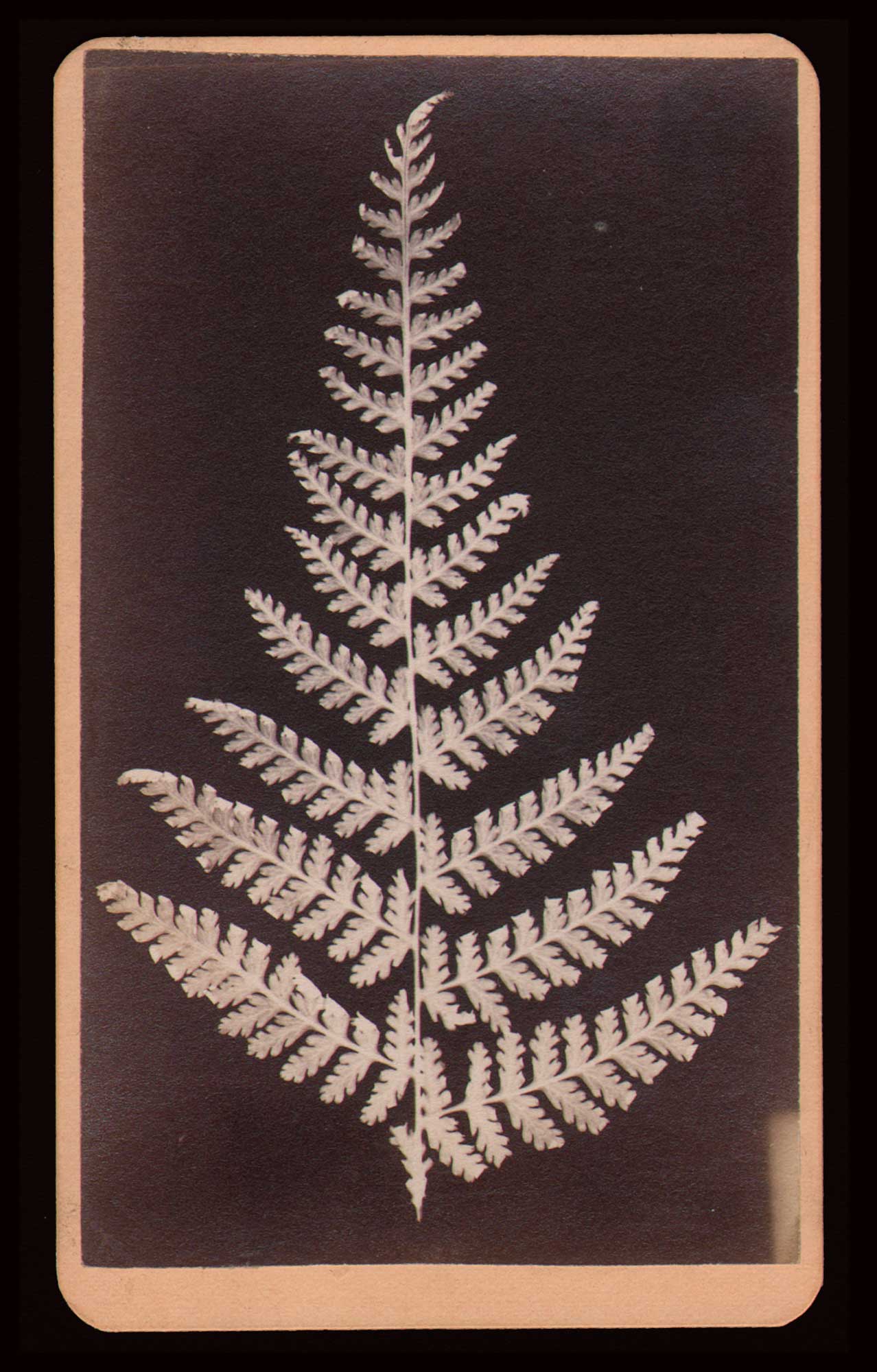
Fern Photogram
Jonas King Patch was a long-time commercial photographer from Shelburne Falls, MA. This cdv photogram, an albumen print of a fern leaf, may have been used as a Memento mori funeral card, and is an uncommon example of his work.
Established about 1850, the Patch Photographic Studio was located on the second floor of the Chapman Block (building) located on the north side of Bridge Street (at Main St.) in Shelburne Falls. (1.)
Jonas King Patch: 1824-1909
The following biography of Patch is from the volume History and Tradition of Shelburne, Massachusetts, published in 1958 by the town of Shelburne, Mass.
JONAS K. PATCH
Article from the Springfield Republican, February 22, 1903: “Half-Century of Photography.”
From our special correspondent, Greenfield, Saturday, February 21 : “His Collection of Pictures and Sketch of his Life.” Jonas K. Patch of Shelburne Falls, a fine type of the old-school gentleman and for over half a century a photographer at Shelburne Falls, is one of the few surviving photographers who have practiced the fascinating art from its earlier beginnings to its present development. In his studio, which by the way, he has occupied continuously for over fifty years, is a collection of daguerreotypes which take one back to the early days of photography. Dr. J. G. Holland, who was lecturing at Shelburne Falls many years ago, sat for Mr. Patch, and his likeness, old-fashioned stock and all, is in the collection. Hiram Powers’ statue of the Greek Slave, which was exhibited around the country more than half a century ago, was photographed by Mr. Patch, and is in the collection. Dr. E. H. Chapin, the noted Universalist divine, is there along with many past worthies of Shelburne Falls. Nathaniel Merrill and Henry Campbell, members of the famous Shelburne Falls band of former generations; William C. Perry, first landlord of the Shelburne Falls House, who came from Brattleboro; William Sherwin, the first jeweler the village had ; A. B. Clark, principal of Franklin Academy, and others look benignly down from the daguerreotypes in the case, the impression apparently untouched by the hand of time and as bright as ever. A copper plate was used on which the photographer spread a deposit of silver. In the studio are patent ambrotypes, with double glass, balsam packed between. The contrast between these earlier methods and those followed by photographers today can readily be seen from the work in the studio.
Mr. Patch was born at Hawley seventy-eight years ago, the son of William Patch, a native of Groton, who, after residing in Hawley for several years, went to Charlemont in 1830, where he passed the remainder of his days. Mr. Patch went to North Adams as a young man and began as a clerk in the drygoods store of Smith and Homer. Thomas Johnson, a designer in the print works, had a camera in which Mr. Patch became interested, and finally a partnership was formed, and the two set out on a tour through the larger towns of Vermont, taking pictures in each place as long as business continued good. It was at Burlington that the Greek Slave was on exhibition when the photograph in the collection was taken. Mr. Johnson’s resources failed, and for that reason he proposed the partnership be dissolved. His partner bought out the business while they were in Brandon in 1850.
Mr. Patch went to Shelburne Falls, opened the studio in the rooms he is still occupying to this day, although additions have been made to the rear. None of the men in business then in the village are alive save Gilbert F. Mitchell, who retired from active business several years ago. At the old stand the sign of J. K. Patch hangs out as it has for many tears, and the treads on the stairs leading to the studio bear witness to the numbers who have faced the camera, getting good work, courteous treatment, and leaving with the kindest of feelings for the genial, dignified, and kindly man and his son, Henry, who is associated with his father. (p. 205)
- Excerpt: History and Tradition of Shelburne, Massachusetts, published in 1958 by the town of Shelburne, Mass. p.30. It’s unclear if the Chapman Block building, dating to 1835, is still standing.