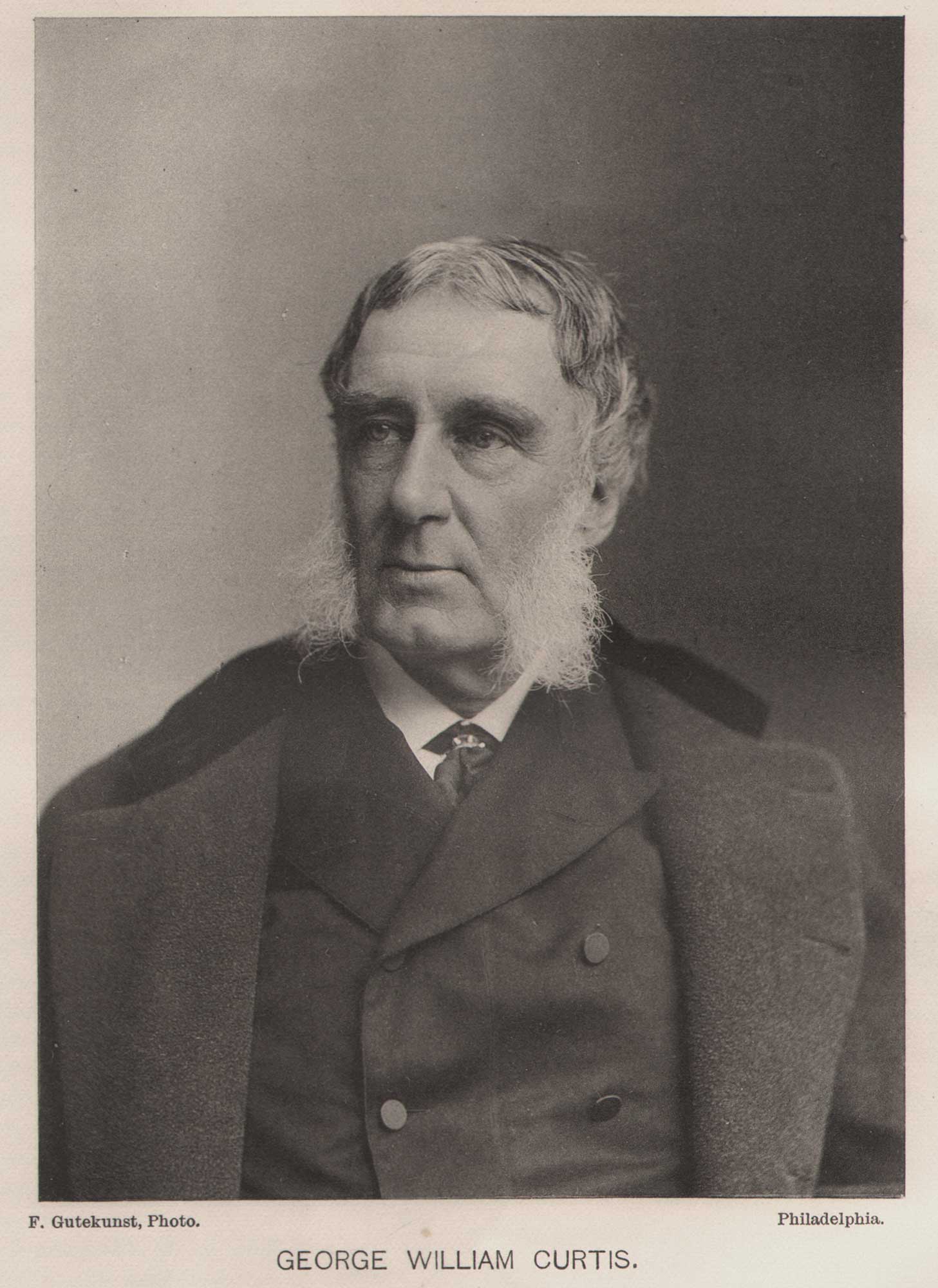
George William Curtis
Editorial comment for this plate:
GEORGE WILLIAM CURTIS.
WE have real pleasure this week in presenting our readers with the portrait of George William Curtis, “that fearless knight of reform.” as he has been called. In the Christian Union of July 18th appeared a portrait of Mr. Curtis and an accompanying editorial from which we reprint the following extract. Nothing could be more fair:
It would be unjust to George William Curtis to call him the American Addison, for this would deny him that individuality of character which is always the trait of a true man, distinguishing him from all masked imitations. Mr. Curtis is always graceful; he wears grace not as a garment, but it is bodied forth, as the simple expression of a soul that is gracious. But it always is, if it does not always appear, the grace of an athlete. His chosen sobriquet, “The Easy Chair,” does him scant justice. Whether he wrestles or reposes, he is equally at ease, and he throws an antagonist in combat as gracefully as he chats with a friend. As an essayist he is the lincal literary descendant of Addison, and Steele, and Lamb, though he is as little like either as they are like each other. As an orator he is America’s most finished and faultless speaker, with the perfect form of an Edward Everett or a Wendell Phillips, but inspired with a more intense earnestness than the former, and restrained by a greater sobriety of judgment than the latter. His political editorials have put “Harper’s Weekly” at the head of our political periodical literature, by a strength without passion, and a style without artifice.
But it is as a man that George William Curtis will be remembered after his writings have been forgotten; for his pen has been so busy serving the present time that it has had no leisure to work for the future. His courageous honor has made him the leader and almost the creator of that body of independents who have put National honor above party victory, and who, by daring to be independent of political platforms, have effectually rebuked those politicians who have dared to be independent of moral principles. As a political leader his place should have been in the Senate of the United States, where, indeed, he might have been had be been less worthy to be there. Though he can no longer be called a young man, whether life is measured by years or deeds, he is the leader of the young men, who gladly claim him as their own; for his heart never grows old.
The portrait was made by Gutekunst, of Philadelphia, in that series of eminent Americans, of which we have already had the pleasure of showing our readers two or three conspicuous examples. They are all models of portraiture, worthy the study of the best professionals. The excellent phototype reproduction was also made by Mr. Gutekunst.
George William Curtis (February 24, 1824 – August 31, 1892) was an American writer, reformer, public speaker, and political activist. He was an abolitionist and supporter of civil rights for African Americans and Native Americans. He also advocated women’s suffrage, civil service reform, and public education.—Wikipedia (2026)