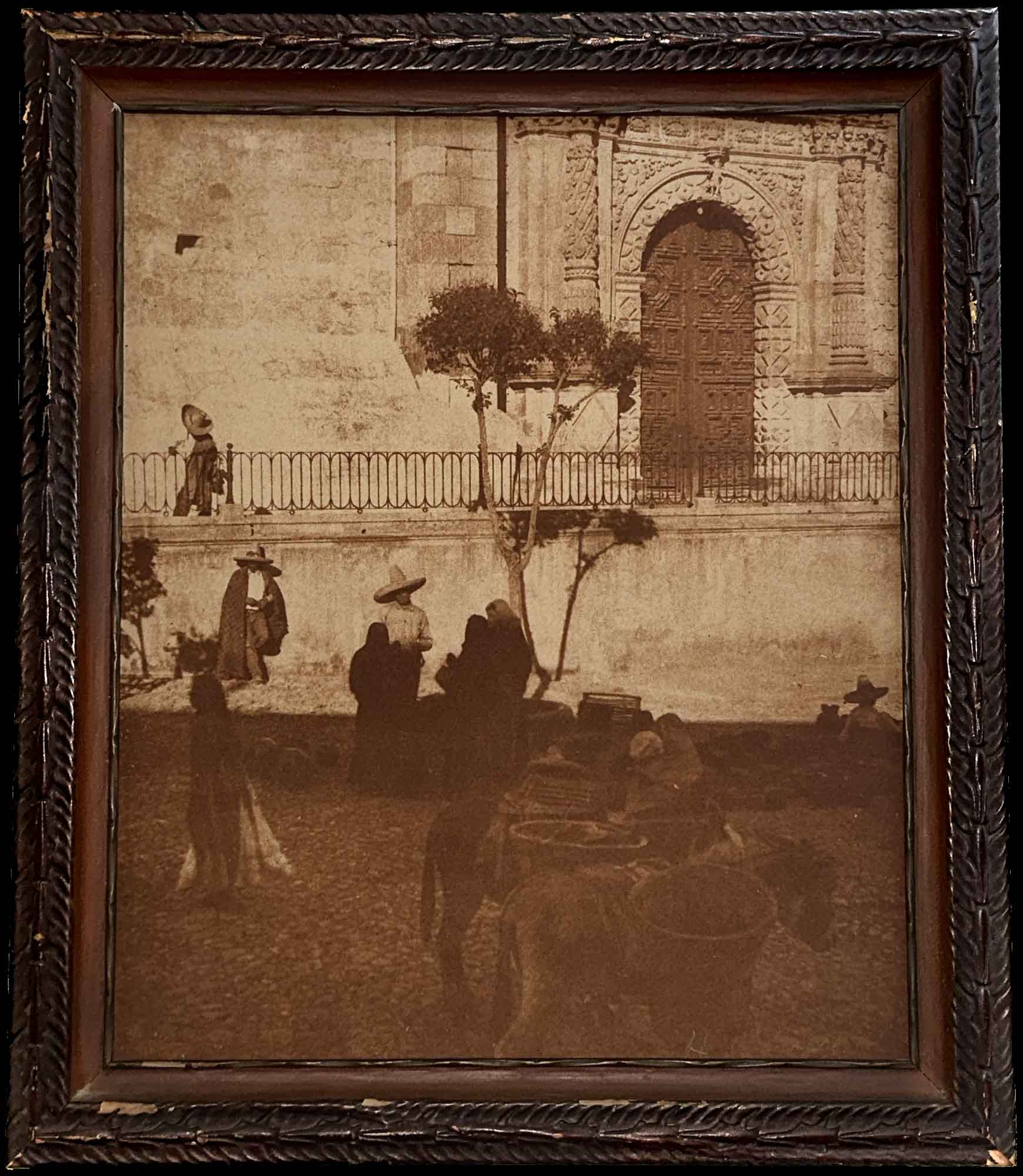
Pottery Sellers by the Church Door
Sellers of various forms of pottery are seen with their wares arranged on the ground in front of the side entrance to the Cathedral of Zacatecas in the city of Zacatecas in North Central Mexico. At foreground are two burros standing in the shadows, each carrying large baskets on their saddles used to transport the pottery. The work is presented here in its original frame, ca. 1915-20 without glazing.
Timeline: Henry Ravell: 1864-1930
1864: Born January 2 in Wolcott, in the state of New York to Charles Henry Ravell (1833-1917) and Cornelia Dudley Ravell. (1840-1908)
1880: U.S. Census lists Ravell, 17 years old, living in Lyons, New York with the profession of photographer. At this time, he worked for his father Charles Henry Ravell, (C.H. Ravell professionally) who operated a commercial portrait studio on Canal Street in Lyons beginning in the 1860’s.
1882: An early reference to Ravell as a painter is printed as a short notice in The Democrat and Chronicle newspaper of Rochester, New York from November 26: “Henry Ravell, of Lyons, was in this city last night, on his return from Medina, (New York-editor) where he disposed of two of his latest paintings for $70.”
1883–1889: Between the ages of 19-25, depending on various published accounts, the photographer moved to Mexico after becoming an agent for Ten Eyck & Co. of Auburn, New York. The firm specialized in producing enlargements of photographs better known today as “Crayon or Pastel Portraits”. Using a solar enlarging camera, these so-called “parlor portraits” were typically made using copy negatives from an original photograph projected onto light-sensitive photographic papers and then embellishing the resulting print using pastels, monochrome or colored pencils. In 1876 Ten Eyck advertised: “common photographs into larger sizes for framing.” … “Plain Copies, and Fine India Ink, Water Colored and Oil Portraits.” More background found on process here.
1888: Before arriving in Mexico, Ravell most likely worked as a photographer in Minnesota alongside his father Charles Henry Ravell. From Langdon’s List of 19th & Early 20th Century Photographers, a listing for a studio in St. Paul, Minnesota: Ravell, Charles H., photographer, res 239 Selby Ave., St. Paul, MN (1888) City Directory. (see 1906 citation below)
1890: It is unclear if Henry came and went to Mexico from Minnesota, or if later published accounts of him were erroneous. Advertisement in The Saint Paul Globe newspaper on May 13 gives a possible clue as to when Henry Ravell may have struck out for Mexico, assuming he had been working for his father in the capacity of a retoucher at his St. Paul studio: Wanted, first-class re-toucher, at Ravell’s Photo Studio-: Western and Selby. (studio that year was located at 168 Western Ave. N. and the family lived at 376 Selby ave. Note: The Minnesota State Historical Society Directory of Minnesota Photographers lists the senior Ravell running his Western Ave. photo studio from 1890-2.
1895: The Minnesota State Census lists Henry Ravell’s occupation as “artist” while living with his parents and younger brother, Charles Ravell Jr. (whose occupation is newspaper advertising) in the city of St. Paul. Interestingly, his father Charles Ravell, now 61, lists his occupation as “Dining Hall Prop.”- Proprietor?) Note: the 1893-4 “Dual City Blue Book” for St. Paul home addresses has only two separate listings for C.H. Ravell and C.H. Ravell Jr. at 420 Selby Ave., but none for Henry Ravell.
1905: An early published example of Ravell’s, titled An Ox Cart, appears as an elaborate mounted and tipped halftone in the luxury portfolio publication Art In Photography, issued by the Photo Era Publishing Company of Boston.
1906: An article on The Art of Photography in the July issue of Bob Taylor’s Magazine mentions Ravell had previously worked in Minnesota: “Henry Ravell, after years of work in Minnesota, now confines himself exclusively to Mexican studies.”
1907: From the volume: List of Photograph Dealers with Index by Countries: published by The Massachusetts Library Club, 1907: Henry Ravell, Care W.W. Blake & Co., Gaute 6, Mexico City, Mexico. The volume also lists Ravell’s photographs of “Architecture and general views” (from Mexico) available through the Detroit Publishing Co. (p.16: Index by Countries)
1908: “Some Mexican Churches” From Photographs made by Henry Ravell with text by Lockwood De Forest published in the Century Illustrated Monthly Magazine for May. De Forest concludes the article by giving some excellent early background on the artist:
So much interest is being taken in the artistic development of photography that something should be said about Ravell and his work. His father was a photographer in one of the photographic enlargement firms at Auburn, New York, (1.) which in the seventies and early eighties was the most important center of this industry in the world. Ten Eyck & Co., the largest of the ten principal concerns, did a business of $75,000 a year, and had two hundred agents scattered nearly all over the world. even as far as Australia. They employed not only a staff of photographers but of artists, and were prepared to furnish portraits from eight by ten to life-size in photograph or any other medium, including oil. Some of our successful artists of to-day began there. Ravell, after being his father’s assistant as a boy, studied water-color painting with Henry W. Ranger, and twenty-five years ago was sent to Mexico as an agent. he has been at work there ever since, painting a little, but mainly photographing. He has had to work everything out for himself. His early training has given him exceptional skill in developing different printing processes, which he has brought to great excellence. Last summer he started experiments in color-printing. His process is simple. Instead of introducing colors on the negatives, as in the lumière process, he is using the colors in the sensitizer of the printing paper. The specimens he has sent me are printed in three or four colors. Each print is finished, recoated all over with the sensitizer with the next color, and again printed. This is done for each color separately, the black print coming last, as in the regular color-printing process. (pp. 28-29)
1909: January 2: Review of his work appears as part of the Fifth American Photographic Salon that opened in Pittsburgh, PA in the pages of The Index, Pittsburgh’s Illustrated Weekly: “The most wonderful and striking collection contributed by one man is that of Henry Ravell, of Mexico. All his pictures are in multiple gum or oil and, though many will doubt that the marvelous coloring was obtained by a purely photographic process, this is absolutely the case. “The Street of the Arch,” reproduced on this page, gives an idea of the strength of his composition, but conveys no idea of its wonderful vividness.” (p. 8)
– Ravell was pronounced “King of the Photographers” in the pages of the Pan-American Magazine for April, along with published examples of his work- “Photo Graphic Art Studies” :
We take off our hat to the true artist in any profession, law or letters, medicine or photography. If a man devotes himself conscientiously to the achievement of an ideal in his work, it is but just that he should expect the praise of his fellow men if he succeeds. And if there ever was a genius of photography, one whose work reveals the master hand of the true artist, it is Henry Ravell, of Cuernavava, Morelos. He has lifted colo-photography from a purely mechanical process to the Olympian heights of Ara, and he has been content to overlook the commercial phase of his work, which might have made him a rich man in a more populous city of the world, in order that he might have as the background for his beautiful lines that most picturesque of quaint old towns, Cuernavaca. And yet fame has not permitted Henry Ravell to live out his quiet span in that little town unknown to his fellow artists. Cuernavaca is coming to be a Mecca for the craft. and each carries away pictures that are veritable dreams of art, embellished with every color and tint of the rainbow, and more true to their subjects than any work of landscape or portrait painters. George Lockwood de Forest,(sic) perhaps the foremost of American landscape artists, was among the first to sing the praise of Ravell, and quite lately J. C. Nicoll, president of the American Water Color Society of New York, added his tribute to that of others who recognize in Ravell the king of photographers. (p. 306)
1911: In the guidebook Terry’s Mexico: Handbook for Travellers under the heading Photographs, Views, Colored Post-cards for Mexico City shops, the following notice appeared: “The beautiful color-photography work by H. Ravell, and the excellent views by Cox, by Scott, and by Waite make artistic souvenirs: on sale at the Sonora News Co. store.” (p. 242)
1914: Spread in the February issue of The Century Magazine titled Old Churches In Mexico featuring four, full-page halftones of gum prints by Ravell, including one in Marfil known as the Templo De Marfil De Arriba, or the “Church up Top”.
-Ravell moves back to the United States from Cuernavaca, most likely a result of the ongoing Mexican Civil War, (Mexican Revolution) and settles in Los Angeles, California. Later, in 1921, an exhibit references him as being from Laguna Beach, part of the Los Angeles metropolitan area. (Death Certificate states he resided at same LA address for 16 years)
1916: Eight-page spread of full-page halftones made from gum prints of Mexican scenes published in the December issue of Harper’s Magazine titled Vanishing Mexico: A Series of Pictures By H. Ravell”. Now residing in California, the artist most likely supplied the following lines printed with the spread, although it is not signed:
“A rude hand has been laid upon Mexico. Under the stress and upheaval of revolution the ancient culture, old-time customs and picturesque life are breaking down. These pictures of Mexican scenes are typical of its old-world dignity and beauty, but they present a Mexico that is slowly vanishing.” (p. 97)
– A short biography of Ravell in the 1978 volume Pictorial Photography in Britain 1900-1920 states he had left Mexico by 1916 after rebels destroyed his Cuernavaca studio and includes other background on his career: “In about 1885 he travelled to Mexico, where he became the first artist to obtain any national recognition. He also used photography in his efforts to capture the vanishing way of Mexican life. In 1908 a number of his painterly gum prints were exhibited at the Thurber Gallery. In 1912, he and several other artists were commissioned by the Mexican Government to portray the country of Mexico, some of the resulting work was sent to America. In 1916 an article entitled “Cathedrals of Mexico”, illustrated by his work, was published in Harper’s magazine. About this time he left Mexico, almost as a refugee. His studio in Cuernavaca was destroyed by rebels. He moved California where he began to photograph near Carmel and settled at Santa Barbara.” (p. 83)
1917: Nine, full-page halftones of gum prints of Mexican scenes, including the frontis, by Ravell reproduced in the volume Diplomatic Days by Edith O’Shaughnessy, published by Harper & Brothers. Shaughnessy collected and displayed some of Ravell’s photographs in the American Embassy in Mexico. She was a journalist, biographer, film screenwriter and wife of United States Chargé de Affairs in Mexico, Nelson O’Shaughnessy. This took place during the early years of the Mexican Revolution where she was both a witness and a participant in Mexican political affairs during the presidency of Francisco I. Madero and Victoriano Huerta. (Wikipedia)
1919: Exhibition of 93 photographs displayed at the Albright Art Gallery in Buffalo, New York in from February 22-March 31.
PHOTOGRAPHS BY H. RAVELL AT THE ALBRIGHT ART GALLERY
THE collection of photographs by H. Ravell—which was on view in the gallery during the last week in February and all of March—is very unique and valuable. These photographs are technically known as gum-prints and have all the painter’s quality in their execution. They do not impress one as photographs but rather as work directly from the artist’s brush. The photographs were made by H. Ravell who is now in Santa Barbara. Many of the pictures were taken near Carmel, California, a seashore of much variety where the fantastic cypress trees with their twisted dramatic forms produce wonderful compositions against sea and sky.
Gum-printing is a method of fixing pigment to paper, the image being given by a photographic negative, and the lights and darks by the depth of printing. The materials used are paper, gum-arabic, or gelatin bichromate of potassium, and pigment. The paper is covered with a solution of the three ingredients and when dry is exposed to the light in contact with a negative. It is then soaked in water until that part of the pigment not fastened to the paper by the action of light is washed away.
This is but a short description of the remarkable exhibition of photographs shown at the Albright Art Gallery. It was seen by many art lovers and appreciated especially by all of those interested in artistic photography.
(p. 67: Academy Notes: The Buffalo Fine Arts Academy: Albright Art Gallery: Buffalo, New York: vol. XIV: Jan.-Oct. 1919)
– Photographs by H. Ravell at the Cleveland Museum of Art: November 16-December 5. According to the CMA database, the show was extended from December 30-January 10, 1919.
– January: Exhibition of gum prints at The Art Institute of Chicago. From their Bulletin: “The Ravell photographs, of Mexican and southern California subjects, have already been shown at Pratt Institute and at the Cleveland Museum of Art. Mr. Ravell lived for many years in Cuernavaca, Mexico. He has obtained remarkable results with gum printing, and many of his prints look like the work of a painter.” (February: Vol. 13, No. 2, p. 26)
– Exhibit of his gum prints shown at the Long Beach Public Library from February 1-29. The American Art Annual for 1920 also lists the artist as showing gum prints between 1919-20 at the Friday Morning Club, located at 940 S. Figueroa St. in Los Angeles.
1920: U.S. Census notes Ravell living in Laguna Beach, CA with his profession listed as Gum Printer and Industry being Photography.
1930: Henry Ravell dies as a result of an apoplectic stroke with complications on January 20th. His death certificate lists him as single with the occupation of artist and residing at 1221 S. Kennore (sic-Kenwood) in Los Angeles, California. Cremated, he is later interred in the family plot at Glenside Cemetery in Wolcott, New York.
(Note: a 1929 address for the artist printed in The American Annual of Photography lists it as 1221 So. Kenwood Ave. in Los Angeles.)