Smelting on the River Blythe {Suffolk}
“Smelting,” distance out of focus, principal object not sharp.” ⎯ P.H. Emerson, Sept., 1889, To The Student
From Chapter IX: Smelting on the River Blythe
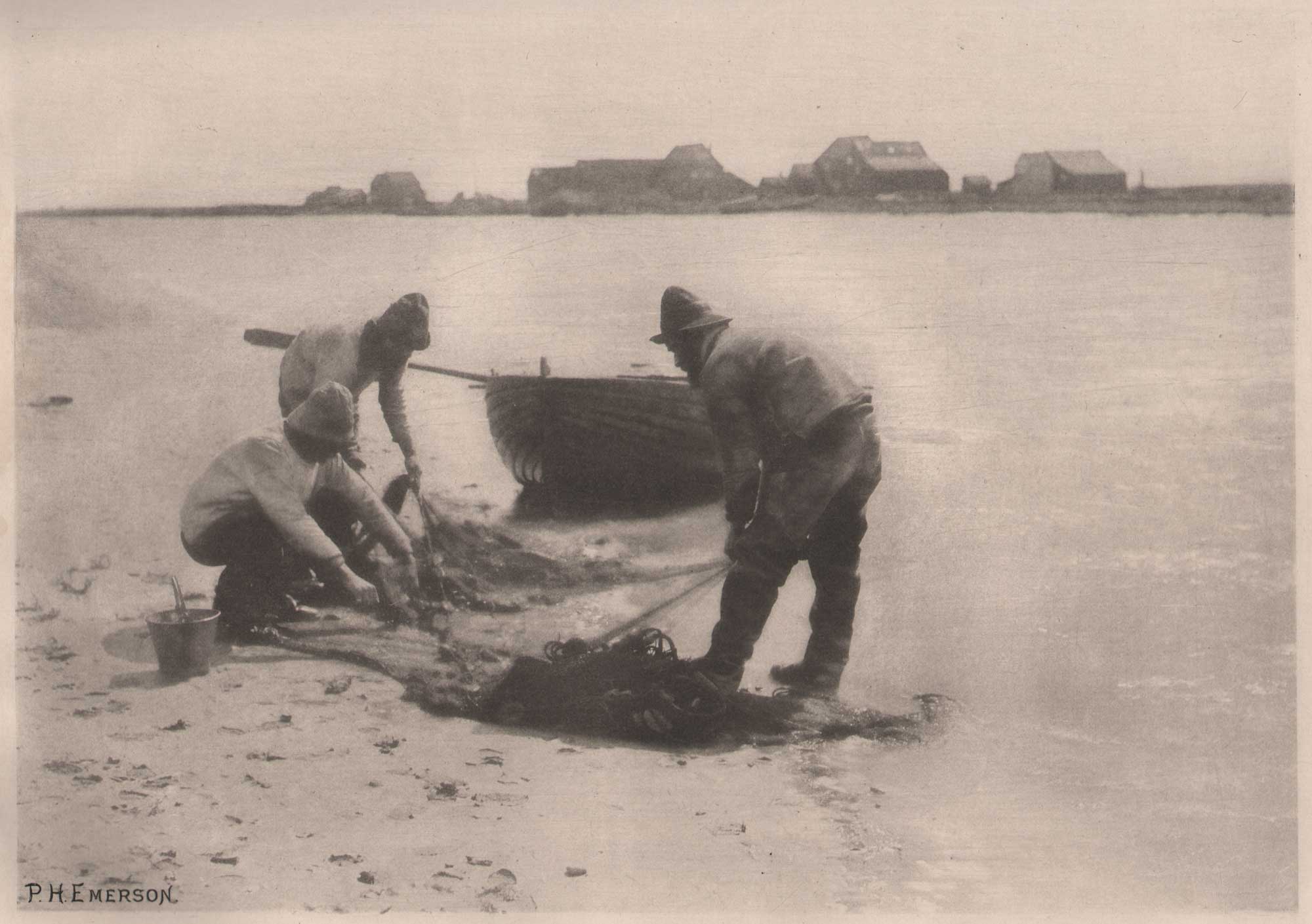
“DURING the cold bleak months of early spring the smelters are daily at work, fishing from the harbour mouth up to Blytheborough. The earliest fishermen begin in February, but March and April are considered the best months here. The net used is locally called a ” draw-net” the mesh of which is a sprat-mesh. To the top of the net are fixed corks, and to the bottom leads, ropes being attached to either end. These nets are valued at about £4 each. Old hands inform us that smelts “always strike one way,” and that is “from the south’ard,” and that they enter the river to spawn in a flood-tide and leave it with the ebb; therefore smelting must be done in a flood-tide, as in an ebb you “won’t get none.” Two, or at most three, men work one net. Beginning, we will say, at Blackshore, two smelters will get into the boat as the tide is on the turn or while it is still flowing, and rowing straight across the river, they will throw out the net as they go, while the third man stays on the shore with one of the end-ropes in his hand. When the net is short, the men in the boat row along the opposite bank, while the man on the shore goes “plouncing” along through the soft mud, protected by his tall sea-boots, pulling at the rope, which passes over his shoulder, thereby towing one end of the net while the boat tows the other. Having scoured a portion of the river in this manner, the two in the boat row over to their companion, who again stands still until their boat grounds, then, hastily pulling her up, they jump ashore, and all three haul at the ropes of the net. Slowly the semicircle contracts, and nearer each haul come the corks, till at length they lie at the feet of the fishermen.
Then with a quick movement, some standing in the water, others in the mud, they draw the net on to the yellow sands, and through the dripping mass of black netting can be seen the glitter of the silver fish. The men now open the net, and, throwing aside the mud and weeds, they pick out the shining, sweet-smelling smelts, and place them in a basket or pail, as shown in our plate. This delicate fish varies in value, the fisherman getting from sixpence to four shillings a score, according to the season, the average price obtained being half-a-crown a score. On a “good day,” therefore, a fisherman can earn a good sum of money.” p. 74