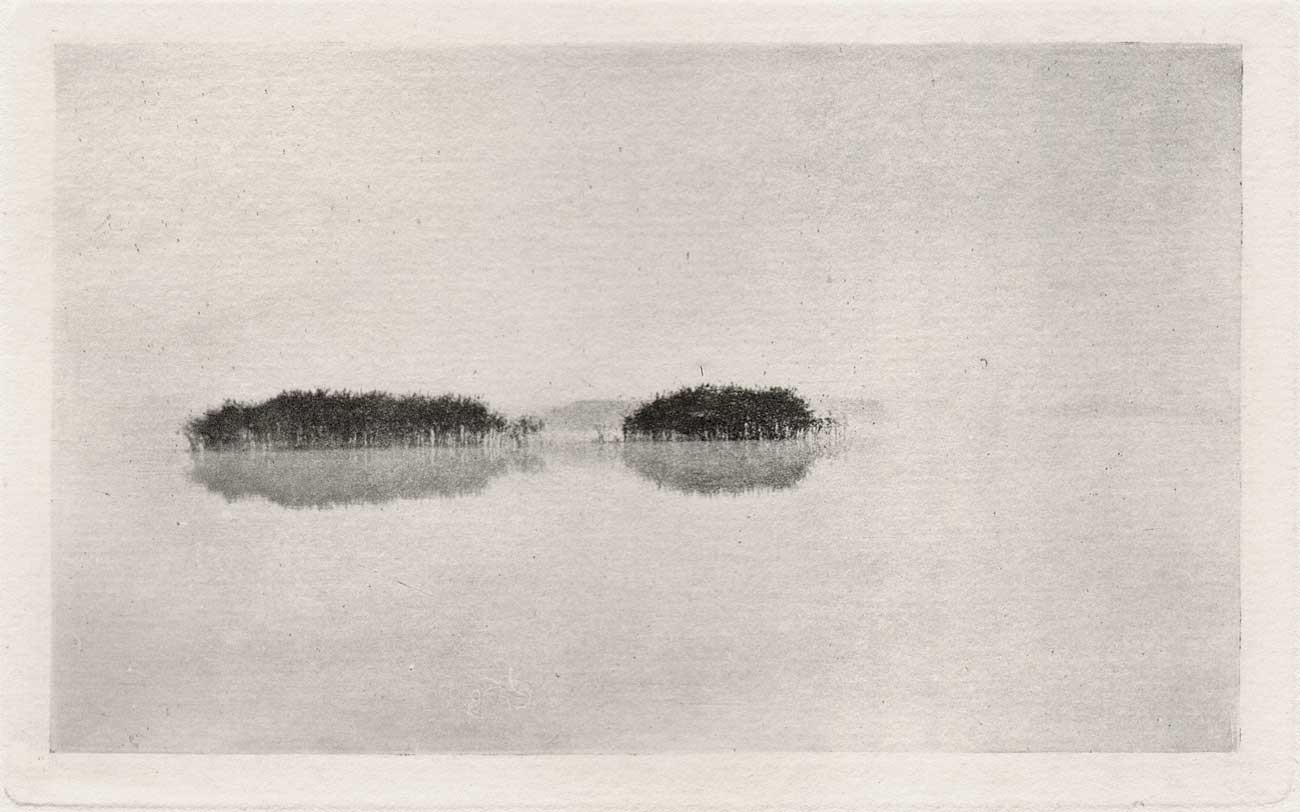
The Lone Lagoon
“Its sixteen photo etchings are delicate, lambent, and elegiac. The landscape is lovely but unreachable, wrapped in mist or touched by frost, unpopulated and nearing abstraction in its most remarkable image, The Lone Lagoon. Virtually a Chinese ink painting or a monochrome abstraction, this image presents two islands across a wide expanse of water as if they are a mirage or a dream.”—Ellen Handy: Imagining Paradise: The Richard and Ronay Menschel Library at George Eastman House, 2007. p. 193
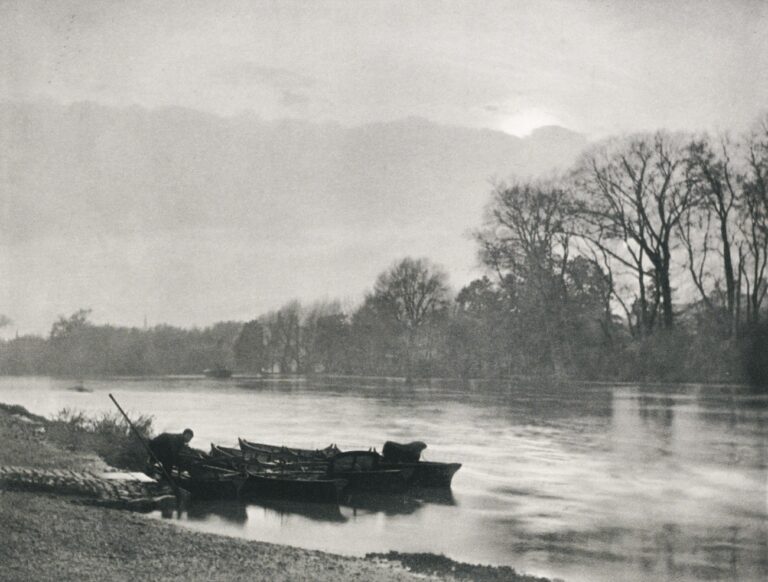
Much has been written of P.H. Emerson’s final volume of masterful photographs reproduced in photogravure titled Marsh Leaves, published in 1895. The source material came from 16 earlier plates taken by the artist in 1890-91 during his one-year cruise aboard the wherry Maid of the Mist while navigating and exploring the Norfolk and Suffolk Broads. Beginning in the late 1880s and during this period he was also learning the art of photoengraving from Walter L. Colls. His 1893 volume On English Lagoons would be the first illustrated with plates etched and printed by himself, followed by these more refined and nuanced East Anglian scenes translated into delicate photogravure impressions.
“Emerson’s final photographic book Marsh Leaves was published five years after he renounced the belief in photography’s fine art status. In many ways paradoxically his most artistic volume, it is comprised of his most personal writings, only obliquely linked to his most exquisite images of pure landscape. Self-consciously composed as a conclusion for his decade in the photographic arena, it is his final statement of art and life, as well as a farewell to the private pictorial sphere that East Anglia had been to him.“—Ellen Handy: Imagining Paradise: The Richard and Ronay Menschel Library at George Eastman House, 2007. p. 193