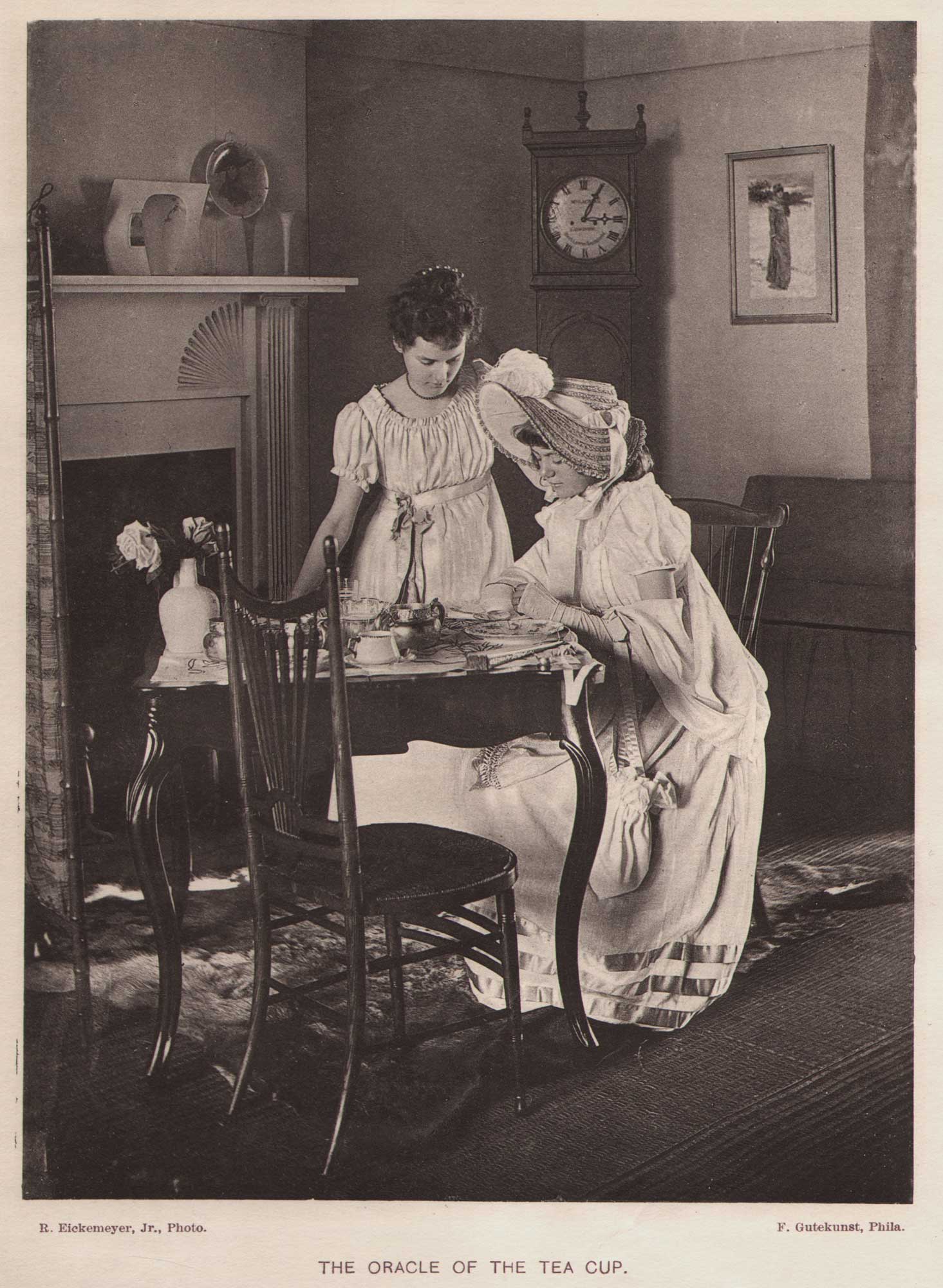
The Oracle of the Tea Cup
Editorial comment for this plate:
THE ORACLE OF THE TEA-CUP.
‘THERE is inherent in every human being a desire to know what lies behind the veil which hangs between the present and the future. We are all aware of the extent to which this art of divining was carried in early times. We have read of the famous oracles of Greece, with their ambiguous answers, and of the College of Augurs, which flourished later in Rome,
In this practical age we try sometimes-“just in fun,” as we say-our fortunes at Hallowe’n, and hope there may be some truth in the rosy prospect foretold us. What is more natural than that the two young girls in our frontispiece should seek to draw from the oracle of the tea-cup an answer favorable to some momentous question.
The picture is from a negative by Mr. Eickemeyer, Jr., of Yonkers, N. Y., who has contributed so many beautiful frontispieces to this magazine.
Rudolf Eickemeyer Jr.: 1862-1932
Eickemeyer was an American pictorialist photographer, active in the late 19th and early 20th centuries. He was one of the first Americans (along with Alfred Stieglitz) to be admitted to the Linked Ring, and his photographs won dozens of medals at exhibitions around the world in the 1890s and early 1900s. He was famous among his contemporaries for his portraits of high-society women, most notably model and singer Evelyn Nesbit. Eickemeyer’s best-known photographs are now part of the collections of the Smithsonian Institution.
Life: Eickemeyer was born in Yonkers, New York, in 1862. Though widely travelled, he would live in Yonkers his entire life. Eickemeyer’s father had fled to New York in the early 1850s following political upheavals in his native Bavaria, and became a noted inventor. His firm, Osterheld and Eickemeyer, invented a hat-blocking machine that revolutionized the hat industry, and made a number of advancements in electrical lighting.The younger Eickemeyer joined his father’s firm as a draftsman in 1879.
Eickemeyer first became interested in photography as a means to help document his father’s inventions. He purchased his first camera, an “abnormally thick” Platyscope B, on February 2, 1884, and took his first photograph, an albumen print of his sister, the following day. Immediately drawn to the camera’s artistic potential, Eickemeyer considered pursuing a career as a photographer, but his father disapproved, so he continued working for his father’s firm.
Eickemeyer won 11 medals at the Yonkers Photo Club’s Lantern Slide Exhibition in October 1890, and over the subsequent decade, he collected over a hundred medals at exhibitions and salons around the world. After his father’s death in 1895, he left his father’s firm and joined the Carbon Studio in Manhattan,which specialized in portraits, and gained a reputation for photographs of high-society women. That year, he and Alfred Stieglitz became the first Americans admitted to the English pictorialist society, the Linked Ring. While Eickemeyer’s work appeared in Stieglitz’s Camera Notes, he was unimpressed with the rise of the Stieglitz-led Photo-Secession early in the following century. He was one of four Links who never joined the Photo-Secession, the others being F. Holland Day, Margaret Russell Foster, and C. Yarnall Abbott.
In 1900, Eickemeyer joined the New York Camera Club, and exhibited 154 frames in his first one-man show at the club. That same year, he published his first book, Down South, and was appointed art manager of the Campbell Art Studio on Fifth Avenue, with which he would remain intermittently until 1915. It was while at Campbell that Eickemeyer conducted his famous shoot of New York model Evelyn Nesbit. -Wikipedia (2024) continues…