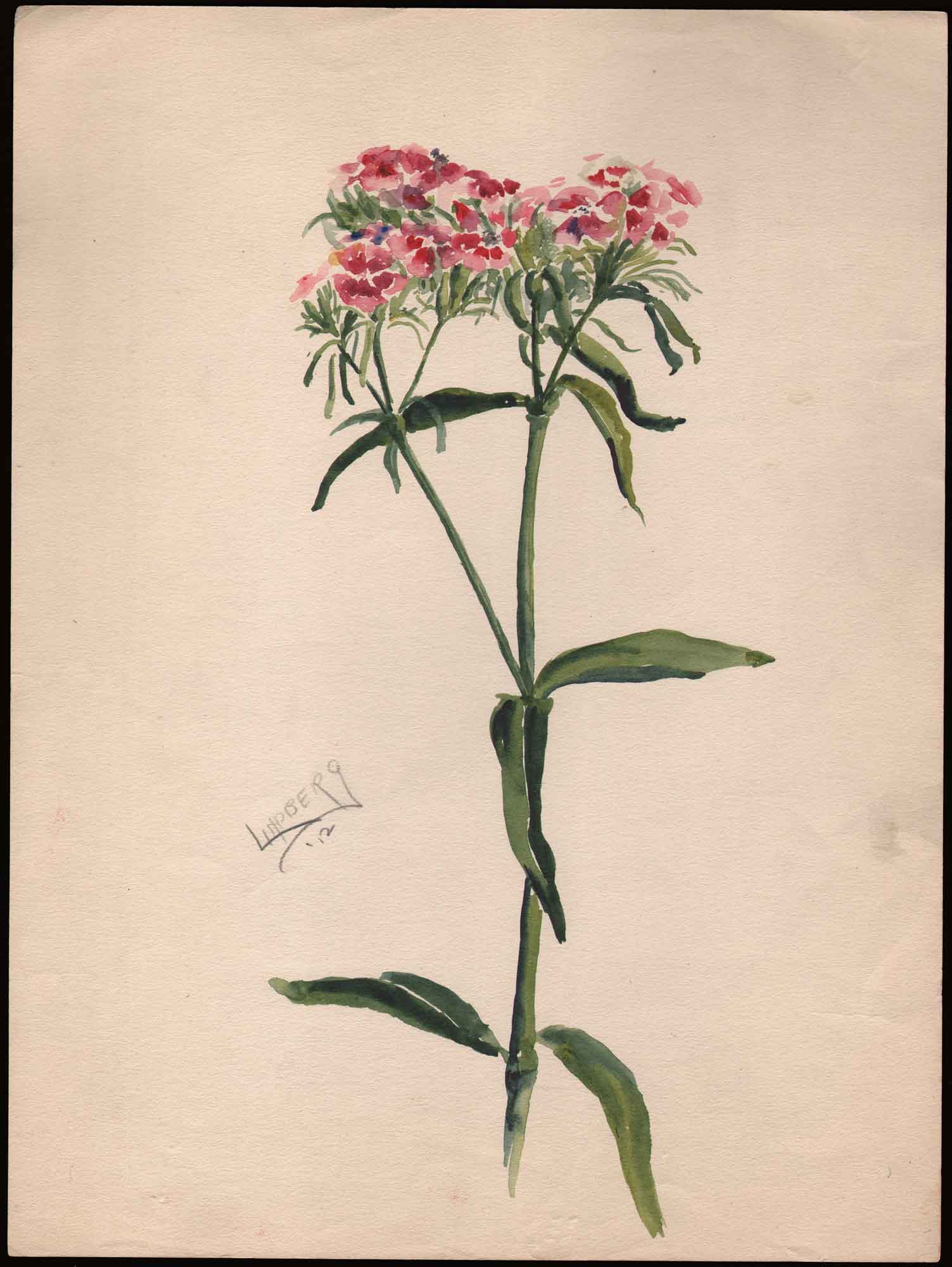
Watercolor Study: Sweet William
Watercolor study on paper of an Sweet William flower and stem.
Dianthus barbatus, the sweet William, is a species of flowering plant in the family Caryophyllaceae, native to southern Europe and parts of Asia. It has become a popular ornamental garden plant. It is a herbaceous biennial or short-lived perennial plant growing to 13–92 cm tall, with flowers in a dense cluster of up to 30 at the top of the stems.—Wikipedia accessed April, 2026
The Burchfield Penney Art Center at Buffalo State College holds the artist’s work: bio: “Arthur H. Lindberg was a realist artist, illustrator, and teacher. Many of his works are comprised of Buffalo’s industrial scenes, factories, grain elevators and steel plants during the 1940s and 1950s. He also portrayed the beauty of nature through his use of oil, watercolor and pastel. He was drawn to water as a subject. particularly waterfronts of the New England area. Lindberg was born in 1895 in Worcester, Massachusetts, and began taking art classes at the Worcester Art Museum at the age of twenty. He continued his studies at the Pratt Institute in Brooklyn for two years before serving in France during World War I. He briefly returned to Worcester following his service, then continued his art training in New York during the late 1920s and early 1930s. He studied at the Grand Central School of Art under Harvey Thomas Dunn and Dean Cornwell. as well as the Art Students League of New York City under Frank Vincent DuMond and George Brandt Bridgman around 1935. He returned to the Pratt Institute the following year, receiving his Bachelor of Fine Arts degree in 1939.”