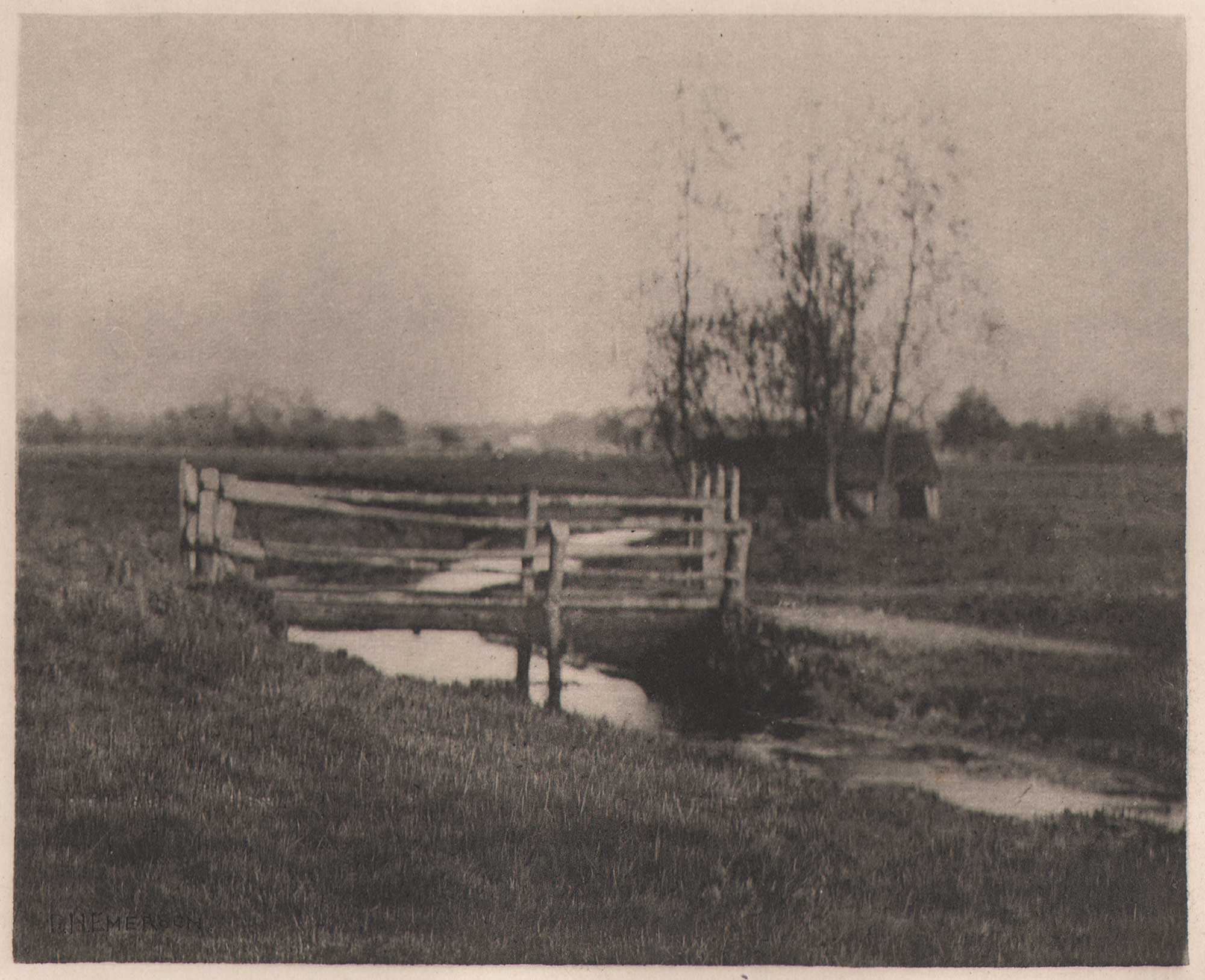
Where Winds the Dike {Norfolk}
“Where winds the Dike,” this is another plate the student wishing to understand Naturalistic Photography should study carefully. The whole picture here is out of focus, deliberately thrown out of focus, and by judicious use of diaphragms, the middle distance and distance are relatively truly rendered. No lens yet made could give this effect by spherical aberration to be introduced by unscrewing back, etc. Dallmeyer’s valuable new rectilinear landscape lens, certainly could not give this effect by focussing sharply and the spherical aberration introduced in its manufacture being trusted to give it.” ⎯ P.H. Emerson, Sept., 1889, To The Student
From Chapter XVIII: Norfolk Marshes
“BOTH these plates give us glimpses of lone pathways across the lonelier marshes. In the first plate, the wandering dike leads the eye up to a quaint rustic bridge, beneath which it flows on past a deserted cattle-shed, half buried in some wispy willows, whose new-born leaves gently rustle in the steamy April breeze. That is all; and yet to us the picture speaks eloquently of flowers of the salt marsh and cries of the circling fen-fowl; of nibbling sheep, and the frolics of new-born foals; of an ever-changeful sky, and more darkly changeful landscape; of the gentle murmurings of spring, of the hot breathings of summer, of the dying moanings of autumn, and of the wild cryings of winter, when the salt stinging blasts from the icy North Sea sweep with mighty sound across the frozen marshes, spreading far and wide death and desolation.” p. 111