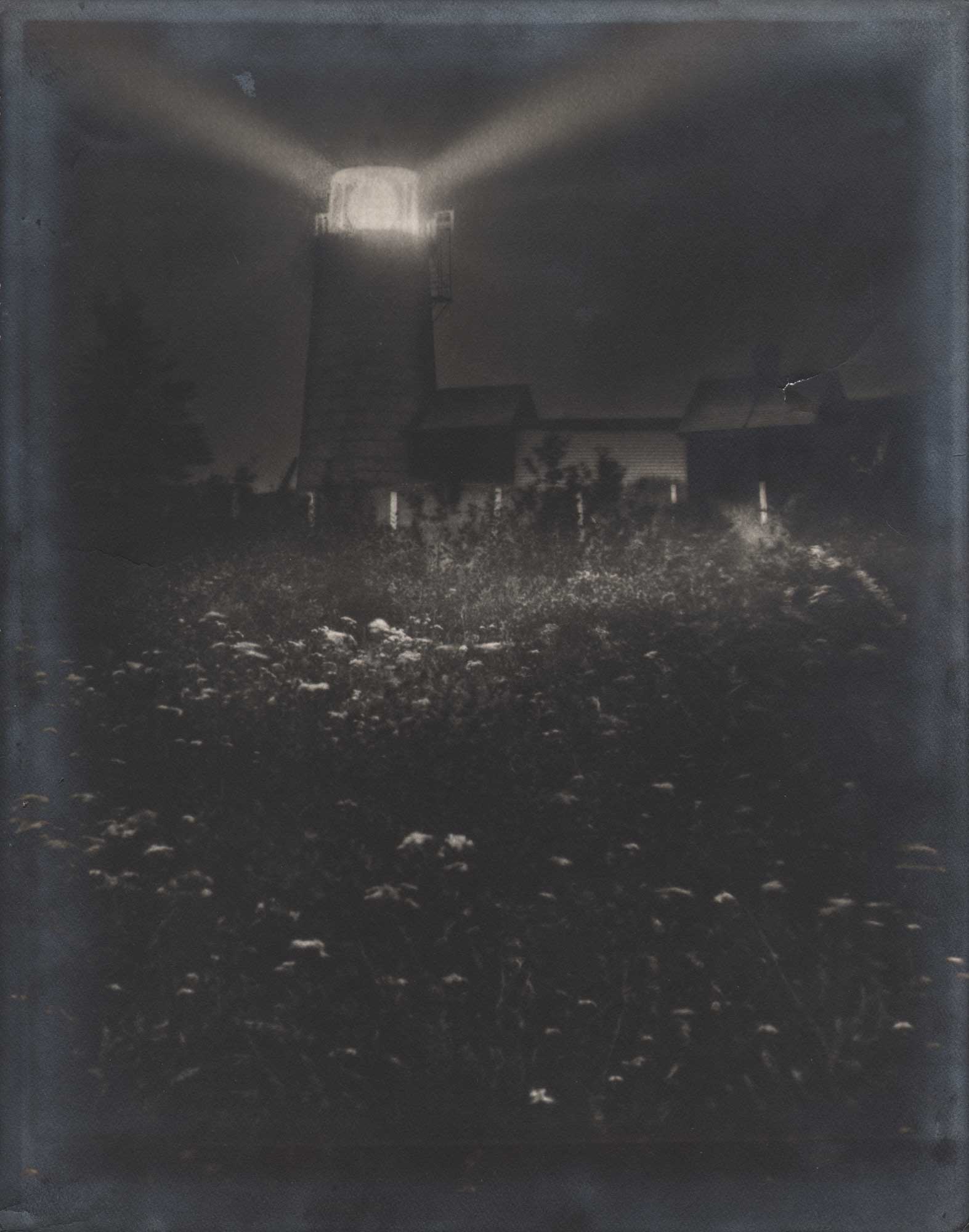
Monhegan Light
The preponderance of night scenes strongly suggests a close study of Whistler. -Susan Danly: ‘Realistic Pictorialism’: The Photographs of Warner Taylor
On Maine’s Monhegan Island, the Monhegan Lighthouse, with light beaming outwards from its fresnel lens at full candlepower, and with a field of wildflowers making up the compositions foreground, cuts through the darkness in this nighttime photograph taken before World War II, when the light was dimmed for wartime. The present-day lighthouse, which dates to 1850, “stands on a hill near the center of Monhegan Island. The lighthouse complex includes the tower, keeper’s house, storage building, and oil house. The tower is a circular structure built out granite blocks with sloping walls, and is 47 feet (14 m) tall, with the lantern house mounted on top.” – Wikipedia, accessed May, 2025
Warner Taylor: 1880-1958
Born in New York City, University of Wisconsin English Professor Warner Taylor was an accomplished pictorialist photographer working actively during the 1930’s & 40’s.
Using family records, author Susan Danly in 2005 penned a fine overview of Taylor’s involvement with pictorial photography which includes the following excerpts:
“A typical member of the Pictorialist movement, Warner Taylor (1880-1958) was self-trained as a photographer, but thoroughly conversant with the aesthetics of his medium. An active member of the National Photographic Society, he won numerous prizes in over 180 national competitions. Raised in Utica, New York, Taylor graduated from Columbia University with a Bachelor of Arts degree in English in 1903 and a Master’s degree in 1905. From 1907 to 1911, he taught in the English Department at Columbia and while in the city, he enjoyed visits to museums, especially The Metropolitan Museum of Art and the Museum of Natural History. (1.)
Warner Taylor first arrived on Monhegan in the summer of 1913 in the company of the artist, William Varnum, a close acquaintance and instructor in the Art Department at the University of Wisconsin in Madison. Taylor’s interest in photography on Monhegan explores many of the same picturesque subjects depicted by the island’s burgeoning artist community. (2.)
Taylor experimented with a variety of print types throughout his career. His earliest photographs, taken with a large format camera, are chloro-bromide and gold-toned gelatin silver prints. He later switched to a Graflex camera and produced exhibition prints on Gevaluxe paper, which is very susceptible to surface damage. A letter from John Hogan of the Photographic Society of America warned Taylor that when he sent prints out for exhibitions, they were certain to be returned with noticeable scratches, but Taylor persisted, clearly preferring the rich surface quality of that distinctive paper. (3.)
During its heyday, Taylor’s work received critical acclaim from the leading representatives of this type of photography. Given the impending climate of war around 1940, it seems significant that Taylor’s scenes of turbulent seas remained his most popular subject for a wide national audience of camera clubs that stretched across the country from coast to coast, from St. Petersburg, Florida, to Pittsburgh, St. Louis, Denver, Los Angeles, and San Diego.
Warner Taylor, like many Pictorialists, firmly believed that for a photograph to be considered a work of art it had to exhibit certain aesthetic principles. (4.)
Perhaps the most surprising aspect of Taylor’s aesthetic position, which was essentially quite conservative, was his awareness of Modernism. He was familiar not only with Edward Weston’s latest work, but he also discussed at some length the New Bauhaus photographs of Lázló Moholy-Nagy and Gyorgy Kepes at the Institute of Design in Chicago. His chief complaint about their work had to do with what he perceived as the poor quality of their prints, rather than their interest in pure abstraction. He acknowledged, further, the importance of their photographic approach in advertising and industrial design. Taylor also noted current popularity of Moholy-Nagy’s photograms which offered: “a method of evolving patterns and rhythms and abstract forms, which when brilliantly conceived and executed, are capable…of stimulating emotional responses. ” In addition, he quoted extensively from Kees book, The Language of Vision, published in 1944, and he grudgingly conceded that the book may have been as influential in the history of photography as the 1913 Armory show had been on the history of painting in the United States. As Taylor observed, the Kepes book is illustrated with photographs, photograms, and abstract and Surrealist paintings by a diverse group of Modernists including Jean Arp, Paul Klee, Georges Braque, Pablo Picasso, Marcel Duchamp, Kasimir Malevich, Joan Miró, and Wassily Kandinsky. (5.)
- Excerpt: Susan Danly: ‘Realistic Pictorialism‘ : The Photographs of Warner Taylor: in: Seeing and Beyond: Essays on Eighteenth- to Twenty-first Century Art in Honor of Kermit S. Champa: 2005: p. 362
- Ibid: p. 363
- Ibid: p. 364
- Ibid: p. 366
- Ibid: p. 367