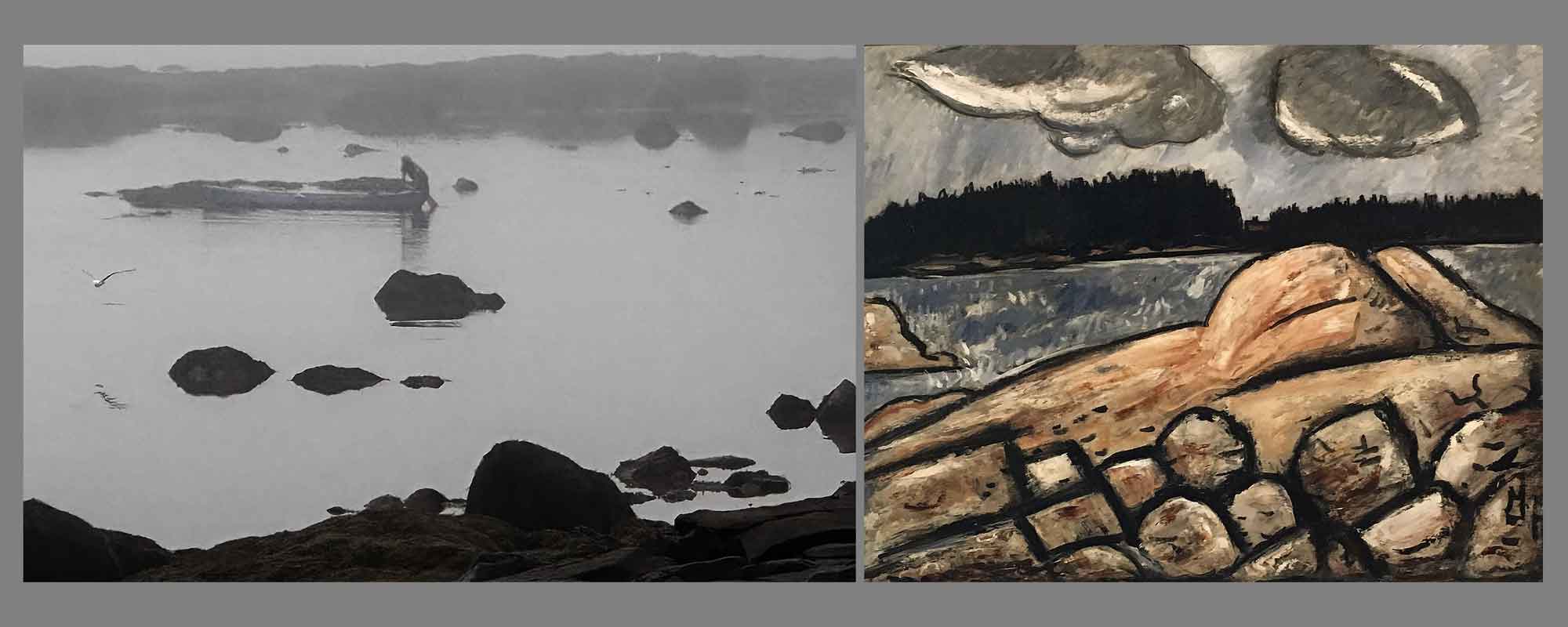
Steuben, 2024: “Clammer Heading Out, Pre-Dawn”. In early morning fog, a clammer pushes his skiff off at low tide on the shoreline of Pigeon Hill Bay as a gull sweeps in low. Photo by David Spencer for PhotoSeed Archive. Right: “After the Storm, Vinalhaven, 1938-1939”, oil on Academy board, Marsden Hartley, American, 1877-1943. Excerpt from wall text: “Like many of Marsden Hartley’s late marine landscapes, After the Storm, Vinalhaven expresses the artists sympathetic response to the elemental strength of his native land. The subject is the rocky seacoast in the vicinity of Vinalhaven Island in Maine’s Penobscot Bay. In the foreground, wind-whipped waves lash unyielding score, storm clouds pass overhead, and, in the distance, a pine-covered broods in solid silence.” Collection: Bowdoin College Museum of Art
Why do certain places exert a unique hold on someone’s artistic sensibilities? Given chance or opportunity, children can even find themselves in the grasp of forces they may not realize are shaping a future career. When I was a kid, my brother and I set off to Camp Idlewild, located on an island in New Hampshire’s Lake Winnipesaukee. We spent a month away that summer: a big step up from our local YMCA day camp experience. My mother later told me she cried after dropping us off after she and my father returned to the ferry landing in Wolfeboro. I remember her telling me she thought she had made a mistake. But that month would turn out to be one of the best in my life. I was happy to be on my own for the first time, albeit surrounded by several hundred other campers. The many diversions, including the much anticipated boat ride aboard the camp’s sleek wooden powerboat, the Riot, were icing on the cake. I vaguely remember toting around a Kodak 110 Instamatic that first summer, but there were certainly no prize-winners when the pictures came back from the drug store.
My second overnight camp experience was altogether different. By this time, around 15, I was in love with the quirky art stylings of cartoonist Don Martin, whose Mad Magazine caricatures I emulated in Testors model paint on the top of my camp trunk. I remember my counselor making positive small talk about the paintings after my parents dropped me off at Camp Netop, located in Casco, Maine. Perhaps the destiny of my becoming a great artist awaited? Not exactly, but Netop did change my life.
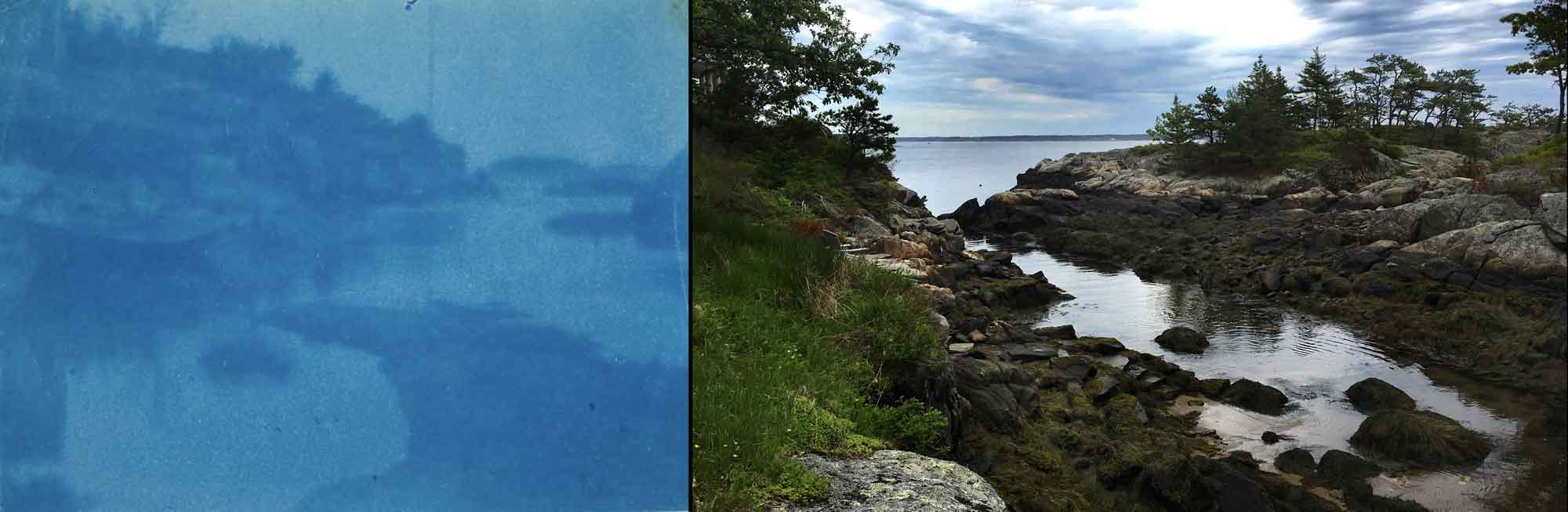
Little Good Harbor, Maine, 1905–1912, Fred Holland Day, American, 1864–1933, cyanotype. Collection: Worcester Art Museum. Right: Little Good Harbor, Low Tide, 2018. Photo by David Spencer for PhotoSeed Archive. Located near the mouth of the Sheepscot River at Five Islands, Georgetown, Maine, Little Good Harbor was the location of photographer Fred Holland Day’s summer home, built in 1912. Author Patricia Fanning, writing in 2001, gives a summary of the property: “Beginning in 1898, Day spent summers at a retreat he called Little Good Harbor near Five Islands, Maine. Because of Day, the bucolic setting became a kind of artist’s colony for his friends and their families. Among the photographers who visited were Gertrude Kasebier, Alvin Langdon Coburn, George Seeley, and Clarence White, who himself opened a summer photography school a few miles from Day’s property. The area was also popular among Day’s inner-city proteges. ( In 1912, Day built a large, Swiss-style chalet to house his numerous guests.) Day’s “camp” was informally fashioned after the programs for disadvantaged youth then popular in New York and Boston, and perhaps was inspired by similar camps run by the Episcopalian Sisters of St. Margaret and Cowley Fathers, with whom Day was closely associated. All visitors enjoyed boating, swimming, reading, board games and, of course, photography. Sailor suits were worn by all to eliminate any trace of social inequality or privilege.” Fanning, Patricia J. (2001). Cultural Commentary: The Pied Piper of Parmenter Street – The Philanthropic Work of F. Holland Day. Bridgewater Review, 20(1), 12-13.
That change was instigated by an actual darkroom located strategically next to the stage area of the main lodge, a former cavernous dance hall built in the 1920s. As it turned out, the camp co-founder, David Webster, a former elementary and junior high school science teacher who everybody called Sparky (his camp bonfires a specialty), had published the book Photo Fun: an Idea book for Shutterbugs, in 1973, about 5 years before I showed up that summer. Besides all the other typical camp activities like swimming, archery, riflery and even minibikes (the most popular by a mile), taking pictures around camp, developing the film and printing the photos was an actual camp activity. I was smitten. The editorial staff at Mad would have to wait. I was on my way to becoming a photographer.
Sparky’s advice in the book’s introduction gave encouragement to kids like myself: “The only way to become a good photographer is to take lots of pictures and note what seems to bring the best results. So load your camera and start snapping away. Have fun!” The book included several photos of Netop campers at play, and I fondly remembered Sparky’s son Doug later recreating one of the photos with his camera from the “Trick Photography” chapter. As I and another camper lined up in the outfield of the baseball field, a fellow camper in the foreground pretended to “hold us up” using his outstretched hands—pre-digital technology magic for this teenager to contemplate.
Through the years, I have continually renewed that early connection with the state of Maine. Besides being known as Vacationland, a tourism slogan appearing on Pine Tree state license plates since 1936, artists and photographers have journeyed here in order to seek creativity since at least the mid 19th century. Its rugged tidal coastlines and islands, natural wonders and changing light never cease to inspire those seeking artistic growth, a change in life or reason to seek a new chapter.
Enjoy these pictures from (mostly coastal) Maine, spanning the outer reaches of the Midcoast region up to my personal favorite, Downeast. With a few of my own snaps to give a flavor of modern times, the fruits of long-ago masters of the brush are showcased with photographs by anonymous amateurs on summer holiday. Maine also holds an important place in the history of photography. On Georgetown Island, the summer beachhead of what became the very first school of artistic photography, the Seguinland School of Photography, was established in 1910 by Clarence White. I paid a visit to what remains, as well as the grounds of The Chalet at Little Good Harbor up the coast, built by White’s fellow summer school teacher/critic Fred Holland Day in 1912.
The Clarence White family also put down long time summer roots in Georgetown when White purchased a coastal building lot and old farmhouse in 1910 close to his school. I’ve included correspondence from my 2018 email exchange with the Georgetown Historical Society, who confirmed my photo showing the former “Popple Beach” location of the home. Demolished and replaced by a new home in the early 1990s, the ghosts of White’s legacy and those photographic documents of his students depicting this rugged coastal retreat remain, with summer visitors in the present continuing to enjoy the coastal views from the porch of the former Sequinland Hotel— the former location of White’s school today known as the Grey Havens Inn. —David Spencer, July 2026
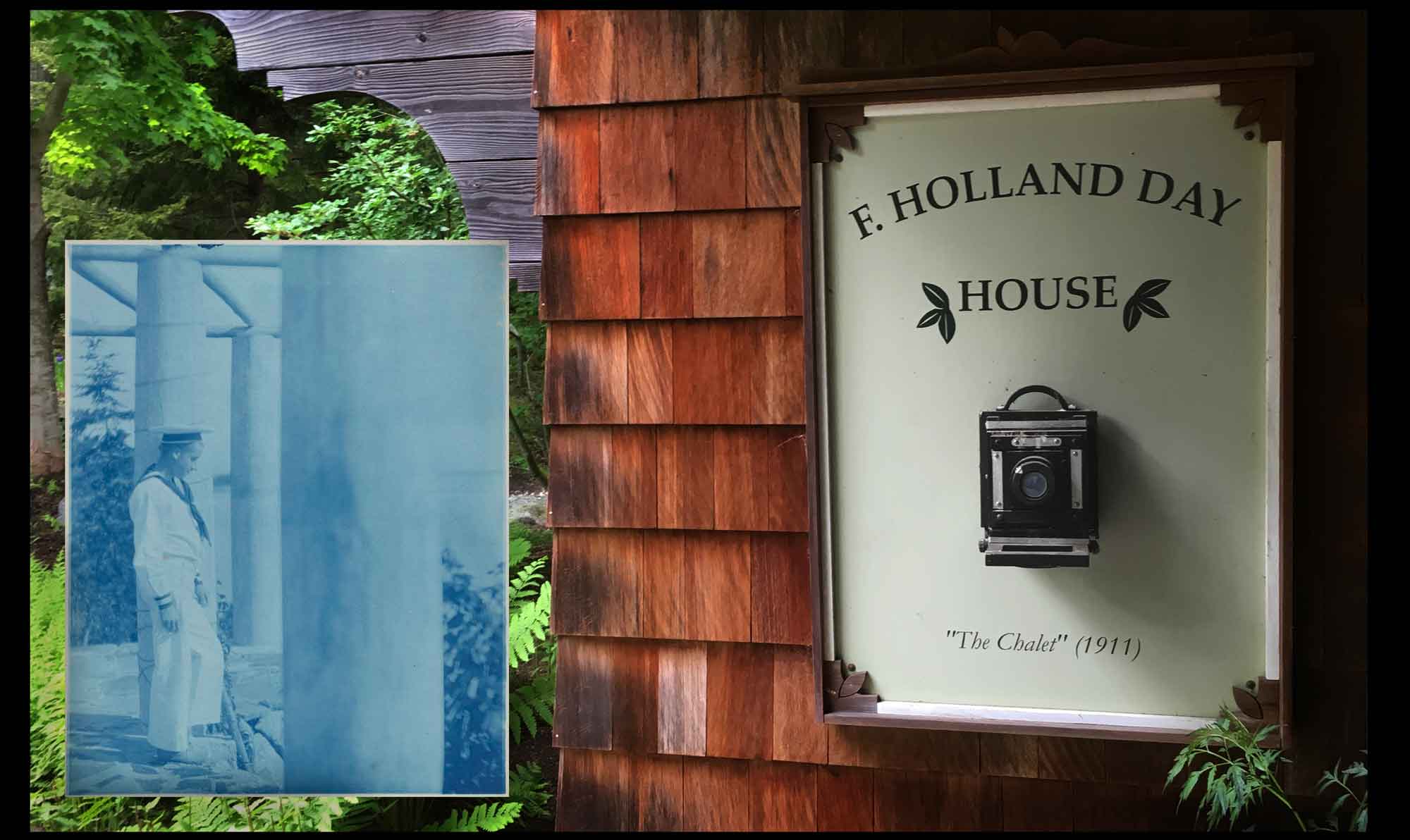
Inset: Maynard White in Sailor Suit Standing Beside a Column on Pergola, 1914, Fred Holland Day, American, 1864–1933, cyanotype. Collection: Library of Congress. See other cyanotypes held by LOC of the pergola construction. Maynard Pressley White, 1896-1961. White went on to receive his B.S. degree in Civil Engineering from Brown in 1920 and a masters in Paleontology from Columbia University in 1922, as well as Ph.D. He was a geologist and paleontologist for various oil companies. Right: F. Holland Day House Entrance Sign, Georgetown, ME, 2018. Privately owned, the former summer home of Fred Holland Day has been used as a wellness retreat. Photo by David Spencer for PhotoSeed Archive
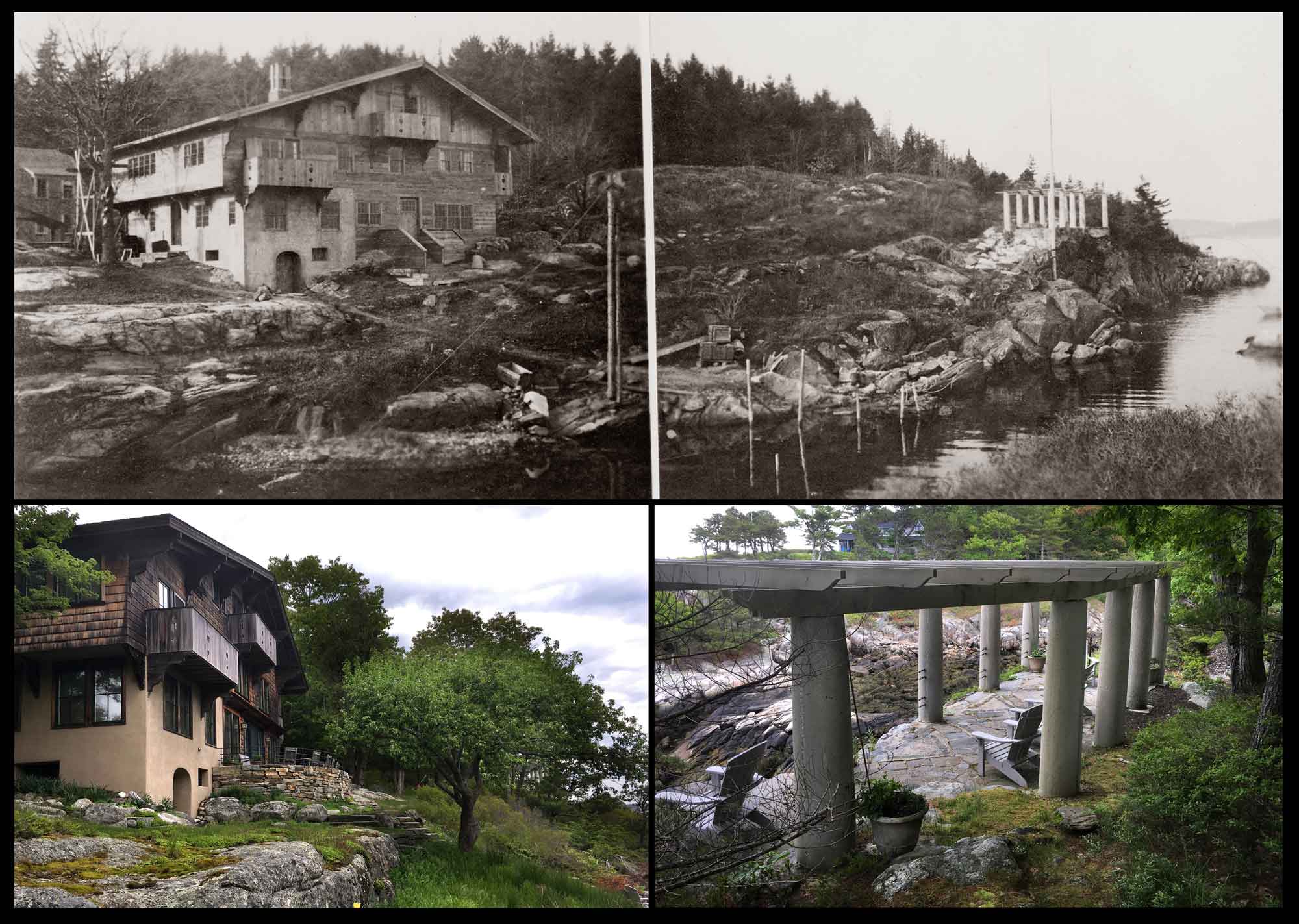
The Chalet Looking Northeast, Little Good Harbor, Maine, (left and middle pane of triptych) 1912 or 1913, Fred Holland Day, American, 1864–1933, b&w film copy negative from album held by Library of Congress: Little Good Harbor records, vol. 2, p. 48. Photographs by F. Holland Day and others. Designed by the Boston architectural firm Newhall & Blevins along with Day, this view from across Little Good Harbor shows the photographer’s summer home in Georgetown, ME known as the Chalet under construction and at right, the pergola. Also see: F. Holland Day’s Country House, Little Good Harbor, October 1912. Bottom Left & Right: From 2018, an exterior view of the Chalet, as well as the pergola, located on the original footprint. David Spencer for PhotoSeed Archive.
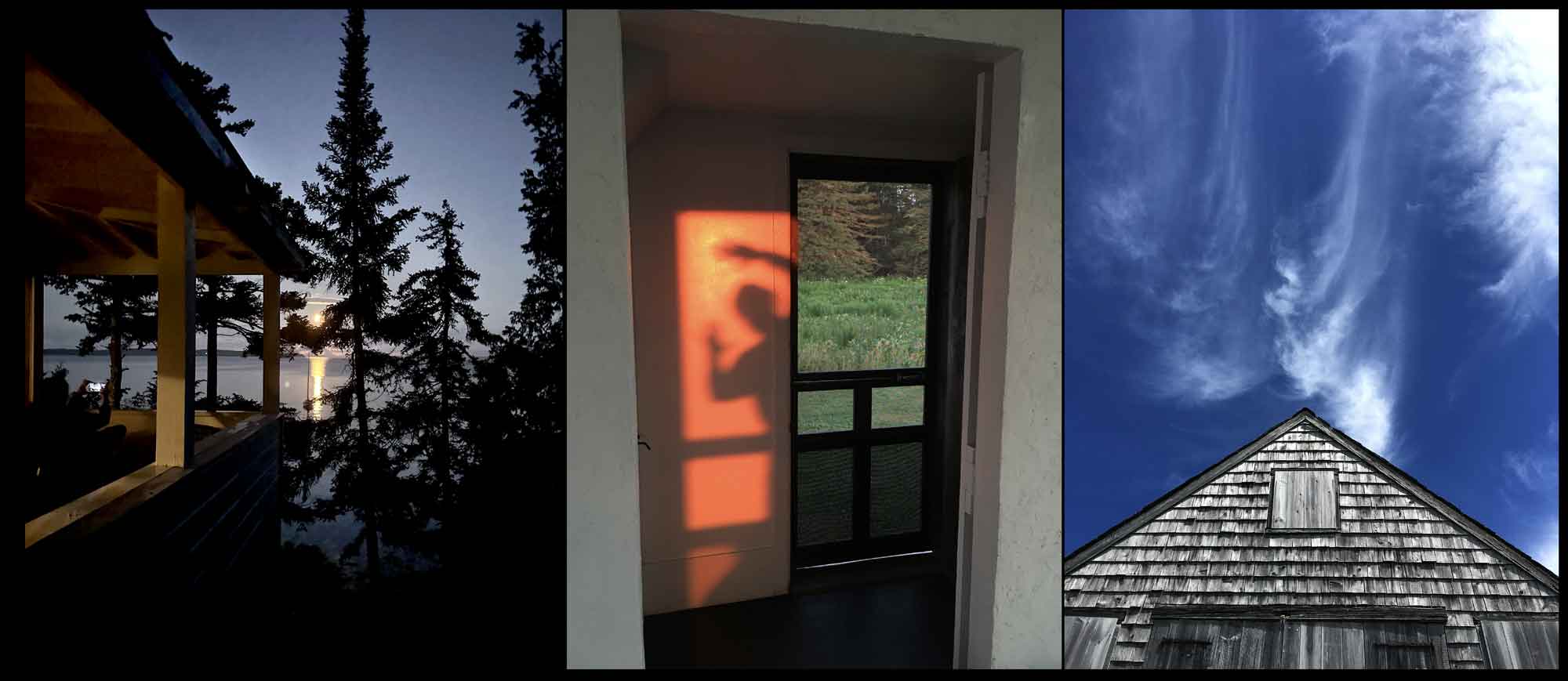
Isleboro, 2023: Photographing Sunrise from Cabin. Middle: Early Morning Figure, Cushing, 2022. Right: Weathered Clapboards & Sky, Pleasant Point, Cushing, ME, 2022. One need not go far for photographic inspiration in Maine. Oftentimes, the interior of your rental accommodation or grounds will produce memorable views. Photos by David Spencer for PhotoSeed Archive
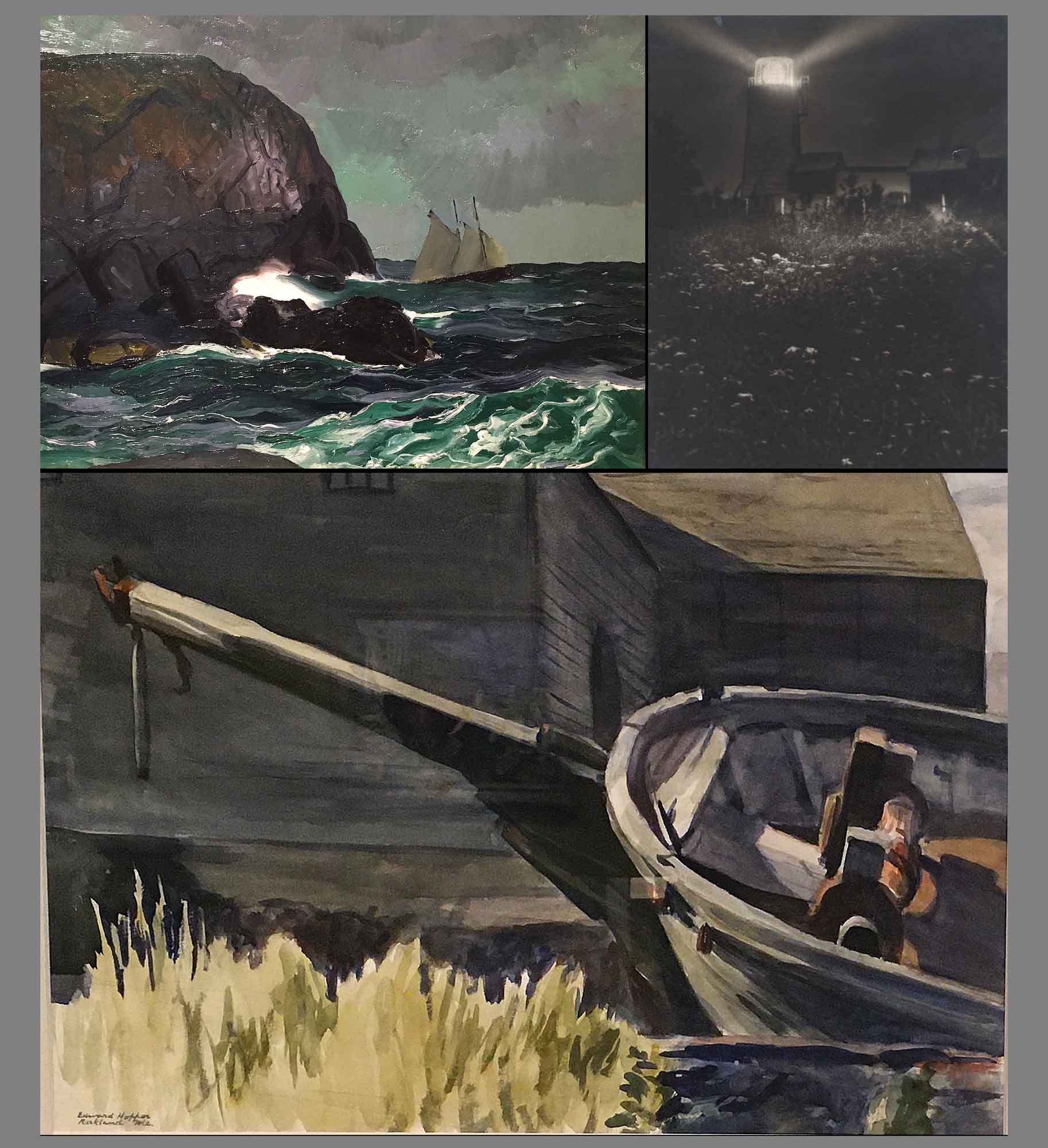
Top Left: Beating Out to Sea, 1913, oil on board, George Wesley Bellows, American, 1882-1925. Excerpt from wall text: “A student of Robert Henri’s, Bellows was inspired by his teacher’s enthusiasm for Monhegan, visiting the island for the first time in 1911….The rugged environment of Mohegan appealed to Bellows. He wrote to his wife Emma, “The island is endless in its wonderful variety. It’s possessed of enough beauty to supply a continent.” During the summer of 1913, when this work was painted, Bellows completed 125 works on Monhegan, 42 of them in one month.” Collection: Farnsworth Art Museum, Rockland, ME. Top Right: Monhegan Light, 1936, Warner Taylor, American, 1880-1958, gelatin silver print, 35.4 x 27.8 cm, unmounted. On Maine’s Monhegan Island, the Monhegan Lighthouse, with light beaming outwards from its fresnel lens at full candlepower, and with a field of wildflowers making up the composition foreground, cuts through the darkness in this nighttime photograph taken before World War II, when the light was dimmed for wartime. From: PhotoSeed Archive. Bottom: Schooner’s Bowsprit, 1926, Edward Hopper, American, 1882-1967, watercolor on paper. Excerpt from wall text: “In the summer of 1926, Hopper and his wife Jo spent seven weeks in Rockland, a period that proved to be one of the most productive of his career. Writing his dealer Frank Rehn in New York, he described Rockland as “a very fine old place with lots of good looking houses but not much shipping.” Hopper favored subjects that recalled the past in the present; here the hull of an abandoned schooner, a relic of days when Rockland was a thriving commercial port.” Collection: Farnsworth Art Museum, Rockland, ME.
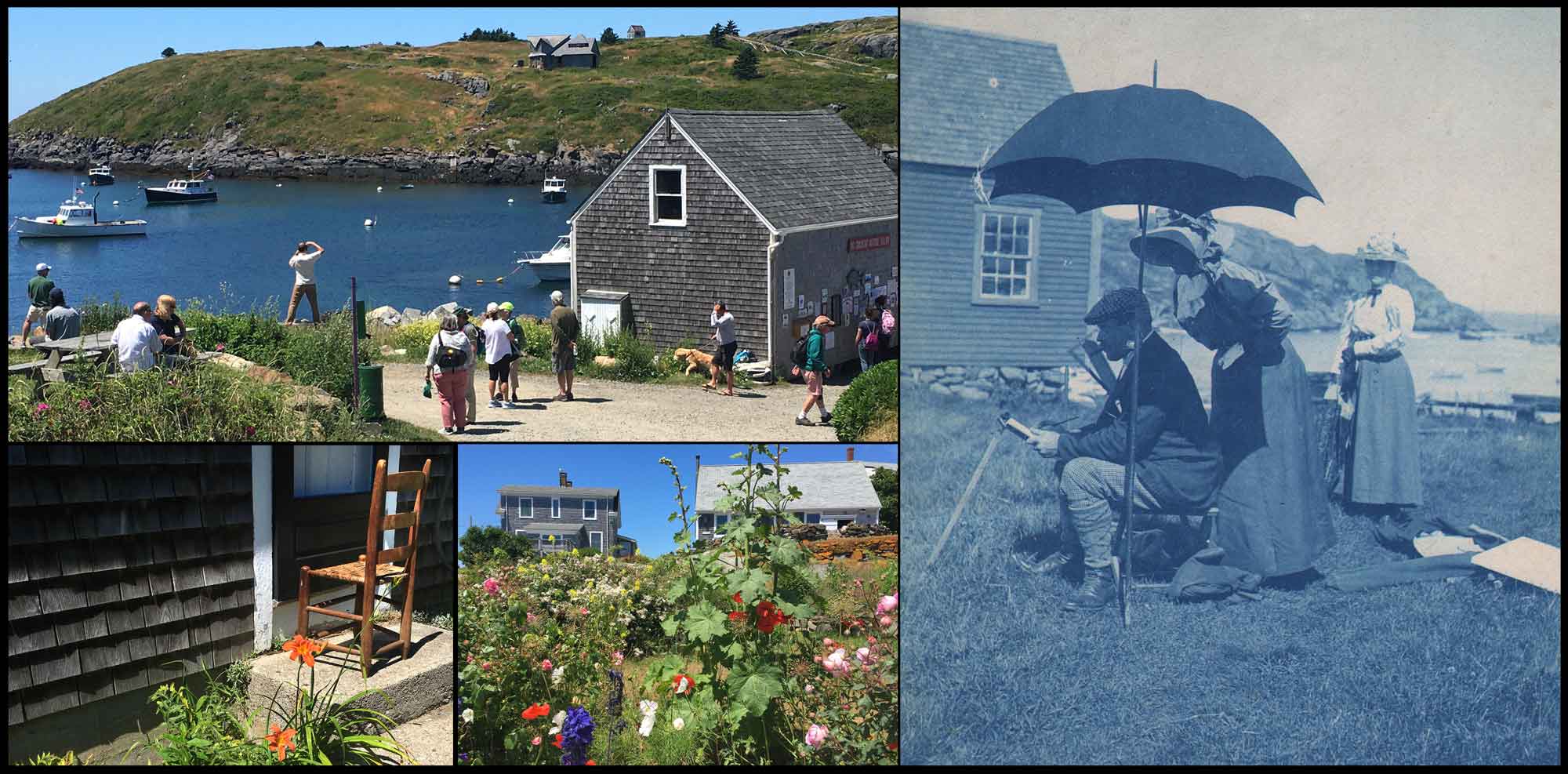
Top Left: Monhegan Island Visitors, 2022. Near the ferry landing on Monhegan Island, a visitor at center lines up a photo of neighboring Manana Island across from Monhegan Harbor. Located approximately 12 nautical miles off the coast of Maine and part of Lincoln County, the island at 4.5 square miles is renowned as one of America’s oldest and most influential artist colonies. Summer month visitors vastly outnumber the locals, counted as 64 people during the 2020 US Census. Lower Left & Middle: Chair on Steps, 2022. This ladderback chair serves guard duty in front of a private Monhegan Island residence; Flowers & Homes, 2022, flowers can be seen just about everywhere on Monhegan. Monhegan and Manana islands form “a unique maritime community that balances historical preservation, environmental conservation, and sustainable tourism.” Right: Sketching on Monhegan Island, ca. 1900-1910, unknown American photographer, cyanotype, 11.8 x 9.3 | 12.6 x 9.9 cm. The Monhegan Museum, which holds a black & white variant of this image, identifies the three people shown, all American artists. Seated while sketching is Eric Hudson, (1864-1932); leaning over him is Alice Swett, (1846-1916) while Maud Briggs Knowlton (1870-1956) stands at far right. Knowlton and Swett were the first two women artists in the Monhegan Island artists’ colony, while maritime painter Eric Hudson’s work and papers can be found at the Smithsonian. From: PhotoSeed Archive
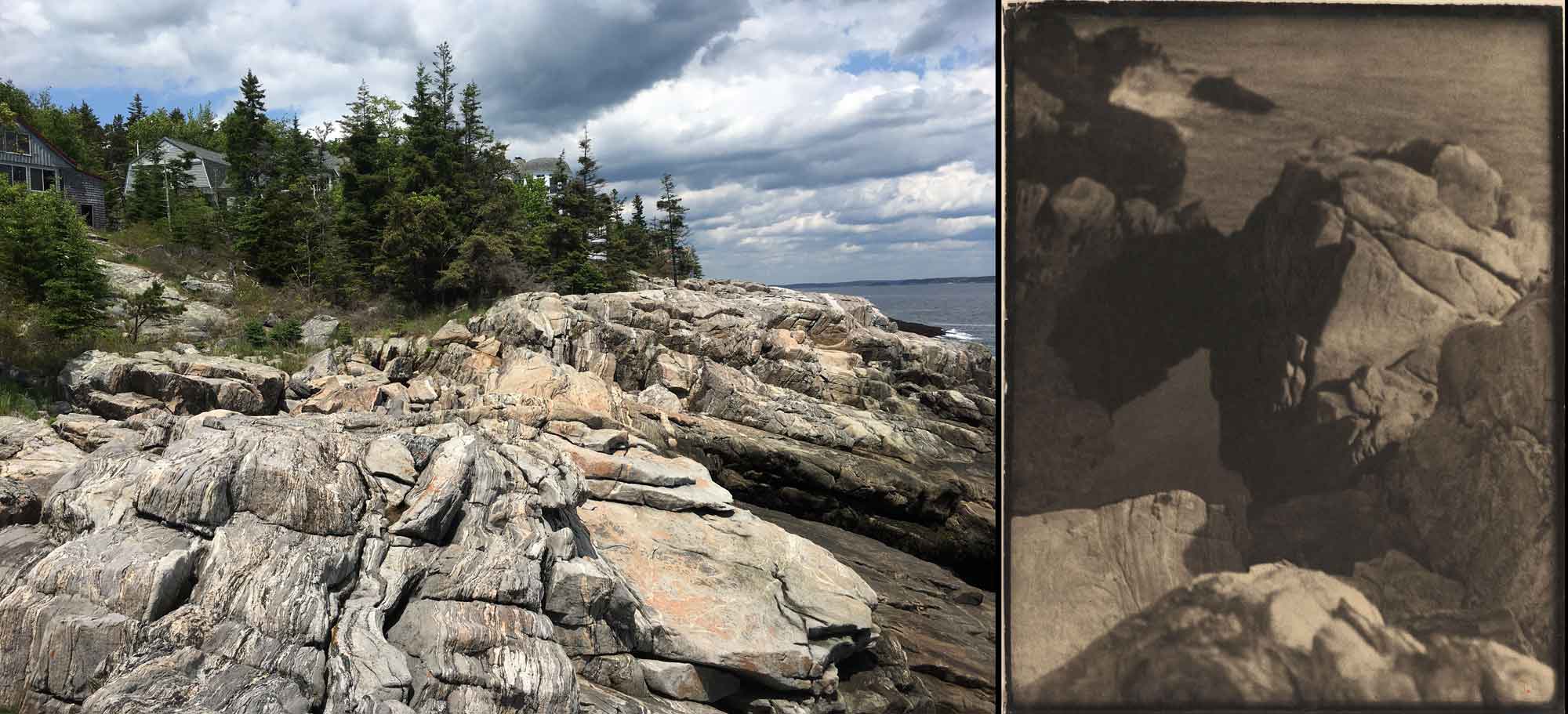
Former White Family Property, “Popple Beach”, Georgetown, ME, 2018. Shrouded by trees at far right center is where American photographer Clarence Hudson White rebuilt a derelict farm house and had it winched closer to the coast overlooking the mouth of the Sheepscot River in 1910. The White family retained the property until 1990, when Ruth Royer White passed. Jeanne McGowan, former president of the Georgetown Historical Society and a close friend and former neighbor of the White family, corresponded with PhotoSeed in 2018, giving the following details of the White property: “The White house originally sat at the corner of what is now Seguinland Road and White Road. About 1910 Clarence and Jane purchased the farmhouse from Walter Reid and moved it closer to the water, using local talent to do so. Mr. Reid had purchased it from a local family as a part of his plan to develop that area of the island. In fact, the Grey Havens Inn was the first part of that plan although Mr. Reid called it the Seguinland Hotel. …After the move, a “tower” was added to the house by the Whites which served as an office for both Clarence Sr. and Clarence Jr. The house stayed in the White family through Clarence Jr’s life and then that of his wife, Ruth Royer White who died in 1990. They moved to Georgetown in the 1970s and lived there full-time. Clarence’s nephew Maynard inherited the house and after some years sold it to the current owner. It was she who demolished the White house and built a new home closer to the water. Ruth White confirmed to my husband and me that the Whites were the ones who named their shorefront Popple Beach because of the large rocks that comprised the shore. Time and tide have changed that somewhat. In fact, Ruth White told us that there was once a “crib wharf” made of rocks. Whatever it’s size and shape, such a wharf would have been there a relatively short time given the wave/water action at that location at the mouth of the Sheepscot River.” Today, this now private property can only be seen from the coastal northern boundary of Reid State Park. Photo by David Spencer for PhotoSeed Archive. Right: The Bath Tub, Maine Coast, ca. 1921, Clarence Hudson White, American, 1871–1925, Gum bichromate on palladium print with wash. Collection: Princeton Museum of Art, Princeton, N.J. (further inscribed on matt verso: Rocks at Georgetown, Maine – about 1921)
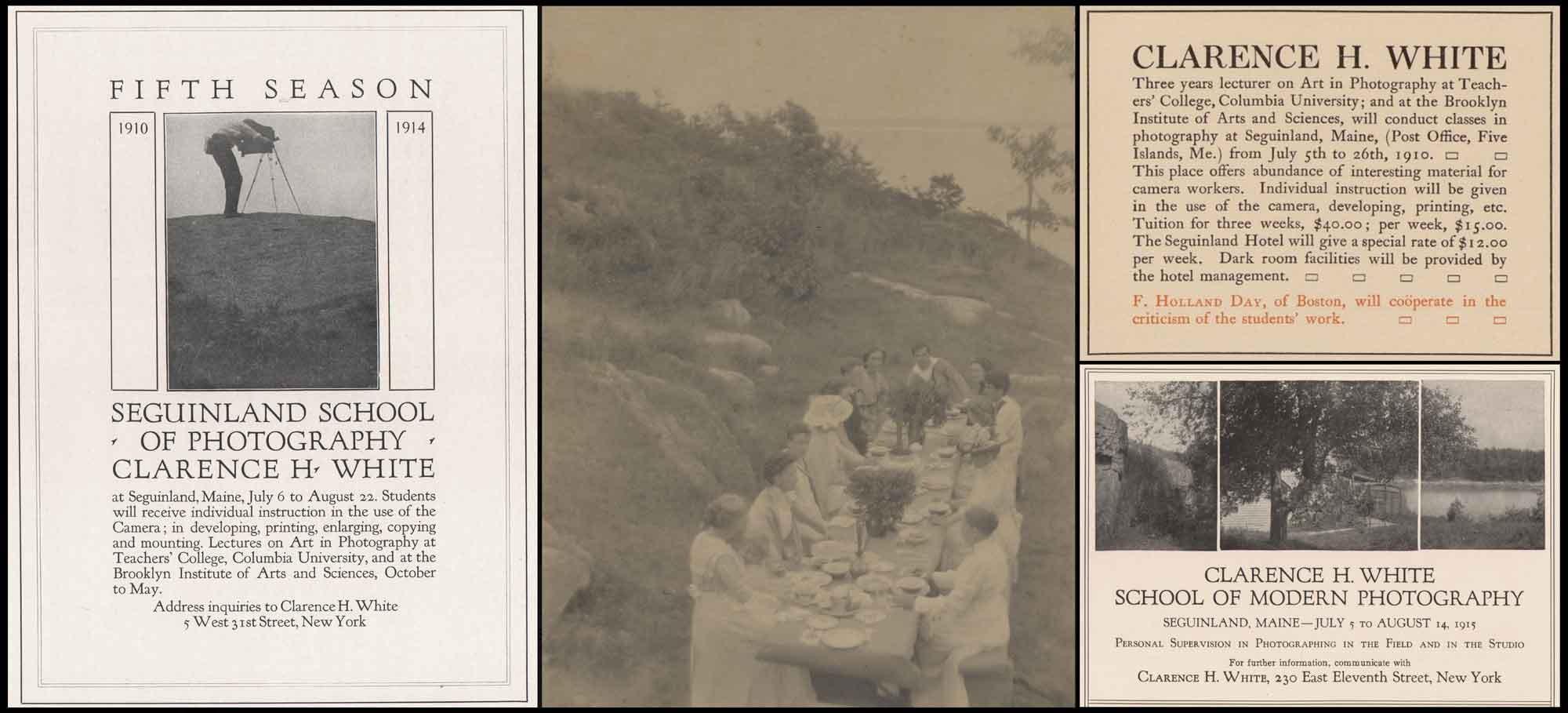
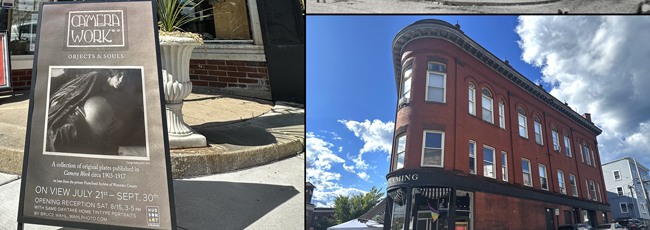
Advertising Material: Seguinland School of Photography: The very first school devoted to artistic photography was founded in 1910 by Clarence White as The Seguinland School of Photography, located in coastal Georgetown, Maine at the head of the Sheepscot River. The Library of Congress notes the school: “was housed in a hotel, which was to be part of the new “Seguinland” resort on the mid-coast of Maine near Georgetown and Seguin Island. Pictorialist photographer F. Holland Day, who summered nearby, had earlier invited White and his family to the area for a respite from the city and the opportunity to explore creative photography outdoors. The fellowship between the two photographers and their families was an important factor in White’s decision to start the summer school. Students wore sailor suits, a practice begun by Day and his summer guests, and boarded at the Seguinland Hotel. Day regularly conducted critiques for White’s students, as on occasion did New York photographer Gertrude Käsebier.” Left: Fifth Season advertisement, published full page (25.5 x 20.3 cm) in Platinum Print: A Journal of Personal Expression, New York, December, 1913. (PhotoSeed Archive) Middle: First Summer School, Five Islands, Maine, 1910, Clarence Hudson White, American, 1871–1925, platinum print: Collection, Museum of Modern Art, New York, N.Y. Dressed in a sailor suit, Clarence White sits at the far end of a communal table along with students attending the first year of his Seguinland School of Photography. Top Right: Advertisement drawing attention to Clarence H. White, notifying subscribers to Camera Work, XXX, April 1910 that he “will conduct classes in photography at Seguinland, Maine, (Post Office, Five Islands, Me.) from July 5th to 26th, 1910.” Lower Right: In 1915, during the sixth and final year of White’s summer school in Maine before moving to East Canaan, Connecticut, the school was marketing itself as The Clarence H. White School of Modern Photography. Advertisement in Platinum Print: A Journal of Personal Expression, New York, Vol. 2, No. 1, 1915. (PhotoSeed Archive)
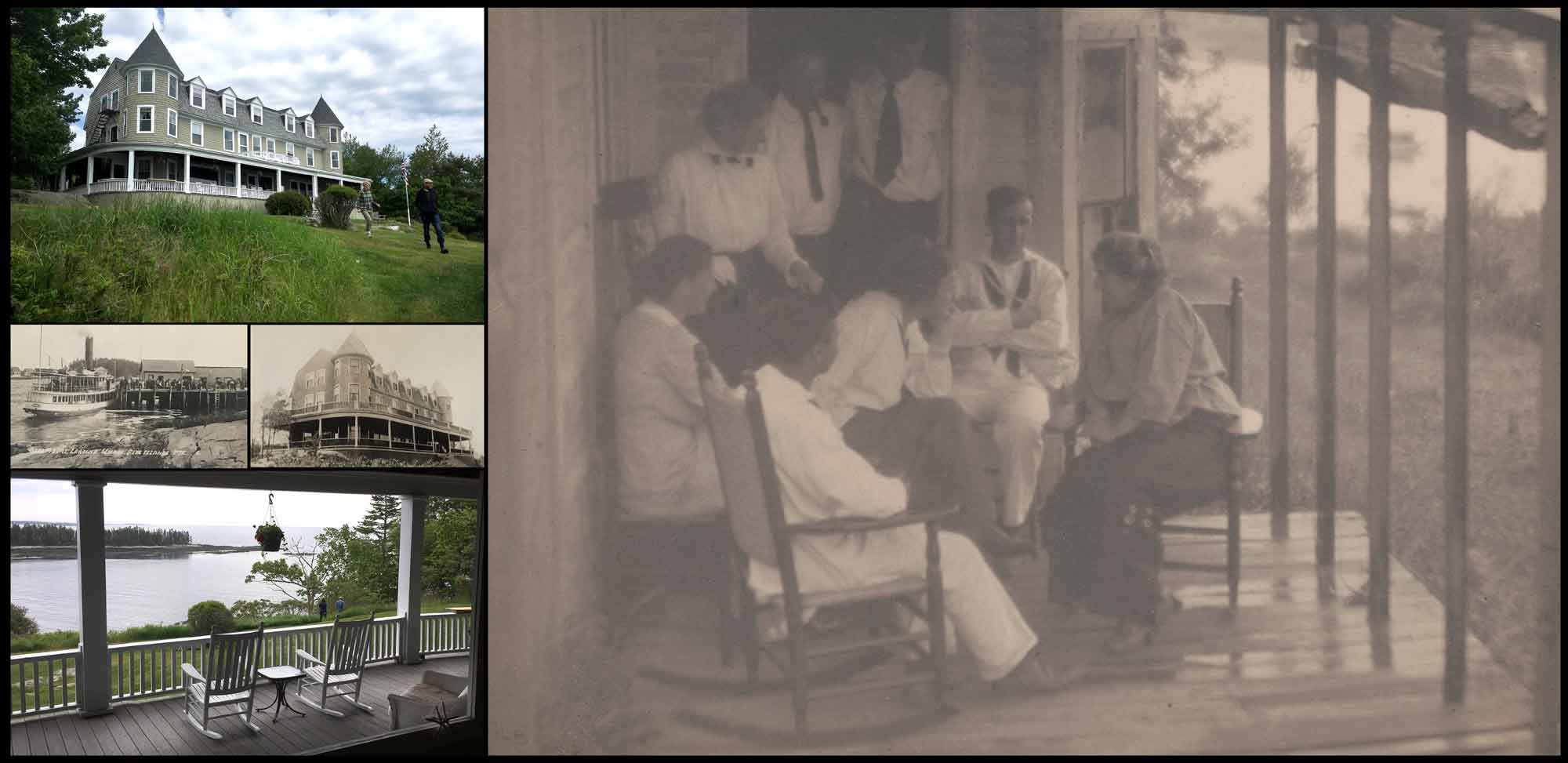
Upper Left: Visitors on Grounds of Grey Havens Inn, Georgetown, ME, 2018. This shingle style hotel was built in 1904 by Georgetown native Walter E. Reid (1869 -1955) as part of his Seguinland Cottage Company, a Georgetown real estate development firm with plans to develop 1500 acres around the hotel as a new summer resort. The hotel was used by summer students of the Clarence White-founded Seguinland School of Photography. In 1910, an ad in Camera Work gave students a special rate for one week of hotel room and board for $12.00. Reid made a name and fortune for himself first with the American Tobacco Company and later as director of the Mack Truck Company from 1927-1951. A life of local philanthropy followed, his significant holdings in Mack Truck giving him the means to initially donate 350 acres of land to the state of Maine in 1946. Named in memory to his parents, Reid State Park—close to the hotel— opened in Georgetown in 1950, the state’s first public recreational park on the ocean. Video history of Walter E. Reid. Middle Left: Historic photographs from about 1920 showing a steamboat at the Five Islands wharf: how visitors arrived and departed for the the hotel; a frontal view of the hotel described in a scrapbook held by the property as “Awnings Gone – Upper Deck Intact“. Lower Left: Listed on the National Historic Register in 1985, hotel visitors can enjoy seating looking at to the mouth of Harmon’s Harbor, an inlet off the Sheepscot River. (David Spencer for PhotoSeed Archive) Right: In this c. 1913 platinum print by Sequinland School of Photography student Gertrude L. Brown, the porch of the nearby Pilot House on the hotel grounds becomes an extended classroom space. School founder Clarence White, in sailor suit seated at background middle, converses with Gertrude Käsebier at right, surrounded by students. Collection: Library of Congress.
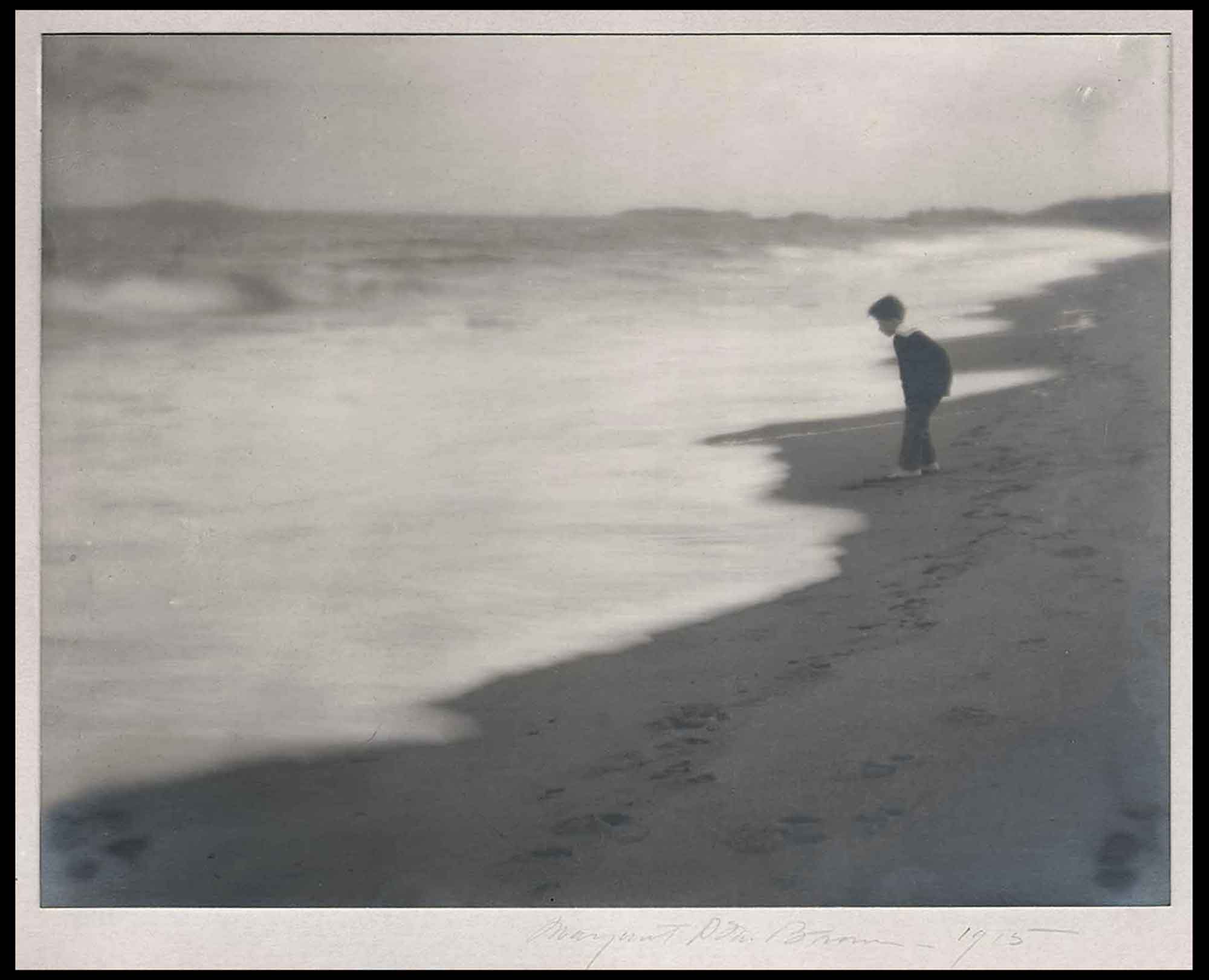
Foamy Shores, 1915, Margaret DeMotte Brown, American, 1880-1959, mounted gelatin silver print, 15.1 x 19.6 | 35.5 x 27.9. cm.Wearing a sailor suit as family tradition held while living in Maine, Clarence Hudson White Jr., (1907–1978) then about eight years old, takes in the waves at Mile Beach at Sequinland, Maine. The beach is now part of Reid State Park in Georgetown, ME. Titled Foamy Shores by the artist, this is a rare surviving example of a student-mounted photograph taken during the final year of the Seguinland School of Photography before classes moved to CT the following year. Clarence Jr. was a visitor and summer resident of this area of coastal Maine his entire life. In the 1970’s, he and wife Ruth Royer White moved back to the family summer home in Georgetown, ME full-time, where he died on March 1, 1978. From: PhotoSeed Archive
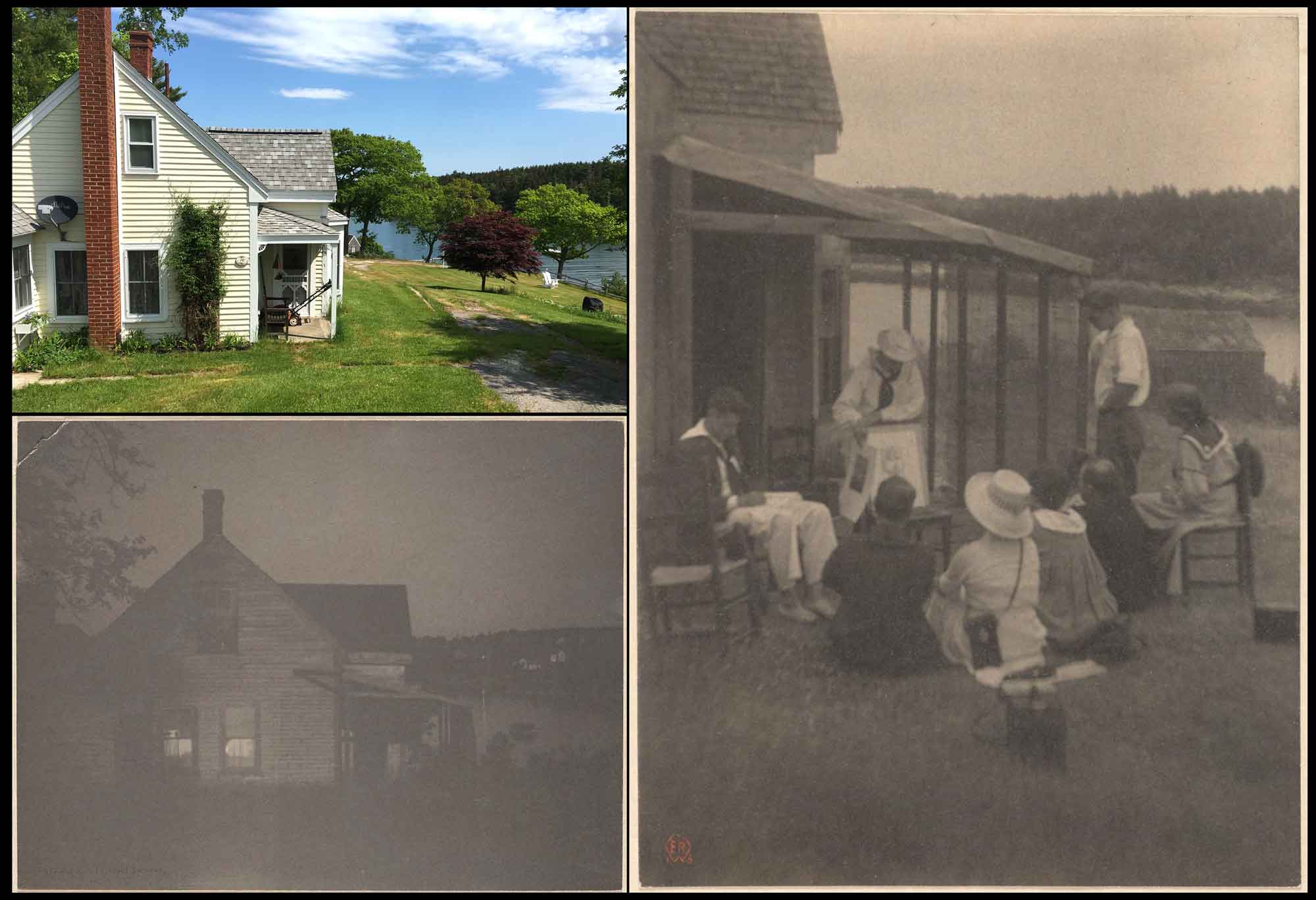
Upper Left: The Pilot House, Georgetown, ME, 2018. The likely domicile of former steam launch or boat pilots who maneuvered the rocky shoreline of nearby Harmon’s Harbor while ferrying guests to the Sequinland Hotel, this home was rented by Clarence White after 1912 for use as a darkroom, studio and classroom space for the Seguinland School of Photography through 1915. (David Spencer for PhotoSeed Archive) Lower Left: Untitled {Architectural study at night}, 1915, Margaret DeMotte Brown, American, 1880-1959, platinum print from Class of 1915 Album. The Pilot house is seen in this nighttime view, the structure today noticeably altered by the placement of a new chimney stack and permanent porch overhang. Collection: Princeton University Art Museum. Right: Clarence White critiquing students at the Sequinland Summer School, 1915, Edith R. Wilson, American, 1864-1924, platinum print from Class of 1915 Album. Historian Anne McCauley, in her fine 2017 volume Clarence H. White and His World: The Art and Craft of Photography, 1895-1925, describes some of the conditions students of the school faced at Sequinland: “For photographers, the implementation of classes in a rural location like coastal Maine was considerably more difficult, since neither running water (vital for processing) nor electricity was available. Well water was pumped, shooting was done in daylight, and sun printing was normal for platinum and gum printing (bromide enlargements were possible with lantern light). (p. 250) Collection: Princeton University Art Museum.
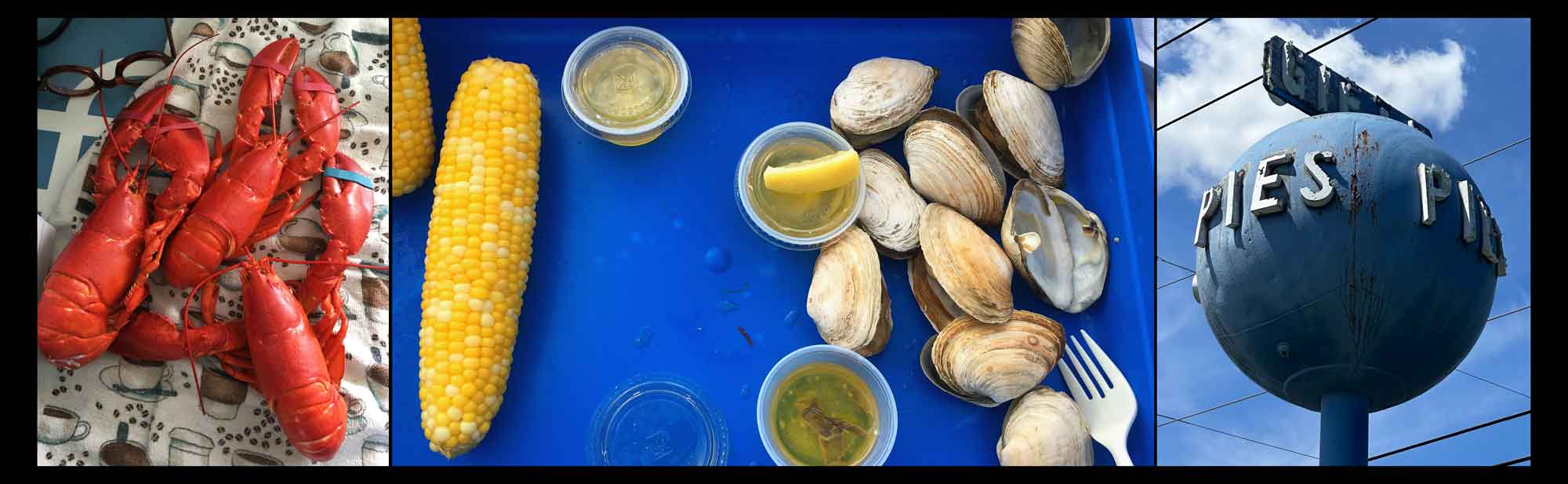
The Red, White & Blue of a Maine Summer: Cushing, 2022: Lobsters Steamed, Pound Direct. Middle: Steamers & Corn, Bar Harbor, ME, 2019. Right: Wild Blueberry Land Sign, Columbia Falls, ME, 2024. Photos by David Spencer for PhotoSeed Archive
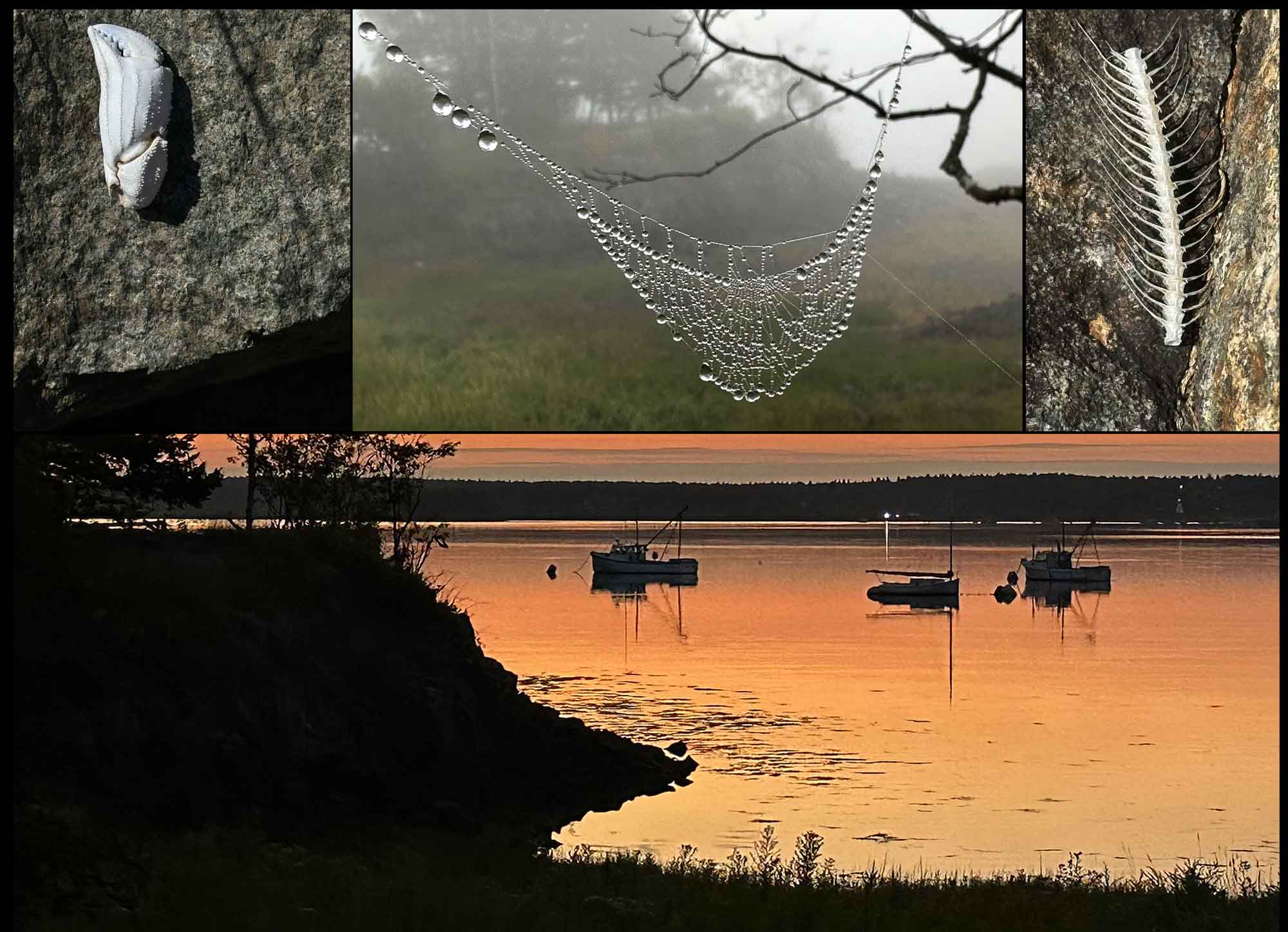
Maine Tide & Time: Upper Left: Bleached Crab Claw on Rock: Bog Brook Cove Preserve Beach, Trescott Township, Washington County, ME, 2026: “Maine Coast Heritage Trust began eyeing this stretch of Down East coast for conservation back in the late 1980s, and the organization worked for 30 years to assemble the nine parcels that now make up 1,770-acre Bog Brook Cove Preserve, straddling the town line of Cutler and Trescott, in Washington County.” Upper Middle: Cobweb Hammock, Lubec, ME, 2026. Upper Right: Fish Spine, Bog Brook Cove Preserve Beach, 2026. Bottom: Eastern Glow, Johnson Bay, Lubec, ME, 2026. Lobster boats and a sailboat dot Johnson Bay in the eastern-most town in the United States, with Canada’s Campobello Island serving as the backdrop. Photos by David Spencer for PhotoSeed Archive
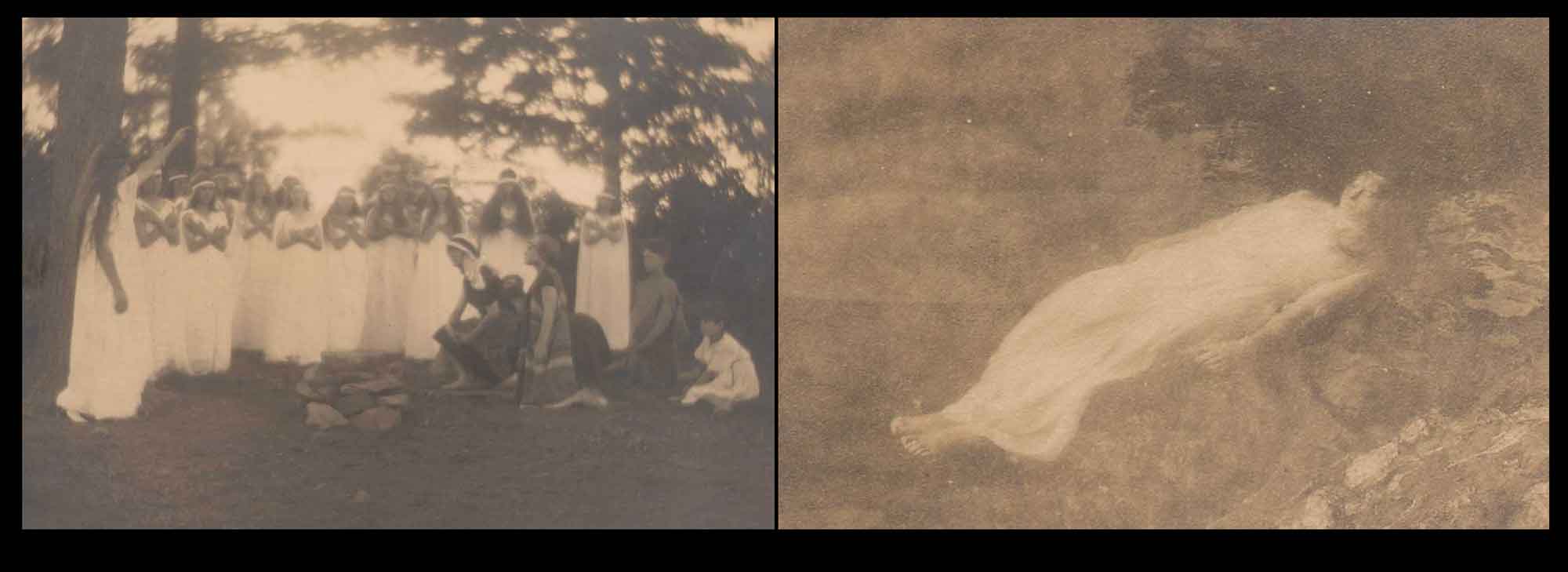
Summer Camp Scenes, Sunday Bible Drama : Camp Sidney Lanier, 1916, Margaret Watkins , Canadian, 1884-1969, gelatin silver print, 15.5 x 20.8 cm. Known as “primitive dramas” , these campers act out a Bible drama written by Sidney Lanier Jr. (1870-1918) in the camps woods. Likely dating to 1916, this and two other known photographs by Watkins were taken at Camp Sidney Lanier, located in Eliot, Maine from 1908-1940. In 1914, Watkins had attended a six-week session of the Clarence H. White Summer School of Photography (Sequinland School of Photography) at Georgetown, ME, eventually teaching at the school in CT and New York City beginning in 1917. Right: Mermaid Study : Submerged, (detail) 1914, Charlotte Vetter Gulick, American, 1865-1928, gelatin silver print, 8.4 x 10.8 | 16.7 x 22.7 cm gray art paper. The subject of this photograph, a person shown underwater, was something rarely if ever photographed, at least successfully, from this time period. Most likely taken with a hand-camera, the swimmer is Katharine “Kitty” Gulick, (1895-1968) youngest daughter of photographer and Wohelo camp founder Charlotte Vetter Gulick. She and husband Luther Halsey Gulick (1865-1918) founded the camp in 1907, located on the shores of Sebago Lake in Raymond, Maine. Wohelo Camps continue to operate in the present day. (2026) Both: PhotoSeed Archive
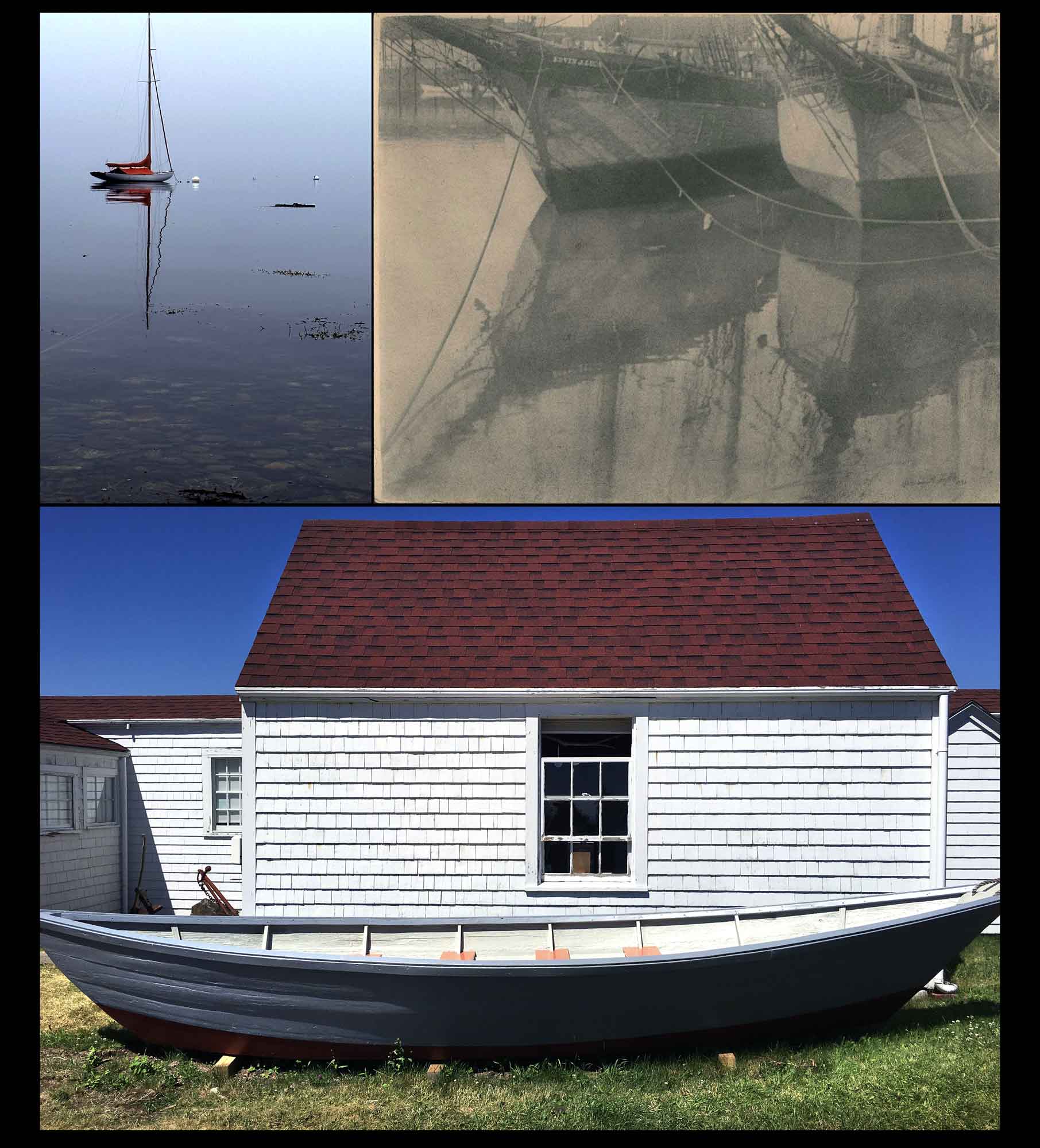
Top Left: Isleboro, 2023: Sailboat Reflection. David Spencer for PhotoSeed Archive. Top Right: In Port (Rockland Maine), 1931, Hermann C. Lythgoe, American, 1874-1962, unmounted bromoil print, 27.7 x 35.2 cm. Reflections from the hulls of two large sailboats and their mooring lines are seen in the harbor at Rockland. PhotoSeed Archive. Bottom: Bottom: The Fitzgerald Dory, Monhegan Island, 2022. Known as The Command, this dory, once owned by Monhegan artist James Fitzgerald, (1899-1971) sits on the grounds of the Monhegan Island Light station. A plate attached to the boat: (excerpt) Fitzgerald “developed a deep appreciation for the beauty and seaworthiness of a dory when he joined the crew of the schooner Elizabeth Howard in 1923. In 1963, he purchased this dory from the captain of a seine boat that had tied up at Monhegan Wharf. Naming it The Command, Fitzgerald often used the dory as a model for his artwork.” David Spencer for PhotoSeed Archive
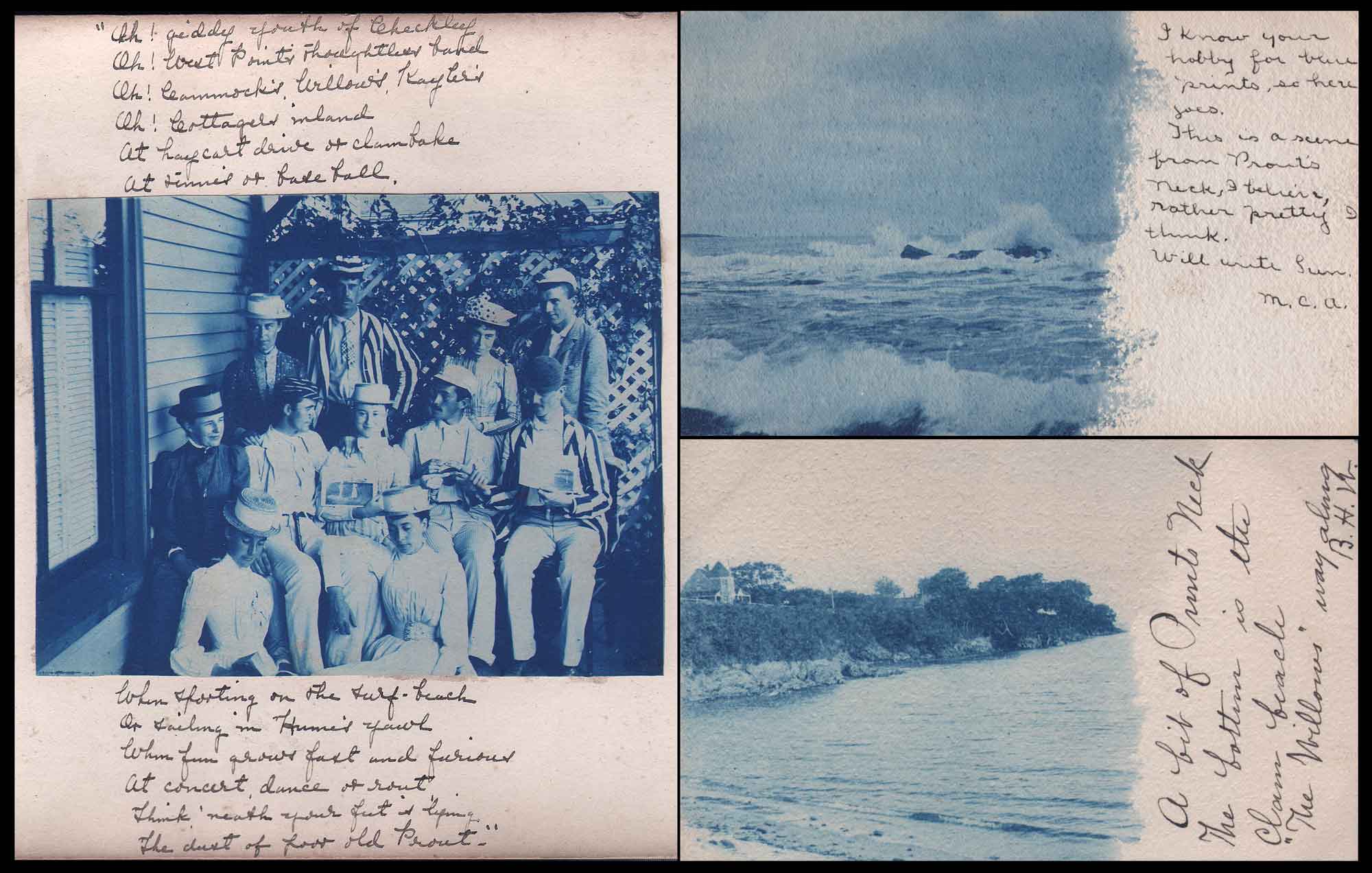
Scenes from Prouts Neck: Left: Young people Dressed for Summer at Prouts Neck, Maine, ca. 1890, unknown American photographer, cyanotype on leaf contained within album, 8.8 x 11.5 | 15.5 x 18.0 cm. The following lines are inscribed with this photograph, the early references being large Summer hotels that once operated in Prouts Neck, often catering to those from society. “Oh! giddy youth of Checkley | Oh! West Point’s thoughtless band | Oh! Cammock’s, Willow’s, Kayler’s | Oh! Cottages inland | At haycart drive or clambake | At tennis or base ball : When sporting on the surf-beach | Or sailing in Homer’s (?) yawl | When fun grows fast and furious | At concert, dance or rout | Think neath your feet is lying | The dust of good old Prout.” Circular photographs consistent with Original or No. 1 model Kodak also included in this album, giving indication of assigned date. From: PhotoSeed Archive. Top Right: Prouts Neck Surf, 1905, unknown American photographer “M.C. A.”, cyanotype, undivided back rppc, 8.6 x 13.8 cm. Mailed from Union, N.H. to Miss Ina M. Allen of Westbrook, ME, “M.C. A.” writes on recto: “I know your hobby for these prints, so here goes. This is a scene fro Prout’s Neck, I believe, rather pretty I think. Will write Soon.” Bottom Right: A Bit of Prouts Neck, ca. 1905, Signed on recto by the unknown American photographer B.H.W., cyanotype rppc, not mailed, undivided back, 8.6 x 13.8 cm. In hand of photographer on recto: A bit of Prouts Neck | The bottom is the Clam beach | “The Willows” way along.” The Willows Hotel, also known as Sea View House, was established in Prouts Neck in 1871 by Benaiah Libby. (1814-1878) Both: PhotoSeed Archive
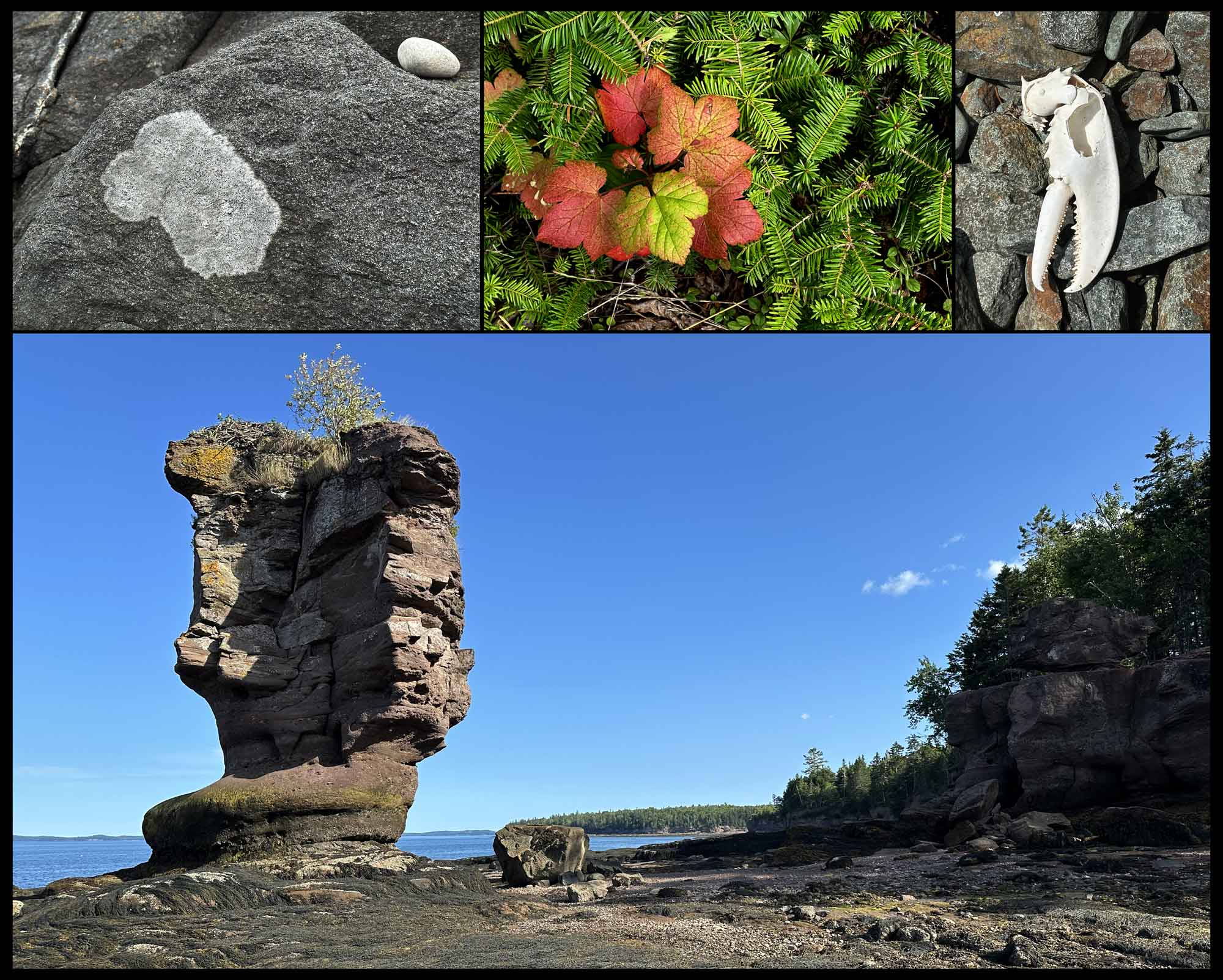
Steuben, 2024: “Lichen & White Rock”. Spied on Petit Manan Point shoreline on Pigeon Hill Bay, part of the Maine Coastal Island National Wildlife Refuge in Steuben, ME. Top Middle: Ribes glandulosum ? (skunk currant) & Fir Seedlings, Quoddy Head State Park, Lubec, ME, 2025. Top Right: Bleached Lobster Claw, Eastern Knubble Preserve, Cutler, ME., 2025. Bottom: Pulpit Rock at low Tide, Perry, ME, 2025. “Pulpit Rock is a sea stack, located between Mill Cove and Lewis Cove in the down east town of Perry on the Saint Croix River. A sea stack is an isolated, pillar-like rocky island, detached from the mainland by wave erosion (Bates and Jackson, 1984). Pulpit Rock was first noted in print by geologist C. T. Jackson in 1837 in his First Report on the Geology of the State of Maine. It has since been visited and described by a number of geologists. The area is noted for its high tides so it is imperative to plan a visit during a falling or low tide.” From: Maine Geologic Facts and Localities, Jan. 2016. All: Photos by David Spencer for PhotoSeed Archive.
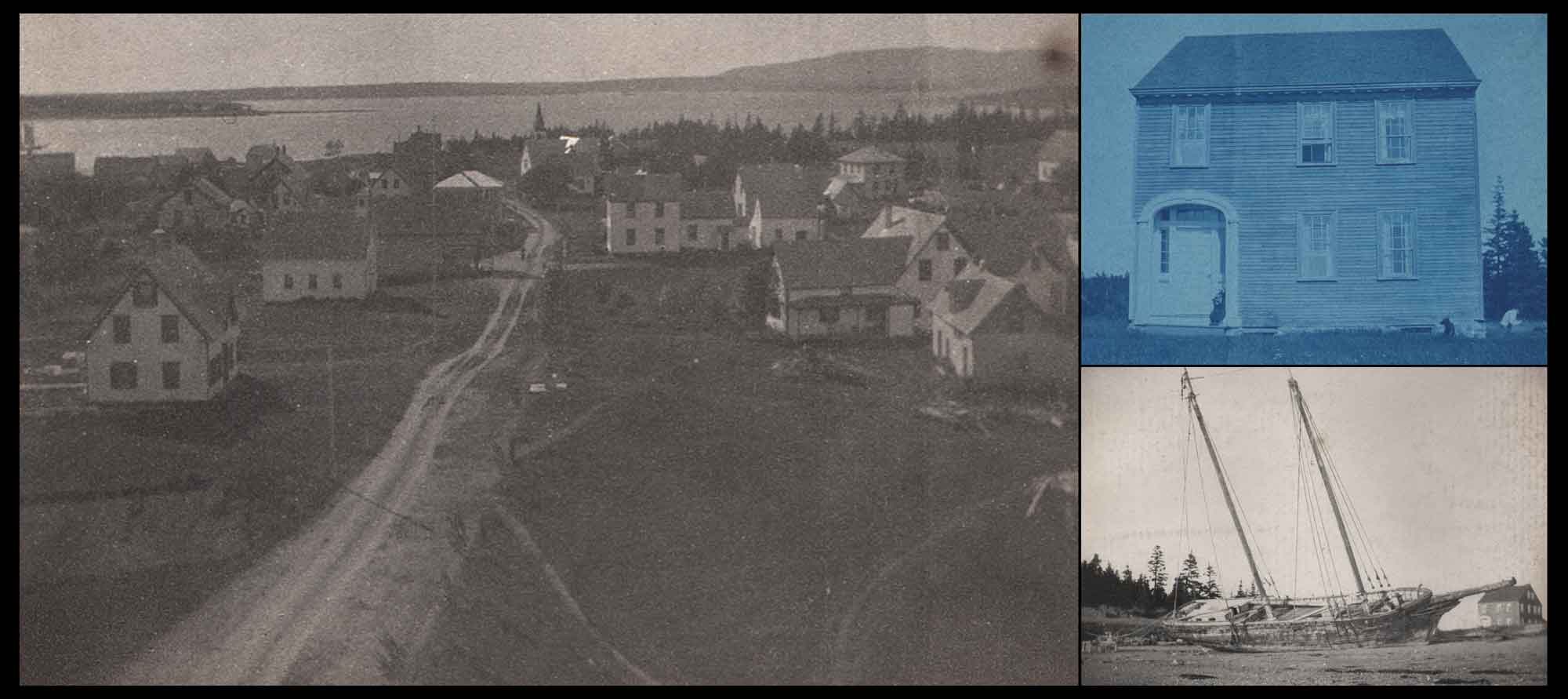
Summer Maine Rentals: View labeled Cranberry Isles, Maine, 1899, detail: album-mounted gelatin silver print, Phillip Patterson Wells, American, 1868-1929, 8.3 x 8.1 | 16.5 x 21.5 cm. This view is believed to show Great Cranberry Island, one of the five islands comprising the Town of Cranberry Isles. Wells and his family spent the summer on the island. Top Right: Capt. Hadlocks house rented to us, 1899, detail: album-mounted cyanotype print, 8.5 x 8.5 | 16.5 x 21.5 cm. (Phillip Patterson Wells) Captain Gilbert T. Hadlock, (1837-1917) who served as a Captain of a Treasury Department Lifesaving Station (Predecessor of the US Coast Guard) and ran steamboats, rented this home to Dr. Wells and his family. One of his children can be seen on the front entrance step. The home burned down in 1915. Lower Right: Old wreck at Isleford, 1899, detail: album-mounted gelatin silver print, 8.5 x 8.5 | 16.5 x 21.5 cm. (Phillip Patterson Wells) The wreck of a large two-masted sailboat is beached in front of the Hadlock house, seen in background, far right. Another view of the home, from the Great Cranberry Island Historical Society. Dr. Wells was librarian and instructor at Yale Law School for several years, and chief law officer under Gifford Pinchot for the U. S. Forestry Service, 1907-1910, counsel National Conservation Association, 1910-1911, chief law officer U. S. Reclamation Service (Department of the Interior), 1911-1913. All: PhotoSeed Archive
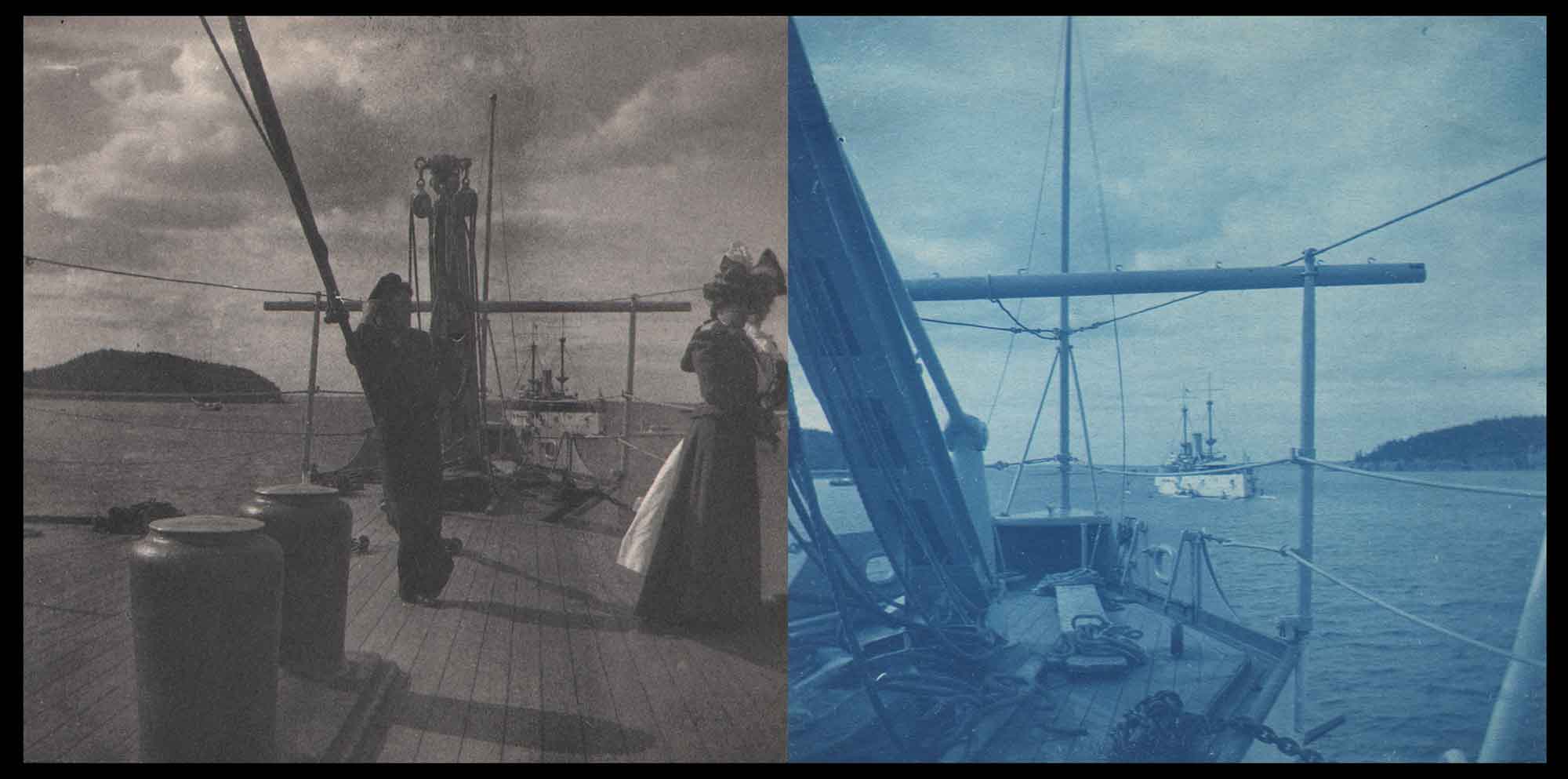
Summer Sailing Excursion: Fleet at Bar Harbor, 1899, album-mounted gelatin silver print, left and cyanotype at right, Phillip Patterson Wells, American, 1868-1929, each: 8.3 x 8.1 | 16.5 x 21.5 cm. From an album of summer views labeled Isleford, 1899 assembled by Wells. These two photographs appear on opposite album pages and were taken moments apart on the deck of a Bar Harbor excursion ship. Notice the sailor standing at ease in photo at left while several fashionably dressed women in hats stand nearby. At right, a closer view of the unknown US Navy battleship seen off the main bow area. Both: PhotoSeed Archive
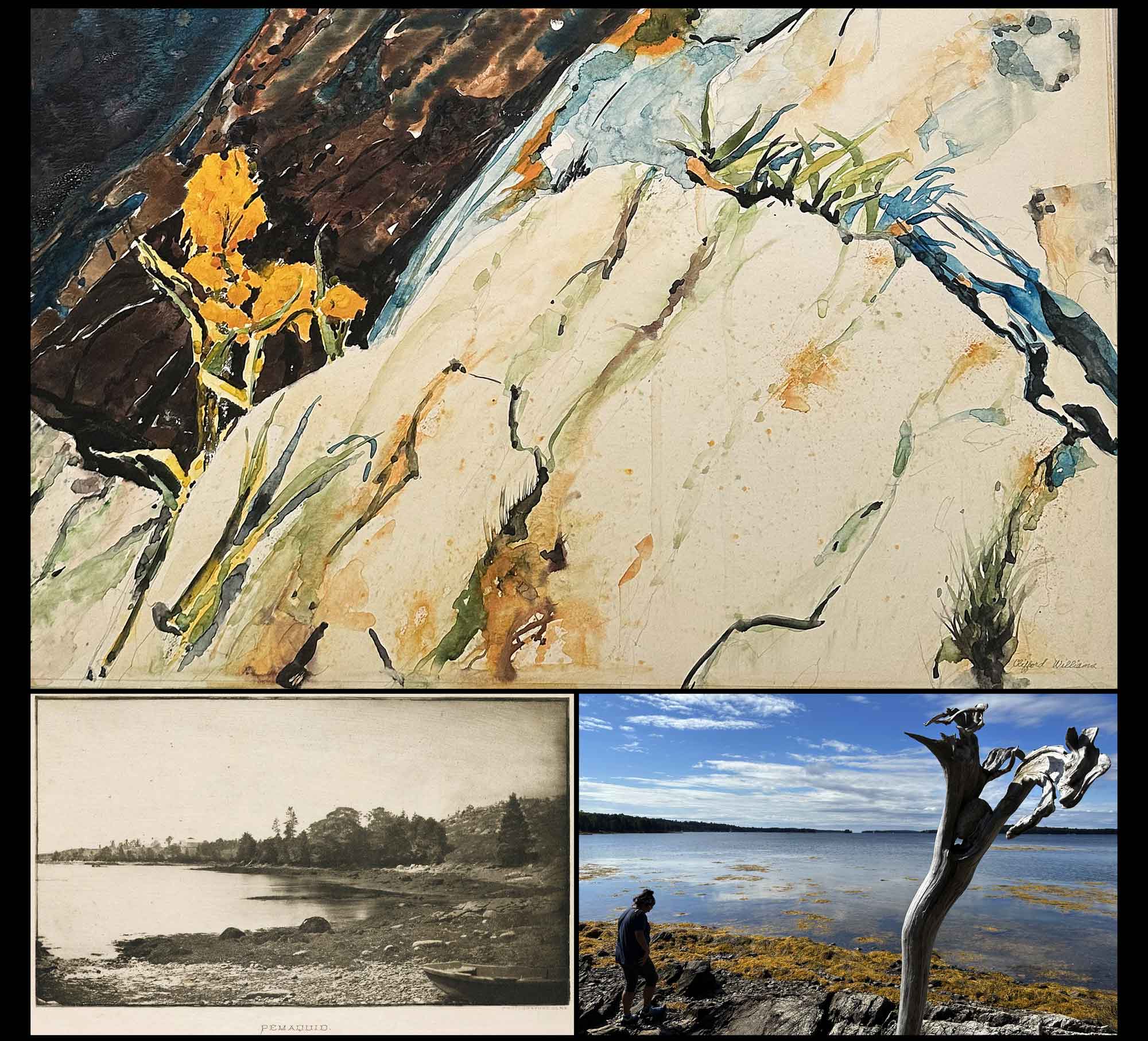
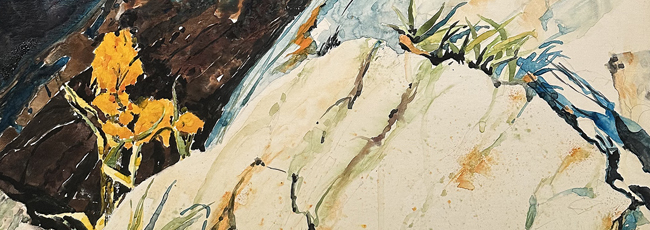
Rock Flower, Pemaquid, detail, ca. 1955-65, Clifford Williams, American, 1885-1971, watercolor on Fome-Cor type matrix, 54.0 x 53.6 cm. Likely depicting Seaside Goldenrod, (Solidago sempervirens) this abstract study of a rocky shoreline was done late in the artists career, and bears a deaccessioned label from the Providence Art Club of Rhode Island. Edith Clifford Williams was an early pioneer in the American abstract art movement. She was part of the circle that gathered around the photographer and modern art promoter Alfred Stieglitz. She was also a long-time confidante of Hu Shih (1891–1962), who was arguably the most prominent Chinese intellectual in the first half of the 20th century. Born in Ithaca, New York, Williams—who preferred to be known as Clifford—spent most of her girlhood in New Haven, Connecticut, where her father, Henry Shaler Williams, taught geology and paleontology at Yale University. After studying with the painter John Henry Twachtman and at Yale’s School of the Fine Arts, she traveled to Europe, and was enrolled briefly at the Académie Julian in Paris. Lower Left: Pemaquid, 1888, tissue photogravure, believed to be by Ernest Edwards, naturalized American, born England, 1836-1903, 10.8 x 18.6 | 25.3 x 30.5 cm. Pemaquid is a village within the town of Bristol, Maine, situated on the Pemaquid Peninsula, which extends into the Gulf of Maine. Lower Right: Nature Walk, Gilkey Harbor, Broad Point Preserve, Islesboro, ME, 2023. A large upended piece of driftwood becomes a readymade sculpture along the coastal trail at Broad Point Preserve, part of the Islesboro Islands Trust. David Spencer for PhotoSeed Archive
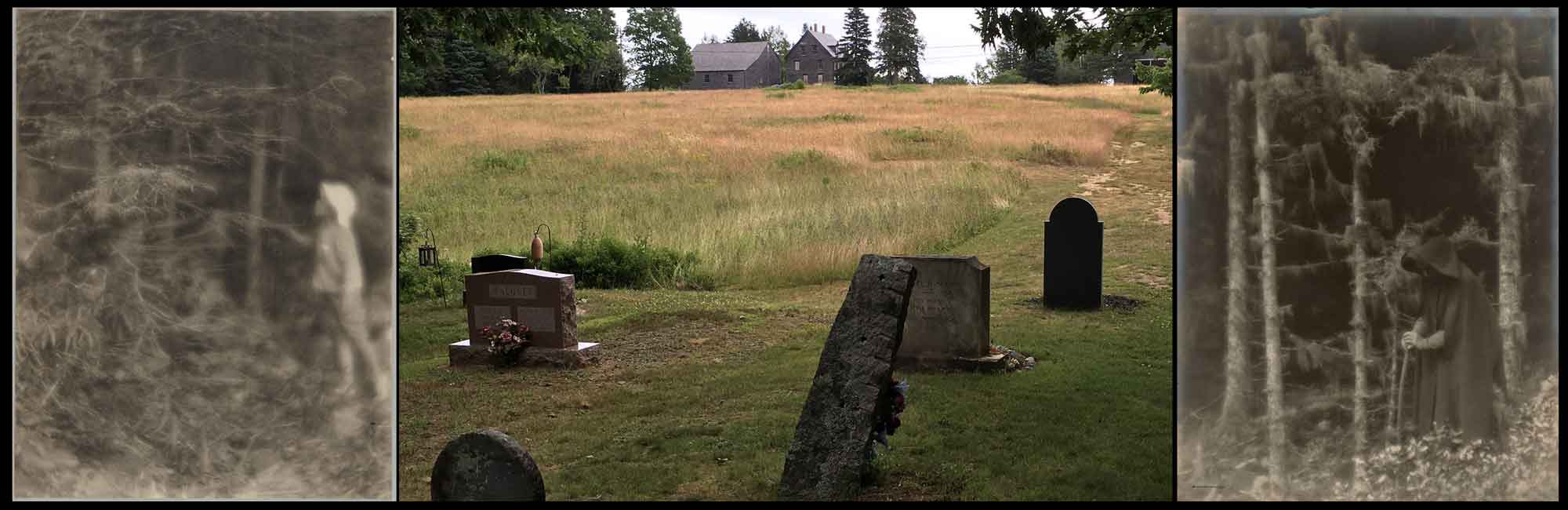
Artistic Ghosts of Maine: Child in woods, Maine (Clarence H. White, Jr.?) ca. 1910–1915, Clarence Hudson White, American, 1871–1925, platinum print. Collection: Princeton Museum of Art, Princeton, N.J. Middle: Olson House Grounds & Wyeth Plot, Cushing, Maine, 2022. The late 1700’s Olson House, a National Historic Landmark that served as artistic meadow backdrop for Andrew Wyeth’s 1948 painting Christina’s World, is seen at center background along with the gravesite (front right) of American artist Andrew Wyeth (1917-2009) & Betsey Wyeth. (1921-2020) The Museum of Modern Art, which owns the painting, states: “The title Christina’s World, courtesy of Wyeth’s wife, indicates that the painting is more a psychological landscape than a portrait, a portrayal of a state of mind rather than a place.” Anna Christina Olson, 1893-1968, the subject of the painting, is also buried here with other Olson family members. Right: Witches’ Wood, 1915-20, Bertrand H. Wentworth, American, 1869-1953, gelatin silver print, 34.9 x 27.1 cm. Most likely a self-portrait, Wentworth, from Gardiner, ME, spent time at the artists colony on Monhegan Island. He was described as a “master craftsman” affiliated with the Society of Arts and Crafts of Boston and marketed his work as The Wentworth Photographs. Learn more. From: PhotoSeed Archive
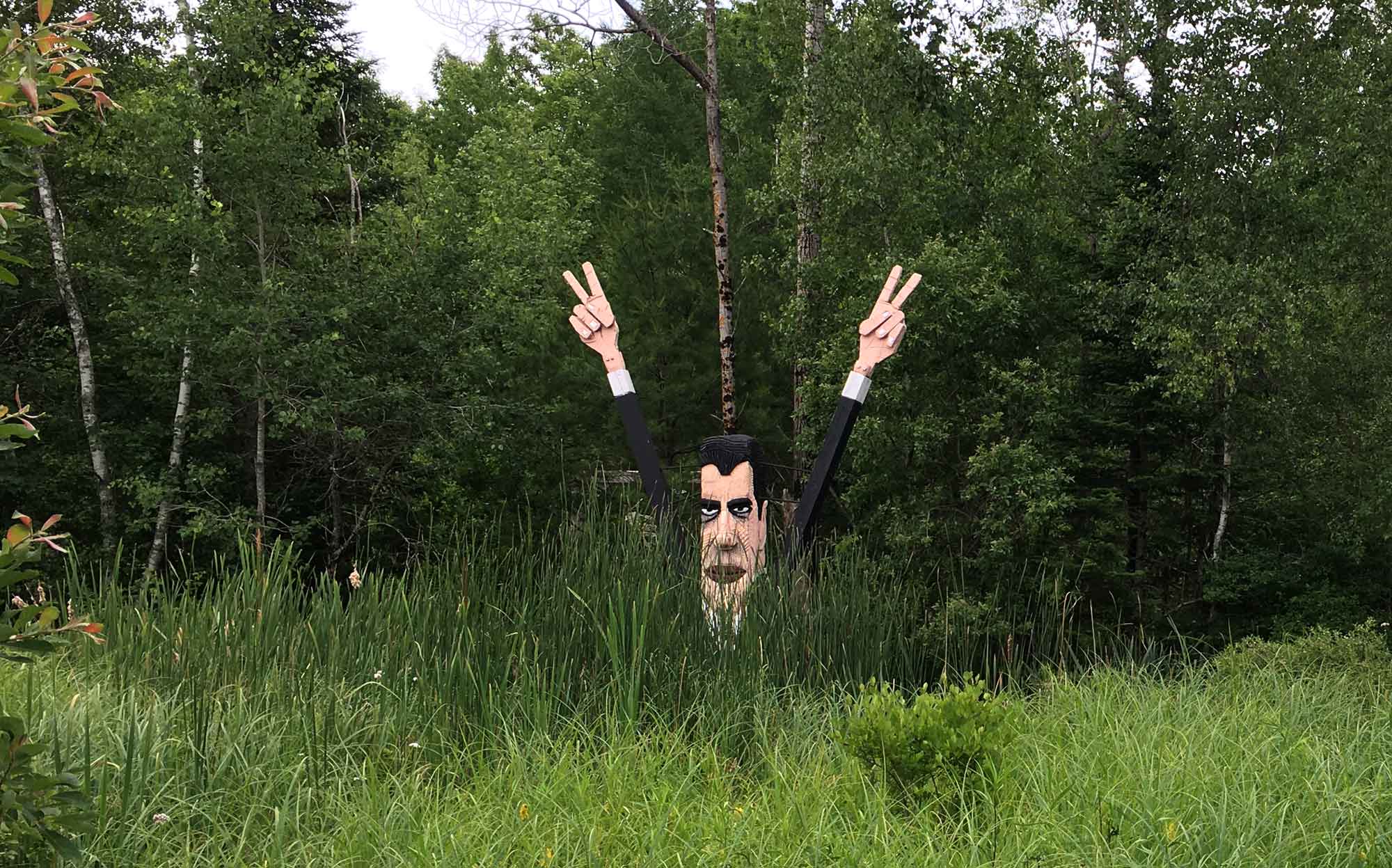
Nixon, 1973, Cushing, ME, 2022. Surprises are in store for intrepid visitors venturing off the well-worn tourist outposts in Maine. Sprouting from the reeds along the art trail of the Langlais Sculpture Preserve is former US President Richard Nixon carved in wood from a famous photograph. The work is by Maine artist Bernard Langlais, 1921-1977: “I don’t know if I’m called a constructivist, sculptor, or painter…But I wouldn’t mind being called a backwoodsman.” – Bernard Langlais, 1961. Photo by David Spencer for PhotoSeed Archive