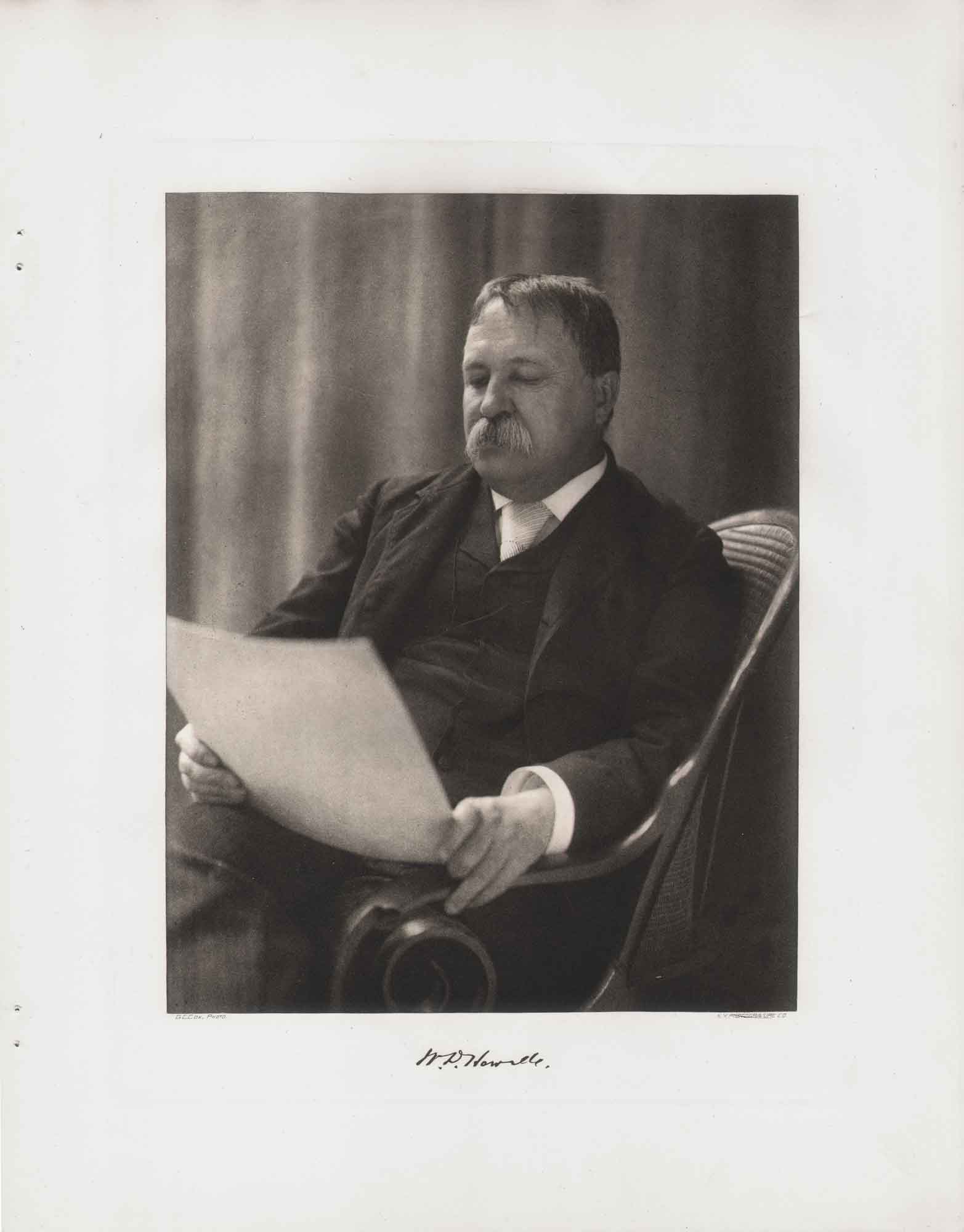
William Dean Howells—American Author & Editor
The following commentary appeared on the index page for this portrait of William Dean Howells by George Collins Cox: “Mr. Howells was born at Martin’s Ferry, Ohio, March Ist, 1837. His ancestors on his father’s side were Welsh Quakers. They were well-to-do manufacturers. When he was three years old, his father removed to Hamilton, Ohio, and started a weekly journal which he soon parted with; and, changing his abode to Dayton, Ohio, he bought and published the “Dayton Transcript,” on which, later, young Howells and his brothers assisted at type-setting for the journal. This venture eventually proving a failure, “We all went went down to the Miami River and had a swim,” says the author. In 1851 he was assisting his father on the “Ashtabula Sentinel.” At the age of 19 he was the Columbus correspondent of the “Cincinnati Gazette, and at 22 was contributing poems to the Atlantic Monthly. In 1861 he received the appointment of Consul to Venice, where he remained four years. Here he wrote a series of papers called ” Venetian Life,” which first appeared in book form in England. This work made a sensation, and gave Mr. Howells at once a place in literature,
“The sketches had the novelty of realism, never was Venice so perfectly photographed, and the reader was agreeably surprised to find that the intrinsic romance of the city of the lagoons was heightened by the delicate and sympathic analysis ” said an English critic.
Returning home Mr. Howells was for some time engaged as editorial writer on the N. Y. “Tribune” and “Times.” In 1866 he was appointed assistant editor of the “Atlantic Monthly,” and in 1872 assumed entire control of the editorial department of that periodical, holding the position more than 10 years. He left it to accept an editorial position on “Harper’s Magazine,” where he remained another 10 years, during which time he printed many essays and criticisms on American and European authors which were widely copied and commented on. In these papers he spoke his mind freely and well, so well in fact that many of the brightest and best minds in literature put on the gloves to have a bout with him, and skin tight many of the gloves were, too.
The ponderous, soggy English journals howled at the daring of this Yankee iconoclast. Whether or no one agrees with his critical judgment, the fact remains that he is today the foremost figure in American literature, and it is a most tremendous feather in his cap that he should have arrayed against him so many able, if unreasonable minds.
After reading “Private Theatricals,” a lady said to the writer of this note, “I am out of patience with Mr. Howells. He has no business to know so much about the foibles and weakness of female human nature, and, knowing them, it’s mean to tell them to other men.” This may be said to be absolutely first-class recognition of his accurate observation, and his telling way of putting it into print.
The list of his novels, farces and plays is very long. He has also published one or more volumes of poetry.
He now occupies the editorial chair of the Cosmopolitan Magazine of New York.“
George Collins Cox: 1851-1903
“Cox, who is an exceedingly eccentric genius, stands in a class by himself, his portraits comparing very favorably with those of Hollyer, Cameron, Crooke, and other giants of yours. For years past, this artist has been turning out magnificent portraits full of character and individuality, and treated in a bold execution, but it is impossible to induce him to exhibit any of his work, even in an exhibition like the Salon.”—Alfred Stieglitz: The Photographic Year in the United States-Photograms of the Year 1897
From the 1989 Guide to Photographic Collections at the Smithsonian Institution: National Museum of American History, we learn some background biography for this important American photographer, including museum holdings. An updated biography with holdings was later prepared by museum intern Patrick Jackson for a blog post on August 18, 2017, which follows.
George Collins Cox (1851-1902) began his photographic career in Newark, New Jersey. Between 1884 and 1901 Cox had his own photographic portrait studio at 826 Broadway in New York. He photographed friends, including prominent figures, such as, Edward Everett Hale, General George B. McClellan, and Walt Whitman.
Both American impressionist painter William Merritt Chase and sculptor Augustus Saint-Gaudens are known to have used Cox’s photographs as preliminary visual aids or studies for their own work. This collection was acquired in 1962 from Cox’s family.
Some of Cox’s portraits were reproduced in journals, such as, The Century Magazine, The Century Gallery of One Hundred Portraits, 1897, and Harper’s Weekly. Note: Cox copyrighted his portraits of Walt Whitman.
Physical Description
The collection consists of 1,400 photographs, including platinum photoprints, salted paper photoprints, and silver gelatin photoprints.
Subjects
The photographs are portraits of American actors; artists; celebrities; editors; financiers; painters; poets; sculptors; and writers of the 1880s and 1890s. There are many portraits of William Merritt Chase; Richard Watson Gilder; H.H. Richardson; Augustus Saint-Gaudens; and Walt Whitman. There are also many portraits of anonymous children, men, and women, both in the studio and in their homes. PH-12 (pp. 221-2)
2017: National Museum of American History: Unmasking photographer George Collins Cox, by Patrick Jackson
“When I started my internship here at the {Smithsonian] museum, I was tasked with tackling the collection of the photographer George Collins Cox (1851–1903), which I now know contains almost 2,000 photographs. The Cox collection is very exciting to me, not only because of its significance to the history of photography, but because of its massive potential for further research. The Cox collection, as far as we know, has not been researched or written about for over 50 years, since Marchal Landgren, an advocate for Cox, helped to bring the collection to the Smithsonian in 1963. While there is so much to be said, three stories begin to characterize Cox’s life and work.
Cox’s subjects and friends
In a letter from editor Richard Watson Gilder to famed sculptor Augustus Saint-Gaudens, Cox was introduced as “a photographer made (by God) especially for artists.” Saint-Gaudens certainly believed it, as he employed Cox to photograph his subjects and frequently used Cox’s photos as reference for his busts. Saint-Gaudens introduced Cox to some of the most notable people of his day, including poet Walt Whitman, philanthropist Peter Cooper, General William Tecumseh Sherman, and author William Dean Howells. Cox spent his early years, from about 1870 to 1883, in Newark, New Jersey, where he worked with the photographers DeCamp and Crane before starting his own studio, and where he also met Gilder and Saint-Gaudens. Cox cultivated a long-lasting relationship with both men, and although he had an asset in his two notable fans, it was Cox’s skills as a photographer that ultimately won him so many customers and admirers. The famous photographer F. Holland Day sat for Cox in New York in 1890 and admired Cox’s work enough to include it in an exhibit dedicated to “Leaders in the Newer Photographic Methods,” alongside other pioneering photographers like Gertrude Käsebier and Edward Steichen.
Bishop William Taylor, an American Methodist missionary who made a number of trips to Africa, was one of the many significant Americans who sat for Cox. The bishop for a time did not understand why Cox would not pose him for the photo session, but rather engaged him in a lively conversation. Taylor told Cox the story of a young man who came to see the bishop off on his trip back to America: “Good-bye, dear Bishop,” the man blubbered; “I shall probably never see you again.”
“No,” said the Bishop, “you may be dead when I get back.”
It was at this unguarded moment when Cox chose to capture his image.
This was Cox’s intention all along, though Taylor did not know this at first.
Cox did not pose or direct his subjects, but instead attempted to make them forget that they were having their portrait made in the first place. According to journalist Ida Tarbell, Cox believed that “all men purposely or unwittingly wear a mask, and that unless this mask can be torn away . . . no characteristic picture is possible.” This was Cox’s ultimate goal in his pursuit of the photographic art—he wished to capture the essence of the person sitting before him. This anecdote about Bishop Taylor is certainly not the only account of Cox’s successes using his method. Eleonora Duse, the Italian stage actress, when reacting to Cox’s famous photograph of Whitman, exclaimed: “But it is his soul! How can one photograph a soul?”
Cox’s art and isolation
Ida M. Tarbell, later known as the “muckraking” journalist responsible for The History of the Standard Oil Company, wrote an article about Cox for McClure’s magazine in May 1897. To date, it is the only known writing about Cox before his death, and although it was edited to half the original length before publication, is one of the best sources about Cox’s life and his method of photography. Tarbell’s article sheds light on Cox’s situation, in that he was not, as long as his New York studio was open, a conventional commercial photographer. Cox made his living by charging his sitters $20 for a sitting that produced six prints, and $2 for each subsequent print. Cox never advertised his work and, with the exception of two prints from his famous Whitman session that were sold for the benefit of the poet (then in poor health), he never sold any prints of his work to the public.
Cox was an artist first and foremost.
Tarbell wrote: “Conscious that what he was striving to attain would be understood by only a few men, he has worked for them alone, seeking their criticisms and suggestions and observing closely the effect on them of what he had done.” This was true to a fault. After Tarbell’s modest article was published, Cox closed his New York studio and retreated to his home in South Orange, New Jersey, because he feared “the notoriety and consequent embarrassment” of being more widely recognized. It was only a few years later in 1903 that Cox died, and his work sank into obscurity.
George Collins Cox was widely unknown for many years, even to those in the photographic community, until he found an admirer in Marchal Landgren (1907–1983), a historian and author who was heavily involved throughout his life in the art world of New York and Washington, D.C. It was Landgren who organized the only exhibition of Cox’s work at the Museum of the City of New York in 1939, and who located Cox’s massive private collection of prints in the care of Cox’s son, Robert. After locating and thoroughly investigating Robert’s collection, Landgren negotiated the sale of the Cox collection to the Smithsonian in 1963, published an article on Cox in Walt Whitman Review that same year, and planned to author a monograph of Cox, which was incomplete at the time of his death in 1983.
The Cox collection is an underappreciated and little-known treasure at the Smithsonian. Within the 1,927 prints in the collection, there are 146 identified personalities, but there remain many sitters yet to be identified. Hopefully, with this summer’s work, George Collins Cox will become more visible and entice others to research him. Cox’s contributions to preserving the visages of the Gilded Age are likely to further illuminate this momentous era in American history.
Patrick Jackson is a history student at Washington College and was an intern in the Photographic History Collection in the summer of 2017.
- History: The Century Association, Landmarks Preservation Commission January 5, 1993, Designation List 248 LP-1763: (FORMER) CENTURY ASSOCIATION BUILDING 109-111 East 15th Street, Manhattan. Built 1869; architects Gambrill & Richardson. p. 2
- Excerpt, Henry Van Dyke, “Self Reliance and the Republic”, in: Pro Patria | The Spirit of America Fighting for Peace, N.Y. Charles Scribner’s Sons, 1921, p. 37
Sun & Shade: An Artistic Periodical
“Within the covers of Sun and Shade…We shall especially endeavor to encourage the artistic side of direct photography in all its phases,”—Ernest Edwards, president & publisher, 1889
In July, 1888, the first issue of Sun & Shade: A Photographic Record of Events, was published in New York City by The Photo-Gravure Company. Essentially a high-class art periodical, each issue featured eight or more beautiful hand-pulled photogravures as well as plates printed in photogelatine, (collotype) and halftone. These were collected within a stapled, folio-sized magazine issued monthly. The subject matter included the work of leading amateur and professional photographers, as well as works of art—many from the galleries at The Metropolitan Museum of Art in Manhattan. The December issue—Christmas themed—featured a specially designed cover printed in green ink. Success was swift. The first issue sold 1000 copies “in a fortnight”. (1.) Within the first year, Sun & Shade quickly increased circulation to 4000 copies a month. With a public demand for reprinting earlier issues, this success lead to a rebranding, after which, beginning with the September, 1889 issue, the magazine was renamed Sun & Shade: An Artistic Periodical. The final issue was March, 1896, when financial issues to the parent company, spurred by the eventual May, 1896 bankruptcy of the N.Y. Photo-Gravure Company, forced its closure.
Sun & Shade would become the ultimate statement of the many skills and inquisitive mind of Englishman Ernest Edwards. (1836-1903) Essentially his own printed passion project, the magazine was fueled by his ongoing love of photography in the field (issues featured many plates by him over the years) and a deeply scientific mind which pushed the advancement of the state of photo-mechanical reproduction and fine printing.
The son of a clergyman from Bloomsbury in London, he initially made a name for himself taking photographic portraits of eminent people in his Baker Street gallery. (Charles Darwin sat for him several times) His love of the outdoors also bore fruit and he became an accomplished alpine photographer. But his real interest centered around photo-mechanical reproduction. In 1869, he took out a patent in England for his own rudimentary collotype process called heliotype. In the Fall of 1872, he moved across the pond along with his wife Charlotte, and became superintendent of Boston’s Heliotype Printing Company after selling the American rights to American publisher James Ripley Osgood. (1836–1892) Edwards ran the Heliotype Printing Co. there until the end of 1884. The following year the James R. Osgood & Co. went bankrupt, although not a result of the heliotype division.
Growing restless in Boston, he then moved to New York City, where he established a new firm in March, 1885: The Photo-Gravure Company, (subsequently renamed The New York Photo-Gravure Company) with offices in Manhattan and a leased printing factory in Brooklyn. In 1887, his company received perhaps the one commission it’s best known for today: the printing of 781 collotypes, which Edwards called photogelatine plates, making up the monumental publication:
Animal Locomotion. An Electro-Photographic Investigation of Consecutive Phases of Animal Movements, 1872-1885, with the landmark sequenced motion study photographs taken by British photographer Eadweard Muybridge.
Restructured in 1891 as the New York Photogravure Co., Ernest Edwards continued to advance the state of photo-mechanical printing during his final decade, with Sun & Shade publishing some of the earliest examples of his own invention by 1894: plates printed in a three-color process called chrome-gelatine, a variation of his heliotype process.
Quality Rather than Quantity
Even though it survived less than eight years in print, describing Sun & Shade in Ernest Edward’s own words is perhaps the best posterity for this important photographic periodical with an artistic heart. One year after its’ debut, he wrote the following, published in The Photographic Times for August 2, 1889:
“A year ago we commenced the publication of our novel venture in journalism Sun and Shade, a Picture Periodical without letterpress, almost as an experiment, with a modest list of less than fifty subscribers. To-day we are printing an edition of 4,000 copies monthly. A sufficiently convincing proof of the wisdom of our hope that there was room for us.
“In our rapid growth the wish has been indicated unmistakably for the higher grade of pictures, and of the higher class–always for quality rather than quantity. Following rather than leading such a wish, we feel that we make no mistake in marking the future career of the magazine to be rather that of an artistic periodical than a photographic record of events.
*Our efforts shall be directed in the future to make Sun and Shade an artistic periodical which shall be not only pleasing but educational in its broadest sense, Some of our plans may be briefly referred to.
“We shall reproduce the leading pictures in the great collection of the Metropolitan Museum of Art. Within the covers of Sun and Shade will be found from time to time, reproductions of the works of American artists. We shall especially endeavor to encourage the artistic side of direct photography in all its phases, And we shall supplement these special features with examples of sculpture, architecture, and industrial art. If in the future we receive as hearty a response to our efforts as we have received in the past, our task will be indeed pleasant and our road to success a royal one.” (p. 394)
- Notice: Sun & Shade: October, 1888. The August and September issues did not appear.