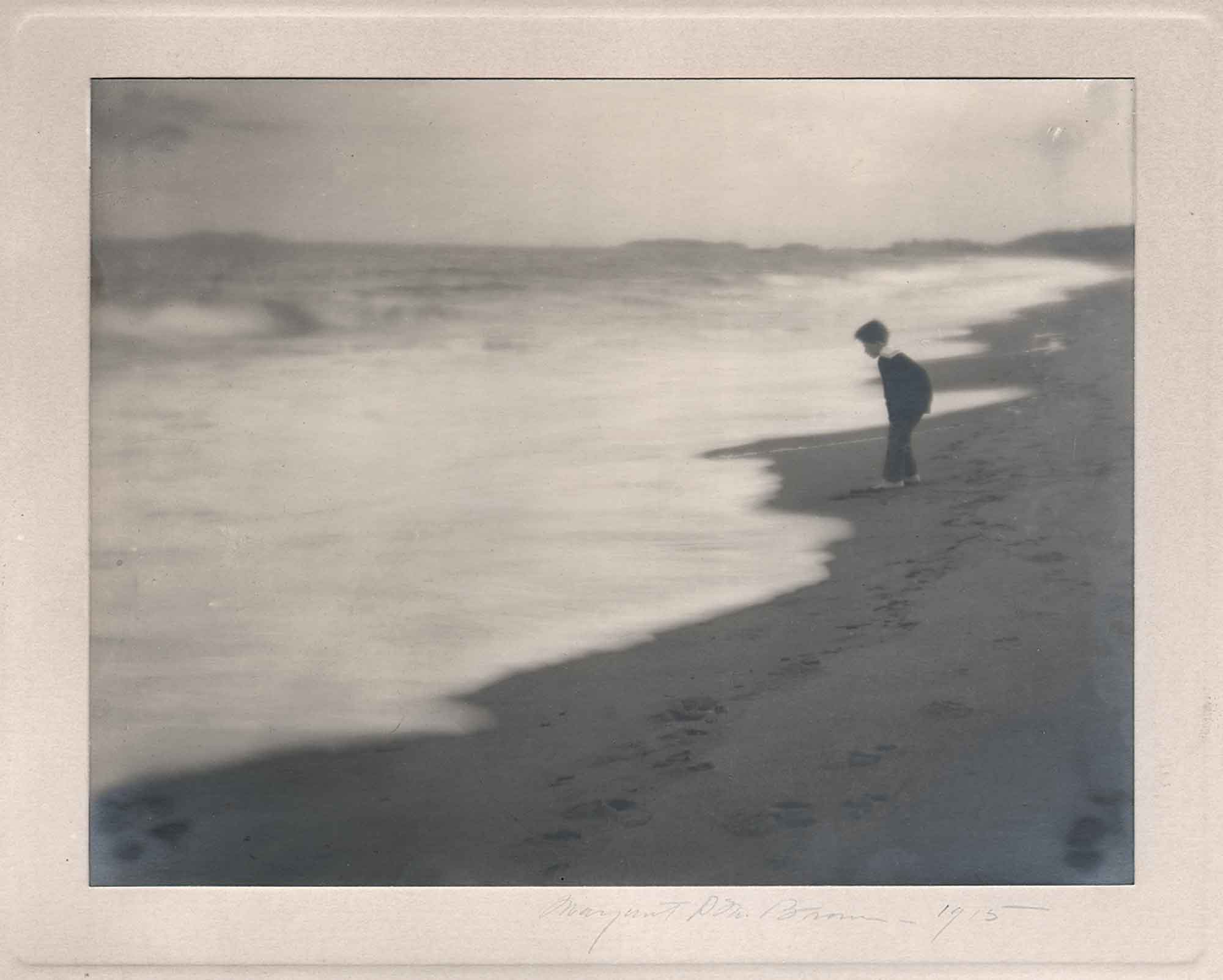
Foamy Shores | Clarence White Jr. at Mile Beach, Sequinland, Maine
Wearing a sailor suit as family tradition held while living in Maine, Clarence Hudson White Jr., (1907–1978) then about eight years old, takes in the waves at Mile Beach at Sequinland, Maine. The beach is now part of Reid State Park in Georgetown, ME. Titled Foamy Shores by the artist, this is a rare surviving example of a signed, student-mounted work taken during the final year of the Seguinland School of Photography before summer classes moved to CT the following year.
White was the third son of photographer Clarence Hudson White, who founded the Seguinland School in Georgetown, ME in 1910. As seen here, Clarence Jr. (as well as older brother Maynard) sometimes served as models for the photography students attending. Later, after his father died in 1925, Clarence Jr. was actively involved in running the Clarence White School of Photography, founded in New York City in 1914. As a result of World War II, the school closed in 1942 but was re-established by him in 1948 at Ohio University, creating the first degree-granting program in photography at a major university in the country. A visitor and summer resident of this area of coastal Maine his entire life, in the 1970’s, he and wife Ruth Royer White moved back to the White family summer home in Georgetown full-time, where he died on March 1, 1978.
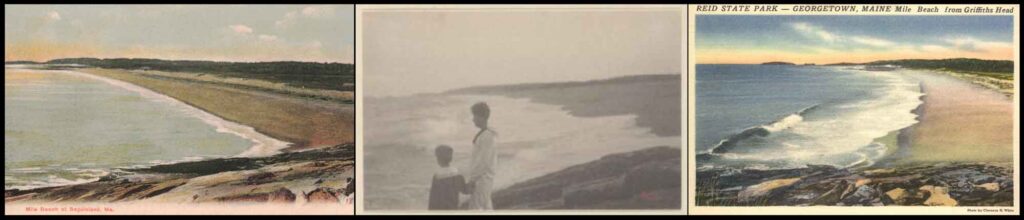
Postcards & Photos of Mile Beach: Left: “Mile Beach at Seguinland, ME”, ca. 1905, undivided back lithographic postcard published in Germany by G.W. Morris, Portland, ME. Middle: “Untitled {Likely Clarence H. White, Jr. at lower left holding hands with brother Maynard White gazing at Maine surf}”, 1915, Ruth W. Henry, American, platinum print from Class of 1915 Album, Collection: Princeton University Art Museum. Right: “Reid State Park —Georgetown, Maine Mile Beach from Griffiths Head”, photographed by Clarence H. White, ca. 1938, Tichnor Brothers “Gloss Series” postcard.
Margaret DeMotte Brown: 1880-1959
Besides research by this site, details for the following timeline are courtesy of independent historian Lee McIntyre, Ph.D., who hosts the blog and podcast Photographs, Pistols & Parasols, celebrating early women artisan photographers. Listen: Finding Miss DeM. Brown, which originally aired July 15, 2017. Also, continued thanks to Anne McCauley, David H. McAlpin Professor of the History of Photography and Modern Art, emerita, Princeton University.
1880: Born March 1 in Jacksonville, Illinois.
1905: In this year, “we start to see her advertising photos for sale in various little photo journals that are circulating among people who are professional photographers and photography hobbyists. In 1905, Miss DeMotte Brown is advertising photos of the south — typical scenes of the south — black and white prints available for sale.” (podcast transcript: Lee McIntyre)
1907: Notice of first year Brown became a teacher at the Illinois School for the Deaf, Jacksonville, IL, where she teaches photography. (1.) Although not deaf herself, her position was undoubtedly attained through connections made by her maternal grandfather Dr. William Holman DeMotte, (1830-1910) a prominent deaf educator who held multiple small college presidencies in the Midwestern United States, including Illinois Female College at Jacksonville, Ill. from 1868-1875. (2.) (the former MacMurray College) The bulk and highlight of his career was that of faculty member for a combined 34 years at the now Indiana School for the Deaf in Indianapolis. During Civil War service in Washington D.C., he was also present at Ford’s Theatre the evening President Abraham Lincoln was shot.
1910: Attends first summer session of the Seguinland School of Photography founded by Clarence H. White at Georgetown, ME. Became friends with California photographer Anne Brigman while there. (Anne McCauley, email correspondence) See photograph at MOMA of Brigman posing for students that summer in photo credited to Brown and John M. Dillon.
1915: Attends the sixth session of the Seguinland School, where she had first attended in 1910 in Maine. Among other work, she takes photographs of Clarence White Jr. at Mile Beach, Sequinland, Maine, and a nighttime study of the Pilot House: Untitled {Architectural study at night}, used by the school as a darkroom, studio and classroom space. This was included in the 1915 class summer album.
—While in Maine, Brown makes the acquaintance of fellow student Ruth Comfort Mitchell, (Young) 1882-1954 an American writer and playwright. Mitchell would be one of the first role models for other accomplished women writers Brown partnered with later in her career. As part of the 1915 summer session, she photographed Mitchell Young at her typewriter, with other students that summer taking additional photographs to illustrate Mitchell’s poem “Ever of Thee“, published in the 1916 volume The Night Court, and Other Verse. (the Maine photographs were not included, but several are in 1915 album)
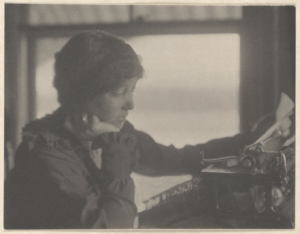
Ruth Comfort Mitchell at typewriter, 1915, (platinum print?) by Margaret DeMotte Brown, included in Seguinland School of Photography summer album. Courtesy Princeton University Art Museum
1916: In the summer, Brown reconnects with White when she goes to New York City to study again with Clarence White, taking a one year leave of absence from teaching at the Illinois School for the Deaf. From Lee McIntyre’s podcast transcript: “This interest in Pictorialism has actually prompted her in the summer of 1916 to go to New York to study there, and there’s an interesting notice in the Jacksonville Daily Journal newspaper in September of 1916 which – let me just read it to you. It says, “… having secured a year’s leave of absence as a member of the faculty of the Illinois School for the Deaf, Miss Margaret DeMotte Brown will spend the time in art work in New York City. During the summer, Miss Brown studied in the east with a well-known illustrator and portrait artist, and she is to have a place in his studio during her absence from Jacksonville.”
1917: Becomes corresponding secretary for the new Pictorial Photographers of America, (PPA) with Clarence White as president.
1918: Resigns her teaching position at the Illinois School for the Deaf in Jacksonville, IL: “Miss Margaret DeMotte Brown, teacher of photography, has resigned to open a portrait studio in Poughkeepsie, New York. She is succeeded by Miss Belinda Daniels, of Chicago, who substituted for her year before last.” —American Annals of the Deaf, Vol. LXIII, Washington, D.C., 1918, p. 483
—Although this move may have been made possible after she received an inheritance from her uncle, Hiram Price Dillon, (Lee McIntyre) Princeton’s Anne McCauley wrote that professional relationships Brown had made previously with Clarence White’s Maine and New York City schools of photography were the more likely impetus for the move from the Illinois School for the Deaf: “Going to the White School turned out to be her ticket out of that job”…”I think the trip East to study with White and to live in NYC was a big change for her”. (Anne McCauley, email correspondence)
—Historian Lee McIntyre points out that by November, she has set up a studio in Poughkeepsie next to the Vassar campus on Raymond Ave. An ad in the Vassar Miscellany News describes the new venture: “Margaret DeM Brown, Photographer.” | “Miss Brown, a photographer whose work has been exhibited in New York in various museums throughout the country, has opened a studio here. Miss Brown approaches her work sympathetically, her main object being to make character portraits of her sitters, in their homes or at her studio.”
1921: Advertisement in Vassar Quarterly, Volume VI, Number 2, 1 February 1921:
MARGARET DeM. BROWN | PICTORIAL PHOTOGRAPHER | I WILL SEND ON APPROVAL SIX OR MORE | PRINTS OF CAMPUS, SUITABLE FOR GIFTS, | TO ANY ALUMNA WHO IS INTERESTED. | 8 RAYMOND AVE. (these may be postcards or larger prints of her campus scene photographs discussed in 1925-40 entry)
1922: Provides the frontis photograph and three other plates for the volume Helga and the White Peacock: A Play in Three Acts for Young People, by Cornelia Meigs, New York, The MacMillan Company.
1924: Provides pictorial landscape photographs for the volume Poughkeepsie; The Origin and Meaning of the Word, by Helen Wilkinson Reynolds, Collections of The Dutchess County Historical Society, Poughkeepsie, N.Y. 1924
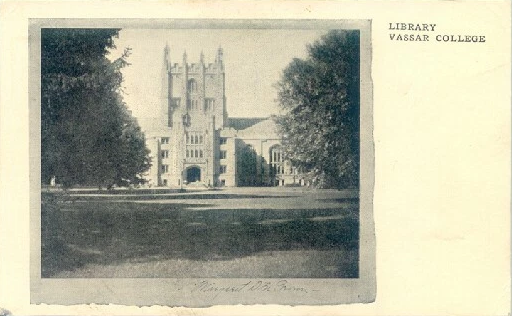
1924-40: Brown produces her own rotogravure postcards featuring campus photographs of Vassar College—done in her signature pictorialist style. Earlier cards from this series are believed to be those showing her signature within the lower border on the rectos. Later cards lack the recto signature and engraved on versos: POST CARDS | From Photographs By | Margaret De M. Brown | For example, in the Vassar Quarterly Advertiser, (Vol. IX, No. 2, Feb. 1924) her ad reads: Margaret DeM. Brown | Campus Photographs and Post Cards | Portraits by appointment | A quick look on Ebay at the time of this writing produced the following titles, followed by “Vassar College” on rectos: Taylor Hall, The Chapel, Alumnae House, The Quadrangle, Cushing House, Vassar College From An Old Print, The Lake, The Library, Library, The Circle, Nursery School, Sunset, Alumnae House (vertical view-old stock: postmarked 1958)
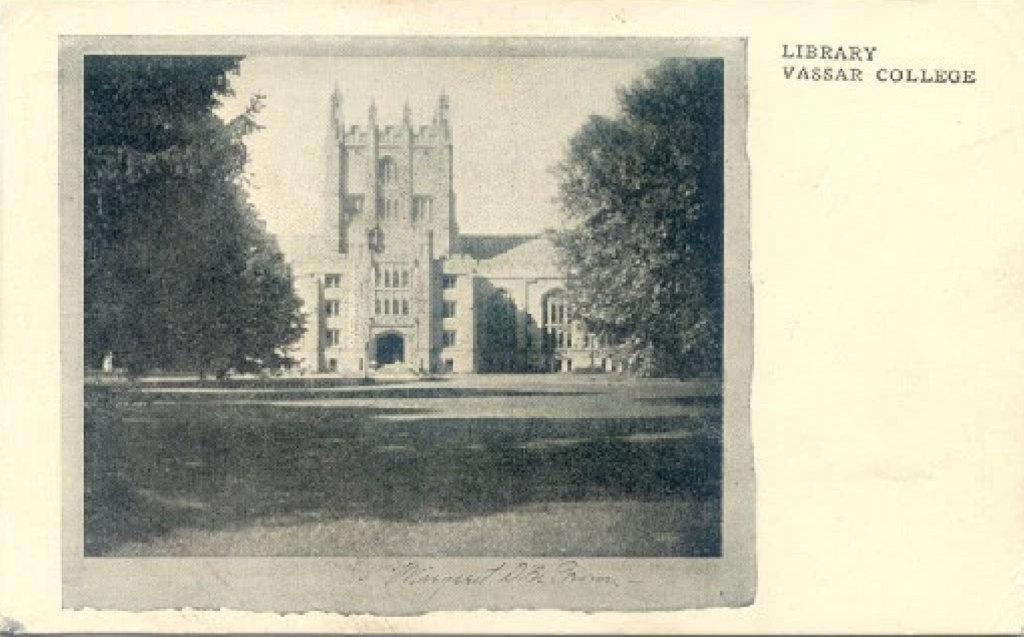
An early photograph ca. 1920-25 of the Vassar College Library by Margaret DeMotte Brown published as a postcard. Notice signature at bottom margin. (credit: web)
1929: Provides photographs for the volume: Dutch Houses in the Hudson Valley Before 1776, by Helen Wilkinson Reynolds with an introduction by Franklin D. Roosevelt.
1931: Provides photographs for the volume: Dutchess County Doorways and Other Examples of Period-Work in Wood, 1730-1830, by Helen Wilkinson Reynolds.
—Photographs Franklin Delano Roosevelt when he is governor of New York state. As late as Sept. 1934 she continues photographing the Roosevelt family as in this example taken at Springwood, FDR’s childhood home.
1936: Provides photographs for the volume: Pre-revolutionary Dutch houses and families in northern New Jersey and southern New York, by Rosalie Fellows Bailey, A.B.; with an introduction by Franklin D. Roosevelt; prepared under the auspices of the Holland Society of New York.
1940: From Lee McIntyre’s podcast transcript we learn: “Margaret has successfully been running the studio now for twenty some years. She’s still a photographer in the 1940 census; she’s now sixty years old, her mother, Nellie, has come to live with her and her aunt, Elizabeth, Nellie’s youngest sister, has come to live with them as well.”
1942: In September, her mother Ellen “Nellie” DeMotte Brown, 1854-1942, dies. Earlier, in May, the last known ad for Margaret Brown’s Poughkeepsie studio runs in the local paper. “It would appear that what happened was Nellie started to get sick, and Margaret makes a decision to move with Nellie to Springfield, Massachusetts, because Springfield is where Margaret’s youngest sister, Mary, has moved to, having married a man named Ballard Sexton some years before.” (LM podcast transcript)
1943: The author Helen Wilkinson Reynolds, Brown’s good friend and author of the 1929 and 1931 volumes listed here, dies on January 3. With the passing of her mother and Reynolds and need to be with her sister Mary gives Brown reasons enough to make Springfield, MA her new home: “As far as I can tell she doesn’t actually reestablish a photography career in Springfield, rather settling there as a retired woman, living with her sister and brother-in-law, and then after Ballard dies in 1946, living just with her sister.” (LM podcast transcript)
1959: Dies, on November 11 in East Longmeadow, MA. (Springfield suburb)
- State of Illinois, Board of Administration, Vol. II, Oct. 1, 1914 to Sept. 30, 1916, Springfield, Illinois State Journal Co., 1917, p. 771)
- Brown’s mother, Ellen “Nellie” DeMotte Brown, 1854-1942, was herself a graduate of Illinois Female College.