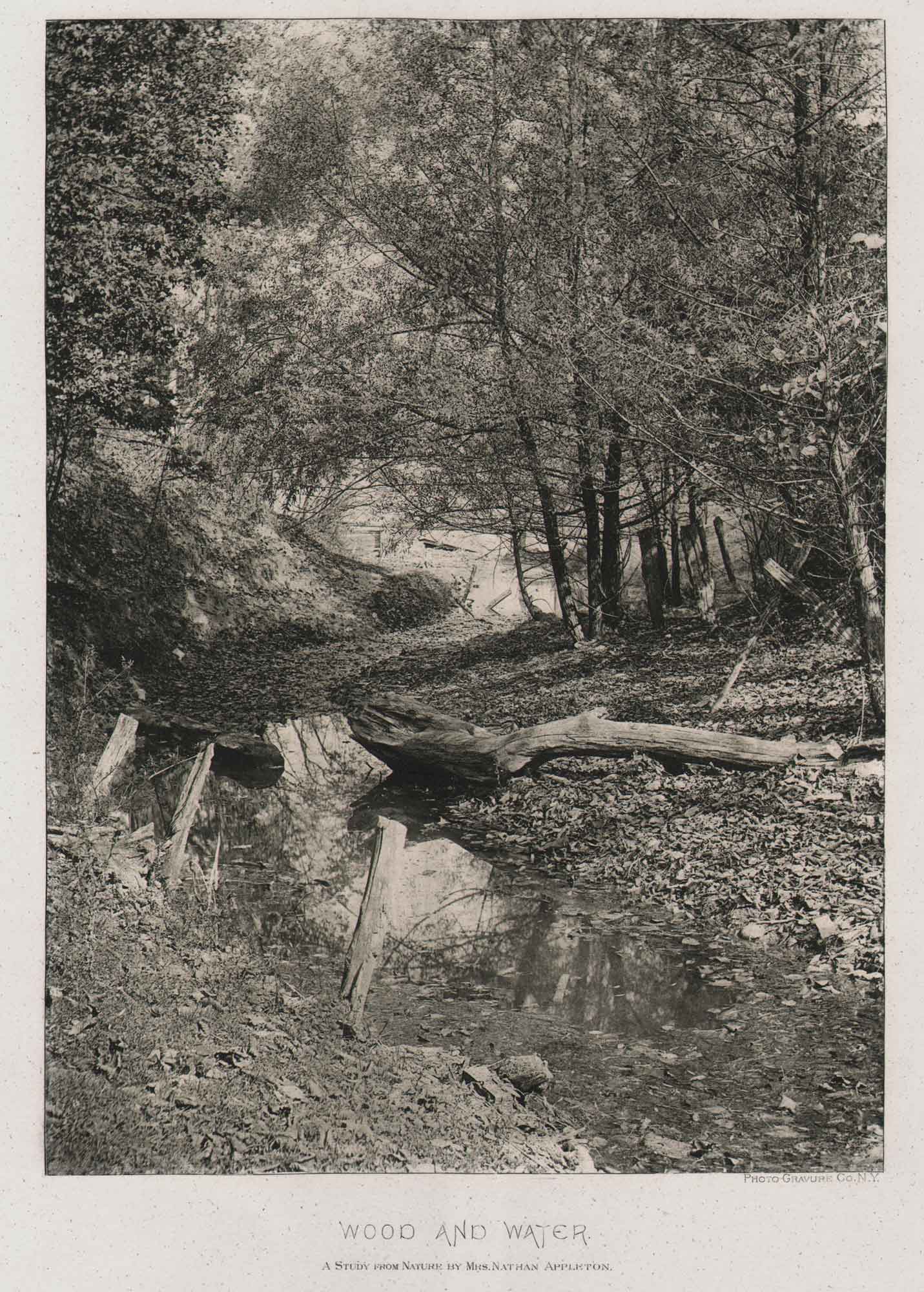
Wood and Water
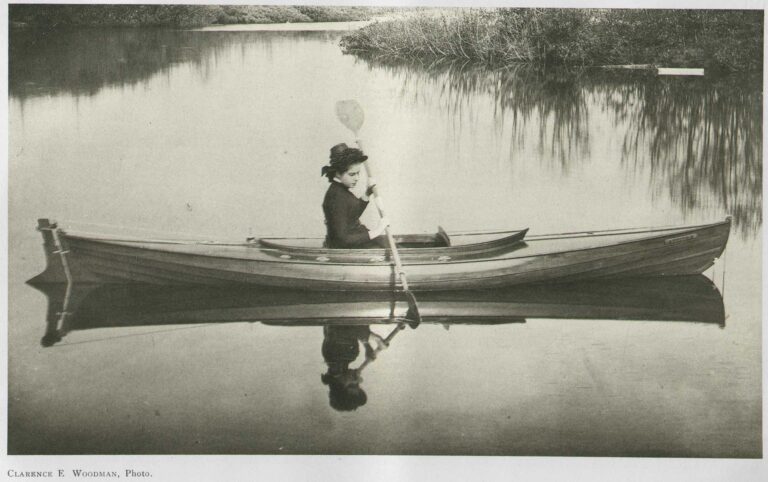
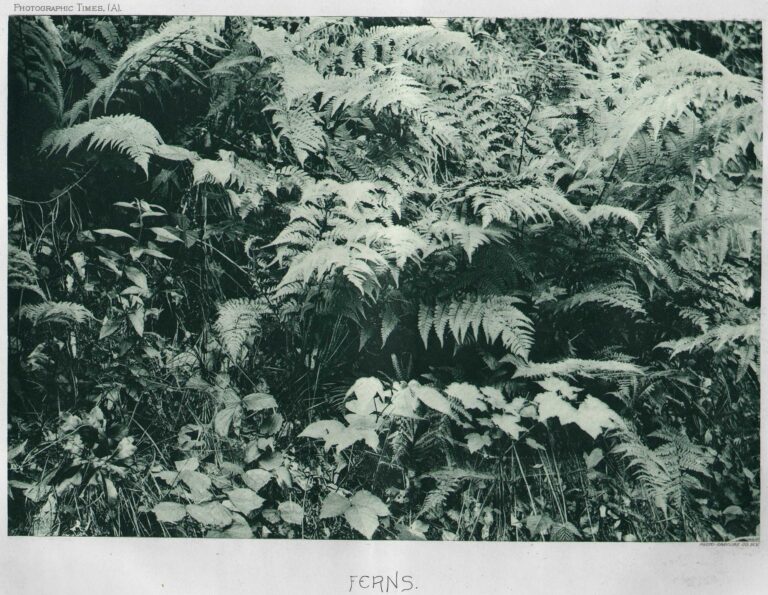
A tranquil woodland study, also reproduced as a tissue gravure the same year by Nims & Knight.
Jeannette Maria Ovington Appleton: 1863-1926
Born Jeanette Maria Ovington, she was known when first married as Mrs. Nathan Appleton, and Mrs. J. M. Appleton, after her separation with Nathan Appleton.
An amateur photographer, Mrs. J.M Appleton is listed in late 1890 as being a member of the Lynn, (Massachusetts) Camera Club as well as the Society of Amateur Photographers of New York. She took up the camera in late 1887 or early 1888, writing about her interest in the medium in The American Amateur Photographer, March, 1890:
The Pleasures of Photography.
BY Jeannette M. Appleton.
“ONE of the principal reasons for my becoming an amateur photographer was the uncongenial labor of keeping any form of diary when traveling abroad, accompanied by a natural desire to preserve the memory of places seen and enjoyed, yet not considered worthy of description by guide books or reproduction by local photographers.
Chemistry has always been my hobby, and artistic knowledge gleaned by many years spent among the art galleries of Paris, Dresden, and Munich, and some study of art principles, inclined me to combine the two and take up photography, now nearly three years ago. It has proved of great interest to me–an educator in more ways than one–and last, but not least, many a home letter has been shortened by inclosing prints, rather than writing lengthy descriptions, the dates and names of places recorded, by the customary marking of negatives.” —pp. 79-80 (continues)
Educated in Paris, The New-York Historical Society states “by 1886 Jeannette Ovington was part of the singer Emma Thursby‘s household, an arrangement that ended with the girl’s 1887 marriage to the millionaire Bostonian Nathan Appleton. The Appletons made their home in Paris, but within two years they separated and Jeannette resumed living with Emma Thursby until they quarreled about finances.”
Her husband, the scion Captain Nathan Appleton Jr., (1843-1906) was the son of Nathan Appleton, one of the three founders of Lowell, MA who had earlier made a great fortune with others by first introducing the power loom and the manufacture of cotton on a large scale into the United States.
Appleton and Ovington, whose own family had made their fortune in the china (porcelain) trade in Brooklyn, were married there on Nov. 16, 1887 by the Rev. Dr. Edward Everett Hale. Described at the time as the highlight of the social season in New York and Boston, over 1000 guests attended. The nuptials would not last, separating in 1889.
It was around this time it’s believed Jeannette began photographing scenic vistas around Boston’s north shore, with the resulting tissue gravures printed by the New York Photogravure Company in 1891 and published as Photogravures of Manchester-by-the-Sea, Beverley Farms, Pride’s Crossing.
The following year brought about a bombshell in the press between the still separated Jeanette and Katherine Parsons, the favored daughter of one Colonel Henry Clay Parsons of Virginia. In the article Accused of Hypnotism – Novel Complaint of Colonel Parson of Virginia, (Brooklyn Daily Eagle, Dec. 22, 1892) he accused Jeanette of essentially absconding with his daughter.
Upon the death of Jeannettes estranged husband in 1906, (Appleton’s will only stipulated for Jeannette to receive $1.00) the following article in the Eagle appeared, citing “artistic aspirations” as reason enough for Jeannette and Katharine to be together. An excerpt:
Mrs. Appleton’s Devotion to a Woman Friend.
“Going to Virginia shortly after leaving her husband, Mrs. Appleton met Colonel Henry Clay Parsons, of a celebrated Virginia family and a close friend of James G. Blaine.
The colonel introduced her to his daughter, Katherine, a girl of brilliant talents, and a strong artistic temperament. At once an attachment sprang up between the two women that has never been shaken. Wherever Mrs. Appleton has gone there has gone Miss Parsons.
The young woman’s father often entreated her to return to her home, but she always replied that she was happier with Mrs Appleton, whose artistic aspirations made for her a congenial atmosphere which, she said, she could find nowhere else.
Once Colonel Parsons asked the aid of Superintendent of Police Byrnes, but even his high official station had no effect upon the devotion of Miss Parsons. The two women have been abroad together for years at a time and have helped each other in art studies.
It is this common interest in art that has caused friends of Miss Parsons to ridicule the suggestion that hypnotism enters in any degree Into the fascination which Mrs. Appleton has seemed to exert upon the young Virginian. Miss Parsons is now about 32.”—excerpt: Capt. Appleton’s Death Ends a Strange Career, The Brooklyn Daily Eagle, Sunday, August 26, 1906
According to U.S. passport applications, Jeannette Appleton emigrated to England (Mursley, Surrey, from 1912-1916) and later Switzerland (Klosters, from 1916-?) where she maintained her legal domicile for medical and health reasons. Her permanent residence was listed as Brooklyn, N.Y.
FamilySearch cites Ovington died at 63 years of age on Nov. 5, 1926, in Bressanone, Bolzano, Trentino-Alto Adige, Italy.
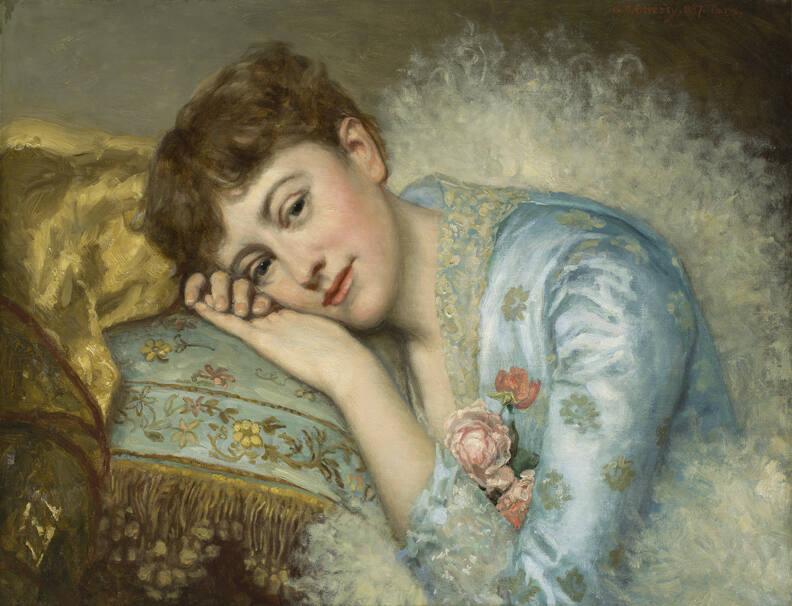
1887 Oil portrait of Jeanette Ovington by George Peter Alexander Healy (1813-1894)
Sun & Shade: An Artistic Periodical
“Within the covers of Sun and Shade…We shall especially endeavor to encourage the artistic side of direct photography in all its phases,”—Ernest Edwards, president & publisher, 1889
In July, 1888, the first issue of Sun & Shade: A Photographic Record of Events, was published in New York City by The Photo-Gravure Company. Essentially a high-class art periodical, each issue featured eight or more beautiful hand-pulled photogravures as well as plates printed in photogelatine, (collotype) and halftone. These were collected within a stapled, folio-sized magazine issued monthly. The subject matter included the work of leading amateur and professional photographers, as well as works of art—many from the galleries at The Metropolitan Museum of Art in Manhattan. The December issue—Christmas themed—featured a specially designed cover printed in green ink. Success was swift. The first issue sold 1000 copies “in a fortnight”. (1.) Within the first year, Sun & Shade quickly increased circulation to 4000 copies a month. With a public demand for reprinting earlier issues, this success lead to a rebranding, after which, beginning with the September, 1889 issue, the magazine was renamed Sun & Shade: An Artistic Periodical. The final issue was March, 1896, when financial issues to the parent company, spurred by the eventual May, 1896 bankruptcy of the N.Y. Photo-Gravure Company, forced its closure.
Sun & Shade would become the ultimate statement of the many skills and inquisitive mind of Englishman Ernest Edwards. (1836-1903) Essentially his own printed passion project, the magazine was fueled by his ongoing love of photography in the field (issues featured many plates by him over the years) and a deeply scientific mind which pushed the advancement of the state of photo-mechanical reproduction and fine printing.
The son of a clergyman from Bloomsbury in London, he initially made a name for himself taking photographic portraits of eminent people in his Baker Street gallery. (Charles Darwin sat for him several times) His love of the outdoors also bore fruit and he became an accomplished alpine photographer. But his real interest centered around photo-mechanical reproduction. In 1869, he took out a patent in England for his own rudimentary collotype process called heliotype. In the Fall of 1872, he moved across the pond along with his wife Charlotte, and became superintendent of Boston’s Heliotype Printing Company after selling the American rights to American publisher James Ripley Osgood. (1836–1892) Edwards ran the Heliotype Printing Co. there until the end of 1884. The following year the James R. Osgood & Co. went bankrupt, although not a result of the heliotype division.
Growing restless in Boston, he then moved to New York City, where he established a new firm in March, 1885: The Photo-Gravure Company, (subsequently renamed The New York Photo-Gravure Company) with offices in Manhattan and a leased printing factory in Brooklyn. In 1887, his company received perhaps the one commission it’s best known for today: the printing of 781 collotypes, which Edwards called photogelatine plates, making up the monumental publication:
Animal Locomotion. An Electro-Photographic Investigation of Consecutive Phases of Animal Movements, 1872-1885, with the landmark sequenced motion study photographs taken by British photographer Eadweard Muybridge.
Restructured in 1891 as the New York Photogravure Co., Ernest Edwards continued to advance the state of photo-mechanical printing during his final decade, with Sun & Shade publishing some of the earliest examples of his own invention by 1894: plates printed in a three-color process called chrome-gelatine, a variation of his heliotype process.
Quality Rather than Quantity
Even though it survived less than eight years in print, describing Sun & Shade in Ernest Edward’s own words is perhaps the best posterity for this important photographic periodical with an artistic heart. One year after its’ debut, he wrote the following, published in The Photographic Times for August 2, 1889:
“A year ago we commenced the publication of our novel venture in journalism Sun and Shade, a Picture Periodical without letterpress, almost as an experiment, with a modest list of less than fifty subscribers. To-day we are printing an edition of 4,000 copies monthly. A sufficiently convincing proof of the wisdom of our hope that there was room for us.
“In our rapid growth the wish has been indicated unmistakably for the higher grade of pictures, and of the higher class–always for quality rather than quantity. Following rather than leading such a wish, we feel that we make no mistake in marking the future career of the magazine to be rather that of an artistic periodical than a photographic record of events.
*Our efforts shall be directed in the future to make Sun and Shade an artistic periodical which shall be not only pleasing but educational in its broadest sense, Some of our plans may be briefly referred to.
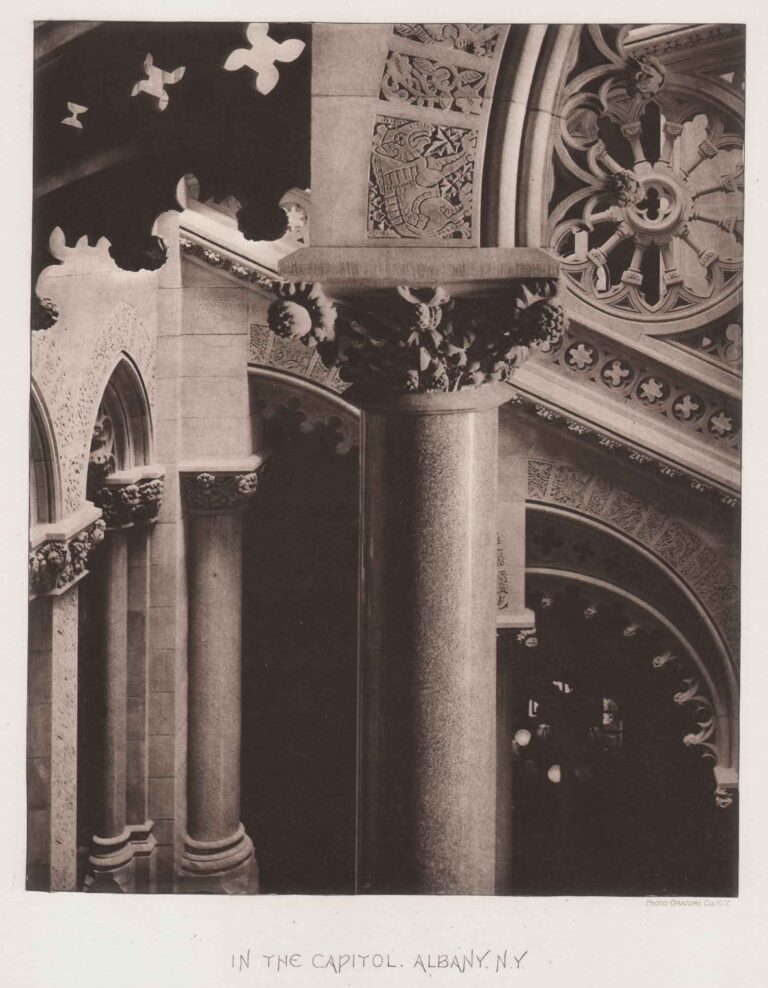
“We shall reproduce the leading pictures in the great collection of the Metropolitan Museum of Art. Within the covers of Sun and Shade will be found from time to time, reproductions of the works of American artists. We shall especially endeavor to encourage the artistic side of direct photography in all its phases, And we shall supplement these special features with examples of sculpture, architecture, and industrial art. If in the future we receive as hearty a response to our efforts as we have received in the past, our task will be indeed pleasant and our road to success a royal one.” (p. 394)
- Notice: Sun & Shade: October, 1888. The August and September issues did not appear.