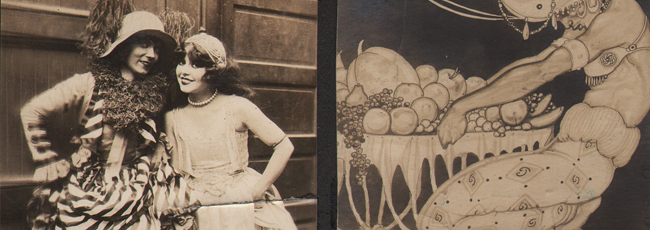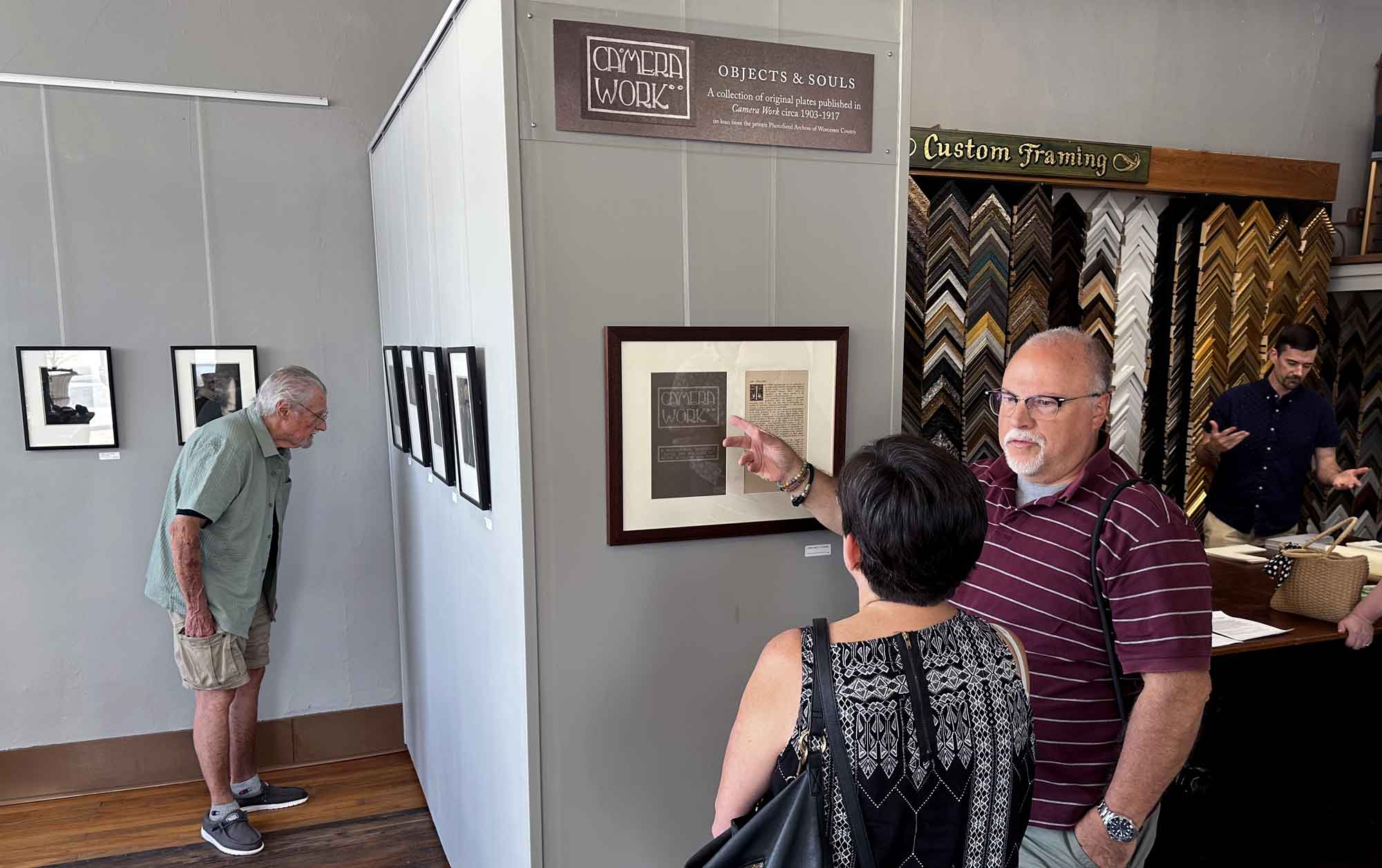
At an opening reception for Camera Work Portraits: Objects and Souls on August 15, 2026, New Hampshire photographer Scot Langdon discusses the exhibit with wife Mary in front of an introductory panel featuring Edward Steichen’s Art Nouveau designed cover of Camera Work I from 1903 and first page of the famous “An Apology” essay written by Alfred Stieglitz and others. Excerpt: “The time appearing ripe for the publication of an independent American photographic magazine devoted largely to the interests of pictorial photography, “Camera Work” makes its appearance as the logical outcome of the evolution of the photographic art. It is proposed to issue quarterly an illustrated publication which will appeal to the ever-increasing ranks of those who have faith in photography as a medium of individual expression, and, in addition, to make converts of many at present ignorant of its possibilities.” At right, Hudson Art and Framing owner Brian Dean works with a client on a framing order. Photo by David Spencer for PhotoSeed Archive
A milestone has been reached, of sorts, with a current exhibition of photographs now on display in a Massachusetts custom frame store and gallery. Camera Work Portraits: Objects and Souls, featuring mostly photogravure plates from this revolutionary arts magazine founded by Alfred Stieglitz, are now at Hudson Art and Framing through September 30. I’m proud of this first first public exhibit featuring work from the PhotoSeed Archive, and hope to feature vintage work in other future venues.
Many a museum show has featured plates from Camera Work, the mouthpiece and journal of the American Photo-Secession published between 1903-17. In fact, should you find yourself at the Museum of Modern Art right now, a visit to the ongoing A Little Gallery of the Photo-Secession exhibit in gallery #504 includes original photographs by American Photo-Secession members and full issues of Camera Work opened within a large display case.
With a nod to photographs showing interior views of The Little Galleries of the Photo-Secession published in Camera Work XIV, (1906) the light-filled gallery space of Brian Dean’s Hudson Art and Framing already replicates the minimalist look of Edward Steichen’s spaces featured in the inaugural New York show at 291 Fifth Ave., which ran November 24, 1905 – January 5, 1906. To top it off, Brian custom built some lovely frames featuring black painted wood moulding in an understated rustic look to compliment cream colored mats I supplied.
Again: not the typical exhibit one encounters in an American custom framing store/gallery. The plates on display—mostly gravures— are the unsung heroes of the photographic collecting field in that they were printed from copper plates made from the original negative, and therefore considered original prints in the marketplace. Museum of Modern Art conservator Lee Ann Daffner elucidates further: “… issues of Camera Work were also impeccably produced: Stieglitz and the Photo-Secessionists aimed to disseminate reproductions that were faithful to the original photographs. So much attention was lavished on choosing the best materials, achieving optimal printing, and the careful mounting. Stieglitz retouched any flaws, in every single print, himself. Truly, they are as precious as the original photographs on the wall.”
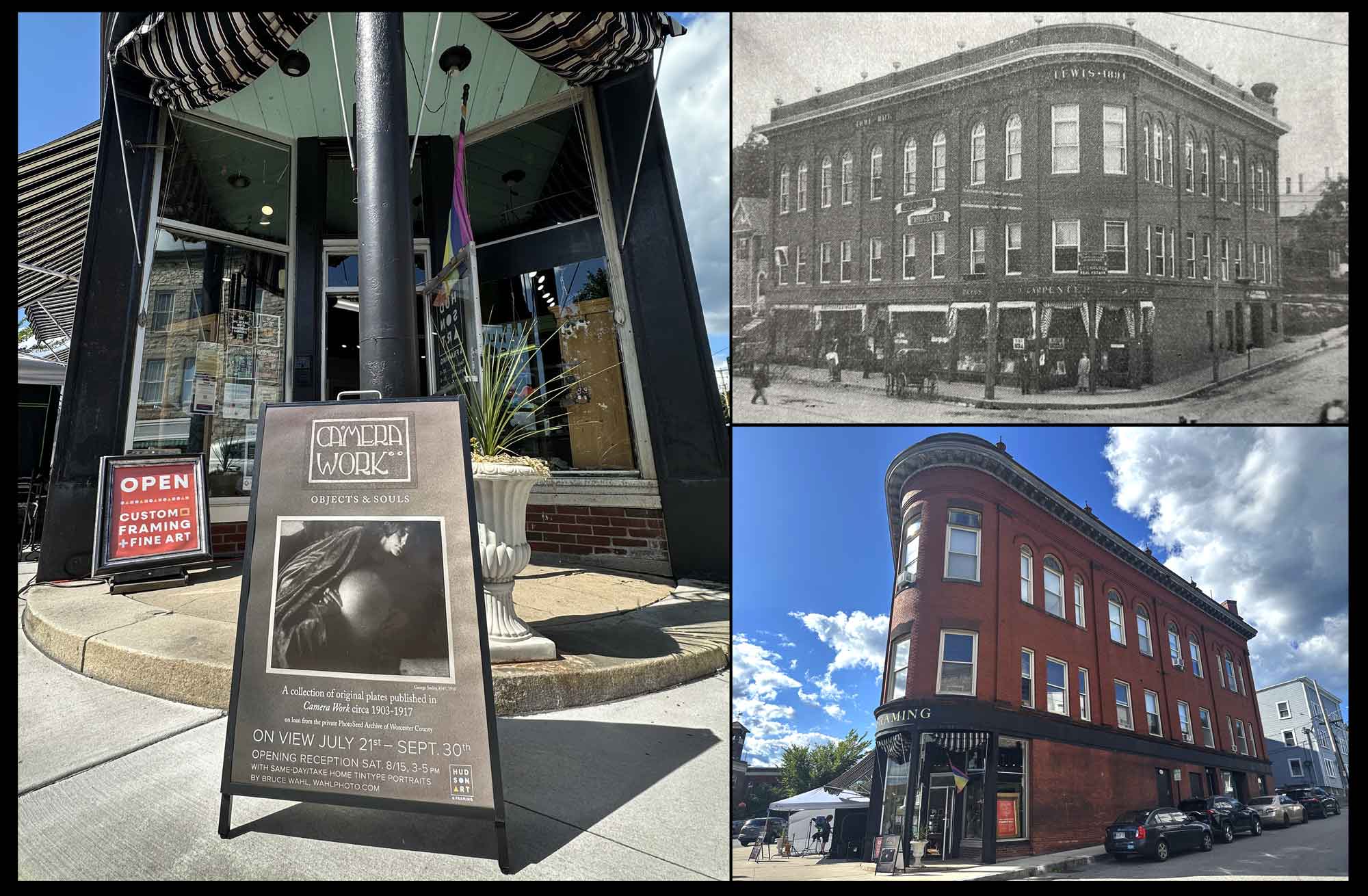
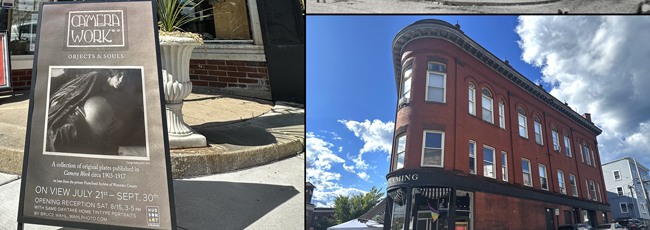
Left: Sandwich board featuring show poster for Camera Work Portraits: Objects and Souls photographed during the opening reception at Hudson Art & Framing in Hudson, MA on August 15, 2026. Top Right: A street scene of then new Lewis Building built in 1894 after a massive fire destroyed downtown Hudson shows people standing near front entrance of the L.D. Carpenter Drug Store—the space now occupied by the gallery. (clipping courtesy Brian Dean) Bottom Right: A profile view of the building today, known as Odd Fellows Hall. It was built by commercial photographer Russell Burnap Lewis. Photographed August 15, 2026 by David Spencer for PhotoSeed Archive
Photographic degrees of separation are something this site prides itself on. When Brian Dean told me Boston-based tintype photographer Bruce Wahl would also be setting up his darkroom on site during the recent Hudson show opening, the association of the Stieglitz journal plates on the walls inside and tintypes being made outside the gallery doors was an uncanny 21st Century development for modern day practitioners keeping the past alive.
Specifically, it was an itinerant tintype and commercial photographer by the name of George S. Irish (1847-1920) who had a profound influence on a nine-year child by the name of Alfred Stieglitz. From Richard Whelan’s 1995 book Alfred Stieglitz, A Biography:
“In the summer of 1873, accompanied by several friends, he took his collection of lead horses to be photographed by Mr. Irish, the tintyper in Caldwell. Alfred carefully arranged his models on a cloth and, after the exposure was made, was granted permission to follow Mr. Irish into his darkroom. It was not the first time Alfred had entered such a sanctum, for the previous year he had been allowed into the darkroom when his mother had taken him and his brothers and sisters to be photographed by the fashionable Abraham Bogardus, in New York. “I was far less interested in the pictures than in going into darkrooms, recalled Stieglitz. “I wanted to know what went on in those mysterious places. … Alfred would simply drop in to chat with the friendly photographer and watch him work. He was fascinated by the skill with which Mr. Irish directed his portrait subjects, and he was opinionated about at least one of his friend’s practices, that of touching up the cheeks of his portraits with carmine. Mr. Irish said it made the pictures look “more natural, but Alfred disagreed. In a late version of the story, he claimed already to have an intuition that the integrity of the photographic image should be respected. More likely, he simply thought that the incongruously rouged cheeks looked silly.” (pp. 40-41)
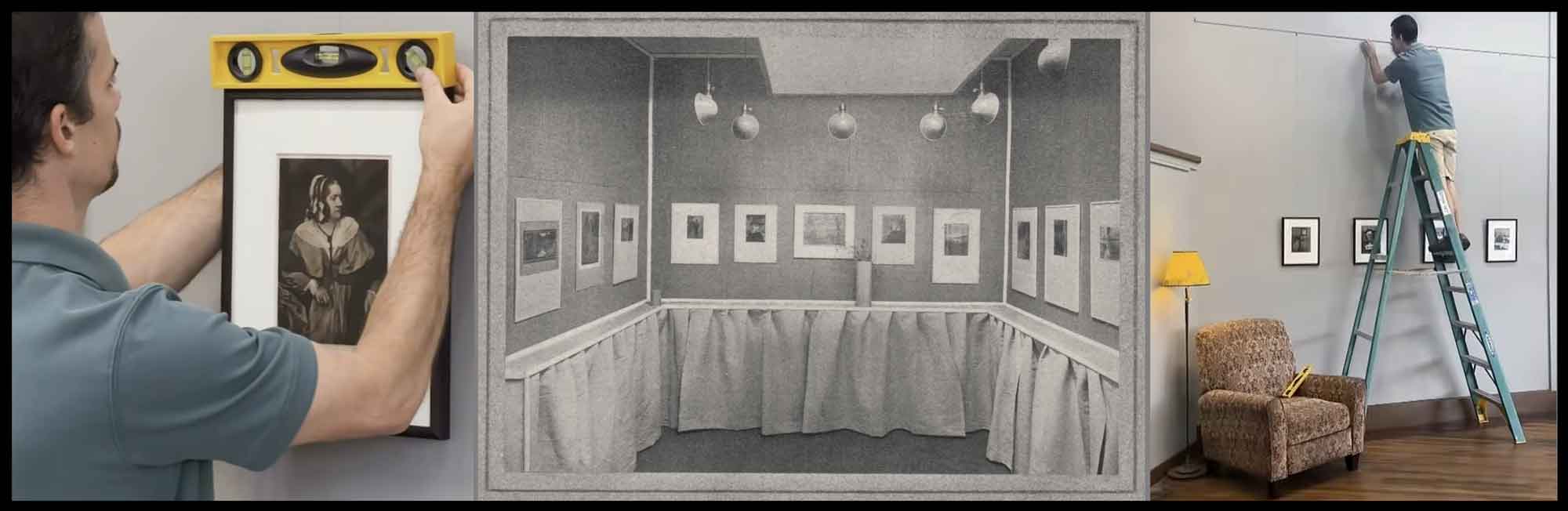
Left: After custom building the individual frames for the show, Hudson Art & Framing owner Brian Dean uses a level to hang a ca. 1890 photogravure plate of Mrs. Anna Jameson-Author, by David Octavius Hill (1802-1870) and Robert Adamson. (1821-1848) Formerly part of the Margaret Harker collection and offered for sale, this plate was made by Scottish photographer James Craig Annan, (1864-1946) an important pictorialist and leading practitioner of the hand-pulled photogravure process. The image was later reprinted again by T. & R. Annan & Sons, appearing in Camera Work XXXVII. (1912) (courtesy Brian Dean) Middle: Halftone published in Camera Work XIV, (1906) showing one of the original rooms designed by Edward Steichen for The Little Galleries of the Photo-Secession in New York City, ca. 1905-06. (PhotoSeed Archive) Right: Brian Dean works on a ladder in preparation for the show opening in July, 2026. His light-filled gallery space—part of his framing business— wonderfully replicating the minimalist look of the Stieglitz run gallery, later known as “291”. Photo courtesy Brian Dean
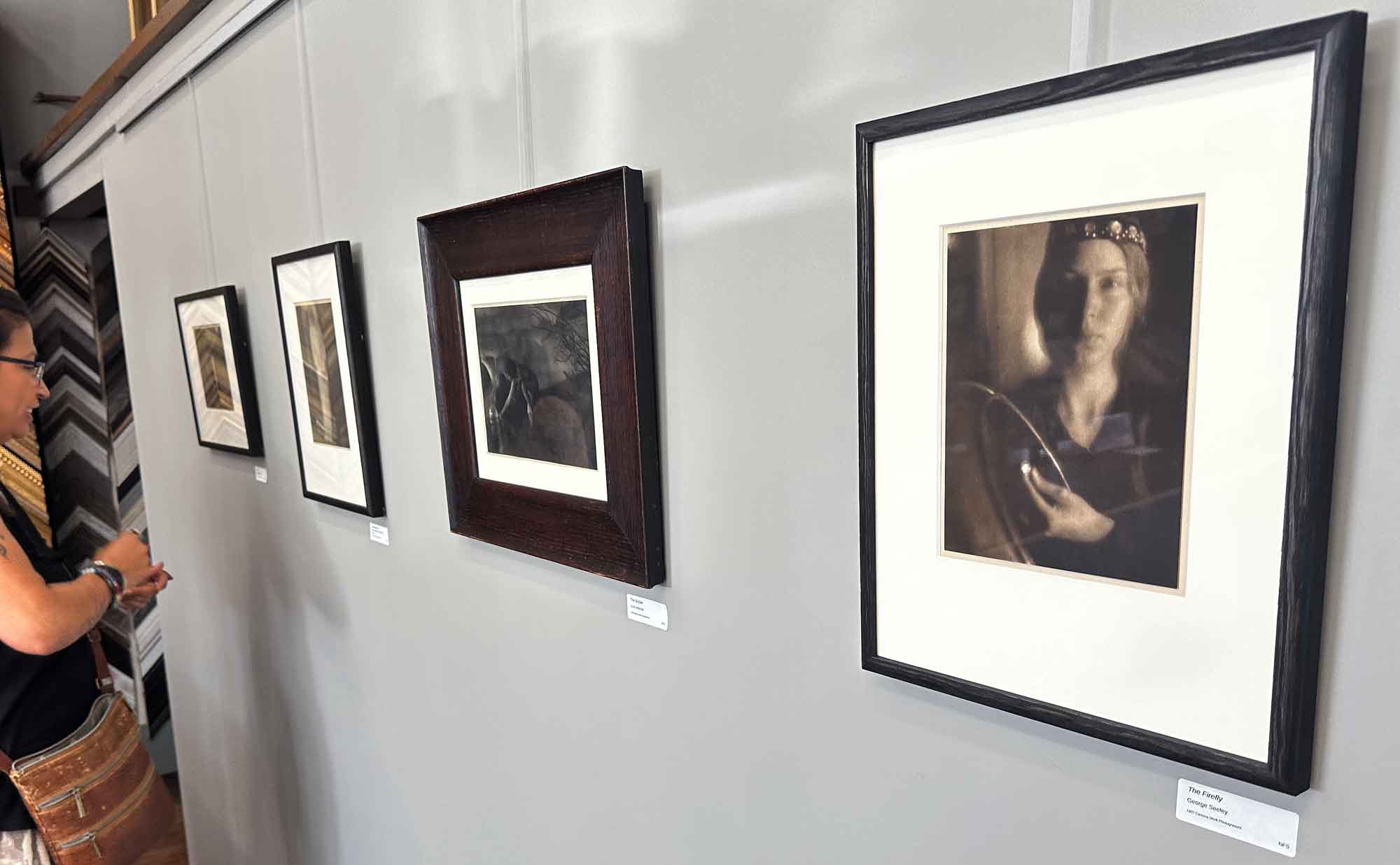
A visitor takes in a wall of plates from Camera Work Portraits: Objects and Souls during the opening reception at Hudson Art & Framing on August 15, 2026. Right to Left: The Firefly, by George Seeley; The Bubble, by Anne Brigman (in period quarter-sawn oak frame); Experiment 27 by Alfred Stieglitz and Clarence White (XXVII, 1909); Untitled by George Seeley, (Woman on Path: XV, 1906). Photo by David Spencer for PhotoSeed Archive
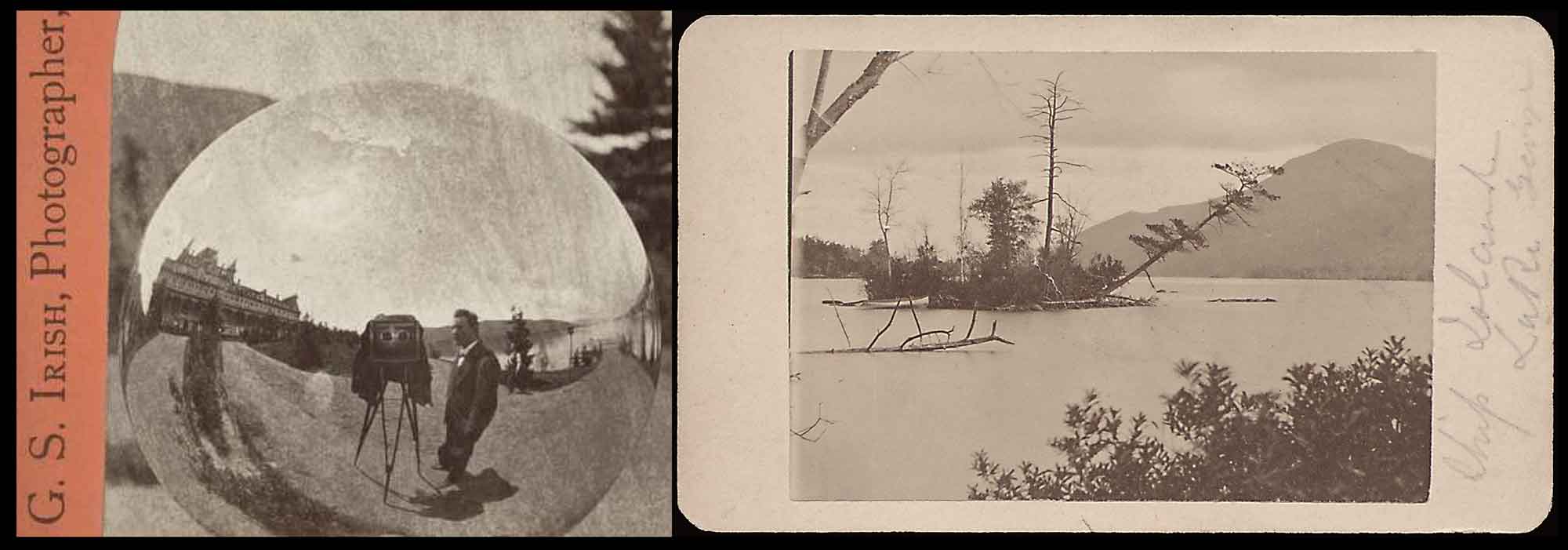
Camera Work publisher Stieglitz, Influenced by Tintype Photographer: Left: Glens Fall, New York itinerant tintype and commercial photographer George S. Irish, (1847-1920) is seen reflected in a gazing ball in front of the first Fort William Henry Hotel at Lake George ca. 1870. From 1873, Irish had a profound influence on Alfred Stieglitz, then a child vacationing in the Lake George region. Right: Ship Island, Lake George, albumen or gelatin silver Carte de Visite, ca. 1870 by George S. Irish, American. (backstamp: G. S. Irish, Photographer, Glen’s Falls, N . Y.) The Stieglitz family later spent summers at Lake George beginning in 1886 when Alfred’s father Edward Stieglitz purchased “Oaklawn”, a grand Queen Anne style “cottage”. From: PhotoSeed Archive
Turns out, even the bones are photographic. When I asked Brian about the history of his building, he showed me faded newspaper clippings and explained it was generally known in Hudson as Odd Fellows Hall. Located at 18 Main Street at the Hudson rotary, It was built by commercial photographer Russell Burnap Lewis (1835-1924) in 1894 after a major fire devastated the downtown area. Lewis, a shoemaker and Civil War veteran turned photographer, had moved to what became Hudson in 1864 and opened his studio in a wood building that did not survive the fire. Lewis was a very successful businessman. In addition to a thriving studio, in 1876, he had made a small fortune selling thousands of stereographs featuring 12 babies entitled “The Morning Glories” (1.) he had copyrighted in 1874 at the Centennial Exposition in Philadelphia.
The Lewis studio was located on the second floor of his new 1894 building, (2.) (perhaps he took advantage of the large windows on the third floor as a “skylight” studio, common to that era) his major tenant being druggist L.D. Carpenter on the first floor. (3.) A vintage postcard postmarked 1908 reveals the Lewis surname and year 1894 above the entrance near the roofline. Today, this three-story, curving brick structure is one of the finest buildings in a downtown of fine buildings, the curving front facade giving off ever so faint vibes of New York City’s later Flat Iron building.
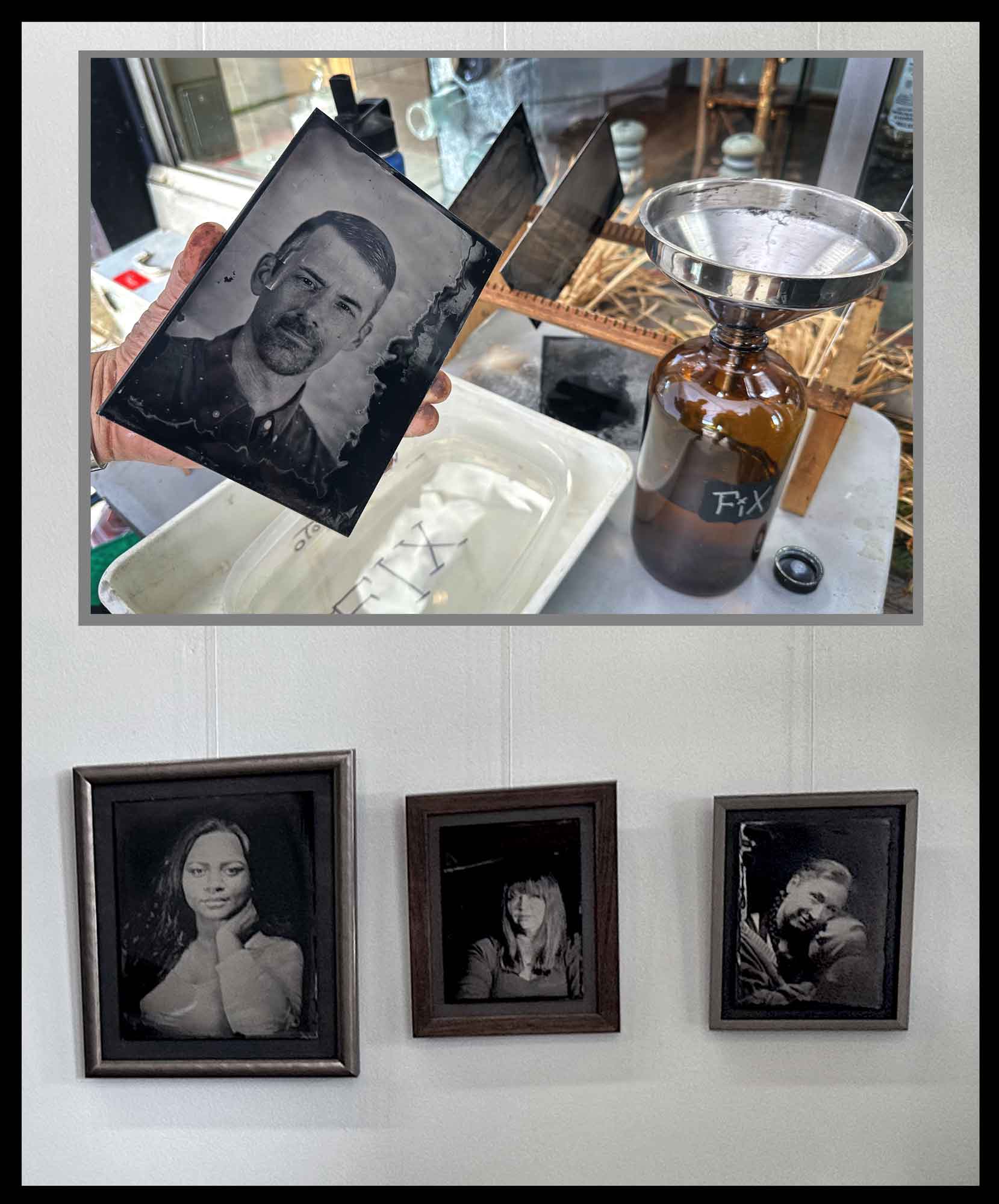
Inset Top: Boston-based tintype photographer Bruce Wahl shows off a drying finished portrait of Hudson Art & Framing owner Brian Dean next to some of his chemicals—part of a darkroom tent and studio he set up outside the gallery during the opening reception August 15, 2026. At Bottom, framed portraits by Wahl displayed as part of the exhibit Camera Work Portraits: Objects and Souls. David Spencer for PhotoSeed Gallery
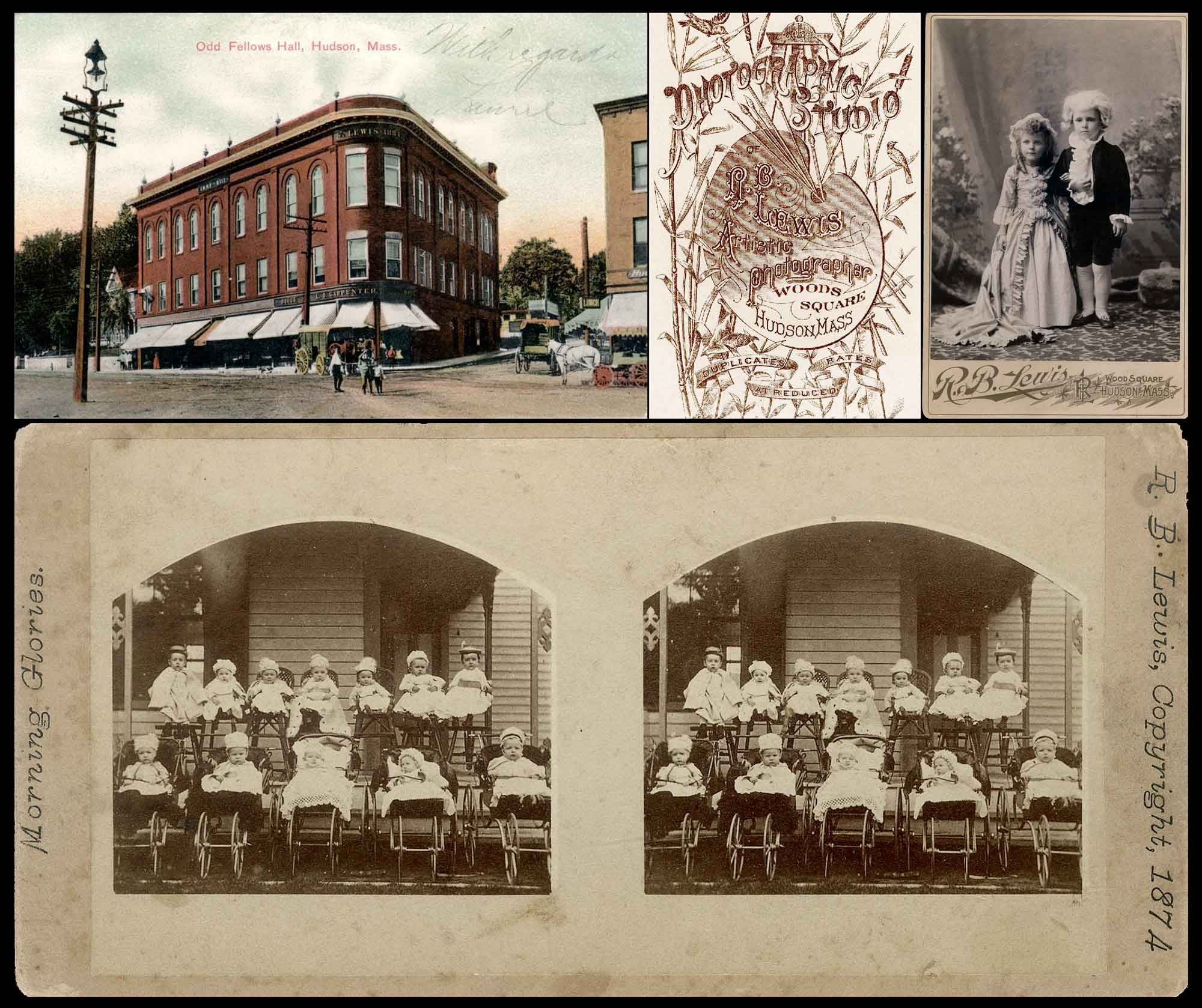
Photographic Empire in a Hudson, MA Building: Top Left: This colored postcard postmarked 1908 shows the brick Odd Fellows Hall building built by commercial photographer R.B. Lewis in 1894. His studio was located on the second floor. Middle & Right: Cabinet card back-stamp and photograph of children by R.B. Lewis: “Artistic Photographer”, ca. 1890’s. The boy and girl are dressed in 18th century style period costume, perhaps portraying George and Martha Washington for a local Hudson pageant. Card courtesy The Cabinet Card Gallery. Bottom: Featuring 12 babies, This stereograph titled “Morning Glories” by R.B. Lewis, was copyrighted in 1874, earning the photographer a small fortune, especially after it sold thousands of copies during the 1876 Philadelphia Centennial Exhibition. On card verso: “A PHOTOGRAPHIC FEAT UNPARALLELED; The Photographing of so many babies, in one group, and getting them ALL STILL, is a thing probably never before accomplished.” Photo credit: web.
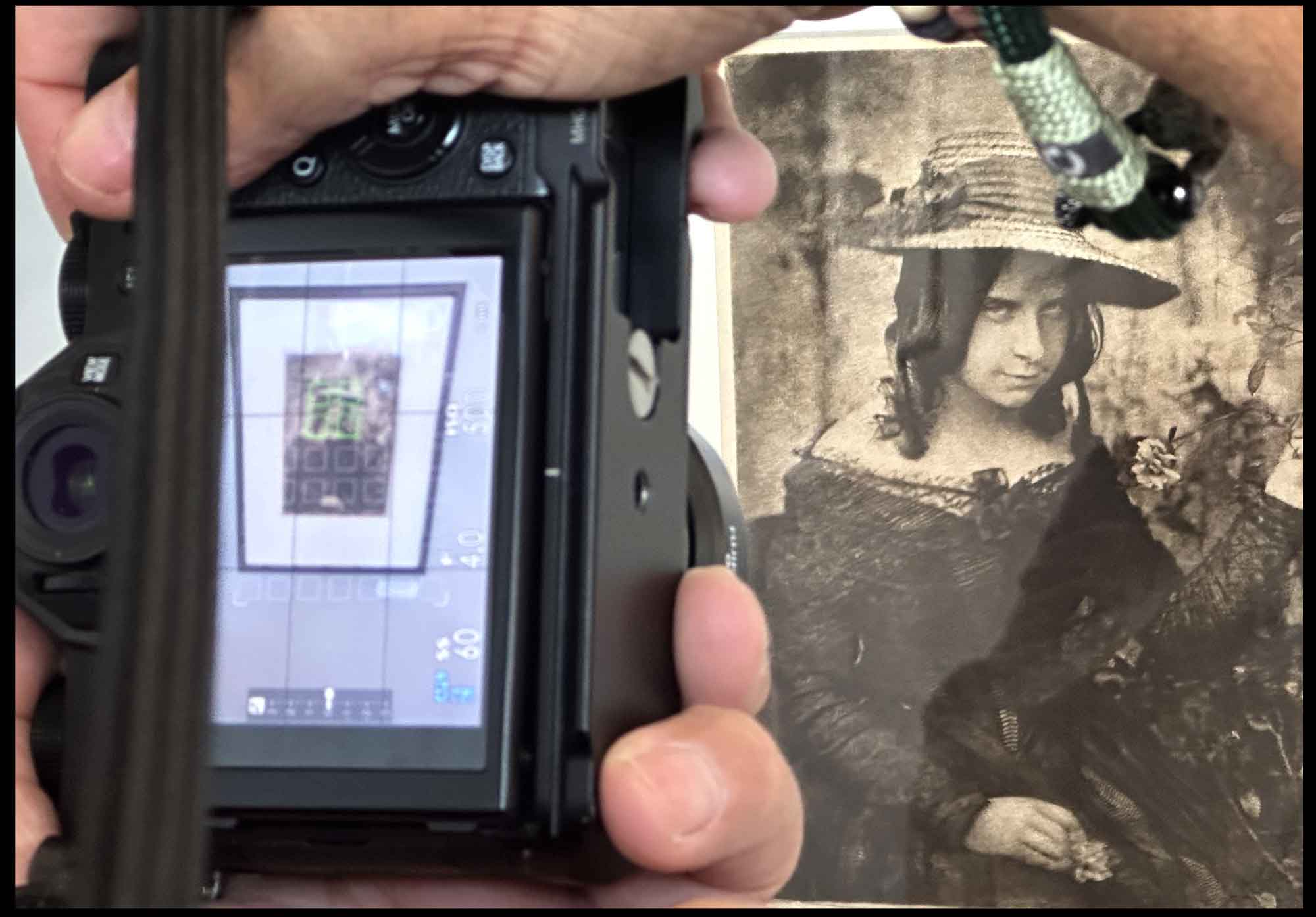
Using his digital camera, New Hampshire photographer Scot Langdon zooms in for a close-up of the portrait Girl in Straw Hat – Miss McCandlish, by David Octavius Hill (1802-1870) and Robert Adamson. (1821-1848) Formerly part of the Margaret Harker collection, this ca. 1890 photogravure printed by James Craig Annan later appeared as a gravure plate in Camera Work XXXVII, published in 1912. Scot was taking the picture as source material for his wife Mary, an author who said she was inspired by the eyes of the subject. “There is a mixture of mistrust, curiosity, and coquettishness in her gaze—an ambivalence that makes this portrait so charming.”—Langer, Freddy, Timm Starl, and Wilfried Wiegand. Icons of Photography: The 19th Century. Munich: Prestel, 2002. p. 20. Photographed by David Spencer for PhotoSeed Archive on August 15, 2026.
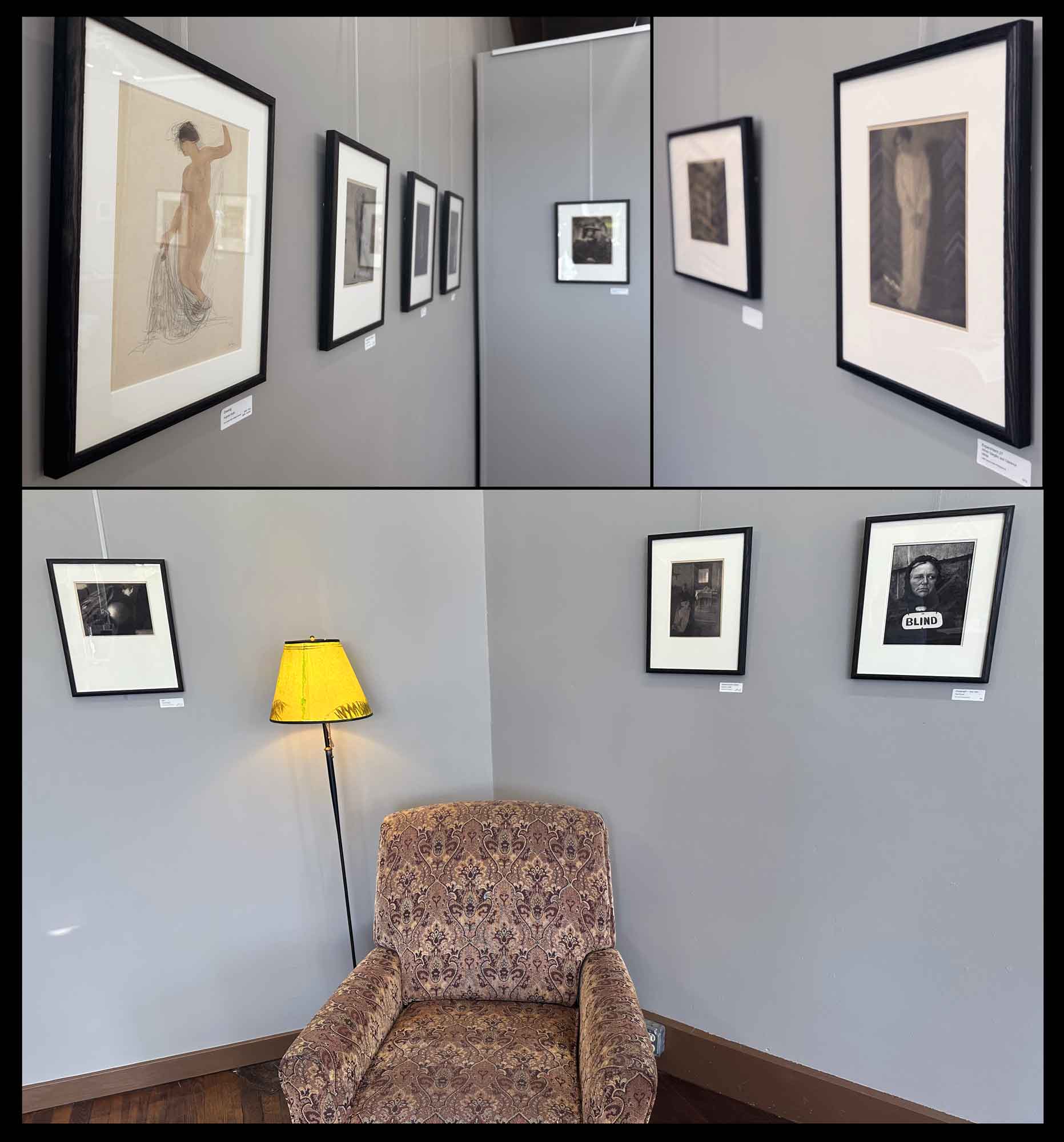
Installation photographs: Camera Work Portraits: Objects and Souls, taken during opening reception August 15, 2026. Top: far left: Drawing by Auguste Rodin, collotype (colored) drawing included in Camera Work XXXIV/XXXV, published 1911. Plate by F. Bruckmann Verlag, Munich. Right: Experiment 27, by Alfred Stieglitz and Clarence White. Photogravure plate included in Camera Work XXVII, 1909. both photographers collaborated on a series of portraits of Mabel Cramer and another woman identified only as Miss Thompson, with four of these sixteen known images reproduced in Camera Work. (first individual CW plate collected by PhotoSeed 25 years ago) Bottom: Take a Seat a Stay a Bit: Camera Work photogravure plates, left to right: #347 by George Seeley, included in Camera Work XXIX, 1910; Illustration to Eben Holden by Clarence H. White, Camera Work III, 1903; Photograph — New York by Paul Strand, published in the final double issue of Camera Work, 1917. Strand used either a false or prism lens on his camera to record a series of ground-breaking modernist images on the streets of New York City in the Fall of 1916. Photos by David Spencer for PhotoSeed Archive
With his own building acting as the historical template for ongoing commerce and a robust venue for over three decades as a gallery spurring on artistic debate, I’ll conclude this post with part of Brian Dean’s Camera Work exhibition essay:
“These photographers and artists took a modernist view of art and the world, always seeking, “to help the modern tendencies to come to the front, to show the public what was being done, and not what had been done; to make people look, not to the past, but to the future” (Paul Haviland, January 1909 Camera Work).
The world would see great changes during this time period through industrialization, urban sprawl, technological progress and eventually devastating war. Modernism was the artist’s way of reacting to these changes, rejecting the ideas of classical and realistic art to focus on Surrealism, Impressionism, or Pictorialism. These portraits, even though created with a camera, do not focus on the act of representation through pure likeness. Instead they aim to , “reveal(s) a definite state of sensibility. To invent a portrait is to consecrate the liberation of a living and thinking being to isolate, not man, but one man, to realize all the distinctive features of his physiognomy, discern and register them; it is in fact an act of freedom.” (Waldemar George).
In our current time we face our own great changes – the AI boom, data economy, and the digitization of every aspect of our lives. This show is a way of remembering that through these great changes we can react in our own way. We can create objects, art and ideas that help us move forward while discerning what is the true soul of what we seek. For just as these plates were created to be, “an object of great beauty and superb quality” we too can create our own objects of beauty and quality.
- See: Paula Richardson Fleming: R. B. Lewis’ Morning Glories, in Stereo World, January/February 2017, p. 4
- Lewis Halprin and the Hudson Historical Society, Hudson: Postcard History Series, 2008, Arcadia Publishing.
- The Wheeler pharmacy then occupied this first floor space now occupied by Hudson Art and Framing. It was initially rented out after the new building was completed in 1894 by druggist Lewis Dutch Carpenter. (1854-1906) Pharmacist Carlton B. Wheeler, (1879-1934) who worked for Carpenter beginning in 1897, earned his doctor of pharmacy degree from the Massachusetts College of Pharmacy and later purchased the business from the Carpenter family after Carpenter’s death in the Spring of 1906.