Featured Entries from the Photoseed Blog

Significant Photographers
29 Entries

Pictures from Maine

Jul 2026 | Alternate Processes, Artists, Color Photography, History of Photography, Painters|Photographers, Photographic Postcards, Significant Photographers, Unknown Photographers

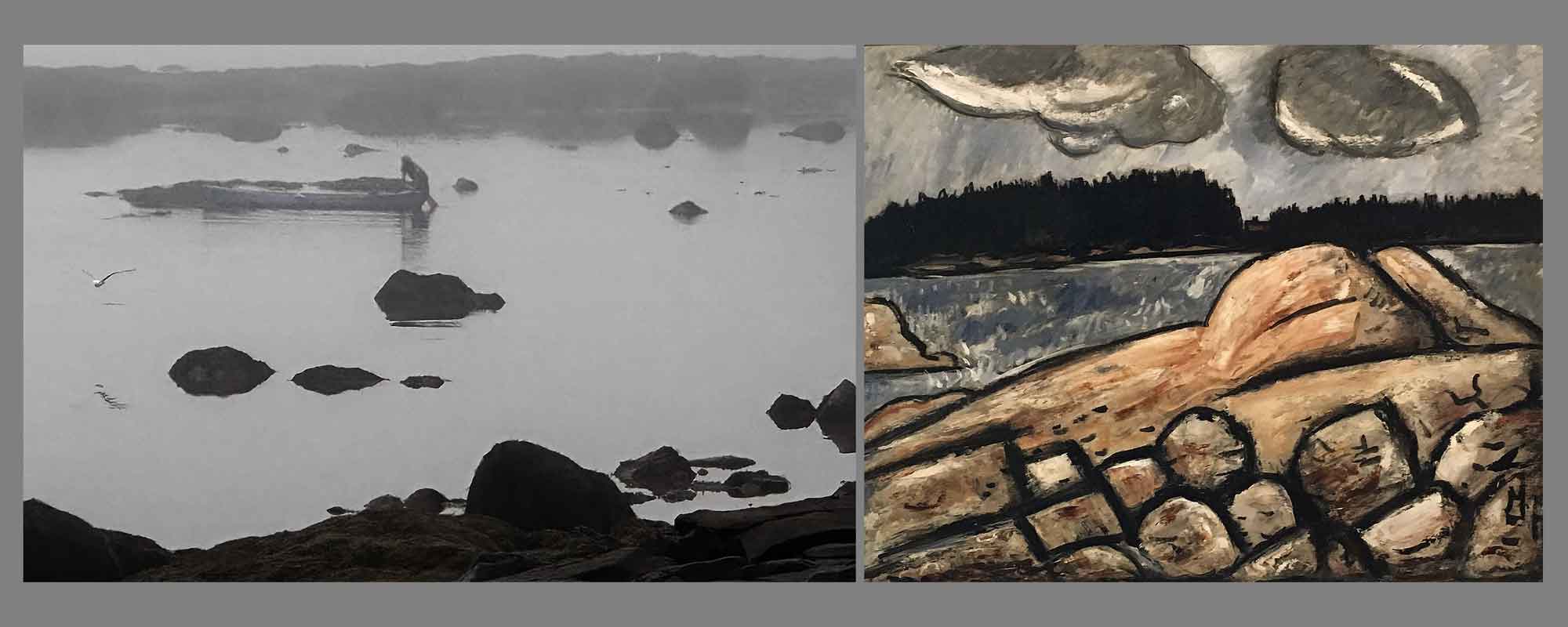
Steuben, 2024: “Clammer Heading Out, Pre-Dawn”. In early morning fog, a clammer pushes his skiff off at low tide on the shoreline of Pigeon Hill Bay as a gull sweeps in low. Photo by David Spencer for PhotoSeed Archive. Right: “After the Storm, Vinalhaven, 1938-1939”, oil on Academy board, Marsden Hartley, American, 1877-1943. Excerpt from wall text: “Like many of Marsden Hartley’s late marine landscapes, After the Storm, Vinalhaven expresses the artists sympathetic response to the elemental strength of his native land. The subject is the rocky seacoast in the vicinity of Vinalhaven Island in Maine’s Penobscot Bay. In the foreground, wind-whipped waves lash unyielding score, storm clouds pass overhead, and, in the distance, a pine-covered broods in solid silence.” Collection: Bowdoin College Museum of Art

Why do certain places exert a unique hold on someone’s artistic sensibilities? Given chance or opportunity, children can even find themselves in the grasp of forces they may not realize are shaping a future career. When I was a kid, my brother and I set off to Camp Idlewild, located on an island in New Hampshire’s Lake Winnipesaukee. We spent a month away that summer: a big step up from our local YMCA day camp experience. My mother later told me she cried after dropping us off after she and my father returned to the ferry landing in Wolfeboro. I remember her telling me she thought she had made a mistake. But that month would turn out to be one of the best in my life. I was happy to be on my own for the first time, albeit surrounded by several hundred other campers. The many diversions, including the much anticipated boat ride aboard the camp’s sleek wooden powerboat, the Riot, were icing on the cake. I vaguely remember toting around a Kodak 110 Instamatic that first summer, but there were certainly no prize-winners when the pictures came back from the drug store.

My second overnight camp experience was altogether different. By this time, around 15, I was in love with the quirky art stylings of cartoonist Don Martin, whose Mad Magazine caricatures I emulated in Testors model paint on the top of my camp trunk. I remember my counselor making positive small talk about the paintings after my parents dropped me off at Camp Netop, located in Casco, Maine. Perhaps the destiny of my becoming a great artist awaited? Not exactly, but Netop did change my life.

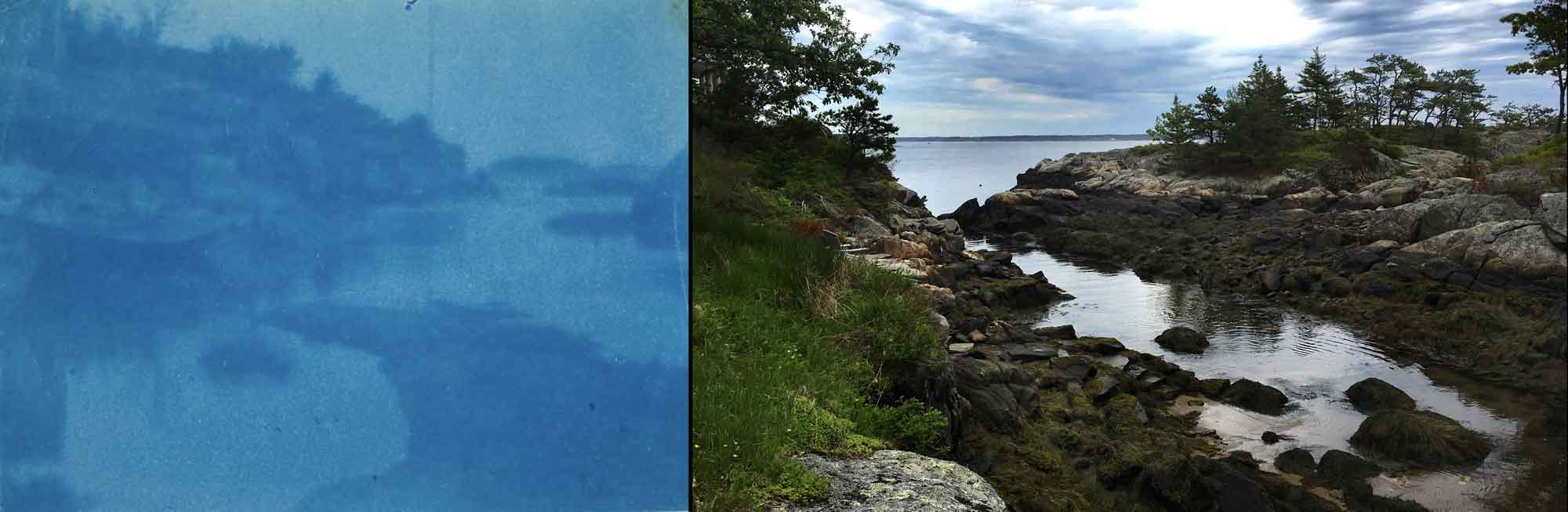
Little Good Harbor, Maine, 1905–1912, Fred Holland Day, American, 1864–1933, cyanotype. Collection: Worcester Art Museum. Right: Little Good Harbor, Low Tide, 2018. Photo by David Spencer for PhotoSeed Archive. Located near the mouth of the Sheepscot River at Five Islands, Georgetown, Maine, Little Good Harbor was the location of photographer Fred Holland Day’s summer home, built in 1912. Author Patricia Fanning, writing in 2001, gives a summary of the property: “Beginning in 1898, Day spent summers at a retreat he called Little Good Harbor near Five Islands, Maine. Because of Day, the bucolic setting became a kind of artist’s colony for his friends and their families. Among the photographers who visited were Gertrude Kasebier, Alvin Langdon Coburn, George Seeley, and Clarence White, who himself opened a summer photography school a few miles from Day’s property. The area was also popular among Day’s inner-city proteges. ( In 1912, Day built a large, Swiss-style chalet to house his numerous guests.) Day’s “camp” was informally fashioned after the programs for disadvantaged youth then popular in New York and Boston, and perhaps was inspired by similar camps run by the Episcopalian Sisters of St. Margaret and Cowley Fathers, with whom Day was closely associated. All visitors enjoyed boating, swimming, reading, board games and, of course, photography. Sailor suits were worn by all to eliminate any trace of social inequality or privilege.” Fanning, Patricia J. (2001). Cultural Commentary: The Pied Piper of Parmenter Street – The Philanthropic Work of F. Holland Day. Bridgewater Review, 20(1), 12-13.

That change was instigated by an actual darkroom located strategically next to the stage area of the main lodge, a former cavernous dance hall built in the 1920s. As it turned out, the camp co-founder, David Webster, a former elementary and junior high school science teacher who everybody called Sparky (his camp bonfires a specialty), had published the book Photo Fun: an Idea book for Shutterbugs, in 1973, about 5 years before I showed up that summer. Besides all the other typical camp activities like swimming, archery, riflery and even minibikes (the most popular by a mile), taking pictures around camp, developing the film and printing the photos was an actual camp activity. I was smitten. The editorial staff at Mad would have to wait. I was on my way to becoming a photographer.

Sparky’s advice in the book’s introduction gave encouragement to kids like myself: “The only way to become a good photographer is to take lots of pictures and note what seems to bring the best results. So load your camera and start snapping away. Have fun!” The book included several photos of Netop campers at play, and I fondly remembered Sparky’s son Doug later recreating one of the photos with his camera from the “Trick Photography” chapter. As I and another camper lined up in the outfield of the baseball field, a fellow camper in the foreground pretended to “hold us up” using his outstretched hands—pre-digital technology magic for this teenager to contemplate.

Through the years, I have continually renewed that early connection with the state of Maine. Besides being known as Vacationland, a tourism slogan appearing on Pine Tree state license plates since 1936, artists and photographers have journeyed here in order to seek creativity since at least the mid 19th century. Its rugged tidal coastlines and islands, natural wonders and changing light never cease to inspire those seeking artistic growth, a change in life or reason to seek a new chapter.

Enjoy these pictures from (mostly coastal) Maine, spanning the outer reaches of the Midcoast region up to my personal favorite, Downeast. With a few of my own snaps to give a flavor of modern times, the fruits of long-ago masters of the brush are showcased with photographs by anonymous amateurs on summer holiday. Maine also holds an important place in the history of photography. On Georgetown Island, the summer beachhead of what became the very first school of artistic photography, the Seguinland School of Photography, was established in 1910 by Clarence White. I paid a visit to what remains, as well as the grounds of The Chalet at Little Good Harbor up the coast, built by White’s fellow summer school teacher/critic Fred Holland Day in 1912.

The Clarence White family also put down long time summer roots in Georgetown when White purchased a coastal building lot and old farmhouse in 1910 close to his school. I’ve included correspondence from my 2018 email exchange with the Georgetown Historical Society, who confirmed my photo showing the former “Popple Beach” location of the home. Demolished and replaced by a new home in the early 1990s, the ghosts of White’s legacy and those photographic documents of his students depicting this rugged coastal retreat remain, with summer visitors in the present continuing to enjoy the coastal views from the porch of the former Sequinland Hotel— the former location of White’s school today known as the Grey Havens Inn. —David Spencer, July 2026

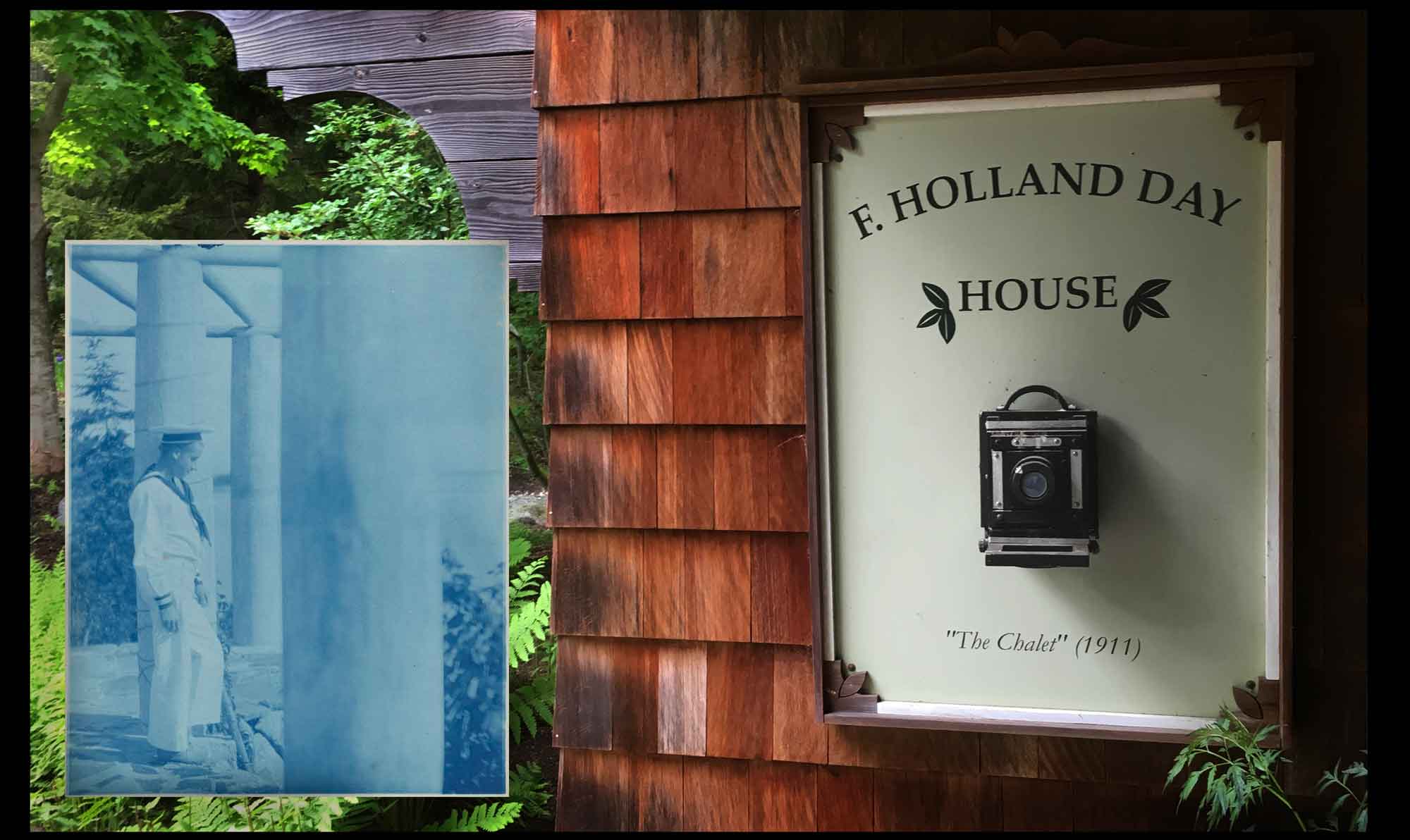
Inset: Maynard White in Sailor Suit Standing Beside a Column on Pergola, 1914, Fred Holland Day, American, 1864–1933, cyanotype. Collection: Library of Congress. See other cyanotypes held by LOC of the pergola construction. Maynard Pressley White, 1896-1961. White went on to receive his B.S. degree in Civil Engineering from Brown in 1920 and a masters in Paleontology from Columbia University in 1922, as well as Ph.D. He was a geologist and paleontologist for various oil companies. Right: F. Holland Day House Entrance Sign, Georgetown, ME, 2018. Privately owned, the former summer home of Fred Holland Day has been used as a wellness retreat. Photo by David Spencer for PhotoSeed Archive

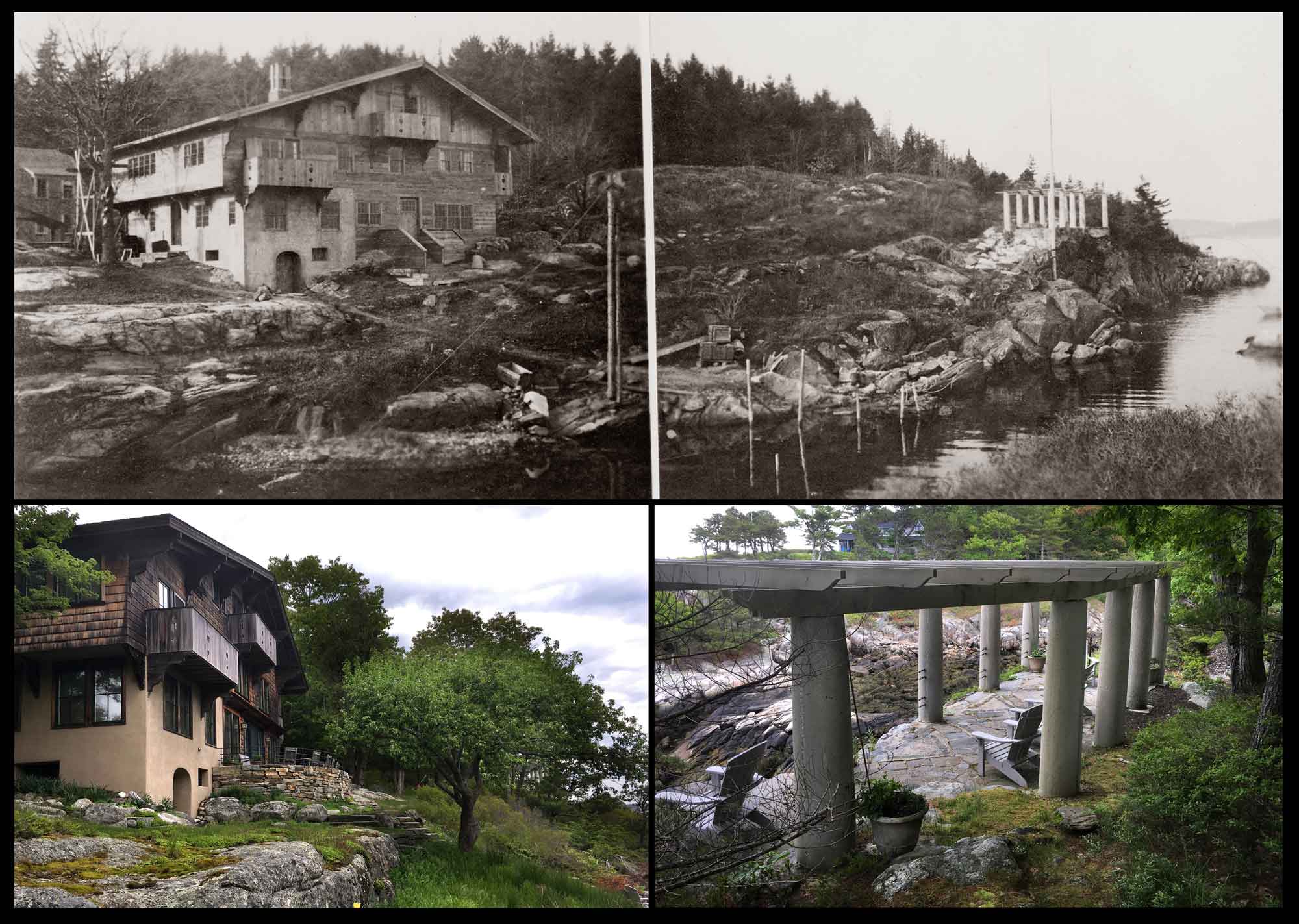
The Chalet Looking Northeast, Little Good Harbor, Maine, (left and middle pane of triptych) 1912 or 1913, Fred Holland Day, American, 1864–1933, b&w film copy negative from album held by Library of Congress: Little Good Harbor records, vol. 2, p. 48. Photographs by F. Holland Day and others. Designed by the Boston architectural firm Newhall & Blevins along with Day, this view from across Little Good Harbor shows the photographer’s summer home in Georgetown, ME known as the Chalet under construction and at right, the pergola. Also see: F. Holland Day’s Country House, Little Good Harbor, October 1912Bottom Left & Right: From 2018, an exterior view of the Chalet, as well as the pergola, located on the original footprint. David Spencer for PhotoSeed Archive.

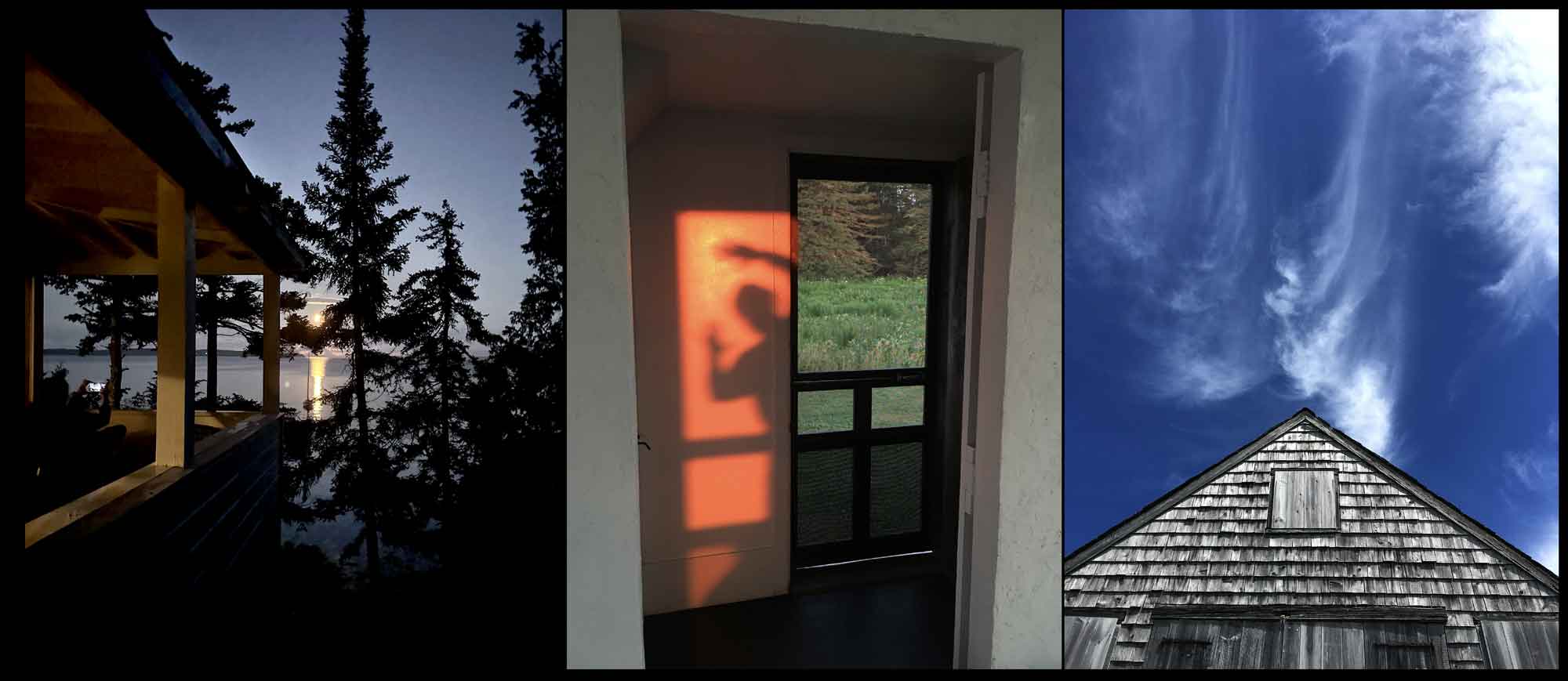
Isleboro, 2023: Photographing Sunrise from Cabin. Middle: Early Morning Figure, Cushing, 2022. Right: Weathered Clapboards & Sky, Pleasant Point, Cushing, ME, 2022. One need not go far for photographic inspiration in Maine. Oftentimes, the interior of your rental accommodation or grounds will produce memorable views. Photos by David Spencer for PhotoSeed Archive

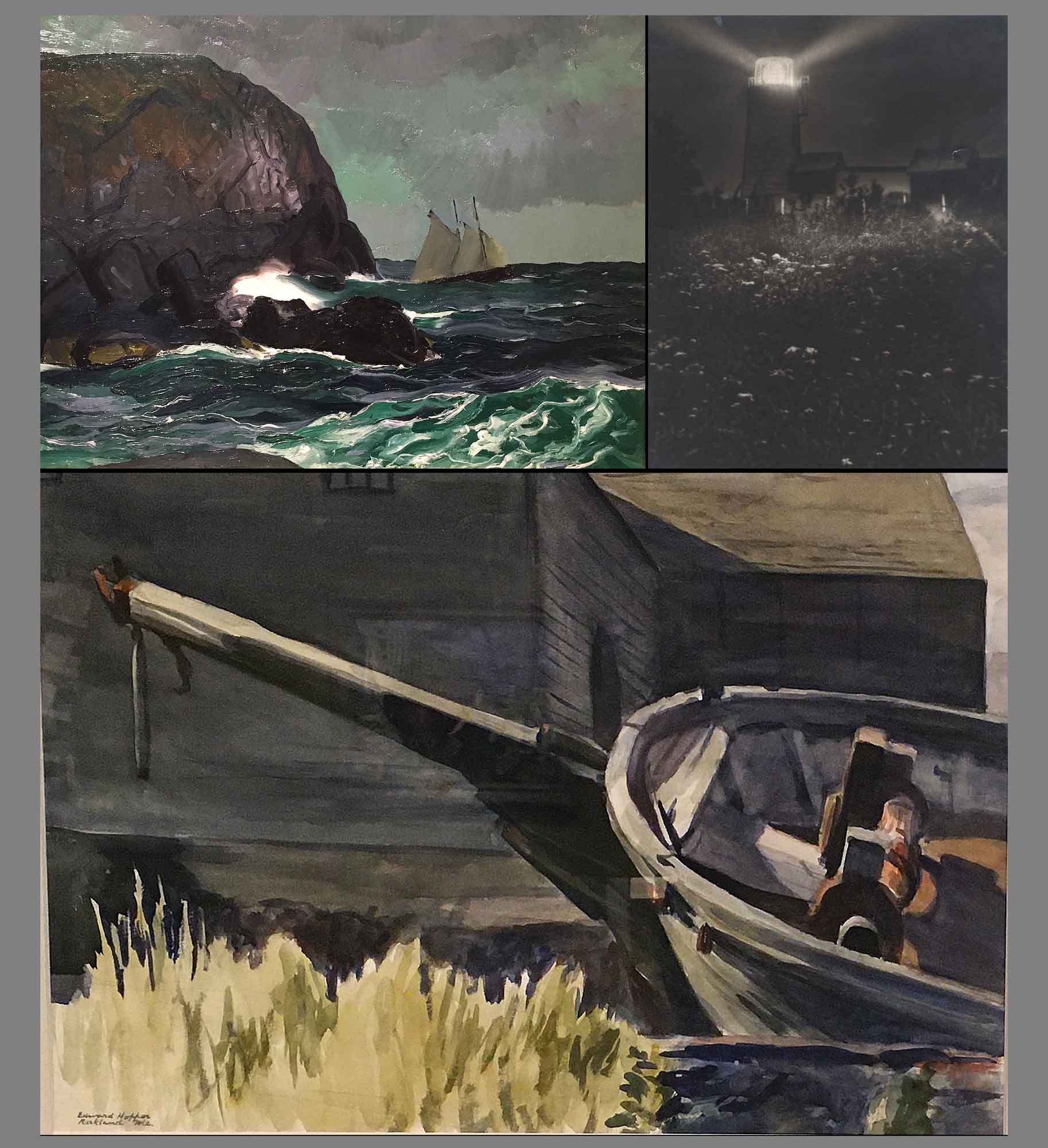
Top Left: Beating Out to Sea, 1913, oil on board, George Wesley Bellows, American, 1882-1925. Excerpt from wall text: “A student of Robert Henri’s, Bellows was inspired by his teacher’s enthusiasm for Monhegan, visiting the island for the first time in 1911….The rugged environment of Mohegan appealed to Bellows. He wrote to his wife Emma, “The island is endless in its wonderful variety. It’s possessed of enough beauty to supply a continent.” During the summer of 1913, when this work was painted, Bellows completed 125 works on Monhegan, 42 of them in one month.” Collection: Farnsworth Art Museum, Rockland, ME. Top Right: Monhegan Light, 1936, Warner Taylor, American, 1880-1958, gelatin silver print, 35.4 x 27.8 cm, unmounted. On Maine’s Monhegan Island, the Monhegan Lighthouse, with light beaming outwards from its fresnel lens at full candlepower, and with a field of wildflowers making up the composition foreground, cuts through the darkness in this nighttime photograph taken before World War II, when the light was dimmed for wartime. From: PhotoSeed Archive. Bottom: Schooner’s Bowsprit, 1926, Edward Hopper, American, 1882-1967, watercolor on paper. Excerpt from wall text: “In the summer of 1926, Hopper and his wife Jo spent seven weeks in Rockland, a period that proved to be one of the most productive of his career. Writing his dealer Frank Rehn in New York, he described Rockland as “a very fine old place with lots of good looking houses but not much shipping.” Hopper favored subjects that recalled the past in the present; here the hull of an abandoned schooner, a relic of days when Rockland was a thriving commercial port.” Collection: Farnsworth Art Museum, Rockland, ME.

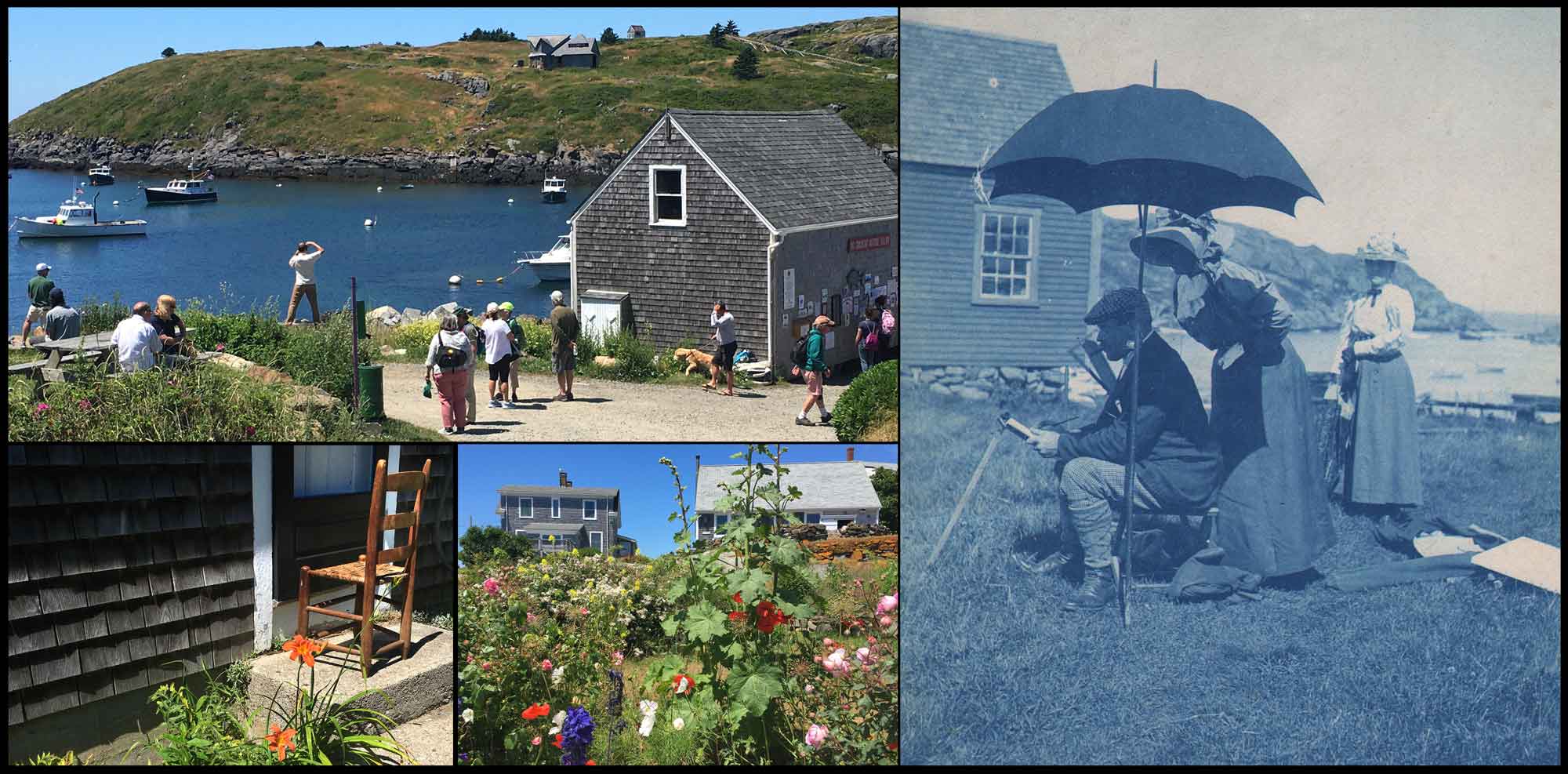
Top Left: Monhegan Island Visitors, 2022. Near the ferry landing on Monhegan Island, a visitor at center lines up a photo of neighboring Manana Island across from Monhegan Harbor. Located approximately 12 nautical miles off the coast of Maine and part of Lincoln County, the island at 4.5 square miles is renowned as one of America’s oldest and most influential artist colonies. Summer month visitors vastly outnumber the locals, counted as 64 people during the 2020 US Census. Lower Left & Middle: Chair on Steps, 2022. This ladderback chair serves guard duty in front of a private Monhegan Island residence; Flowers & Homes, 2022,  flowers can be seen just about everywhere on Monhegan. Monhegan and Manana islands form “a unique maritime community that balances historical preservation, environmental conservation, and sustainable tourism.” Right: Sketching on Monhegan Island, ca. 1900-1910, unknown American photographer, cyanotype, 11.8 x 9.3 | 12.6 x 9.9 cm. The Monhegan Museum, which holds a black & white variant of this image, identifies the three people shown, all American artists. Seated while sketching is Eric Hudson, (1864-1932); leaning over him is Alice Swett, (1846-1916) while Maud Briggs Knowlton (1870-1956) stands at far right. Knowlton and Swett were the first two women artists in the Monhegan Island artists’ colony, while maritime painter Eric Hudson’s work and papers can be found at the Smithsonian. From: PhotoSeed Archive

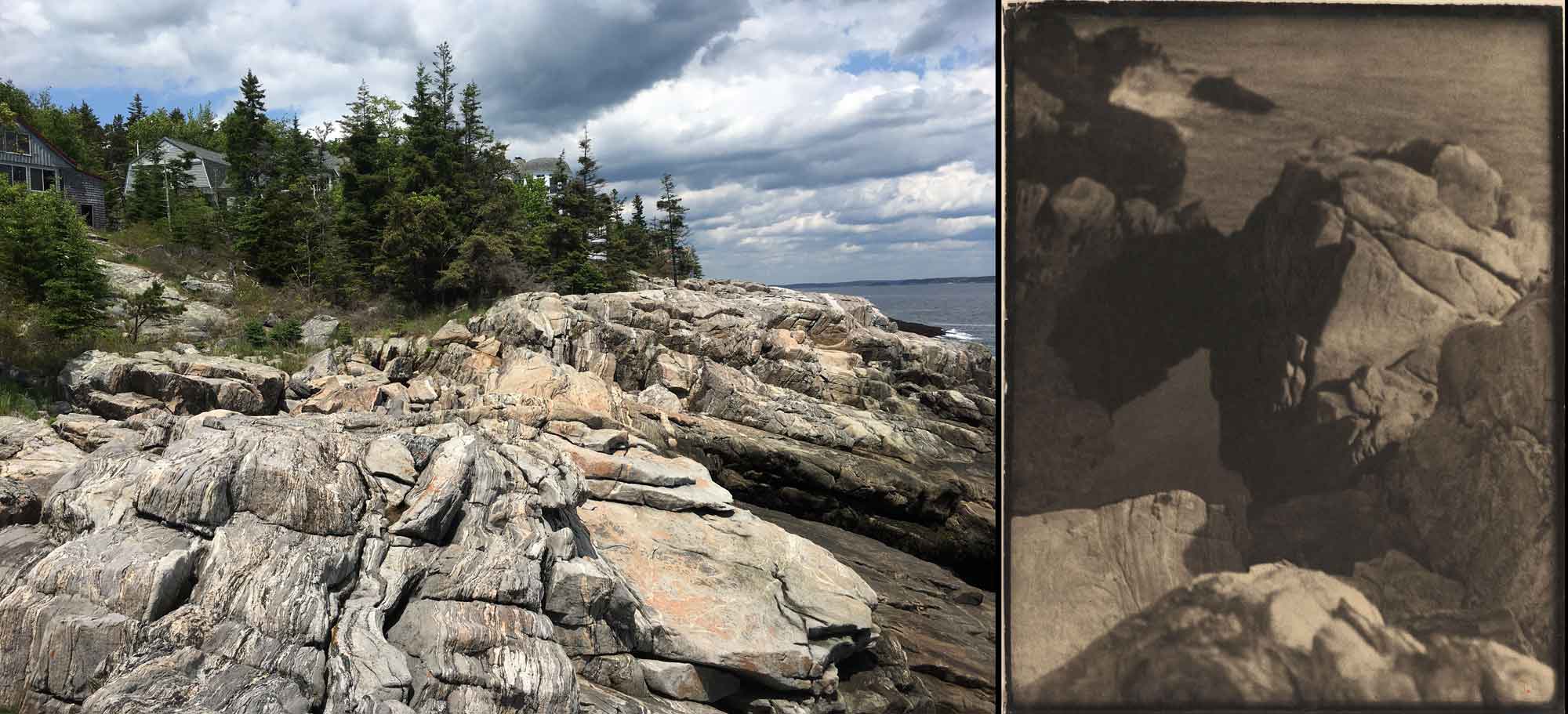
Former White Family Property, “Popple Beach”, Georgetown, ME, 2018. Shrouded by trees at far right center is where American photographer Clarence Hudson White rebuilt a derelict farm house and had it winched closer to the coast overlooking the mouth of the Sheepscot River in 1910. The White family retained the property until 1990, when Ruth Royer White passed. Jeanne McGowan, former president of the Georgetown Historical Society and a close friend and former neighbor of the White family, corresponded with PhotoSeed in 2018, giving the following details of the White property: “The White house originally sat at the corner of what is now Seguinland Road and White Road. About 1910 Clarence and Jane purchased the farmhouse from Walter Reid and moved it closer to the water, using local talent to do so. Mr. Reid had purchased it from a local family as a part of his plan to develop that area of the island. In fact, the Grey Havens Inn was the first part of that plan although Mr. Reid called it the Seguinland Hotel. …After the move, a “tower” was added to the house by the Whites which served as an office for both Clarence Sr. and Clarence Jr. The house stayed in the White family through Clarence Jr’s life and then that of his wife, Ruth Royer White who died in 1990. They moved to Georgetown in the 1970s and lived there full-time. Clarence’s nephew Maynard inherited the house and after some years sold it to the current owner. It was she who demolished the White house and built a new home closer to the water. Ruth White confirmed to my husband and me that the Whites were the ones who named their shorefront Popple Beach because of the large rocks that comprised the shore. Time and tide have changed that somewhat. In fact, Ruth White told us that there was once a “crib wharf” made of rocks. Whatever it’s size and shape, such a wharf would have been there a relatively short time given the wave/water action at that location at the mouth of the Sheepscot River.” Today, this now private property can only be seen from the coastal northern boundary of Reid State Park. Photo by David Spencer for PhotoSeed Archive. Right: The Bath Tub, Maine Coast, ca. 1921, Clarence Hudson White, American, 1871–1925, Gum bichromate on palladium print with wash. Collection: Princeton Museum of Art, Princeton, N.J. (further inscribed on matt verso: Rocks at Georgetown, Maine – about 1921)

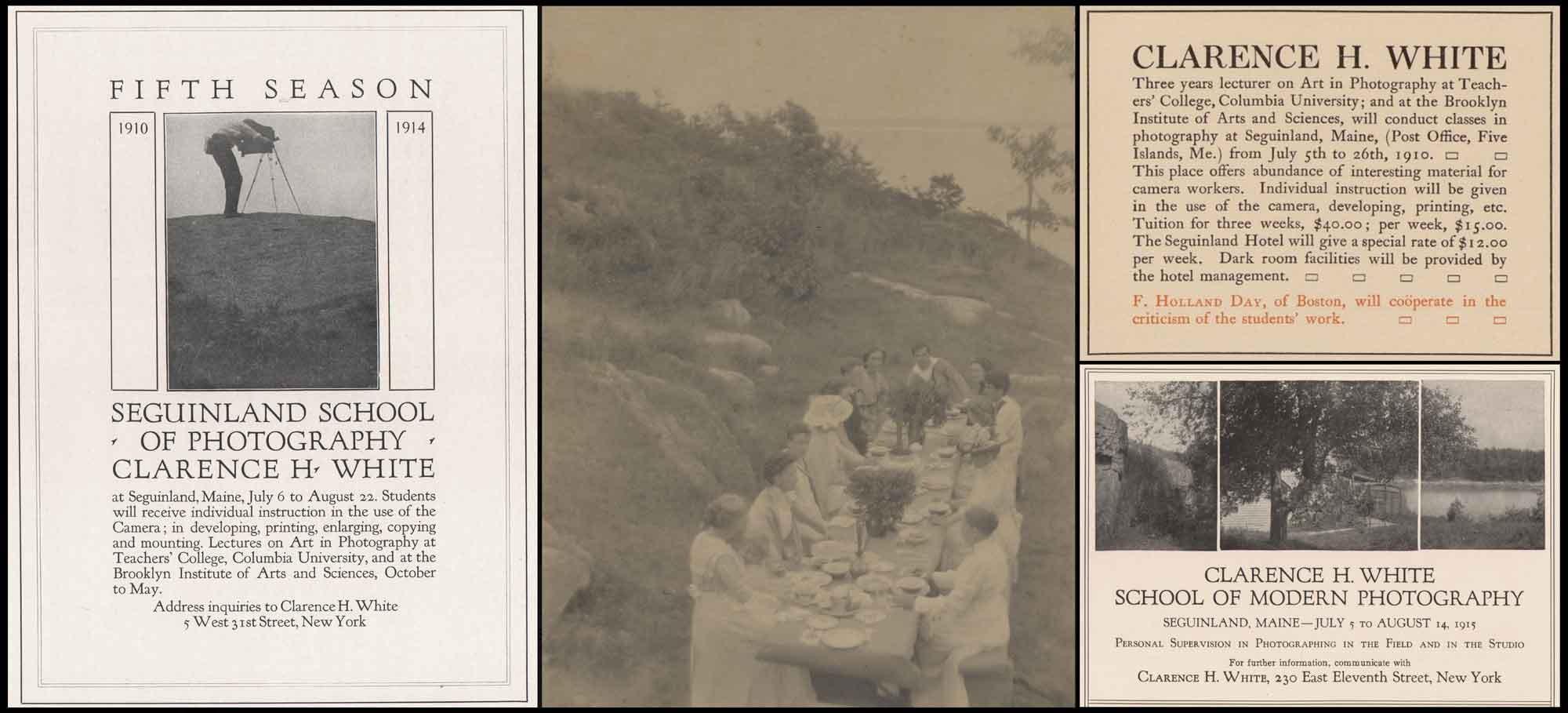
Advertising Material: Seguinland School of Photography: The very first school devoted to artistic photography was founded in 1910 by Clarence White as The Seguinland School of Photography, located in coastal Georgetown, Maine at the head of the Sheepscot River. The Library of Congress notes the school: “was housed in a hotel, which was to be part of the new “Seguinland” resort on the mid-coast of Maine near Georgetown and Seguin Island. Pictorialist photographer F. Holland Day, who summered nearby, had earlier invited White and his family to the area for a respite from the city and the opportunity to explore creative photography outdoors. The fellowship between the two photographers and their families was an important factor in White’s decision to start the summer school. Students wore sailor suits, a practice begun by Day and his summer guests, and boarded at the Seguinland Hotel. Day regularly conducted critiques for White’s students, as on occasion did New York photographer Gertrude Käsebier.Left: Fifth Season advertisement, published full page (25.5 x 20.3 cm) in Platinum Print: A Journal of Personal Expression, New York, December, 1913. (PhotoSeed Archive) Middle: First Summer School, Five Islands, Maine, 1910, Clarence Hudson White, American, 1871–1925, platinum print: Collection, Museum of Modern Art, New York, N.Y. Dressed in a sailor suit, Clarence White sits at the far end of a communal table along with students attending the first year of his Seguinland School of Photography. Top Right: Advertisement drawing attention to Clarence H. White, notifying subscribers to Camera Work, XXX, April 1910 that he “will conduct classes in photography at Seguinland, Maine, (Post Office, Five Islands, Me.) from July 5th to 26th, 1910.” Lower Right: In 1915, during the sixth and final year of White’s summer school in Maine before moving to East Canaan, Connecticut, the school was marketing itself as The Clarence H. White School of Modern Photography. Advertisement in Platinum Print: A Journal of Personal Expression, New York, Vol. 2, No. 1, 1915. (PhotoSeed Archive)

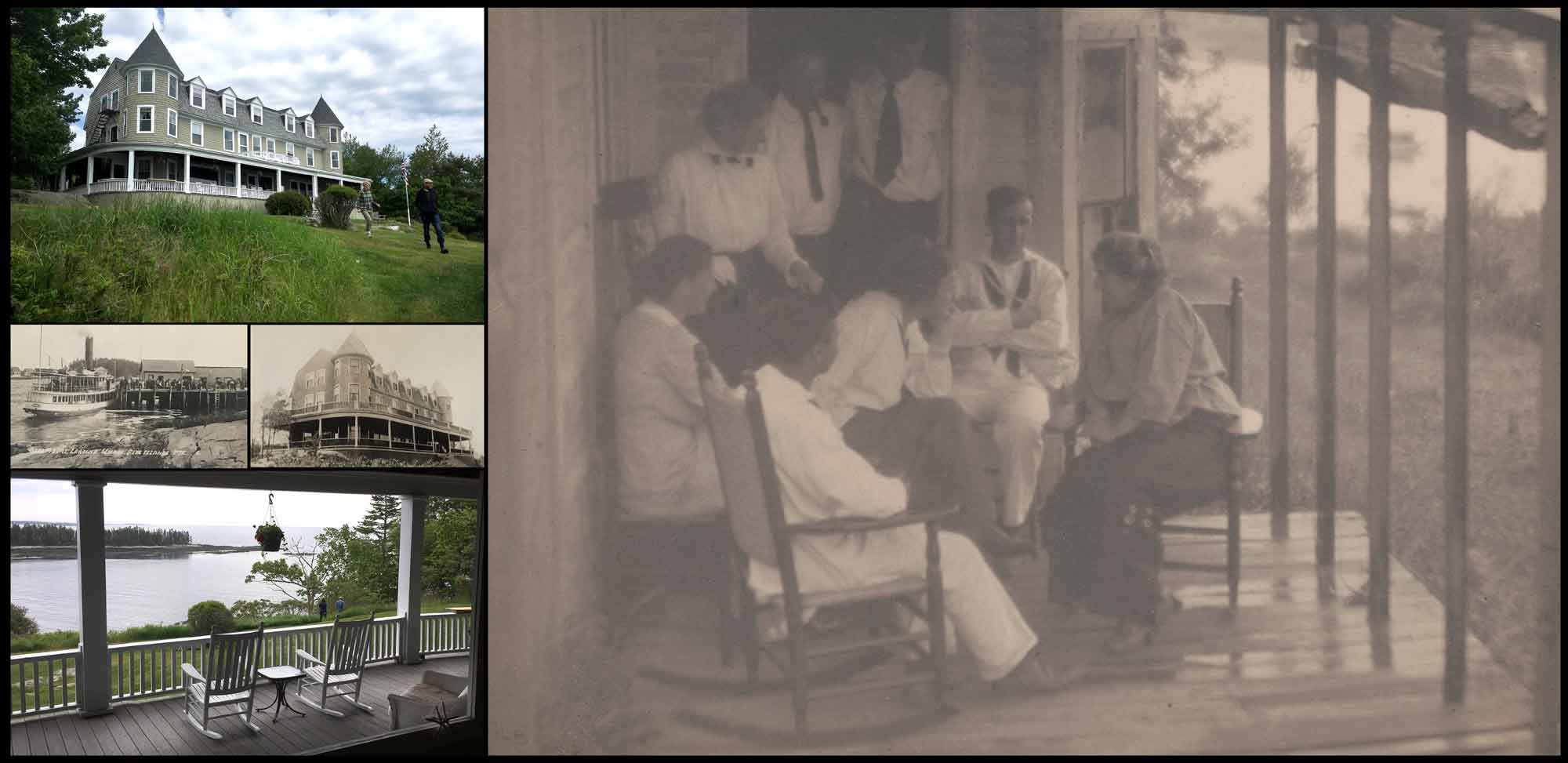
Upper Left: Visitors on Grounds of Grey Havens Inn, Georgetown, ME, 2018. This shingle style hotel was built in 1904 by Georgetown native Walter E. Reid (1869 -1955) as part of his Seguinland Cottage Company, a Georgetown real estate development firm with plans to develop 1500 acres around the hotel as a new summer resort. The hotel was used by summer students of the Clarence White-founded Seguinland School of Photography. In 1910, an ad in Camera Work gave students a special rate for one week of hotel room and board for $12.00. Reid made a name and fortune for himself first with the American Tobacco Company and later as director of the Mack Truck Company from 1927-1951. A life of local philanthropy followed, his significant holdings in Mack Truck giving him the means to initially donate 350 acres of land to the state of Maine in 1946. Named in memory to his parents, Reid State Park—close to the hotel— opened in Georgetown in 1950, the state’s first public recreational park on the ocean. Video history of Walter E. Reid. Middle Left: Historic photographs from about 1920 showing a steamboat at the Five Islands wharf: how visitors arrived and departed for the the hotel; a frontal view of the hotel described in a scrapbook held by the property as “Awnings Gone – Upper Deck Intact“. Lower Left: Listed on the National Historic Register in 1985, hotel visitors can enjoy seating looking at to the mouth of Harmon’s Harbor, an inlet off the Sheepscot River. (David Spencer for PhotoSeed Archive) Right: In this c. 1913 platinum print by Sequinland School of Photography student Gertrude L. Brown, the porch of the nearby Pilot House on the hotel grounds becomes an extended classroom space. School founder Clarence White, in sailor suit seated at background middle, converses with Gertrude Käsebier at right, surrounded by students. Collection: Library of Congress.

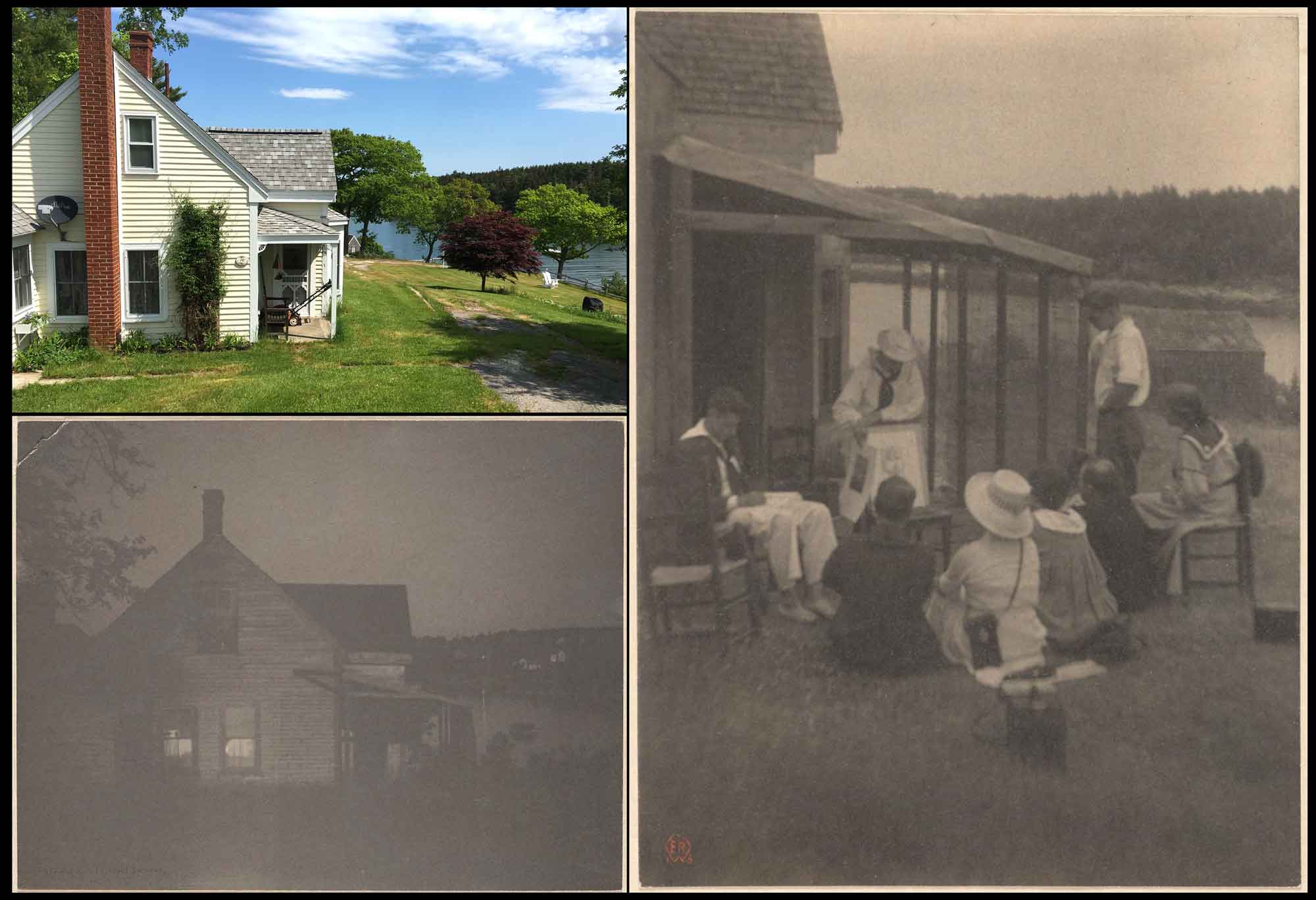
Upper Left: The Pilot House, Georgetown, ME, 2018. The likely domicile of former steam launch or boat pilots who maneuvered the rocky shoreline of nearby Harmon’s Harbor while ferrying guests to the Sequinland Hotel, this home was rented by Clarence White after 1912 for use as a darkroom, studio and classroom space for the Seguinland School of Photography through 1915. (David Spencer for PhotoSeed Archive) Lower Left: Untitled {Architectural study at night}, 1915, Margaret DeMotte Brown, American, 1880-1959, platinum print from Class of 1915 Album. The Pilot house is seen in this nighttime view, the structure today noticeably altered by the placement of a new chimney stack and permanent porch overhang. Collection: Princeton University Art Museum. Right: Clarence White critiquing students at the Sequinland Summer School, 1915, Edith R. Wilson, American, 1864-1924, platinum print from Class of 1915 Album. Historian Anne McCauley, in her fine 2017 volume Clarence H. White and His World: The Art and Craft of Photography, 1895-1925, describes some of the conditions students of the school faced at Sequinland: “For photographers, the implementation of classes in a rural location like coastal Maine was considerably more difficult, since neither running water (vital for processing) nor electricity was available. Well water was pumped, shooting was done in daylight, and sun printing was normal for platinum and gum printing (bromide enlargements were possible with lantern light). (p. 250) Collection: Princeton University Art Museum.

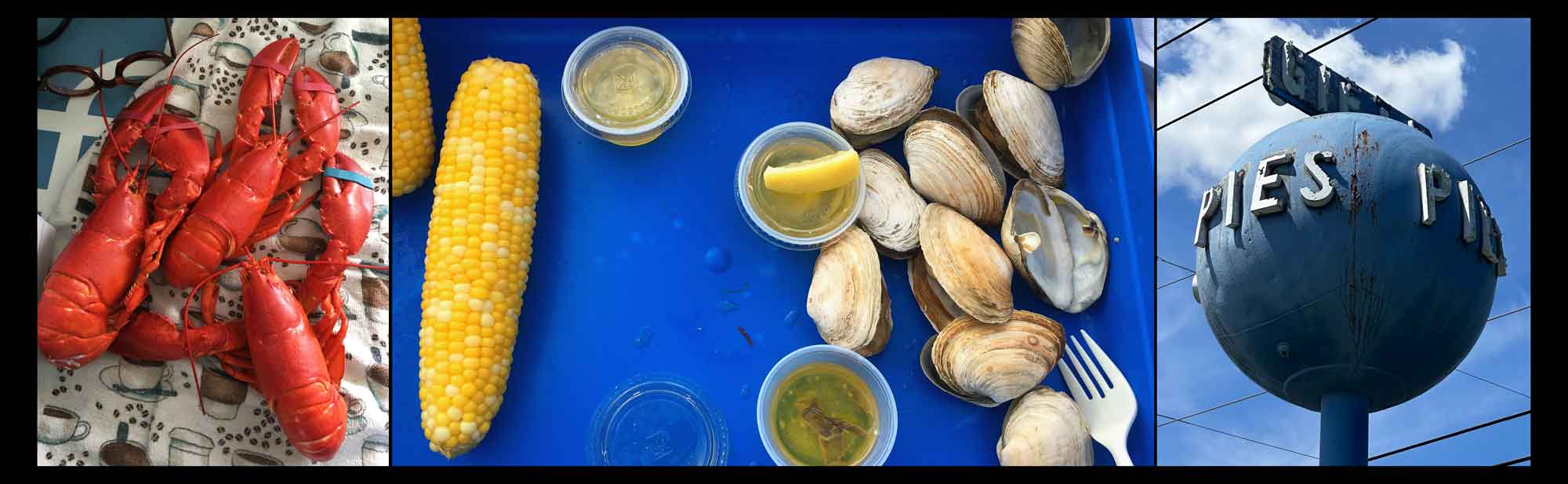
The Red, White & Blue of a Maine Summer: Cushing, 2022: Lobsters Steamed, Pound Direct. Middle: Steamers & Corn, Bar Harbor, ME, 2019. Right: Wild Blueberry Land Sign, Columbia Falls, ME, 2024. Photos by David Spencer for PhotoSeed Archive

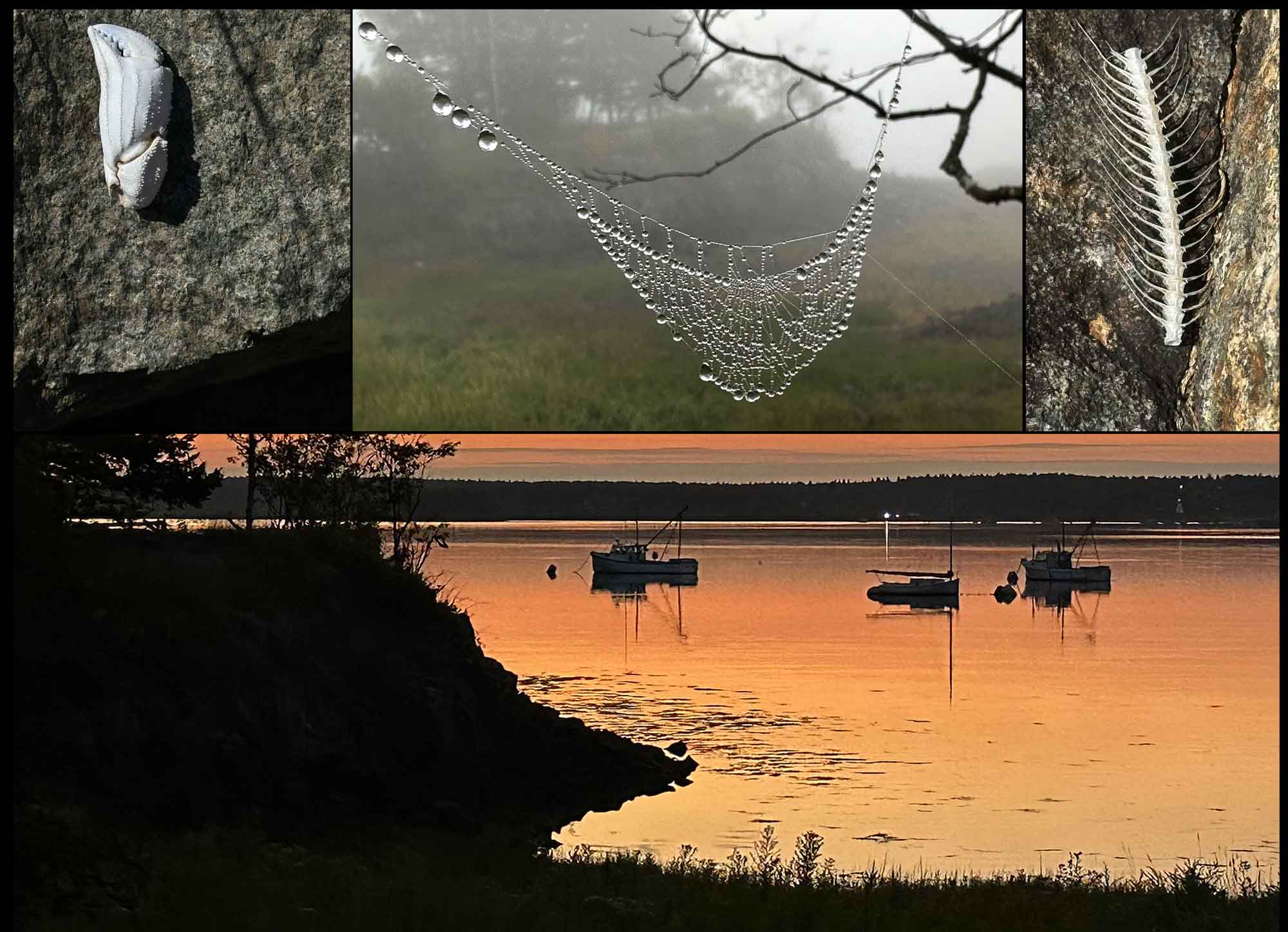
Maine Tide & Time: Upper Left: Bleached Crab Claw on Rock: Bog Brook Cove Preserve Beach, Trescott Township, Washington County, ME, 2026: “Maine Coast Heritage Trust began eyeing this stretch of Down East coast for conservation back in the late 1980s, and the organization worked for 30 years to assemble the nine parcels that now make up 1,770-acre Bog Brook Cove Preserve, straddling the town line of Cutler and Trescott, in Washington County.” Upper Middle: Cobweb Hammock, Lubec, ME, 2026. Upper Right: Fish Spine, Bog Brook Cove Preserve Beach, 2026. Bottom: Eastern Glow, Johnson Bay, Lubec, ME, 2026. Lobster boats and a sailboat dot Johnson Bay in the eastern-most town in the United States, with Canada’s Campobello Island serving as the backdrop. Photos by David Spencer for PhotoSeed Archive

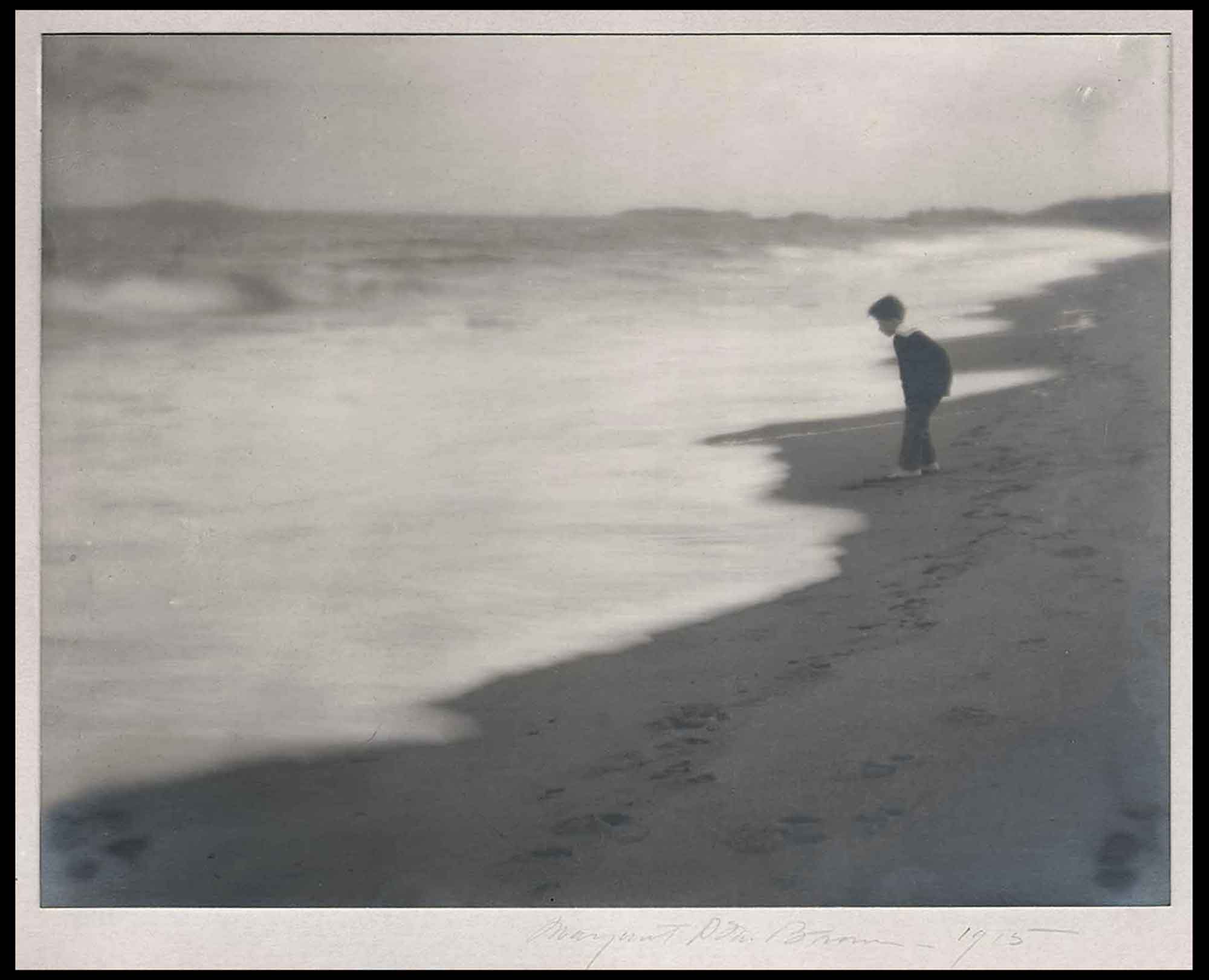
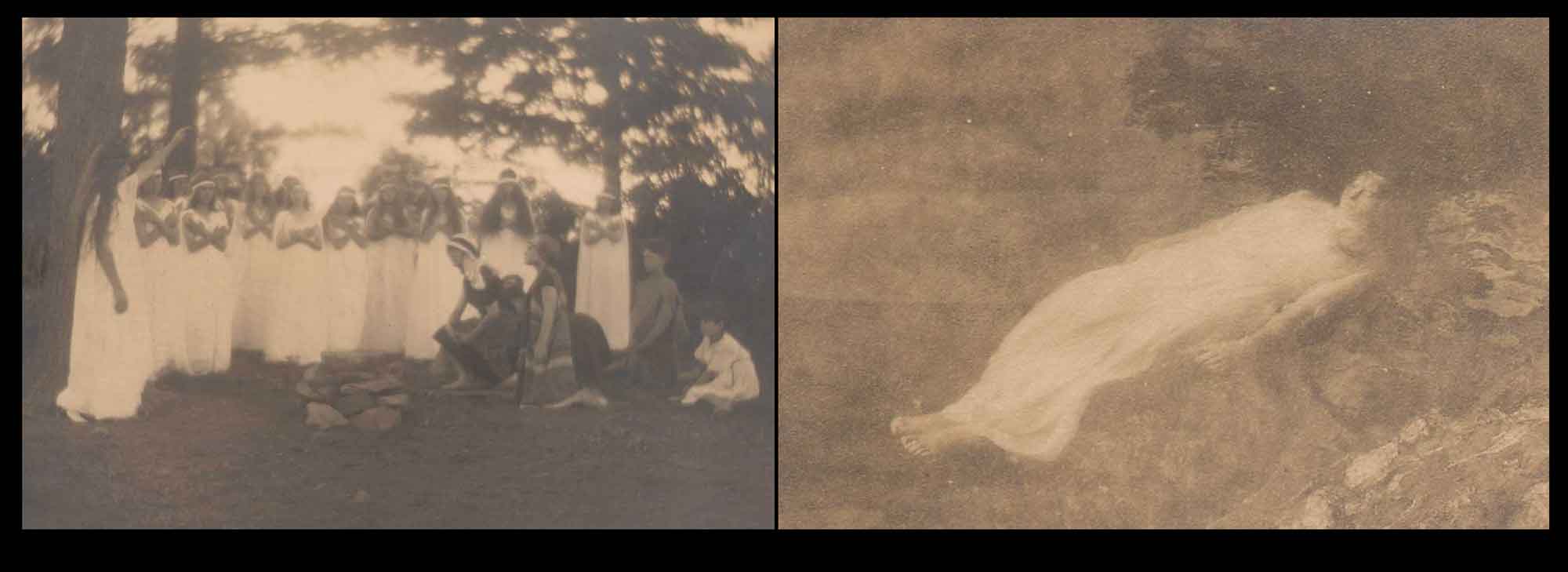
Summer Camp Scenes, Sunday Bible Drama : Camp Sidney Lanier, 1916, Margaret Watkins , Canadian, 1884-1969, gelatin silver print, 15.5 x 20.8 cm. Known as “primitive dramas” , these campers act out a Bible drama written by Sidney Lanier Jr. (1870-1918) in the camps woods. Likely dating to 1916, this and two other known photographs by Watkins were taken at Camp Sidney Lanier, located in Eliot, Maine from 1908-1940. In 1914, Watkins had attended a six-week session of the Clarence H. White Summer School of Photography (Sequinland School of Photography) at Georgetown, ME, eventually teaching at the school in CT and New York City beginning in 1917. Right: Mermaid Study : Submerged, (detail) 1914, Charlotte Vetter Gulick, American, 1865-1928, gelatin silver print, 8.4 x 10.8 | 16.7 x 22.7 cm gray art paper. The subject of this photograph, a person shown underwater, was something rarely if ever photographed, at least successfully, from this time period. Most likely taken with a hand-camera, the swimmer is Katharine “Kitty” Gulick, (1895-1968) youngest daughter of photographer and Wohelo camp founder Charlotte Vetter Gulick. She and husband Luther Halsey Gulick (1865-1918) founded the camp in 1907, located on the shores of Sebago Lake in Raymond, Maine. Wohelo Camps continue to operate in the present day. (2026) Both: PhotoSeed Archive

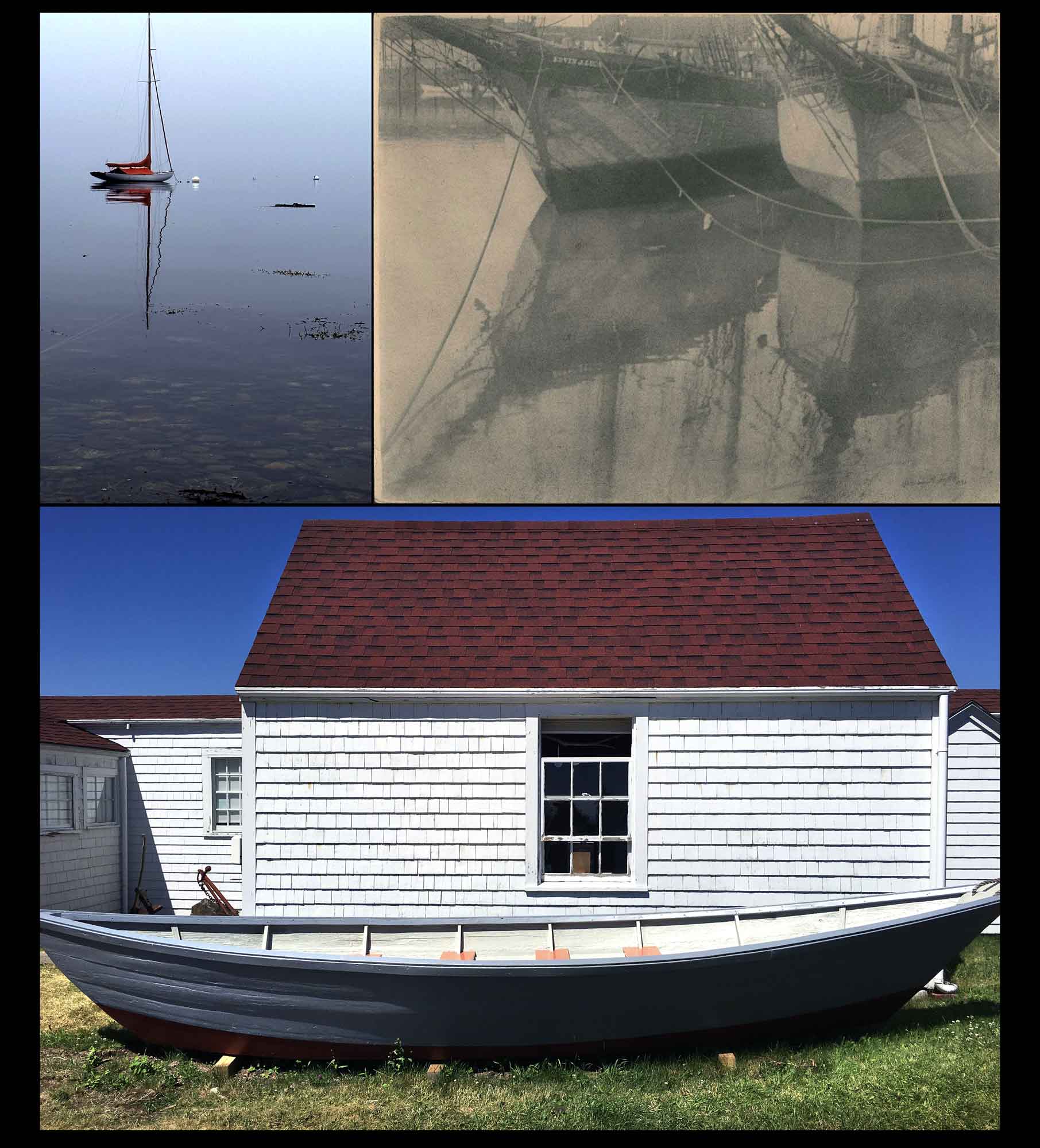
Top Left: Isleboro, 2023: Sailboat Reflection. David Spencer for PhotoSeed Archive. Top Right: In Port (Rockland Maine), 1931, Hermann C. Lythgoe, American, 1874-1962, unmounted bromoil print, 27.7 x 35.2 cm. Reflections from the hulls of two large sailboats and their mooring lines are seen in the harbor at Rockland. PhotoSeed Archive. Bottom: Bottom: The Fitzgerald Dory, Monhegan Island, 2022. Known as The Command, this dory, once owned by Monhegan artist James Fitzgerald, (1899-1971) sits on the grounds of the Monhegan Island Light station. A plate attached to the boat: (excerpt) Fitzgerald “developed a deep appreciation for the beauty and seaworthiness of a dory when he joined the crew of the schooner Elizabeth Howard in 1923. In 1963, he purchased this dory from the captain of a seine boat that had tied up at Monhegan Wharf. Naming it The Command, Fitzgerald often used the dory as a model for his artwork.” David Spencer for PhotoSeed Archive

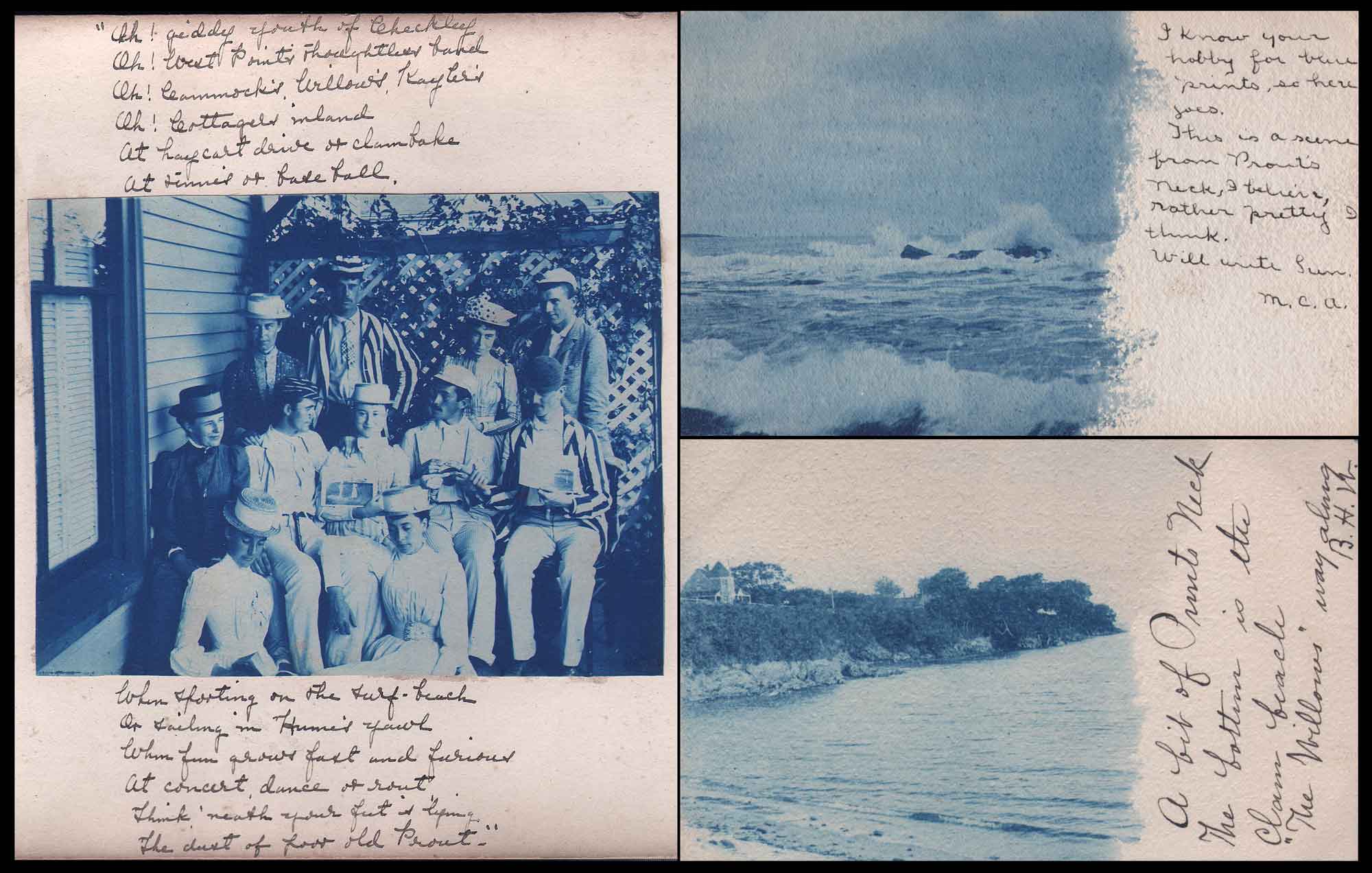
Scenes from Prouts Neck: Left: Young people Dressed for Summer at Prouts Neck, Maine, ca. 1890, unknown American photographer, cyanotype on leaf contained within album, 8.8 x 11.5 | 15.5 x 18.0 cm. The following lines are inscribed with this photograph, the early references being large Summer hotels that once operated in Prouts Neck, often catering to those from society. “Oh! giddy youth of Checkley | Oh! West Point’s thoughtless band | Oh! Cammock’s, Willow’s, Kayler’s | Oh! Cottages inland | At haycart drive or clambake | At tennis or base ball : When sporting on the surf-beach | Or sailing in Homer’s (?) yawl | When fun grows fast and furious | At concert, dance or rout | Think neath your feet is lying | The dust of good old Prout.” Circular photographs consistent with Original or No. 1 model Kodak also included in this album, giving indication of assigned date. From: PhotoSeed Archive. Top Right: Prouts Neck Surf, 1905, unknown American photographer “M.C. A.”, cyanotype, undivided back rppc, 8.6 x 13.8 cm. Mailed from Union, N.H. to Miss Ina M. Allen of Westbrook, ME, “M.C. A.” writes on recto: “I know your hobby for these prints, so here goes. This is a scene fro Prout’s Neck, I believe, rather pretty I think. Will write Soon.” Bottom Right: A Bit of Prouts Neck, ca. 1905, Signed on recto by the unknown American photographer B.H.W., cyanotype rppc, not mailed, undivided back, 8.6 x 13.8 cm. In hand of photographer on recto: A bit of Prouts Neck | The bottom is the Clam beach | “The Willows” way along.” The Willows Hotel, also known as Sea View House, was established in Prouts Neck in 1871 by Benaiah Libby. (1814-1878) Both: PhotoSeed Archive

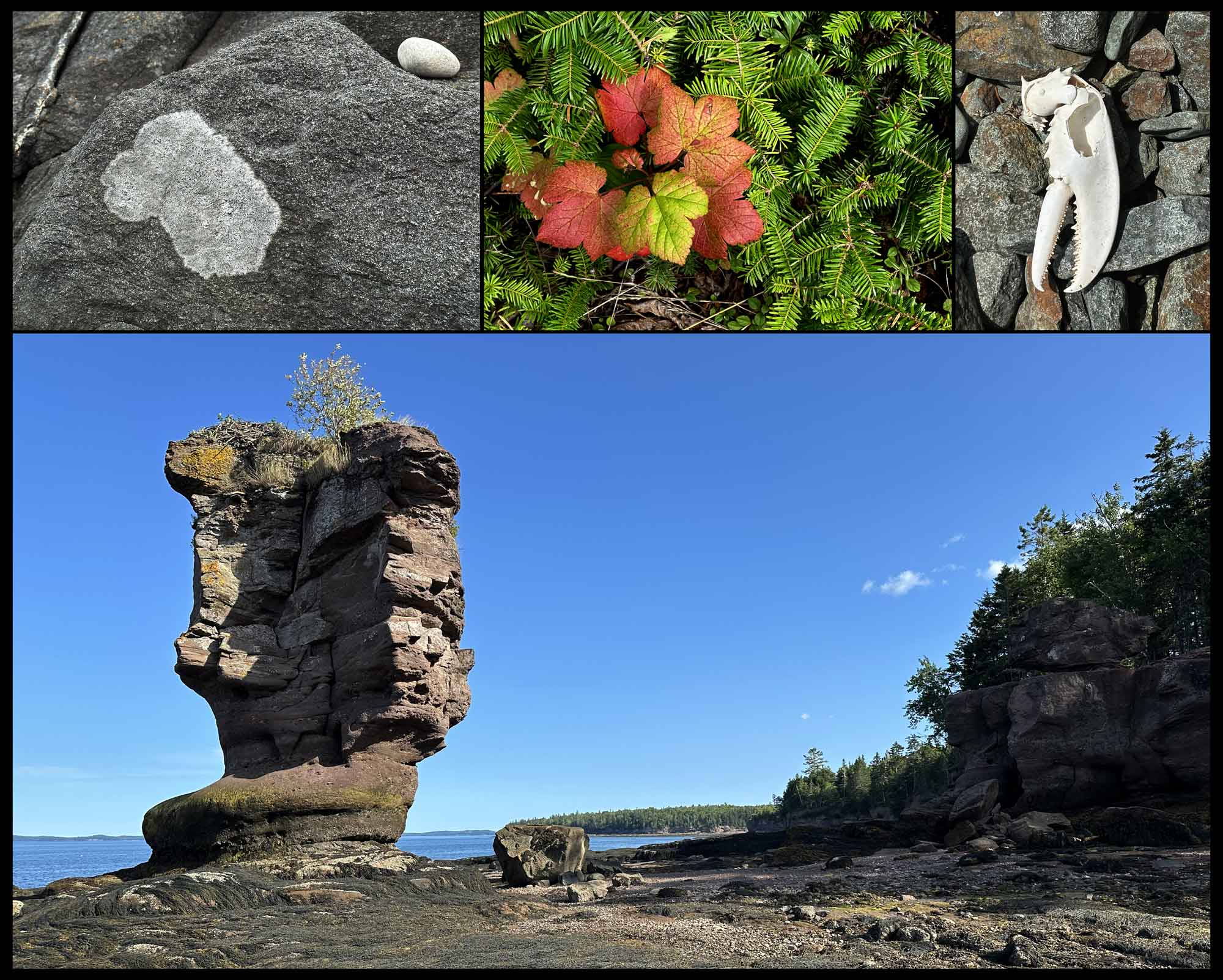
Steuben, 2024: “Lichen & White Rock”. Spied on Petit Manan Point shoreline on Pigeon Hill Bay, part of the Maine Coastal Island National Wildlife Refuge in Steuben, ME. Top Middle: Ribes glandulosum ? (skunk currant) & Fir Seedlings, Quoddy Head State Park, Lubec, ME, 2025. Top Right: Bleached Lobster Claw, Eastern Knubble Preserve, Cutler, ME., 2025. Bottom: Pulpit Rock at low Tide, Perry, ME, 2025. “Pulpit Rock is a sea stack, located between Mill Cove and Lewis Cove in the down east town of Perry on the Saint Croix River. A sea stack is an isolated, pillar-like rocky island, detached from the mainland by wave erosion (Bates and Jackson, 1984). Pulpit Rock was first noted in print by geologist C. T. Jackson in 1837 in his First Report on the Geology of the State of Maine. It has since been visited and described by a number of geologists. The area is noted for its high tides so it is imperative to plan a visit during a falling or low tide.” From: Maine Geologic Facts and Localities, Jan. 2016. All: Photos by David Spencer for PhotoSeed Archive.

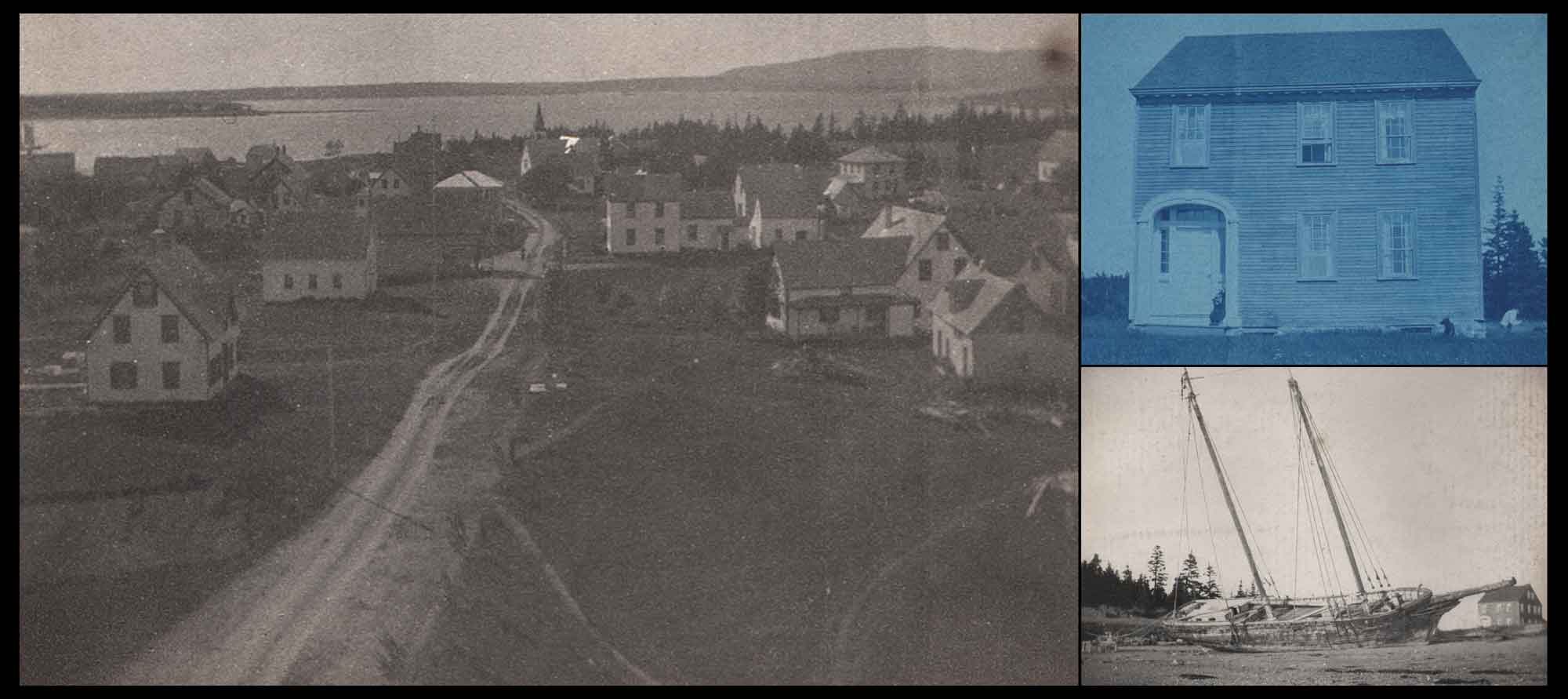
Summer Maine Rentals: View labeled Cranberry Isles, Maine, 1899, detail: album-mounted gelatin silver print, Phillip Patterson Wells, American, 1868-1929, 8.3 x 8.1 | 16.5 x 21.5 cm. This view is believed to show Great Cranberry Island, one of the five islands comprising the Town of Cranberry Isles. Wells and his family spent the summer on the island. Top Right: Capt. Hadlocks house rented to us, 1899, detail: album-mounted cyanotype print, 8.5 x 8.5 | 16.5 x 21.5 cm. (Phillip Patterson Wells) Captain Gilbert T. Hadlock, (1837-1917) who served as a Captain of a Treasury Department Lifesaving Station (Predecessor of the US Coast Guard) and ran steamboats, rented this home to Dr. Wells and his family. One of his children can be seen on the front entrance step. The home burned down in 1915. Lower Right: Old wreck at Isleford, 1899, detail: album-mounted gelatin silver print, 8.5 x 8.5 | 16.5 x 21.5 cm. (Phillip Patterson Wells) The wreck of a large two-masted sailboat is beached in front of the Hadlock house, seen in background, far right. Another view of the home, from the Great Cranberry Island Historical Society. Dr. Wells was librarian and instructor at Yale Law School for several years, and chief law officer under Gifford Pinchot for the U. S. Forestry Service, 1907-1910, counsel National Conservation Association, 1910-1911, chief law officer U. S. Reclamation Service (Department of the Interior), 1911-1913. All: PhotoSeed Archive

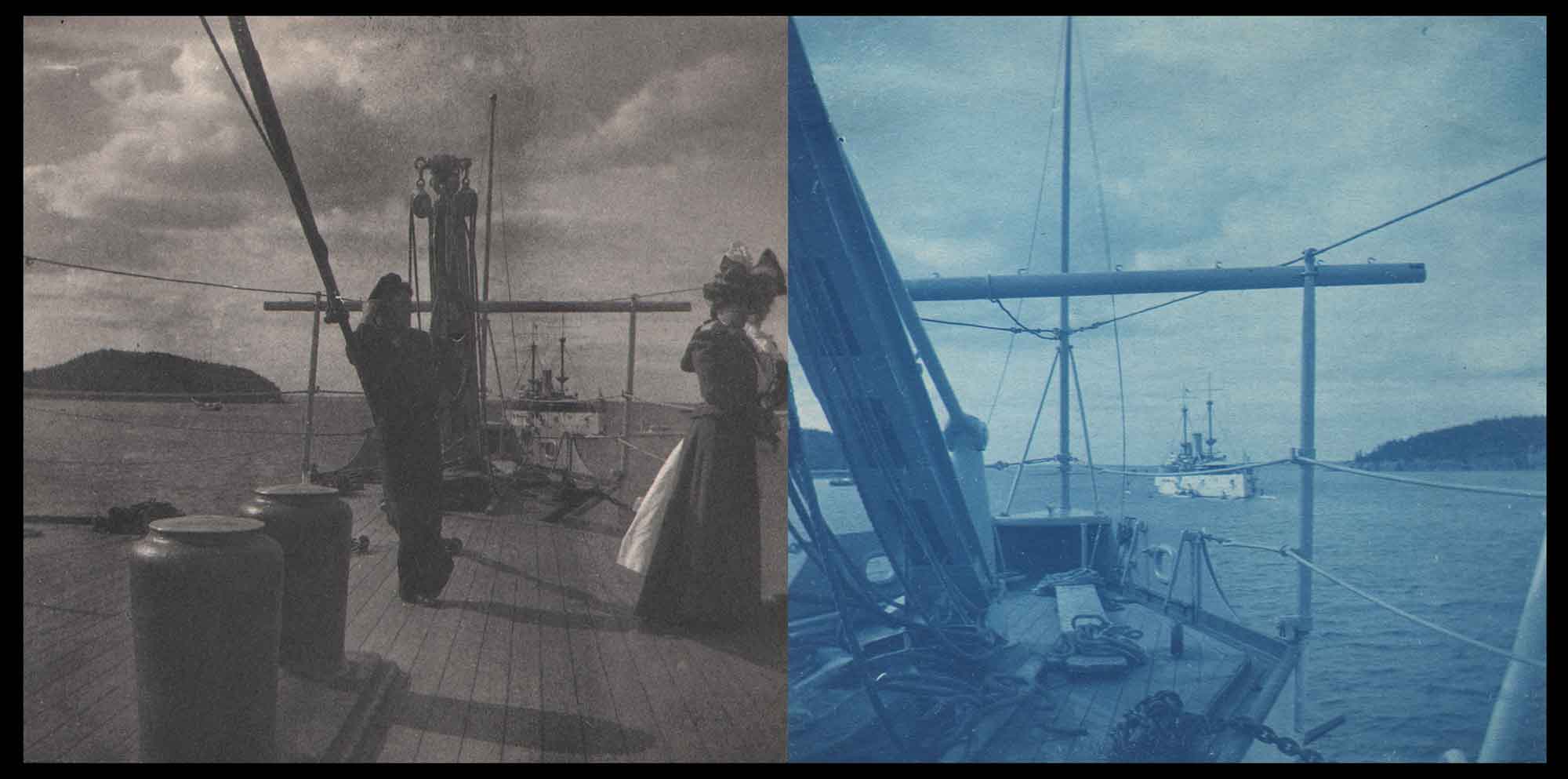
Summer Sailing Excursion: Fleet at Bar Harbor, 1899, album-mounted gelatin silver print, left and cyanotype at right, Phillip Patterson Wells, American, 1868-1929, each: 8.3 x 8.1 | 16.5 x 21.5 cm. From an album of summer views labeled Isleford, 1899 assembled by Wells. These two photographs appear on opposite album pages and were taken moments apart on the deck of a Bar Harbor excursion ship. Notice the sailor standing at ease in photo at left while several fashionably dressed women in hats stand nearby. At right, a closer view of the unknown US Navy battleship seen off the main bow area. Both: PhotoSeed Archive

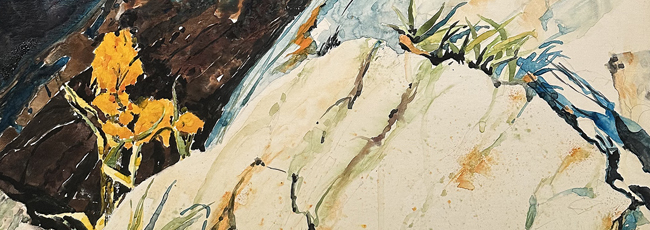
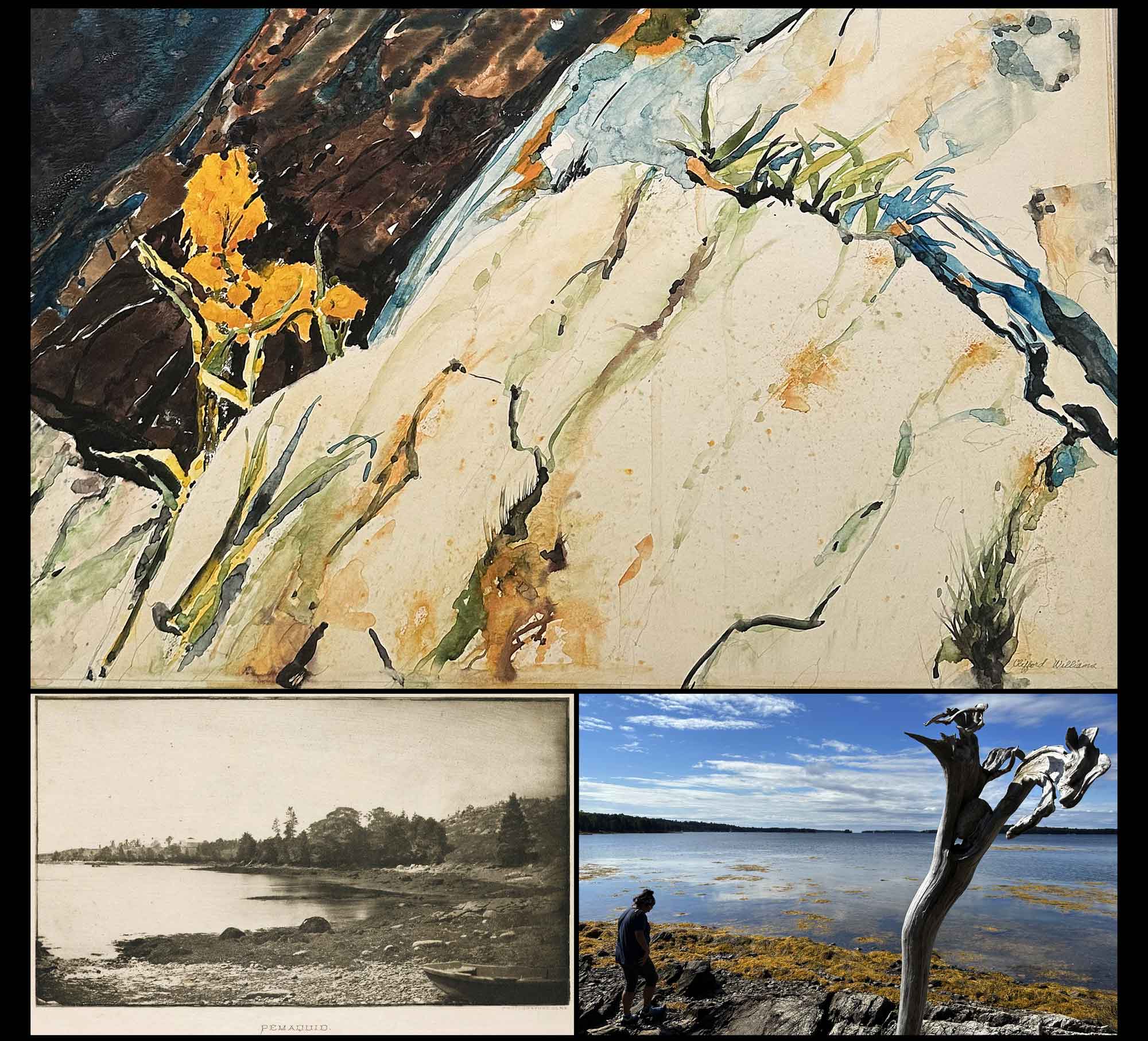
Rock Flower, Pemaquid, detail, ca. 1955-65, Clifford Williams, American, 1885-1971, watercolor on Fome-Cor type matrix, 54.0 x 53.6 cm. Likely depicting Seaside Goldenrod, (Solidago sempervirens) this abstract study of a rocky shoreline was done late in the artists career, and bears a deaccessioned label from the Providence Art Club of Rhode Island. Edith Clifford Williams was an early pioneer in the American abstract art movement. She was part of the circle that gathered around the photographer and modern art promoter Alfred Stieglitz. She was also a long-time confidante of Hu Shih (1891–1962), who was arguably the most prominent Chinese intellectual in the first half of the 20th century. Born in Ithaca, New York, Williams—who preferred to be known as Clifford—spent most of her girlhood in New Haven, Connecticut, where her father, Henry Shaler Williams, taught geology and paleontology at Yale University. After studying with the painter John Henry Twachtman and at Yale’s School of the Fine Arts, she traveled to Europe, and was enrolled briefly at the Académie Julian in Paris. Lower Left: Pemaquid, 1888, tissue photogravure, believed to be by Ernest Edwards, naturalized American, born England, 1836-1903, 10.8 x 18.6 | 25.3 x 30.5 cm. Pemaquid is a village within the town of Bristol, Maine, situated on the Pemaquid Peninsula, which extends into the Gulf of Maine. Lower Right: Nature Walk, Gilkey Harbor, Broad Point Preserve, Islesboro, ME, 2023. A large upended piece of driftwood becomes a readymade sculpture along the coastal trail at Broad Point Preserve, part of the Islesboro Islands Trust. David Spencer for PhotoSeed Archive

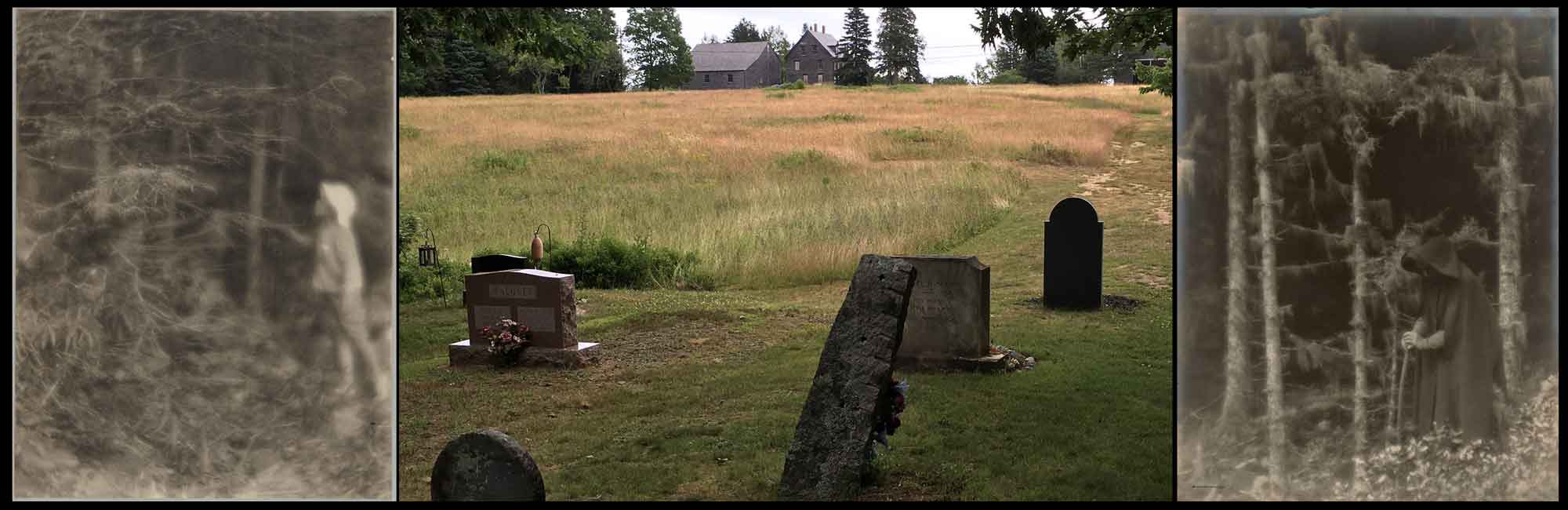
Artistic Ghosts of Maine: Child in woods, Maine (Clarence H. White, Jr.?) ca. 1910–1915, Clarence Hudson White, American, 1871–1925, platinum print. Collection: Princeton Museum of Art, Princeton, N.J. Middle: Olson House Grounds & Wyeth Plot, Cushing, Maine, 2022. The late 1700’s Olson House, a National Historic Landmark that served as artistic meadow backdrop for Andrew Wyeth’s 1948 painting Christina’s World, is seen at center background along with the gravesite (front right) of American artist Andrew Wyeth (1917-2009) &  Betsey Wyeth. (1921-2020) The Museum of Modern Art, which owns the painting, states: “The title Christina’s World, courtesy of Wyeth’s wife, indicates that the painting is more a psychological landscape than a portrait, a portrayal of a state of mind rather than a place.” Anna Christina Olson, 1893-1968, the subject of the painting, is also buried here with other Olson family members. Right: Witches’ Wood, 1915-20, Bertrand H. Wentworth, American, 1869-1953, gelatin silver print, 34.9 x 27.1 cm. Most likely a self-portrait, Wentworth, from Gardiner, ME, spent time at the artists colony on Monhegan Island. He was described as a “master craftsman” affiliated with the Society of Arts and Crafts of Boston and marketed his work as The Wentworth Photographs. Learn more. From: PhotoSeed Archive

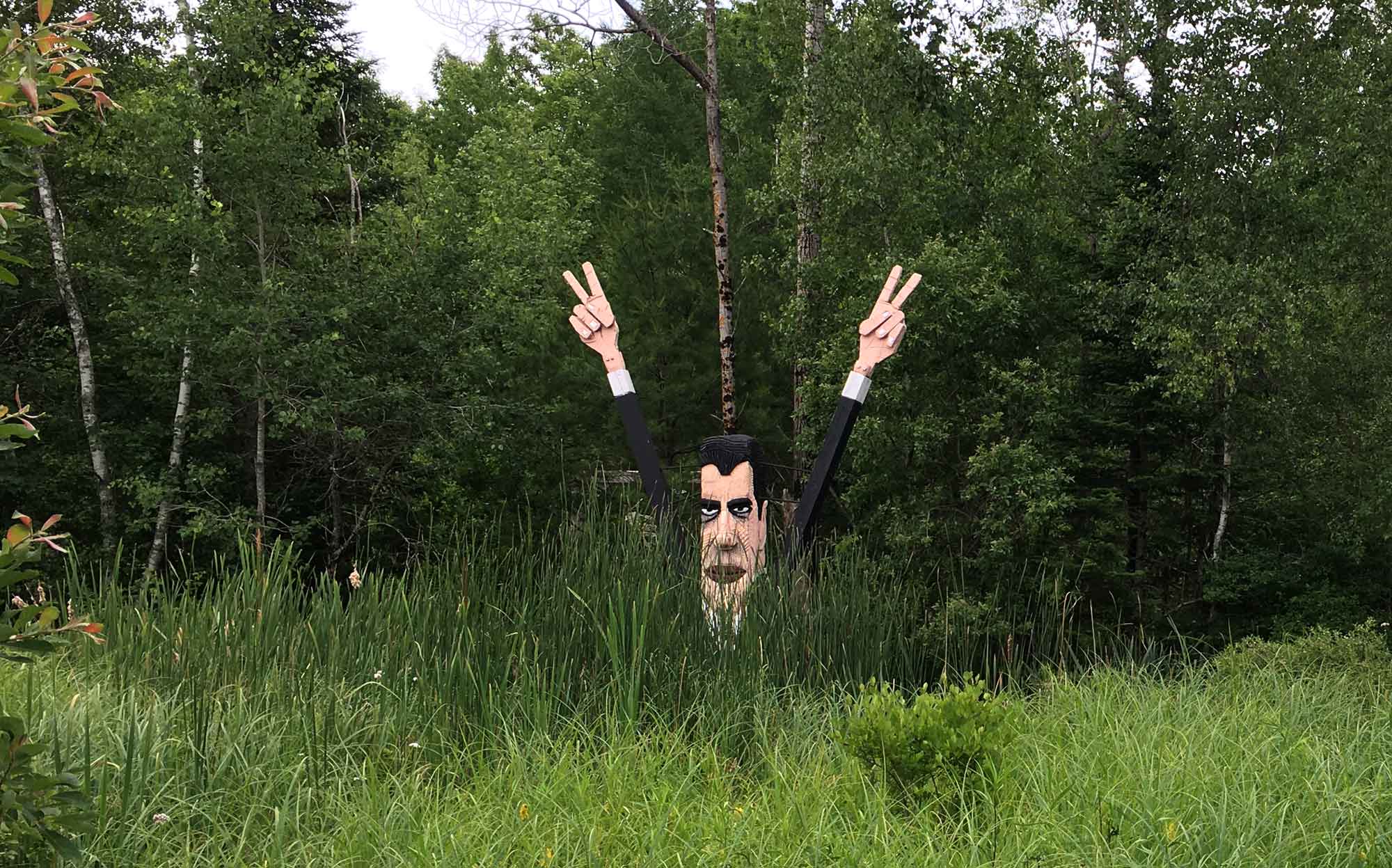
Nixon, 1973, Cushing, ME, 2022. Surprises are in store for intrepid visitors venturing off the well-worn tourist outposts in Maine. Sprouting from the reeds along the art trail of the Langlais Sculpture Preserve is former US President Richard Nixon carved in wood from a famous photograph. The work is by Maine artist Bernard Langlais, 1921-1977: “I don’t know if I’m called a constructivist, sculptor, or painter…But I wouldn’t mind being called a backwoodsman.” – Bernard Langlais, 1961. Photo by David Spencer for PhotoSeed Archive

Winter Joy

Dec 2025 | Childhood Photography, Significant Photographers

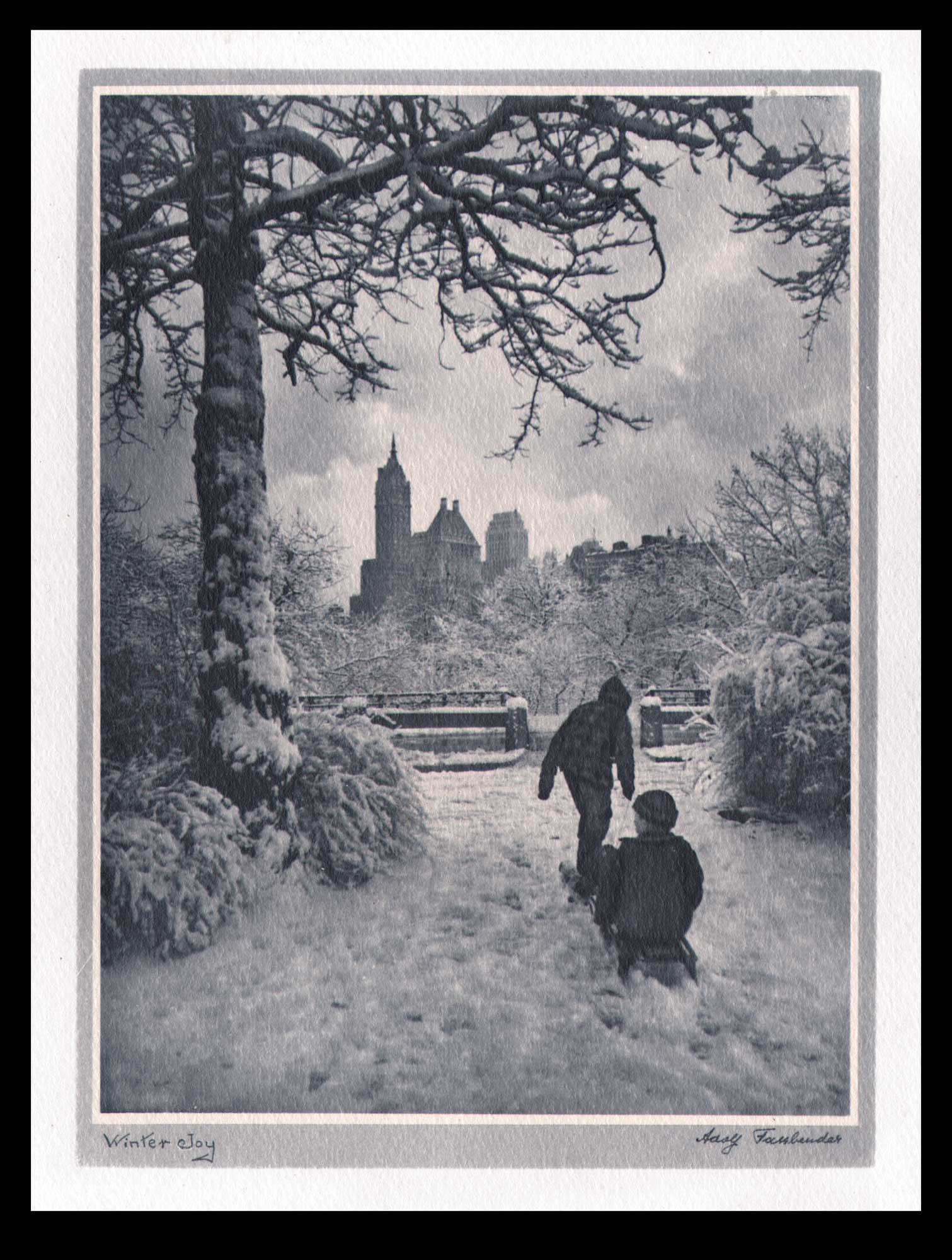
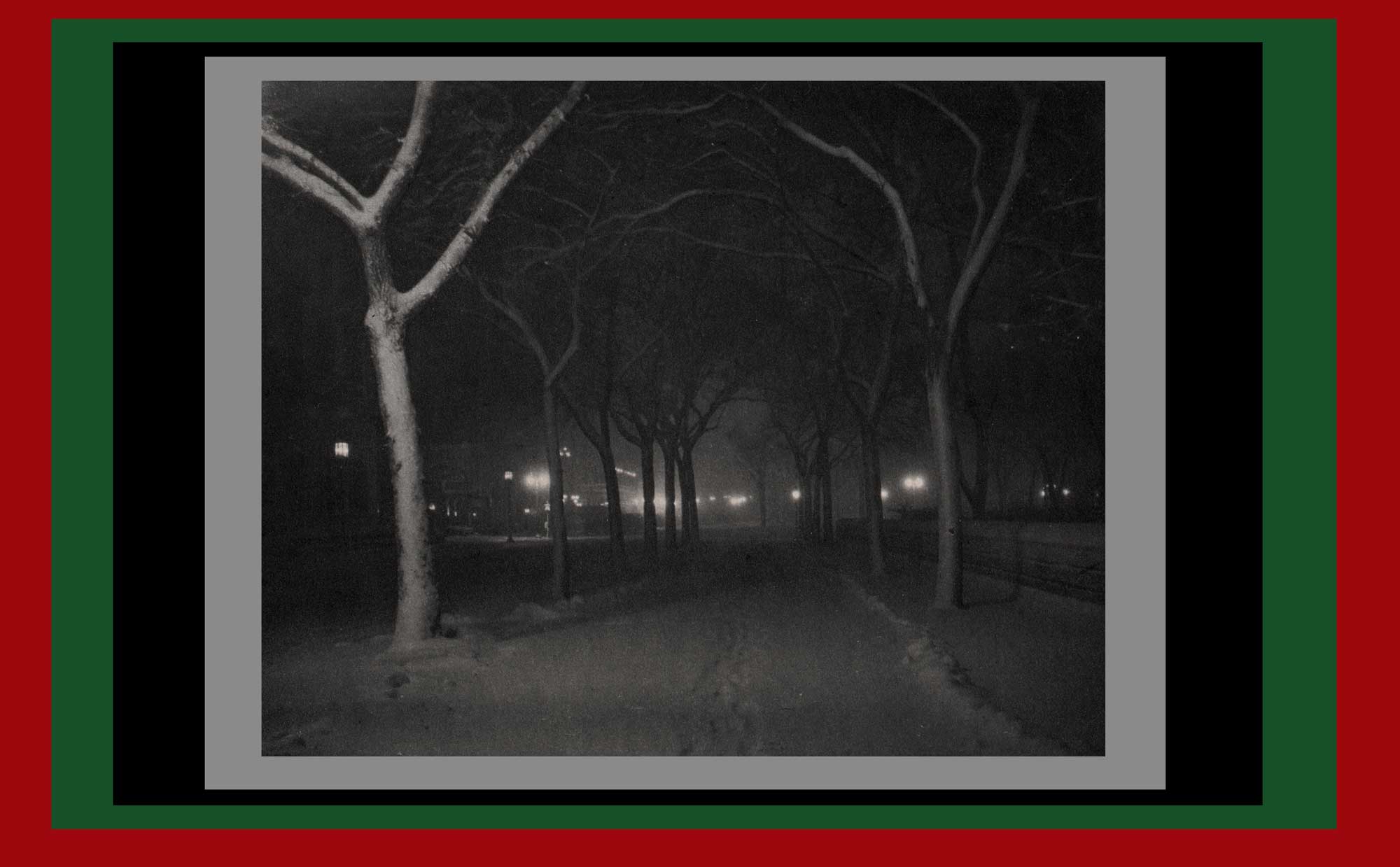
Winter Joy“, Adolf Fassbender, American, born Germany, 1884-1980, vintage bromide Christmas Card, ca. 1935-1955, 13.6 x 10.0 | 16.6 x 12.6 | 20.2 x 15.1 cm. A child is pulled on a sled through fresh snow inside New York’s Central Park, with the former Sherry Netherland and Savoy Plaza Hotels rising in the background. The front of this card (recto) had been remounted and once framed, and in the collection of former Camera Craft editor Sigismund Blumann on his passing in 1956. Fassbender, a contributor to Blumann’s later journal Photo Art Monthly, was known to send photographic cards like this one featuring winter and religious themes to friends and associates during the holidays. Another card owned by this archive contains this sentiment arranged in the shape of a Christmas tree: “May the beauty of this Christmas inspire you and yours throughout the New Year” —The Fassbenders. The artist utilized a copy negative incorporating a masked border with title and signature for these cards. From: PhotoSeed Archive

Silent Beautiful: Old Deerfield of the Allen Sisters

Nov 2025 | Archive Highlights, Cameras, Childhood Photography, New Additions, Photographic Postcards, Significant Photographers

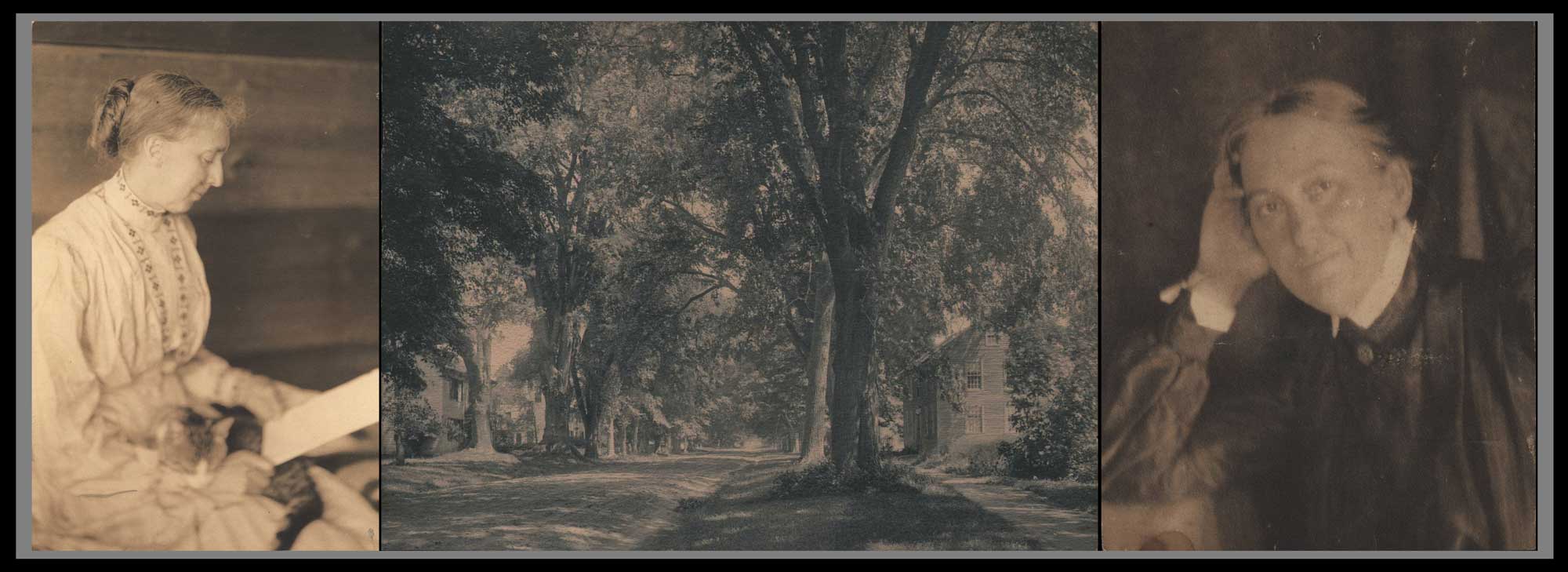
The Allen sisters of Deerfield: Frances Stebbins Allen at left, c. 1906 & Mary Electa Allen at right, c. 1913, (platinum prints) both: Courtesy Memorial Hall Museum, Pocumtuck Valley Memorial Association, Deerfield, MA. Center: “Deerfield Street: Childs House”, c. 1900-1905, Frances & Mary Allen, American, 1854-1941 & 1858-1941, platinum print, unmounted, 15.1 x 20.3 cm. Huge elm trees, now lost, provide the canopy for Old Main st., known as “The Street”, in Old Deerfield village, the photographers long-time home. From: PhotoSeed Archive

“Green meadows stretched in the sunlight, with the horizon of the gently curving hills; a quiet street overarched by mighty elms-the rows of stately trunks and the branches meeting overhead, like the pillars and arches of a cathedral aisle; a path below in green shadow, with splashes of yellow light, this is old Deerfield.” Mary E. Allen, 1892

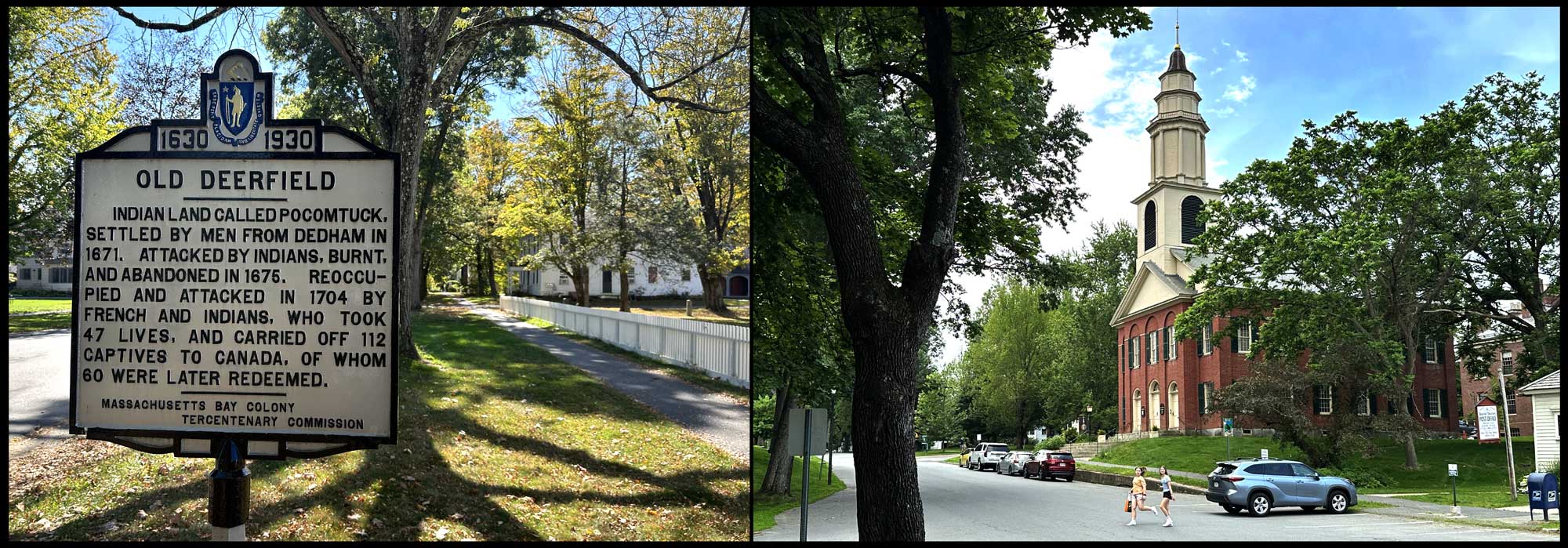
Left: a Massachusetts Tercentenary Commission sign erected in 1930 along the Old Main street in historic Deerfield marks the towns rich history, including the 1704 Raid on Deerfield by French and Native American forces leading to 47 deaths. Right: Visitors scoot across Old Main Street in front of the First Church of Deerfield, built in 1824. Known locally as the “Brick Church”, the present Unitarian congregation was originally established as The Congregational Church of Deerfield, 1673. Both: 2025 photos by David Spencer for PhotoSeed Archive

Frances Stebbins Allen (1854-1941) and younger sister Mary Electa Allen (1858-1941), self taught photographers who worked in the Pictorialist aesthetic, succeeded professionally in their vocation and lived long and fruitful lives, are today’s subject. Never marrying, their sibling bond sustained them through all of life’s challenges and rewards, and they died within four days of each other. Like many of their ancestors going back to the 17th century, the sisters life-long home was in Western Massachusetts, in the village of Deerfield, a place marked by a rich history including the trauma shaping Colonial America. The PhotoSeed archive is fortunate to own a small number of their original photographs, and after collecting ten more examples earlier this year, I decided to dig a bit deeper into their lives.
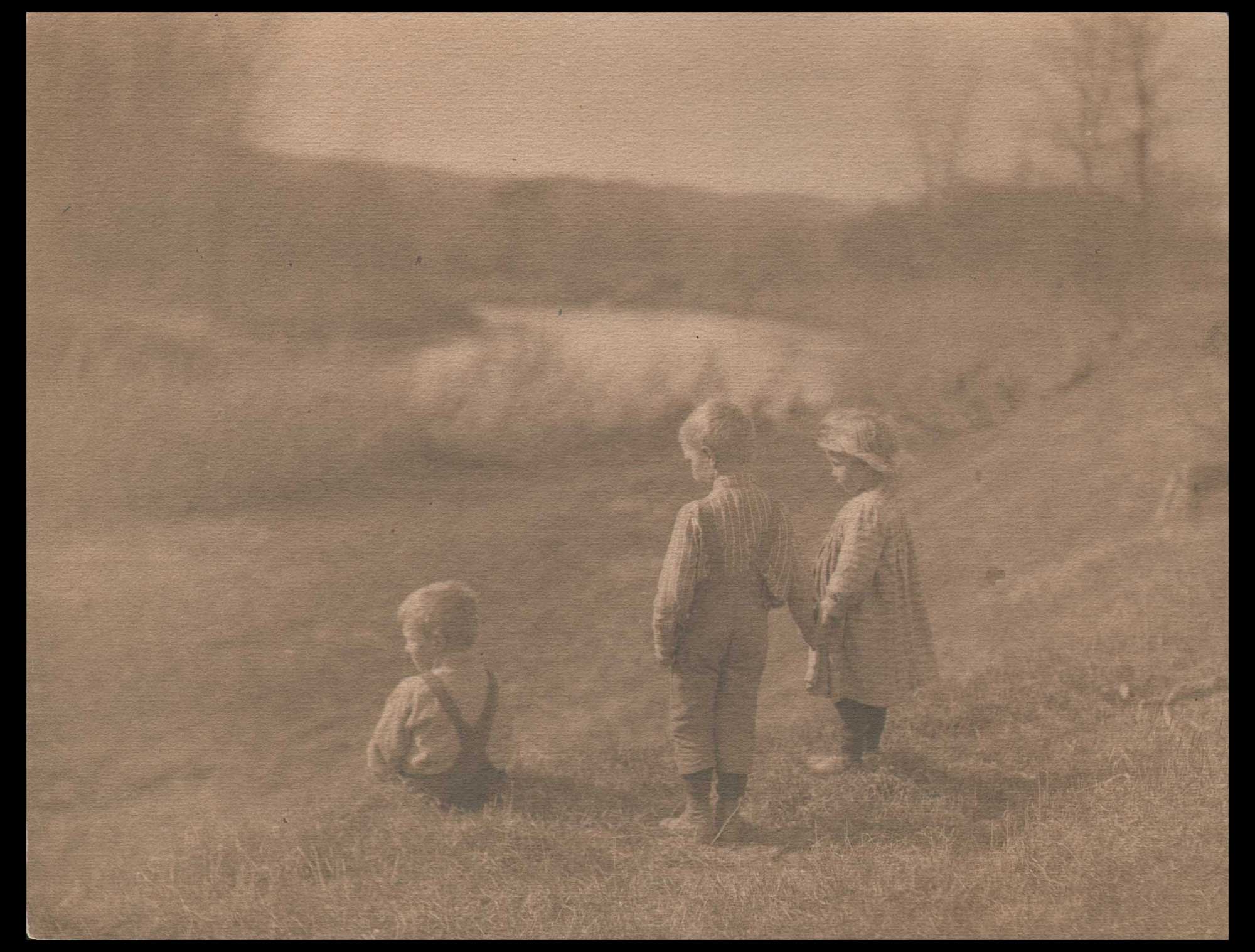
Hear the Frogs !” c. 1908, Frances & Mary Allen, American, 1854-1941 & 1858-1941, platinum print, unmounted, 15.6 x 20.1 cm. A little boy and girl stand holding hands while another sits overlooking the banks of the Deerfield River in the town. This work was shown in late 1908 along with 71 other photographs by the Allen sisters at The Art Institute of Chicago. From: PhotoSeed Archive

The “quiet street” described by Mary Allen in our opening quote, with the sisters photograph showing it at center, was the very street she and Frances lived on starting three years later in 1895. Her words evoke for the reader religious overtones: the imagery of a cathedral, an apt metaphor for the solidity of its “pillars and arches” being a stand-in for their historic New England town. In my mind, her description also extends to photography: these lines were the first for her article in the New England Magazine, which was illustrated by halftone photographs and line engravings also given credit to the author. The importance of light— “splashes of yellow light”—is another giveaway Mary Allen was already a keen observer of the medium’s innate etymological description of “drawing with light”. Ultimately, both the sisters’ lives would be shaped by forceful inner natures aided by Yankee grit, pluck and perseverance.
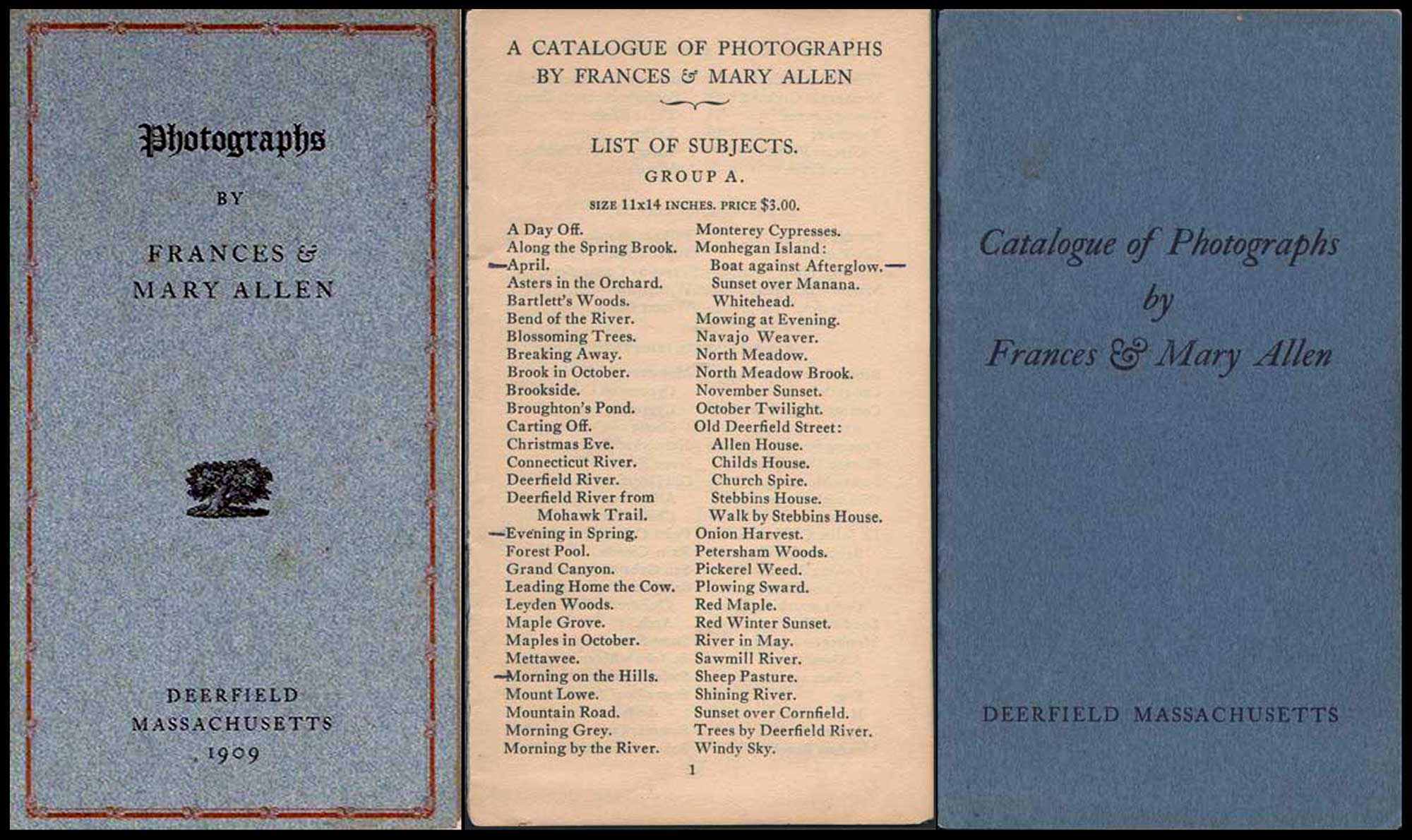
The Allen sisters issued seven catalogues listing their photographs for sale from 1904-20. Left: Catalogue cover: “Photographs by Frances & Mary Allen“, 1909. Credit: private collection. Middle & Right: opening page & cover: “Catalogue of Photographs by Frances & Mary Allen”, 1920, stapled, light blue paper covered wraps, 14.6 x 8.3 cm, 11 printed sides. Last catalogue issued. There are 556 photographs listed for sale in categories including Landscapes, Country Life, Children, Old Deerfield and others, with unmounted platinum prints in various sizes priced at .35¢ to $3.00 for the largest 11 x 14” print. Link to 1920 catalogue in collection. From: PhotoSeed Archive

Here’s a quote I came across defining the arc of their photographic accomplishments by Mel Allen, writing for Yankee Magazine in 2016:

For three decades, from the end of the 19th century into the early 1920s, the photographs made by two sisters, Frances Stebbins Allen and Mary Electa Allen, bathed the people and landscape in and around their home in Deerfield, Massachusetts, in a painterly, elegiac glow.

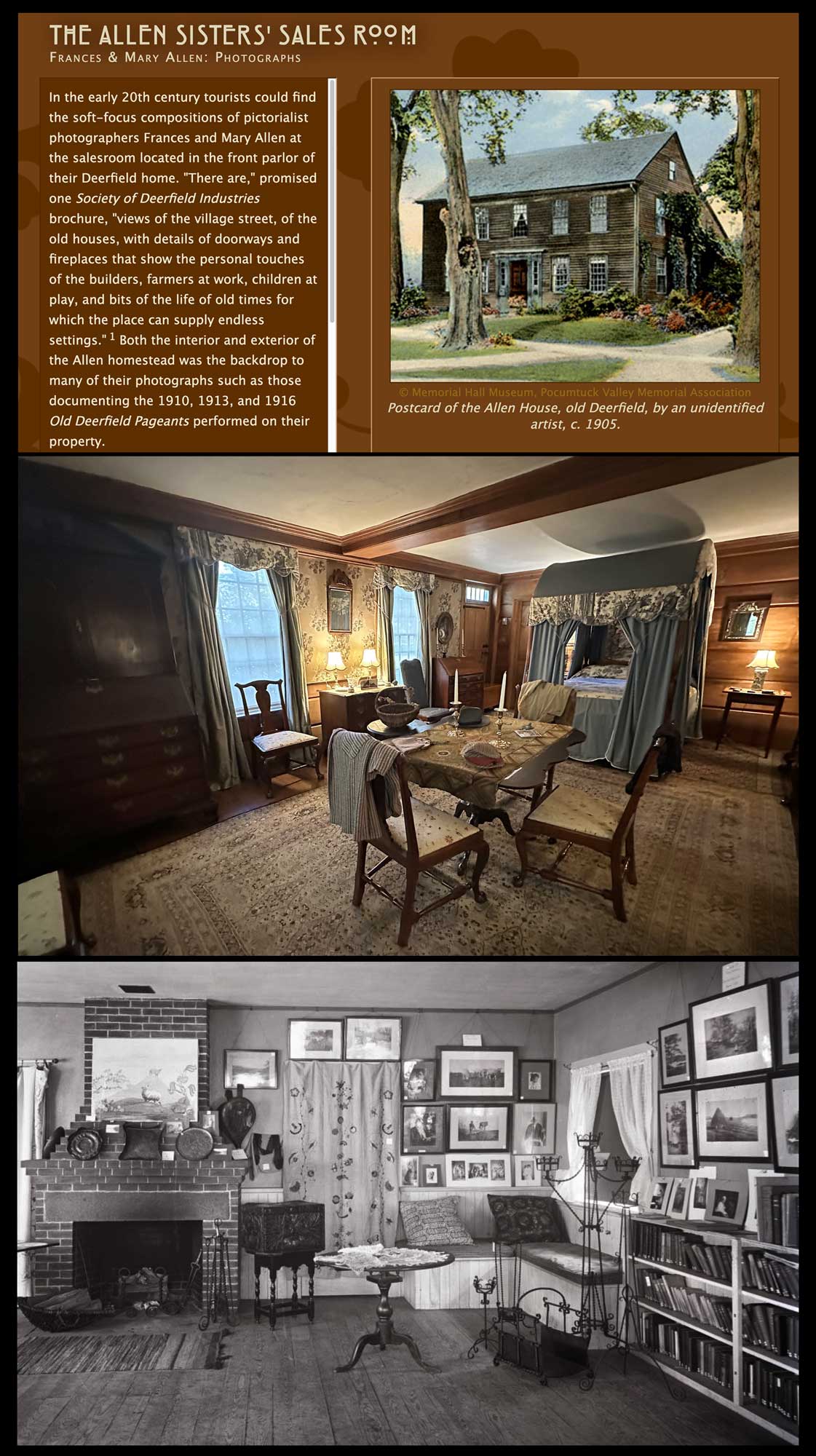
Photographic Sales & Exhibits: The Allen sisters marketed and sold photographs from a first floor parlor of their ancestral 18th Century saltbox in Deerfield from c. 1900 until 1935. Top: Allen house postcard around 1905: part of online presentation for Deerfield Arts & Crafts: In the Springfield Republican newspaper, a visitor impression from 1919: “We cross the road to enter the gray old house of the Misses Allen who make photographs. And there in a front room of the house are pictures enough to charm you as long as you can spare the time to look at them. The photographs are the finished work of artists in their handling of light and shadow and the accentuating of detail. The subjects are many.Screen grab: Courtesy Memorial Hall Museum, Pocumtuck Valley Memorial Association, Deerfield, MA. Middle: Today, the former sales room in the Allen House has been converted back to a 18th century bedroom. The home can be visited as part of the Historic Deerfield experience. Photo: October, 2025 by David Spencer for PhotoSeed Archive. Bottom: The Village Room was the first Deerfield Arts & Crafts exhibition space. A detail from an 1899 photograph by the Allens shows various crafts and wares on display, including framed photographs on the walls by the sisters and Emma Coleman. Courtesy Memorial Hall Museum, Pocumtuck Valley Memorial Association, Deerfield, MA.

And this, from 1905, contrasting their efforts with painting:

Another author argued that, ‘the work of Miss Frances Allen and Miss Mary Allen…would be equally at home in this room or next door to the small gallery of paintings which Mr. Tack has hung in his studio. The Misses Allen use their camera in the same spirit with which a painter uses his brush, and their sense of composition, of the dramatic moment, is as eminent a qualification for their work as for his.’”(1.)
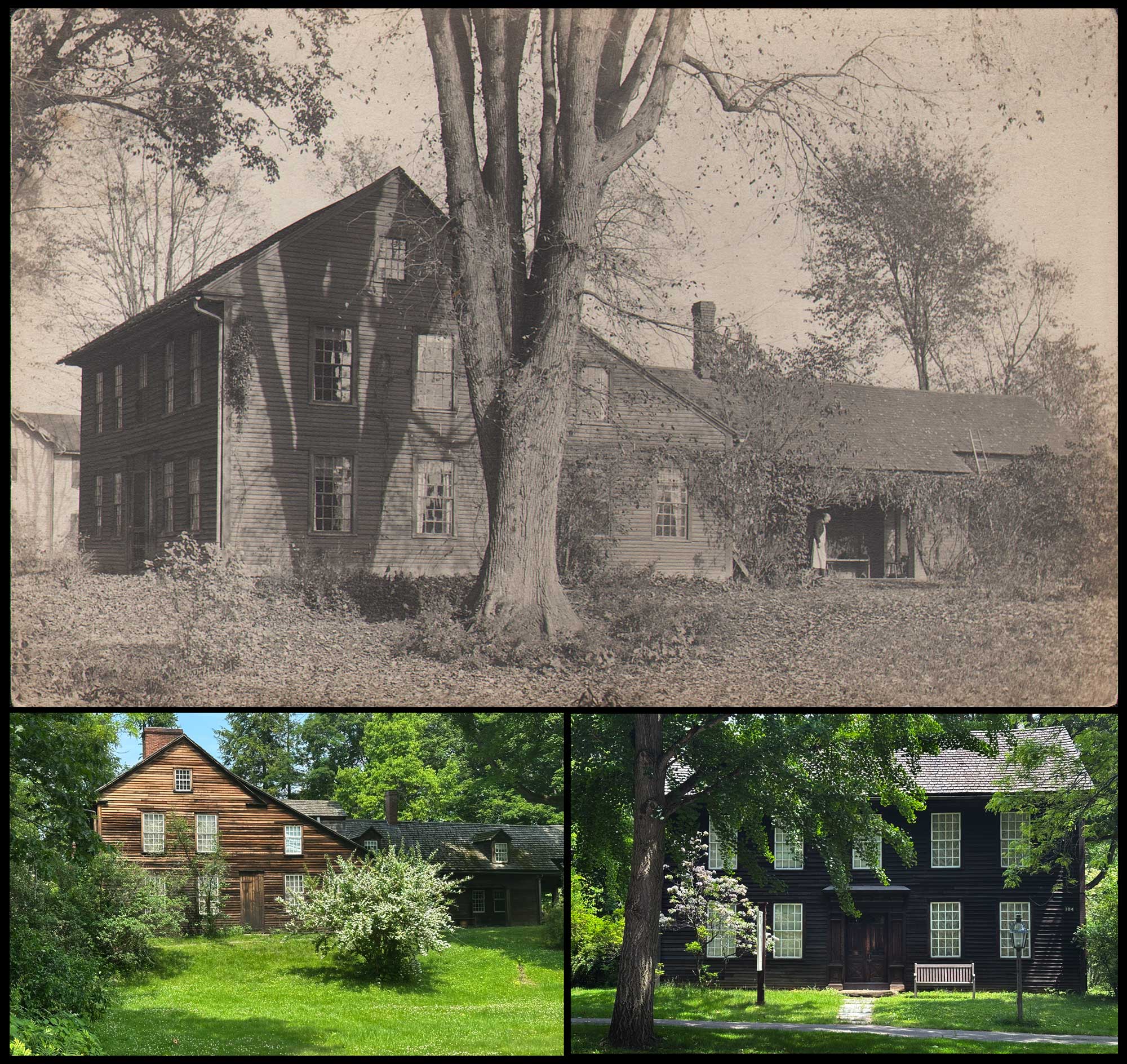
Top: “Allen House, Side View”, c. 1910?,  gelatin silver rppc, AZO stamp box, c. 1918-30, Charles H. Howard, American, 8.7 x 13.8 cm, #41 from series: “Photographic Post Cards of Old Deerfield, Mass., sold by Mary Wells Childs of Deerfield, published by Charles H. Howard, Northampton, Mass.” The woman standing at right is believed to be one of the Allen sisters. Before marketing postcards, Childs made bayberry candles in 1908 and sold rag rugs in 1912 as part of the Society of Deerfield Industries. Historic Buildings of Massachusetts states the Allen House dates to 1734, and “ the land was originally owned by Simon and Hannah Beaman, who had been captured during the raid. The house was occupied by the Bardwell family and then by the Allen family, after the 1842 marriage of Catherine Elizabeth Bardwell and Caleb Allen. In 1896, Caleb Bardwell’s nieces, Frances and Mary Allen, with their mother took possession of the house.” From: PhotoSeed Archive. Bottom: left & right: Two modern views of the home taken in June, 2025: side view and frontal view. Photos by David Spencer for PhotoSeed Archive

I agree with both assessments summing up their talents, but there is so much more the Allen sisters can teach us in the second decade of the 21st century. One attribute: determination. Although it was not cited often, other than brief mentions in secondary sources, (as surely the sisters would have wanted it) their deafness, in my opinion, actually enabled them in their art. After the onset of deafness in the mid 1880s—a shocking change that led to both abandoning brief teaching careers around 1884–a new career path of professional photography took hold in 1888.

The idea that one of the human senses disrupted in life could also be perceived as an advantage lends itself to a working theory of why the sisters’ work endures to the present. At the outset of pictorial photography, in the 1890s, rules for the artistic sensibilities of the medium were still being figured out.  It’s well understood that the loss of one of the five basic human senses of sight, hearing, smell, taste and touch can strengthen the remaining senses. I even looked it up: Neuroplasticity is the scientific name for when those affected areas of the brain are repurposed to enhance a person’s other senses. A possibility perhaps for the Allens but one which might give a clue to their determination and flexibility enabling a profound body of historical photography that still matters today.
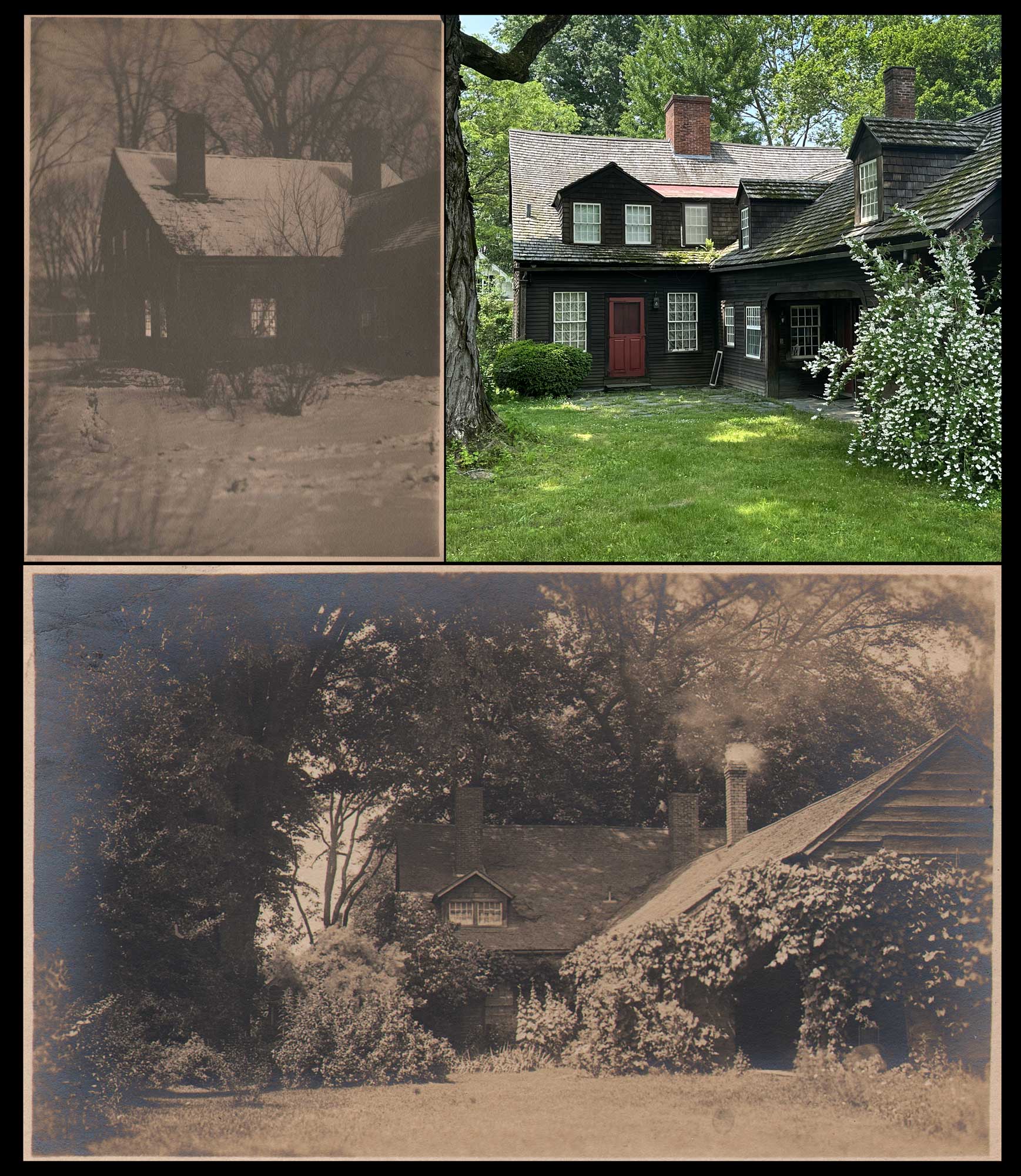
The Allen House: Rear Views: Top Left: “Winter Moonlight”, c. 1906, Frances & Mary Allen, American, 1854-1941 & 1858-1941, platinum print, unmounted, 20.8 x 15.6 cm. An unusual night-time view of the photographers home. Notice the footprints in snow at foreground. Before altered with a central chimney by Henry Flynt in 1945, the home was subdivided into two living quarters: notice the separate chimneys and lack of dormer windows compared to the modern-day view at right, taken June, 2025. A single dormer window appears in another Allen sisters photo at UMass Amherst dated c. 1913. From: PhotoSeed Archive. Right: David Spencer for PhotoSeed Archive. Bottom: “Back of Allen house, Deerfield”, c. 1913, gelatin silver rppc, September 13, 1916 postal cancellation, Frances & Mary Allen, American, 1854-1941 & 1858-1941, 8.6 x 13.8 cm. From the 2002 volume “The Allen Sisters Pictorial Photographers 1885-1920”: “The vine-covered porch at the far end of the ell, known as the “Cabin,” was the location for many portrait and figure studies. In 1903, the Allens added a new developing room to their home on the second floor above the shed.”( p. 29) From: PhotoSeed Archive

This line of thinking could lead to a reasoning where the Allen sisters enabled vision comes into play. The adage of “trusting your eye” is perhaps the best advice anyone can give a collector considering an artist’s work.  In my mind, their photographs elicit a humanity and beautiful sense of place setting it apart from most of their contemporaries. Just look at the joy of humanity in some of their select works, as well as some of their chiaroscuro landscapes shown in this post. On a basic level, they perfected the craft of photography in a silent world. But this disability most assuredly did not prevent their great success. After coming to the attention of American photographer Frances Benjamin Johnston in the mid 1890s, the sisters were soon earning many steady assignments from national magazines such as Good Housekeeping and others- particularly for their endearing studies of children posed in and around their Old Deerfield neighborhood.
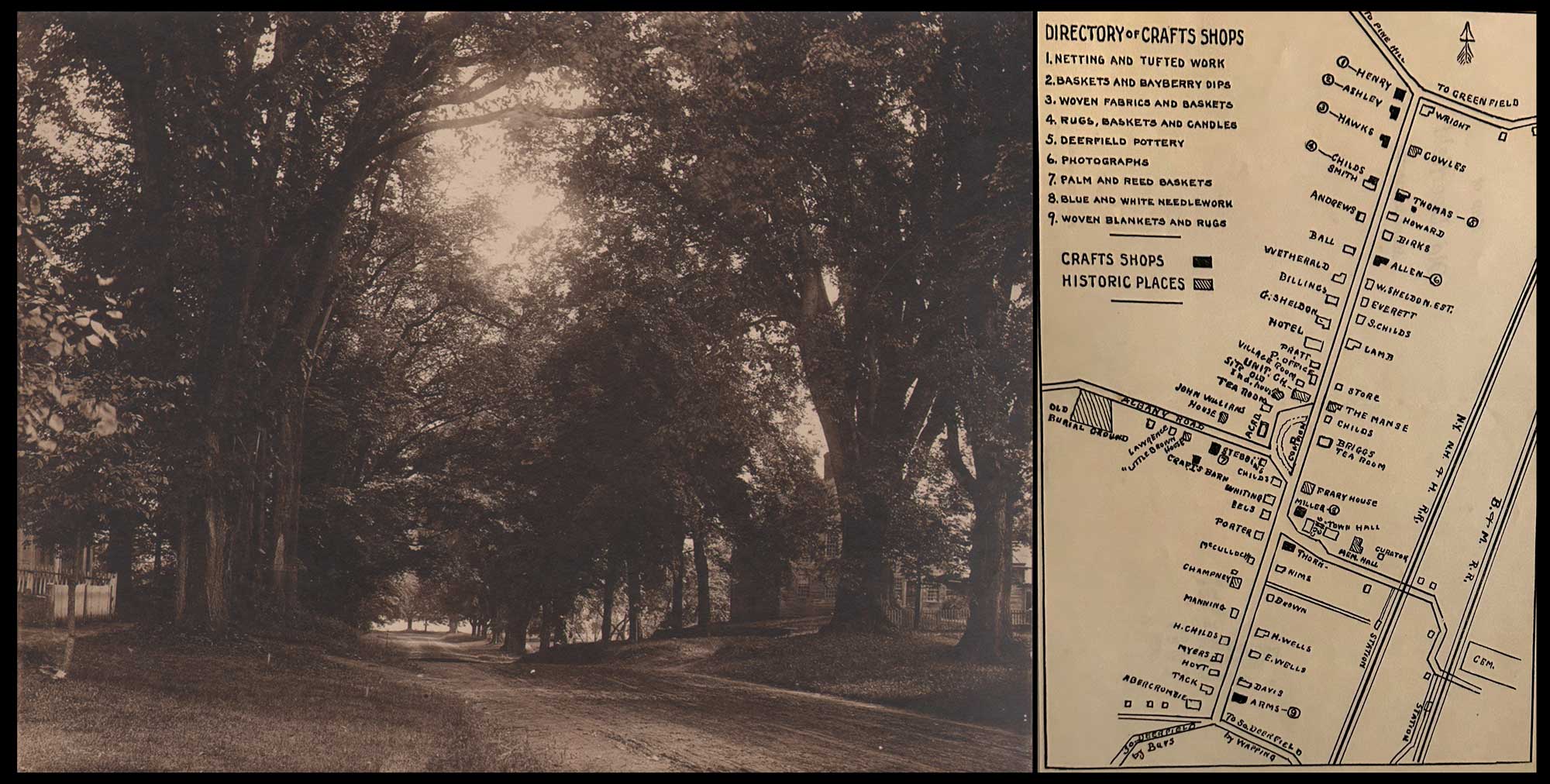
The Street for Arts & Crafts: Left: “The Street: Joseph Stebbins House: Deerfield, MA”, c. 1900, Frances & Mary Allen, American, 1854-1941 & 1858-1941, unmounted gelatin silver print, 15.4 x 20.5 cm. From: PhotoSeed Archive. Right: Displayed as part of the exhibition “Skilled Hands and High Ideals” at Memorial Hall Museum, this 1911 facsimile copy of the Deerfield Industries street map shows open shops for member artisans. Show copy: “These local women became part of an international Arts and Crafts Movement, celebrating the beauty and virtue of handmade items and revitalizing fast-disappearing craft skills. Beginning with the Deerfield Society of Blue and White Needlework in 1896, Deerfield crafts would soon include basketweaving, metalworking, pottery, furniture making, and more. In the process, Deerfield women transformed an economically depressed agricultural town into a vibrant cultural and tourist center, highlighting its colonial history and selling Deerfield-made crafts across the United States.” Copy photo by David Spencer for PhotoSeed Archive

When I was a young and earnest photojournalist, my guiding philosophy was always to blend into the background and look for “found moments” with my camera. I can still hear myself introducing myself to a subject and telling them to “pretend I’m not here” as I drifted into the background, somehow trying to convince them and myself of a magical ability to disappear. But the working reality over 125 years ago for the Allen sisters was that film emulsions and lenses were not fast enough to capture spur of the moment and fleeting human interactions. Their use of a tripod-mounted view camera and all of the attendant equipment needed on location created a much different reality in approaching an assignment or chasing the waning light of a late fall afternoon. Here’s a quote by the sisters published in 1894 in the pages of The Photo-Beacon, summarizing a few of their working methods. It’s a passage showing their practical nature and endearing me to their hands-off approach:

The merit of posing, which you kindly give us credit for, belongs rather to the models. Our chief virtue is in letting them alone. We usually have better success with children who are not too highly civilized, or too conventionally clothed, or who are too young to be conscious. We give them a general idea of the picture we want, and then let them alone until they forget about us and the drop catches an unconscious pose. They consider it a game, and are always ready to play at it.” (2.)
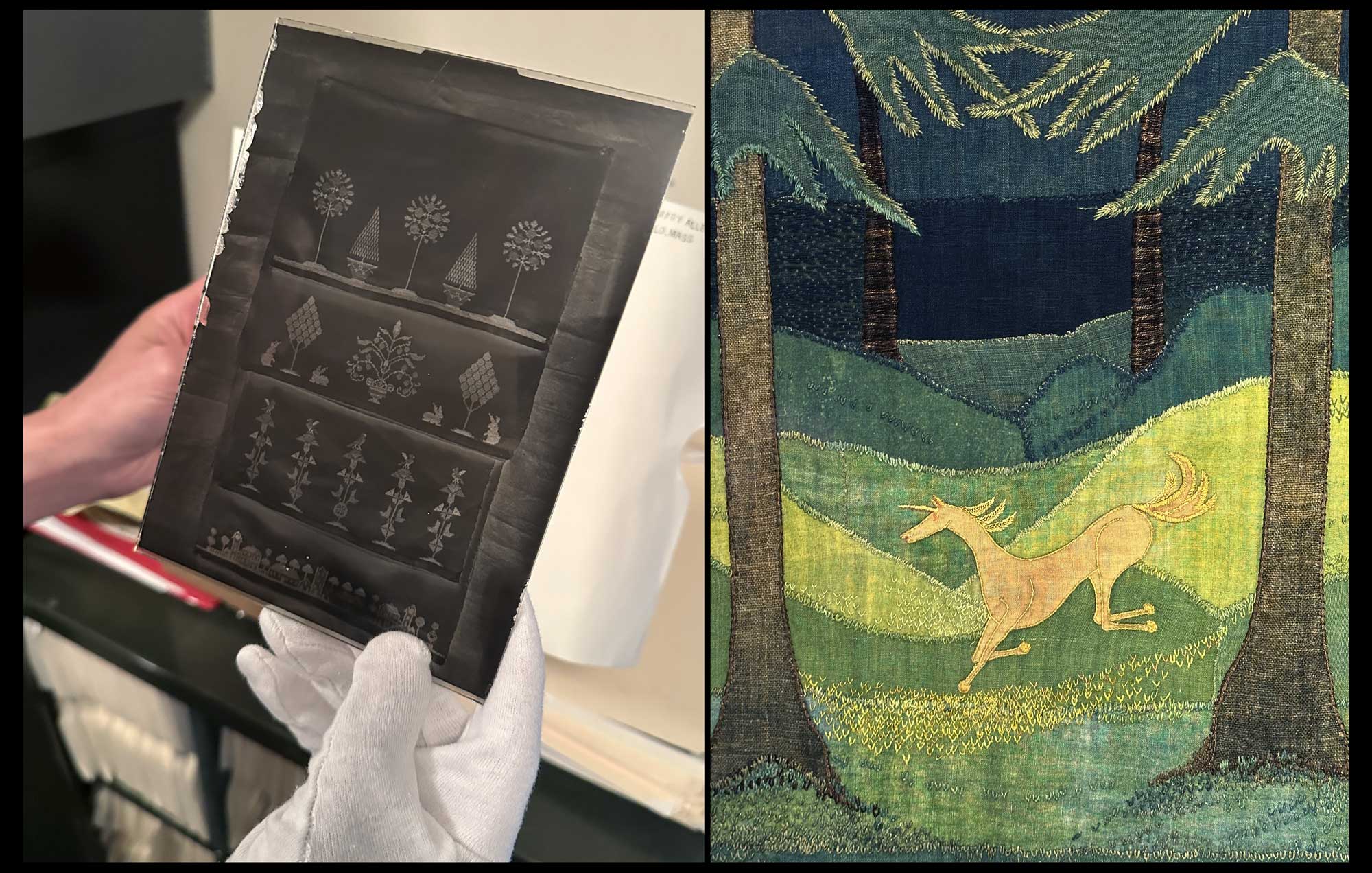
Embroidery as Art: Left: “Rose Standards, top row & Other Designs”, c. 1900 -1916. The gloved hand of Memorial Hall Museum Curator and Assistant Director Ray Radigan holds one of the thousands of original glass plate negatives taken by the Allen sisters, with this plate showing embroidered designs on cloth. Mary Allen was heavily involved in the Deerfield Society of Blue and White Needlework when founded in 1896. She was also treasurer of the Society of Deerfield Industriesfor most of the years between 1901 and 1919”. Right: Detail: “The Unicorn”, c. 1920, Margaret C. Whiting, American, 1860-1946, appliquéd and embroidered panel , H. 55″ x W. 28”, Museum online resource copy: “A lone unicorn springs across a secluded glen in what is believed to be the final work of Deerfield Society of Blue and White Needlework co-founder, Margaret Whiting.  Protected and framed by stately pine trees in the fore- and backgrounds, the illumined clearing is further defined by a series of overlapping hills appliquéd in varying shades of green linen. The needlework’s stylized and carefully arranged woodland motifs foster the sense of emanating quiet.” In 1896, Whiting and Ellen Miller co-founded the Deerfield Society of Blue and White Needlework. Both: Photos taken June, 2025 by David Spencer for PhotoSeed Archive

In 1901, Johnston promoted the Allens work in the pages of the Ladies’ Home Journal as part of the recurring feature: “The Foremost Women Photographers in America.” Vignette portraits of the sisters anchored a full page, featuring five of their better known photographs in the July issue. Before their commercial career wound down by 1920, (they continued to sell photographs from their home until 1935) they had made a good living and become well known in Deerfield and regionally for their camera artistry. By late 1918, “an Allen niece told a neighbor that ‘the aunts have eleven National magazines using their pictures this month.’” (3.)
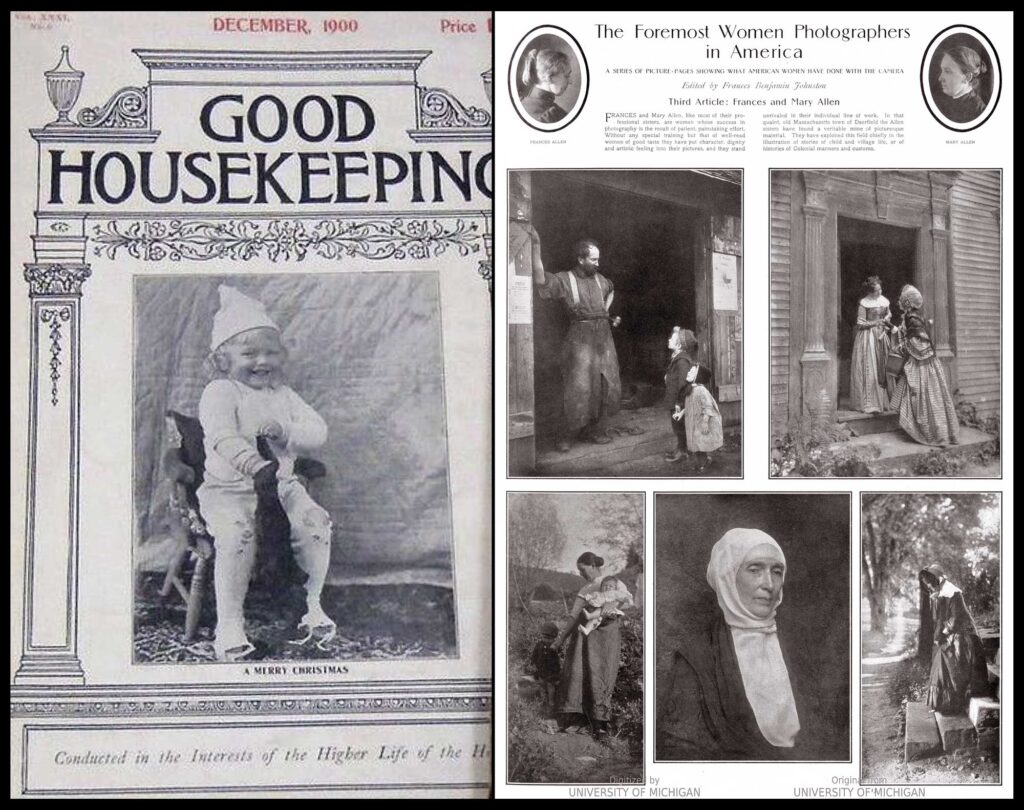
Making a name for themselves with national exposure in the popular press: Left: The December, 1900 cover of Good Housekeeping was the first time the magazine had used a photograph for a cover illustration. The subject was the photographer’s nephew, Frank Allen, looking for goodies inside his Christmas stocking taken the year before. Right: In the recurring magazine feature: “The Foremost Women Photographers in America”, a full page of the Allens photographs along with their vignette portraits appeared in the July, 1901 issue of the Ladies’ Home Journal. The feature had been made possible by American photographer Frances Benjamin Johnston, who began to promote the sisters work beginning in the mid 1890s. Both: online screen grabs: private collection & The University of Michigan.

Essential Monograph & Founding of Historic Deerfield

A lovely volume, The Allen Sisters Pictorial Photographers 1885-1920 (Pocumtuck Valley Memorial Association/University Press of New England, 2002) was the proverbial ball that got things rolling for me in looking closer at the Allen Sisters. This monograph, deeply researched, beautifully designed, and published for a traveling exhibition of their work, was organized and written by Suzanne L. Flynt, then curator of the Pocumtuck Valley Memorial Association.

In a neat occurrence, I learned the author’s husband is the grandson of Historic Deerfield founders Henry and Helen Flynt. After the Allen sisters died, the couple purchased the sisters former home on “The Street,” converting it back to its earlier 18th century architectural origins for their summer home. Unfortunately, other than being known today as The Allen House, nothing remains of the sisters’ life in the home’s interior, other than a general footprint of its late 19th and early 20th century walls. Exterior views, front and back, are unchanged, other than a reconfiguration of a center hall chimney, and I’ve included several historical photographs of the home along with this post, matching them with modern views. Fortunately, the home is occasionally open for tours as part of the larger Old Deerfield visitor experience, which this writer took advantage of. When the Allens lived there, it served as home base for an exhibition space on the first floor, a darkroom in the cellar and studio space with skylight on the back addition. Sixty years after the sisters’ passing, Suzanne Flynt’s monograph would revive national interest in their photography, giving them much deserved acclaim for their work.
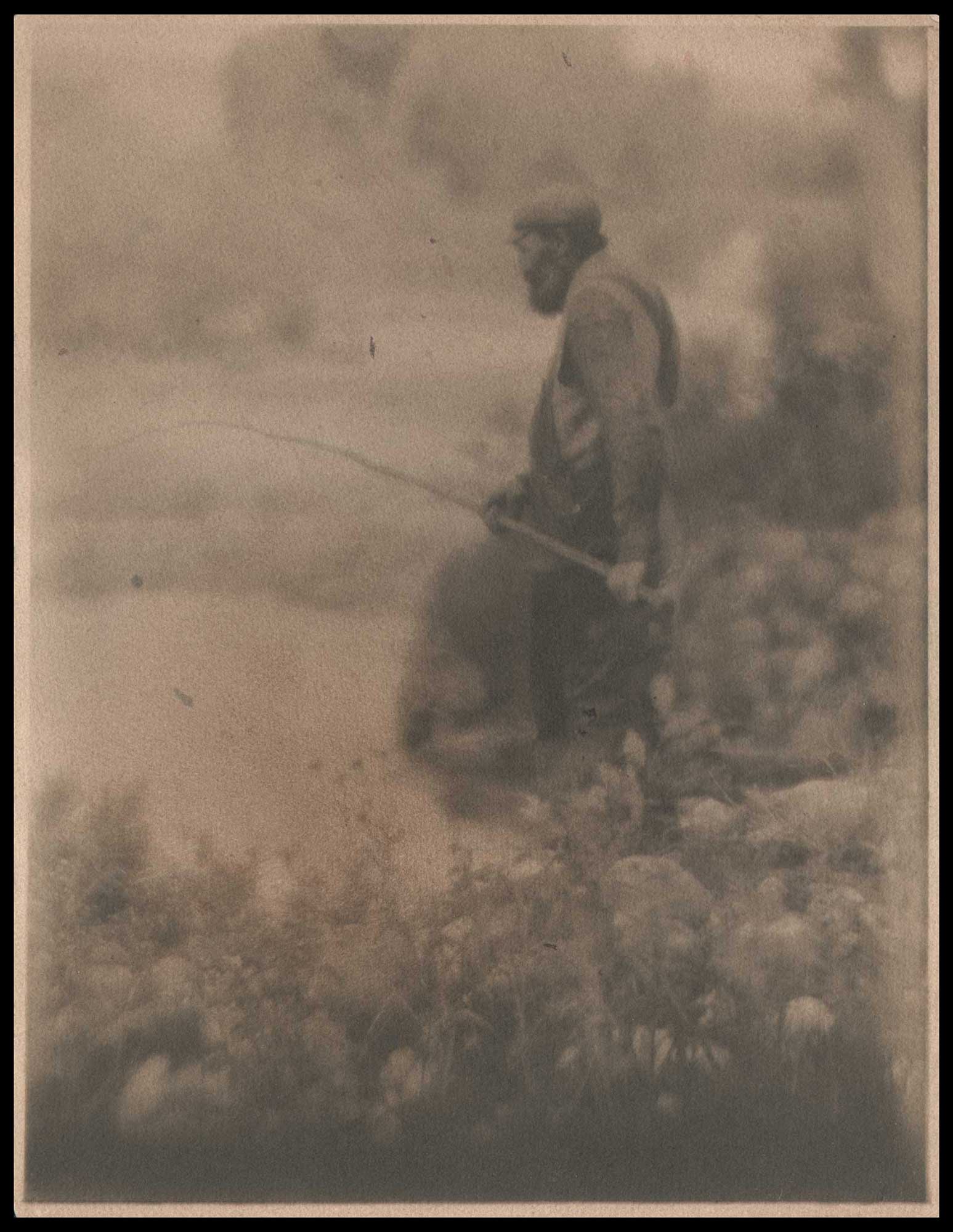
A Day Off”, 1913, Frances & Mary Allen, American, 1854-1941 & 1858-1941, unmounted platinum print, 20.8 x 15.8 | 21.5 x 16.5 cm. In 1913, after a successful session photographing farmhand Dennis Burnett at Mill River (pl. 83), Mary wrote, “I’d rather do country folk at work than anything else in the world. Nothing is more difficult – than to get them in good poses – and unconscious. Dennis B- is a treasure… He has an interesting head – a good bent figure – and is very simple and well bred in manner”. Believed to have been printed around 1920, the orientation of this work has been reversed, compared to plate #83 published in the 2002 volume The Allen Sisters Pictorial Photographers 1885-1920. From: PhotoSeed Archive

Henry Flynt, who was born in Brooklyn and became a lawyer, and his wife incorporated Historic Deerfield in 1952 in the image of Virginia’s Colonial Williamsburg, another living history museum in the US. The Deerfield project, which took form in the late 1930s, was spurred on by their love and preservation of American history when their son in 1936 first attended Deerfield Academy in the town. Unlike Williamsburg, their vision was based on the much earlier English settlement of Deerfield, MA, a town incorporated in 1673. The couple’s passion project led to the town establishing the Old Deerfield Historic District in 1960, and today Historic Deerfield continues to be a vibrant destination and teaching laboratory for early American architecture as well as a showcase for important collections of historical objects, antiques and artwork, some by the Allen sisters. On Henry Flynt’s passing in 1970, the New York Times lauded his vision in part of an editorial:

Approximately 8500 vintage photographs & original glass plate negatives representing 2500 unique images by the Allen sisters are held at Deerfield’s Memorial Hall Museum. Ray Radigan, Curator & Assistant Director, shows off a platinum print: the sisters photograph “Blowing the Fire”, featuring a young Frank Allen using a bellows fireside. Photographed June, 2025 by David Spencer for PhotoSeed Archive

Those who preserve or restore an admirable achievement of the past also serve the future. That is because civilized men and women want to know and understand their own origins. It is not only a deep human impulse but also a sensible recognition of the fact that each generation builds on the accomplishments of all those who have gone before. There is no instant civilization and no way to manufacture a people’s heritage.

In an age of vulgar publicity and hectic impatience for results, it is worth remembering a man like Henry Flynt who took the trouble to rescue what was beautiful and enduring from an earlier age of anger, turmoil and danger.” (4.)

A permanent exhibit featuring several Kodak cameras and view camera lenses used by the Allen sisters is displayed at Memorial Hall Museum. At center is a copy of a c. 1886 photograph of Mary Allen preparing to take an exposure using a view camera, photographed by sister Frances. Among the equipment is a Bausch and Lomb Optical Company lens from around c. 1890 at upper left and Eastman Kodak No 3-A Folding Pocket Camera, Model B-4, at upper right. Some of the museum’s display copy: “As pioneers in the young art of photography, Frances and Mary Allen were famed for their work in the region. They originally shared a single camera, but eventually had at least four between them. Several of their cameras and lenses were manufactured in Rochester, NY, while others came from Boston, and as far away as Paris.” Photograph from June, 2025 by David Spencer for PhotoSeed Archive

Old Deerfield: The Past & Raid

I visited Historic Deerfield several times this year, the first in June after reading the 2024 book The Deerfield Massacre, by James L. Swanson, who sadly passed earlier this year. (5.) I wanted to see and think about the bigger picture of the town’s history as I walked down its leafy main street. The volume is required reading for those wishing to learn more about the background and aftermath of what led to the surprise 1704 attack on Deerfield by French and Native American forces during Queen Anne’s War that killed 47 colonists.

The Allen sisters, by blood, were connected to the tragedy. Mary Allen, writing in 1892, shared her childhood impressions:

The first tales of adventure which we who are Deerfield children heard were the stories our grandfathers lived. I remember lying on the floor, before the open Franklin stove, and reading by the firelight a worn copy of Hoyt’s ‘Antiquarian Researches.’ The book opened of its own accord to the account of the slaying of my own great-great-grandfather by the Indians. The touch of the bloody tomahawk conferred knighthood and renown on its victim. The honors which I tried to bear with modesty are borne by many Deerfield children.” (6.)

On Display & in Storage: At Memorial Hall Museum, a yearly, revolving  gallery of images are displayed on a specific theme. The current show is called: Allen Sisters on “The Street.” Left: From around c. 1900, the framed photograph “Calls in Cranford”, an homage to English author Elizabeth Gaskell’s novel Cranford, shows a woman in period clothing walking down steps to a home on the Street. Top: An original 18th century “skeleton suit” made of calico printed cotton c. 1792 is framed along with the 1897 Allen sisters photograph “An Old-Fashioned Boy”, showing Carl Allen wearing the suit seated on a chair. Bottom: In storage, museum curator Ray Radigan adjusts the fingers of Frances Allen’s “alphabet glove” (a reproduction) used to aid her deafness beginning in the early 1930s. The museum occasionally uses the glove as a teaching aid in telling the Allen sisters story. Photographs from June, 2025 by David Spencer for PhotoSeed Archive

Also known as the Raid on Deerfield, 112 town residents were taken captive and forced to march in the winter snow to Montreal, 300 miles distant. As is true for all of what eventually became known as the United States, the lands in and around what became the future Deerfield were inhabited by native peoples. The indigenous Pocumtuck nation had long settled this area, with the town later “originally established as a grant of land to the residents of Dedham, Massachusetts, who had given land to the Massachusetts Bay Colony for the purpose of settling Christianized Indians.”(7.) It’s hard to believe today, but this area in western Massachusetts was once on the western frontier of English settlement, long before the boundaries of the American continent could even be delineated or a Declaration of Independence written on parchment.

Record of a Brief Life, by Pen & Camera: Correspondence by the Allens, including letters and at least four diaries by Mary Allen, are held in the Pocumtuck Valley Memorial Association Library. Left: Detail from diary entry by Mary Allen on October 5, 1913: “Mrs. Thayer came in late to tell us that little Roana Andrews died this afternoon, of Cholera Infantum. She was running around out of doors- barefoot and scantily clad yesterday and ate watermelon. She has been ailing for a few days and her mother had not considered her sick – until she found her unconscious this morn (?) and sent for the doctor. She was dying-only lived a few hours – It was a great shock to everybody, – the little things ran around like the herd of ducks, with little more attention – Vera said she moaned and called for water the night before but no one paid much attention; Poor little (?) ! She was a (cunning – curious?) thing. Frances has been taking pictures of her lately, over and over- She had more flavor in her looks (?) than most of them.Roana W. Andrews: 1911-1913. Photograph of diary page by David Spencer for PhotoSeed Archive, courtesy PVMA Library. Right: “Roana Sweeping”, 1913, Frances & Mary Allen, American, 1854-1941 & 1858-1941, mounted platinum print. Frances Allen photographed 2 1/2 year old Roana Andrews only days before her death. Roana is caught in the moment of sweeping stepping stones using a small broom. Photograph Courtesy Pocumtuck Valley Memorial Association’s Memorial Hall Museum, Deerfield, MA

Complicated is an understatement, and generational family members tracing their lineage to the 1704 raid and earlier still live in this upper Connecticut River Valley area. A most unusual relic from the raid, that of the battle-axe scarred front door from the former Ensign John Sheldon house survives. The home was razed in 1848, with a replica of the so-called “Old Indian House” erected in 1929 on a different parcel along the main street. American history pilgrims can view the door, part of a little known event shaping the country’s founding, on the second floor of Memorial Hall Museum in Old Deerfield. One interesting bit: Deerfield residents had actually tried saving the Sheldon house from destruction, their efforts of cultural preservation coalescing in 1870 with the founding of the Pocumtuck Valley Memorial Association. Today, PVMA, as part of its mission statement, “purposely chooses to remember and honor the Pocumtuck People and their homeland with the organization’s legal name. PVMA today recognizes the damage inflicted by colonial settlement and seeks to go further by interpreting these difficult histories from culturally diverse, nuanced, and inclusive perspectives.”

The Raid on Deerfield: The Deerfield story was shaped by a surprise 1704 attack by French and Native American forces during Queen Anne’s War that killed 47 colonists in the English village. Left: “Old Sheldon House Door”, this battle-axe scarred front door from the former Ensign John Sheldon house is the centerpiece exhibit at Memorial Hall Museum in Old Deerfield. Top Right: “John Sheldon House 1848”, George Washington Mark, American, 1795-1879. Displayed in the museum is this oil painting of the former home executed the same year it was razed. Mark was a Greenfield, MA folk artist and house painter. Middle Right: In 1929, a replica of the so-called “Old Indian House” was built on a different parcel along the main street in Deerfield. It’s known today as the Indian House Children’s Museum. All: photographed June, 2025 by David Spencer for PhotoSeed Archive. Bottom Right: Infamous, due to the Raid on Deerfield, countless artistic depictions of the Sheldon home survive, including this likely juvenile or folk art depiction by an unknown hand c. 1850-1900. The work descends from the estate of Samuel Burbank Williams, 1843-1927, whose Deerfield lineage descends to Ephraim Williams, 1691-1754, whose son Ephraim Williams Jr. was the founder of Williams College. From: PhotoSeed Archive

A collaborative effort with Historic Deerfield who manage these resources as “Memorial Libraries,”the PVMA operates the Memorial Hall Museum and its library: one of the oldest American history museums in the US and repository for over 8500 Allen sisters photographs & original glass plate negatives representing 2500 unique images.
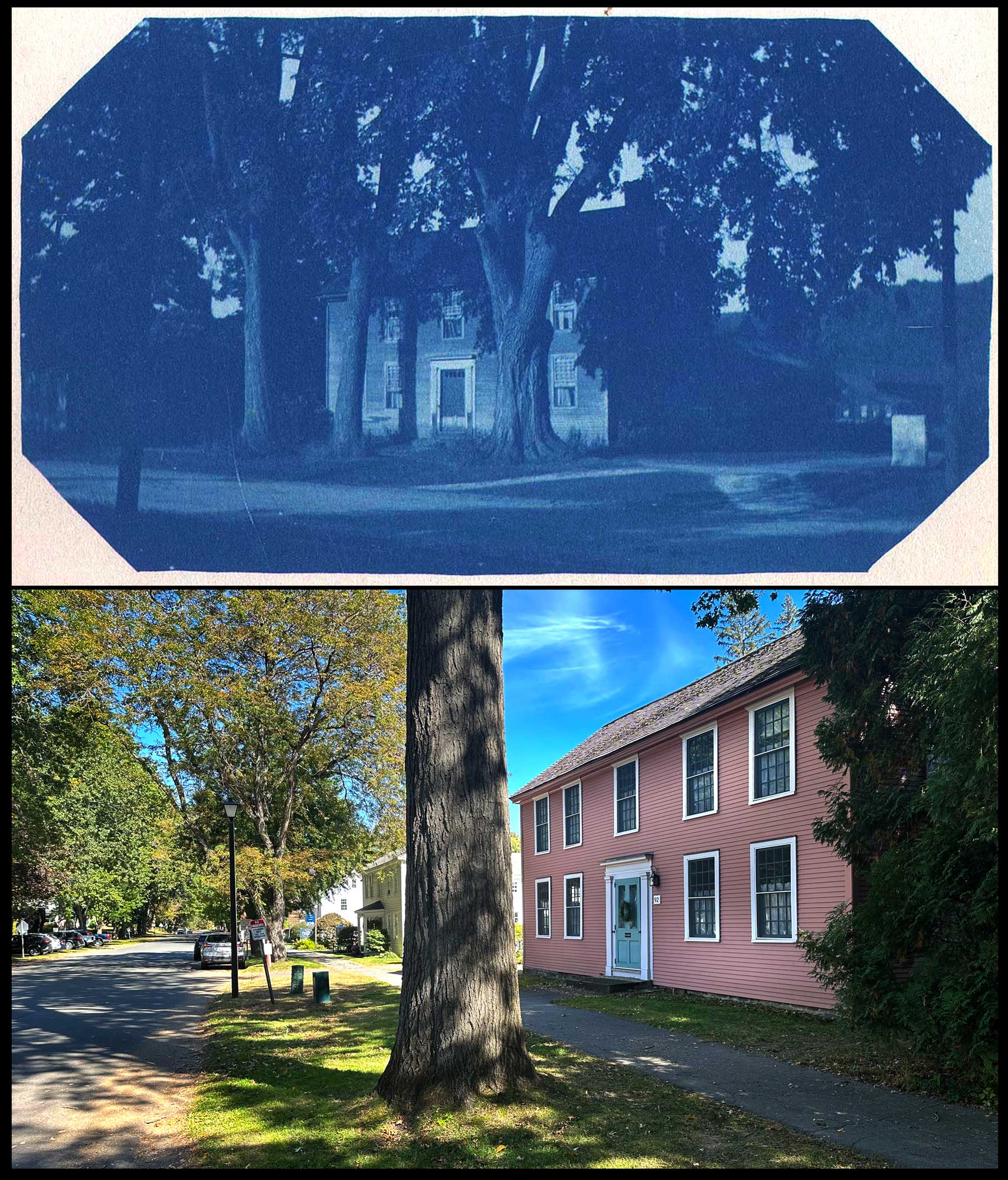
Changing Homes of the Street: Top: “Deerfield Street: Childs House”, c. 1901-1910, unknown American photographer, (possibly Allen sisters who were known to produce cyanotypes of Deerfield), masked cyanotype printed on rppc, 5.7 x 10.0 | 8.7 x 13.8 cm. Dating to around c. 1798, this home was built by David Sheldon (1770-1841) and came to be known later as the “Pink House”: photographer Emma Coleman in her 1907 guidebook calling it “the ‘pink house’ (which was red long ago)”. At the turn of the 20th century, the house was known as the Childs House, named for owners Samuel Childs IV: 1843-1906, and his wife, Mary Ann Vincent Childs: 1854-1938. Memorial Hall Museum Curator & Assistant Director Ray Radigan commented on this photo: “As for dating the photo, the telephone pole and a barely visible trolley track indicate that the photo was taken no earlier than 1901 when the electric trolley was installed in Deerfield.” From: PhotoSeed Archive. Bottom: The home in the present day. Located at 92 Old Main Street in Deerfield, its been owned by the trustees of Deerfield Academy since 1977. Photographed October, 2025 by David Spencer for PhotoSeed Archive

Old Deerfield: The Present

Today, a stroll down “The Street” is a rare occurrence in modern-day America. I’m being a bit flip here of course but that’s because “progress” in this country inevitably involves heavy equipment erasing the past for a new shiny present. Not so in Old Deerfield. The majority of the homes on either side are later 18th and early 19th century in origin, with many of these Federal and later period homes accessible to tour via a Historic Deerfield day ticket. I’ve managed to pair up several “before” photographs taken by the Allens with similar vantage points in the present. Mary Allen’s view of the Manse, also known as the Willard house, as well as a photo credited to the sisters of the front door of the John Williams house, (named for Reverend John Williams, survivor of the 1704 raid) should give you a bit of the flavor of this truly old, at least for us, American town.

Grandpa!”, c. 1912, Frances & Mary Allen, American, 1854-1941 & 1858-1941, unmounted platinum print, 20.8 x 15.9 | 21.5 x 16.4 cm. Taking a moment while leaning on his rake or walking stick, Deerfield resident Benjamin Zebina Stebbins (1827-1912) speaks with his quizzical granddaughter. From: PhotoSeed Archive

If you enjoy museums like I do, it can sometimes be a letdown when visiting one where hardly any photographs are exhibited. I frequently grumble to my wife when exiting nearly any art museum on our travels: “really wonderful, but why not a few photographs on the walls?” Sadly, that seems to be the norm. Not so at Memorial Hall Museum in Old Deerfield. The oldest museum in Western Massachusetts, here you will find vintage photographs by the sisters on permanent display. In the Suzanne L. Flynt Gallery, a hallway exhibition space, a yearly, revolving  gallery of images are displayed on a specific theme. The current show is called: Allen Sisters onThe Street.” Some of the exhibit’s introductory wall text:

It’s hard not to see Deerfield through the Allen sisters’ lens. Frances and Mary Allen used the village as a backdrop in thousands of photographs. These sentimental scenes of days gone by were a mix of truth and fiction. In many photographs they posed friends, family, and neighbors, often including colonial-era costumes and props from local attics. These images were instrumental in shaping Deerfield’s historical image, and contributed to a lasting legacy of its collective memory of its past.

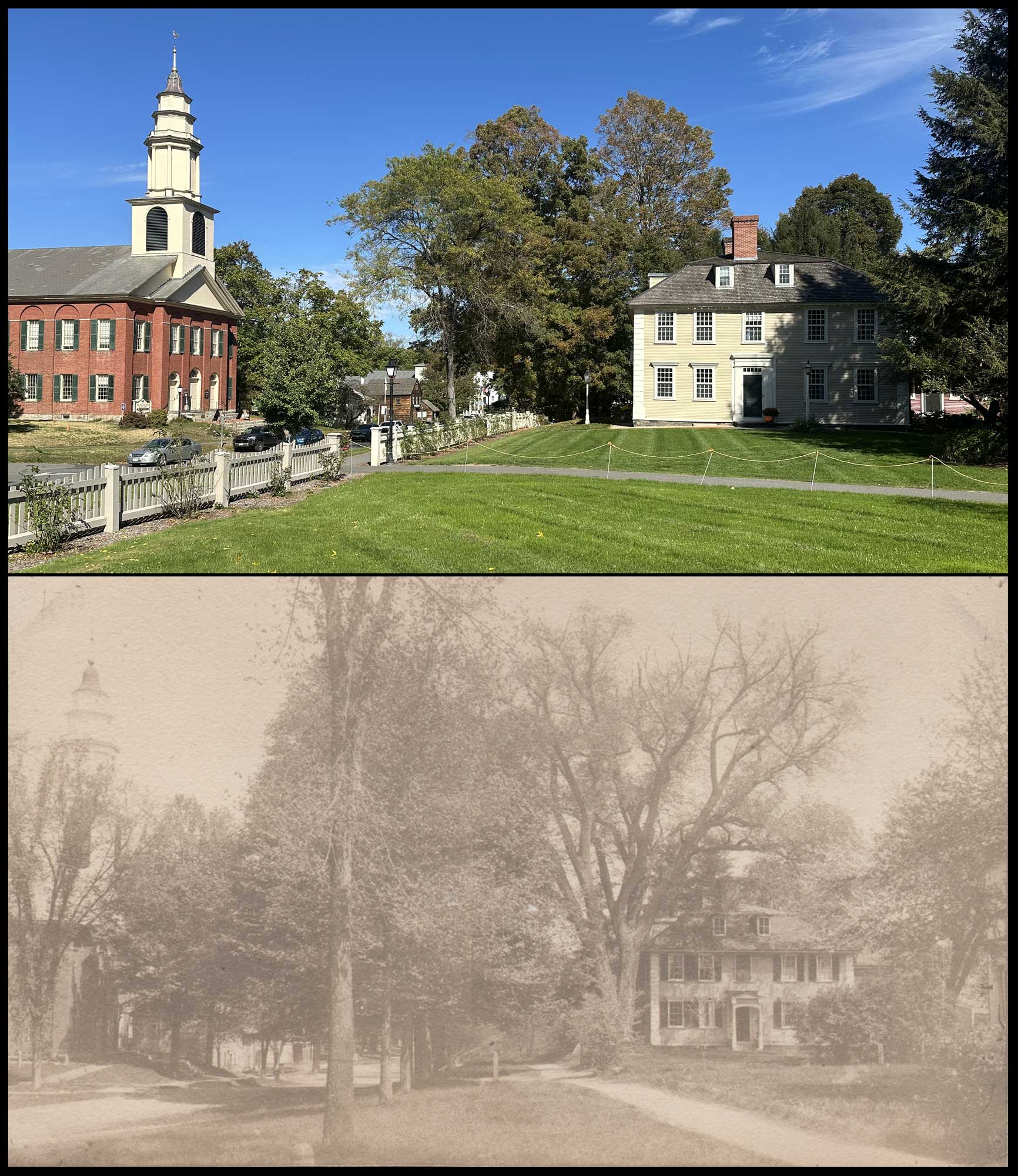
Changing Views on the Street: Top: A present-day view of Deerfield’s First Church at far left and the Manse at right, photographed in October, 2025. Old Main Street runs between the two. This Georgian mansion, also known as the Willard House, is used today as the residence for the Head of School of Deerfield Academy. David Spencer for PhotoSeed Archive. Bottom: “Willard House (Manse at Deerfield Academy)”, 1892 or before, Mary Electa Allen, American, 1858-1941, unmounted platinum print, 11.3 x 19.0 cm. Mary Allen photographed the Manse in 1892 or before, as a variant without the First Church (built 1824) appeared in the illustrated article Old Deerfield, written by her for the September, 1892 issue of The New England Magazine. Built in 1768 but incorporating an earlier structure from around 1694, the Georgian mansion (for mansion house) was purchased in 1811 by the Rev. Samuel Willard, the first Unitarian Minister in Western Massachusetts. From: PhotoSeed Archive.

The museum also features a permanent display case with two Kodak cameras used by the Allen sisters later in their career, along with some of their earlier view camera lenses and lens boards. But I’ve saved the best for last. I met with Ray Radigan, the museum’s Curator & Assistant Director, (8.) several times in preparation for this post. Ever patient and accommodating, Ray, donning white gloves as needed, gave me a peek inside the ultimate Allen sisters archive: a special storage area within the museum. This is where shelved acid-free boxes hold a treasure trove: thousands of carefully matted and loose vintage examples of the Allen sisters life work and equal number of their extant glass plate negatives.

A Deerfield Door, Revisited: Left: “Williams Door”, ca. 1895-1905, Frances & Mary Allen, American, 1854-1941 & 1858-1941, unmounted platinum print, 20.2 x 12.7 cm. Built 1760, this home is named after Rev. John Williams, (1664-1729) who wrote “The Redeemed Captive”, an account of captivity by the Mohawk in Canada after a forced march after the Deerfield Raid of 1704 during Queen Anne’s War. The door was built from old-growth, eastern white pine by joiner Samuel Partridge. From: PhotoSeed Archive. Right: “Williams Door in 2025”, a replacement door has been in place on the front of the Rev. John Williams House since 2001, fashioned from the Partridge original. The home is owned by Deerfield Academy, a private boarding school founded in 1797 whose school seal features the door. Photographed June, 2025 by David Spencer for PhotoSeed Archive
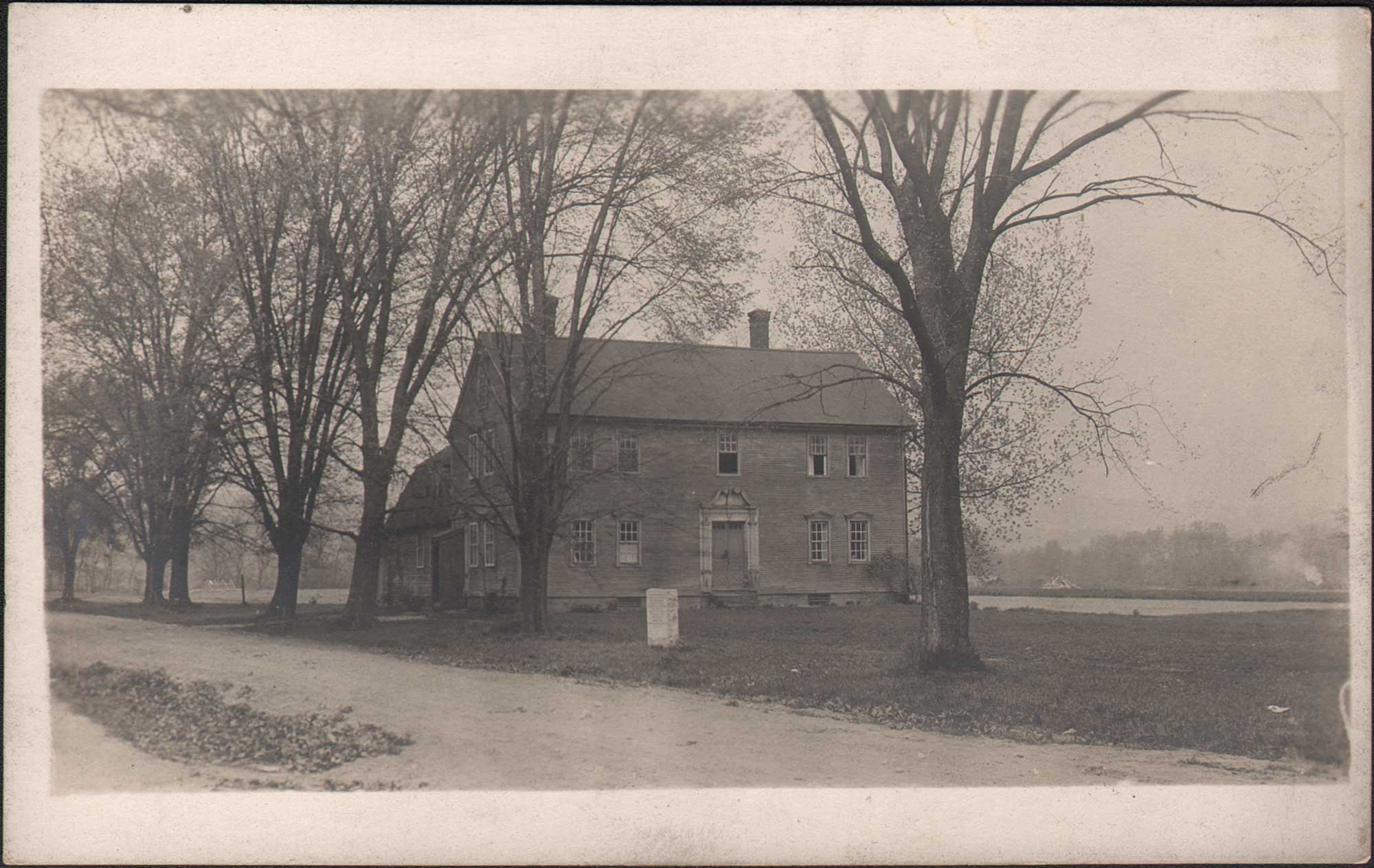
Rev. John Williams House (1760)”, ca. 1900-10, Frances & Mary Allen, American, 1854-1941 & 1858-1941, gelatin silver rppc, (KRUXO?) 1910-20), 7.0 x 13.2 | 8.7 x 13.8 cm (verso: ALLEN, DEERFIELD, MASS, RIGHTS RESERVED) Built 1760, this home is named after Rev. John Williams, (1664-1729) who wrote “The Redeemed Captive”, an account of captivity by the Mohawk in Canada after a forced march after the Deerfield Raid of 1704 during Queen Anne’s War. The following from Historic Buildings of Massachusetts : “His new house replaced the one destroyed in the raid. The current Williams House was actually built in 1760 on the site of the 1707 house by Rev. John Williams’ son, Elijah Williams, who was a shopkeeper and tavern-owner. When the house was in danger of being torn down in 1877, Deerfield historian George Sheldon wrote a series of articles (collected in the book The Rev. John Williams House, published in 1918) that raised awareness of the home’s importance and helped save it from destruction. Today the house is used by Deerfield Academy as the Elijah Williams Dormitory.” From: PhotoSeed Archive

Uncovering Details: Left: “A Holbein Woman”, 1890, Frances & Mary Allen, American, 1854-1941 & 1858-1941, mounted gelatin silver print: 20.1 x 16.3 cm | 35.2 x 27.8 cm. With overmat of primary mount removed, this signature portrait of the artists mother, Mary Stebbins Allen, 1819-1903, reveals graphite framing marginalia: some inverted along lower margin by an unknown hand: “FS Allen and ME Allen; opposite margin: 1- 16 1/4 x 18 Gray Mat Board Frame”. The work was exhibited in an unknown salon during the mid to late 1890’s. Upper Right: Example of an Allen sisters black ink stamp on verso of vintage platinum print: .9 x 4.0 cm. Notice inclusion of partial fingerprint at upper right. Lower Right: Verso: “The Hall and Staircase at “The Manse”, 1900-1910, Frances & Mary Allen, American, 1854-1941 & 1858-1941, unmounted platinum print: 17.7 x 12.6 cm. Ownership history, various publication marginalia and stamps, including by the Allen sisters, nearly fills up the verso of this photograph. All: PhotoSeed Archive

One very good insight he shared was that even with their involvement as artisans affiliated with the Deerfield Society of Arts and Crafts (founded 1901) as well as their earlier engagement with the Deerfield Society of Blue and White Needlework, (founded 1896) their medium of photography was technically advanced for its time and very modern indeed, especially pictorialist art photography. In this respect, Ray made the argument the Allen sisters were pushing the limit in what could then be achieved by photography. This was in contrast to the confluence of a new found interest in the Colonial revival and regional arts and crafts activity then taking place in Old Deerfield, defined by Ray’s employer, the PVMA , as “a movement that encouraged a return to hand craftsmanship, simplicity of design, and honesty of materials.”
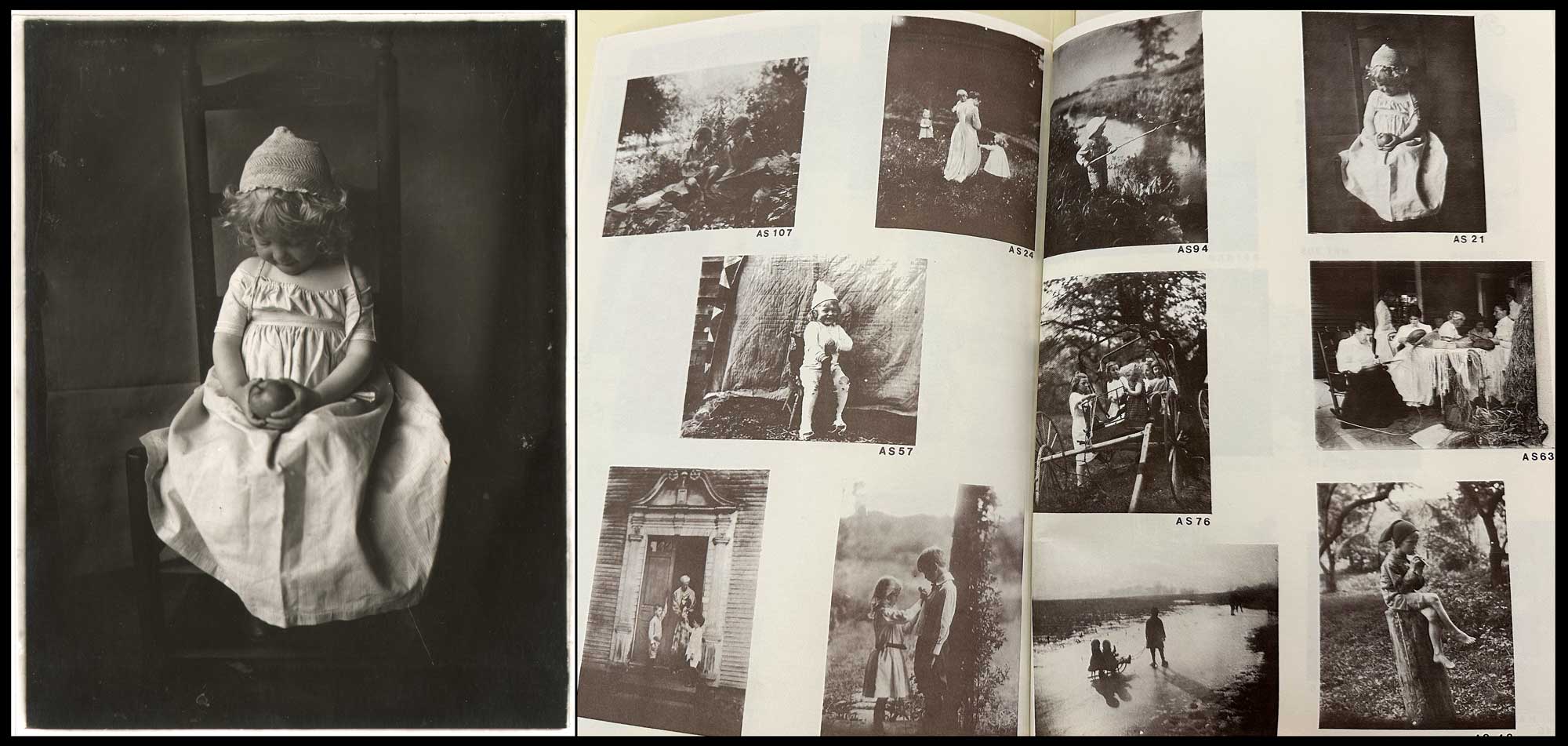
Marketing Venture: Left: “Girl Holding Apple”, c. 1978-81 print from c. 1900-10 negative, Frances & Mary Allen, American, 1854-1941 & 1858-1941, gelatin silver print, 21.9 x 16.5 | 25.1 x 20.2 cm. (work may be known as “For Teacher” in AS catalogue) Between 1978-81, the Pocumtuck Valley Memorial Association marketed the Allen sisters work through Gates & Tripp, a Boston gallery located in Faneuil Hall marketplace. Archivally printed and priced at $20.00 per print, photographs were contact printed from their original glass plate negatives or internegatives made by Sal Lopes of the Olmo Studio, Newport, Rhode Island & presented within 12 x 15” white rag mats. A three-year contract between PVMA and the gallery was signed in May, 1978 with the stipulation 7% of the sale price of each print was paid back as a royalty. Library records from PVMA library show that from November 16 – December 31, 1978, the gallery sold 67 prints from plate size (8 x10”), an additional 13 larger prints sold matted to 16×20”, and six platinum prints (from an edition limited to 100 prints) sold at $60.00. PVMA loaned 124 negatives as part of the contract, with $141.75 paid as royalties the first year. Interestingly, the 1978 G&T promotional brochure “A New England Vision 1880-1930”, featuring platinum prints by the Allens and Martha Hale Harvey misspelled Mary Allens name as  “Mary Electra Allen”, something that continues today. From: PhotoSeed Archive. Right: ca. 1978 “Gates & Tripp Historical Photography” promotional brochure opened to Allen sisters spread. “Girl Holding Apple”, stock #AS 21, reproduced at upper right corner. Photo of spread taken October, 2025 by David Spencer for PhotoSeed Archive, courtesy PVMA Library.

The Allen sisters may have worked in a silent world but left unsaid is the daily influence of the larger community of Deerfield family and neighbors they worked and lived with. Combined with their super power of astute observation and the reality of their deafness, these became guiding forces that enabled a defining vision for Frances and Mary Allen producing a body of work still relevant and beautiful today.
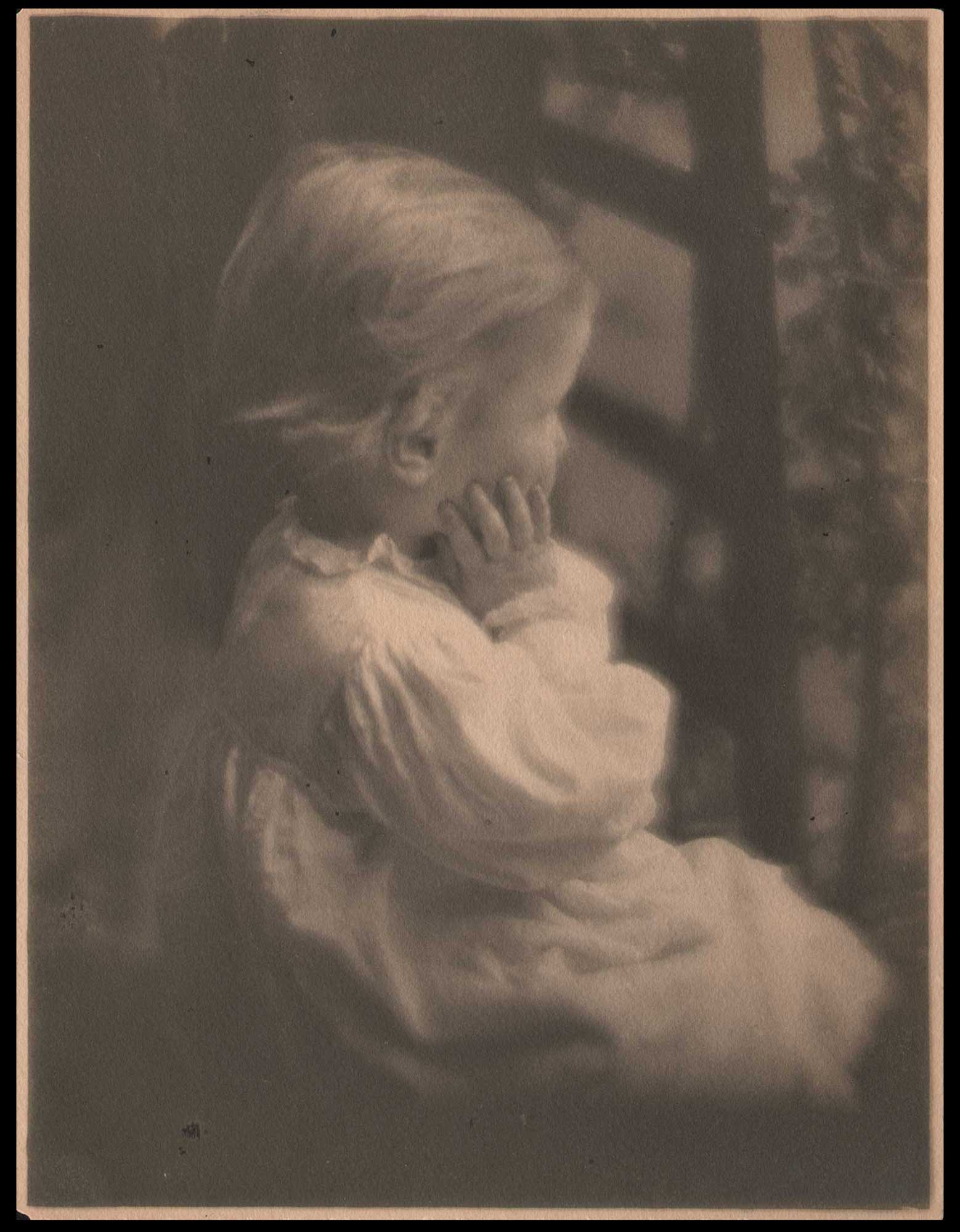
Dorothy”, 1909, Frances & Mary Allen, American, 1854-1941 & 1858-1941, unmounted platinum print, 20.6 x 15.5 | 21.2 x 16.2 cm. Most likely taken in late 1909 based on the child’s age, Deerfield resident Dorothy Andrews (Dorothy Bennett Andrews Parmeter: 1908-2005.) is photographed looking away from the camera while instructed by the Allen sisters to cradle her head. Delicate profile views like this of a neighborhood child places the Allens in rarefied company: select practitioners of early 20th century artistic pictorial photography. From: PhotoSeed Archive

This is the first of a two-part post on the Allen sisters of Deerfield Massachusetts. The second will focus on their involvement with the Deerfield town pageants of the early 20th Century promoting the town’s rich history.

Notes:

  1. Exhibition of the Arts and Crafts in the Martha Pratt Memorial” History and Proceedings of the Pocumtuck Valley Memorial Association, 1899-1904, Vol. IV, (MA: Deerfield), 1905, 277.
  2. Excerpt quote: The Allen Sisters pictorial Photographers 1885-1920, Pocumtuck Valley Memorial Association/University Press of New England, 2002, p. 27.
  3. Ibid, p. 44.
  4. Excerpt: Flynt of Deerfield, The New York Times, August 15, 1970.
  5. James L. Swanson was also an American historian and author of the 2006 book Manhunt: The 12-Day Chase for Lincoln’s Killer. (released as a miniseries produced for Apple TV+ in 2024).
  6. Excerpt, Old Deerfield, Mary E. Allen, New England Magazine: An Illustrated Monthly, September, 1892, p. 34.
  7. Historic Deerfield, Wikipedia accessed 2025
  8. In his spare time, Ray is an accomplished children’s book illustrator.
Platinum Spring Poses

Apr 2025 | New Additions, Significant Photographers

Passion, joy, yearning, and dreaming are common to Cutting’s vocabulary, as, implicitly, they are to his photographs. Ellie Reichlin

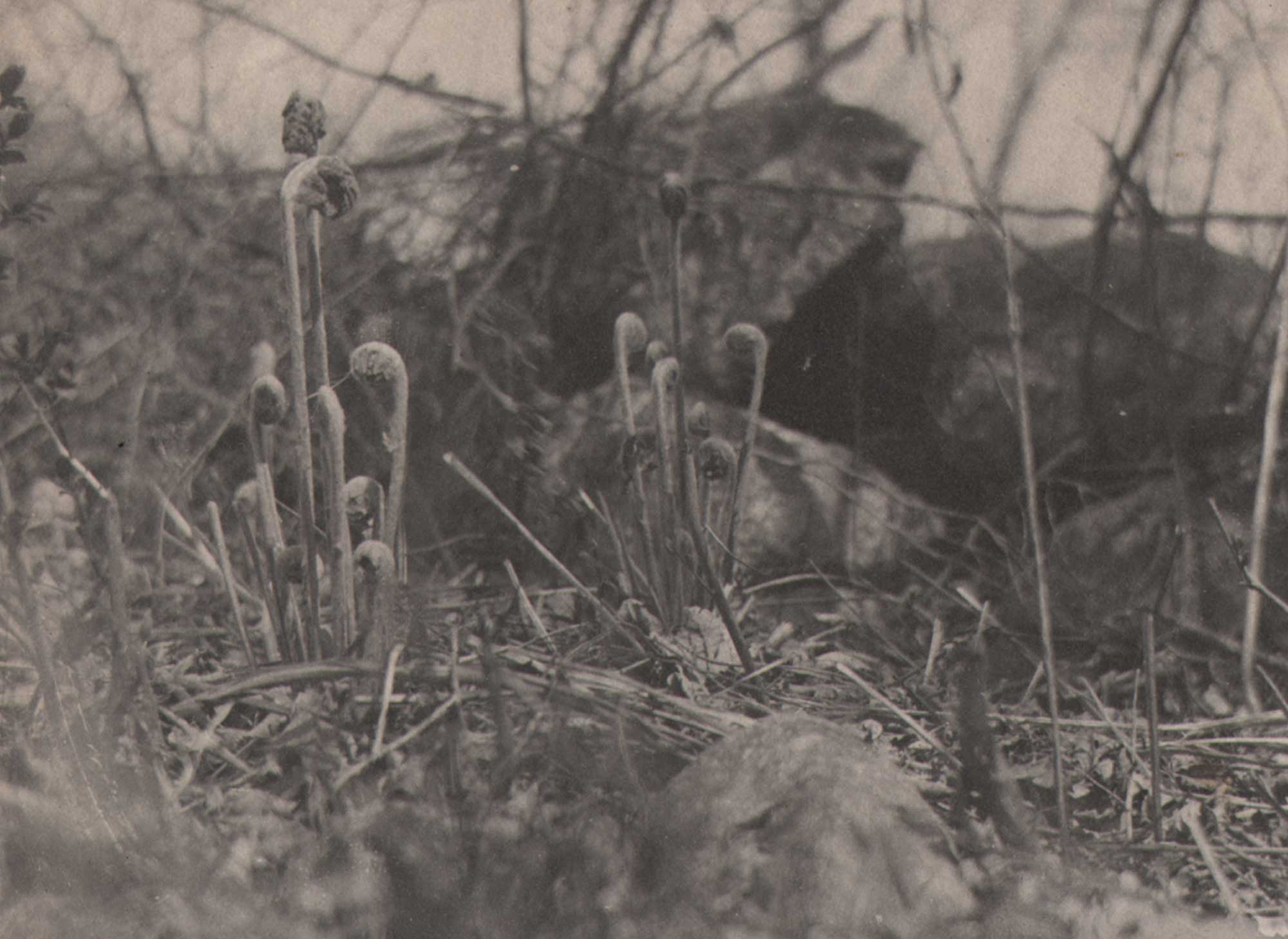
Fiddlehead Ferns Emerge: Matteuccia struthiopteris” 1906, Album-mounted platinum print, Alfred Wayland Cutting, American, 1860-1935, 9.2 x 9.54 | 27.8 x 34.5 cm. Fiddleheads emerge in Spring in this landscape study most likely taken in or around Wayland, MA. Fiddleheads are prized by foragers and can be prepared for consumption in any number of ways. From Wikipedia: “Matteuccia is a genus of ferns with one species: Matteuccia struthiopteris (common names ostrich fern, fiddlehead fern, or shuttlecock fern.” From: PhotoSeed Archive

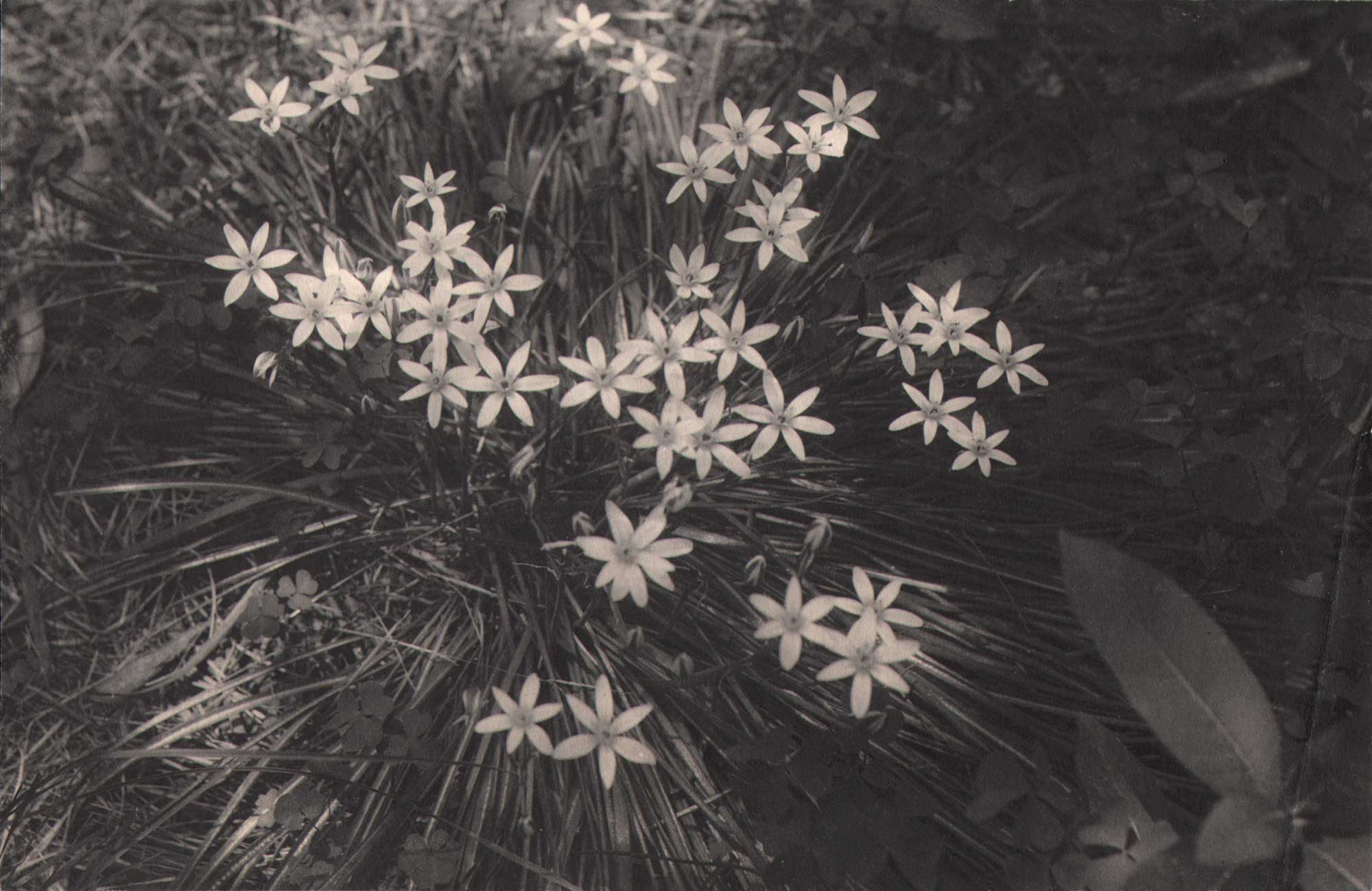
Spring is finally upon us in New England, so I’m making the excuse of showcasing a few more examples of the beautiful work of Wayland, MA resident Alfred Wayland Cutting. (1860-1935)  Pulled from an 1905-1906 Cutting album acquired by PhotoSeed in 2022, these delicate platinum prints may just be the inspiration for you to explore the beauty and magic emerging in your own backyard: the wonder of the season after their Winter slumber.
Star of Bethlehem: Ornithogalum”, 1906, Album-mounted platinum print, Alfred Wayland Cutting, American, 1860-1935, 10.5 x 16.0 | 27.8 x 34.5 cm. However delicate and beautiful, some species of Ornithogalum are classified as noxious invasive weeds in some portions of North America. From Wikipedia: “The common name of the genus, star-of-Bethlehem, is based on its star-shaped flowers, after the Star of Bethlehem that appears in the biblical account of the birth of Jesus. The number of species has varied considerably, depending on authority, from 50 to 300.” From: PhotoSeed Archive
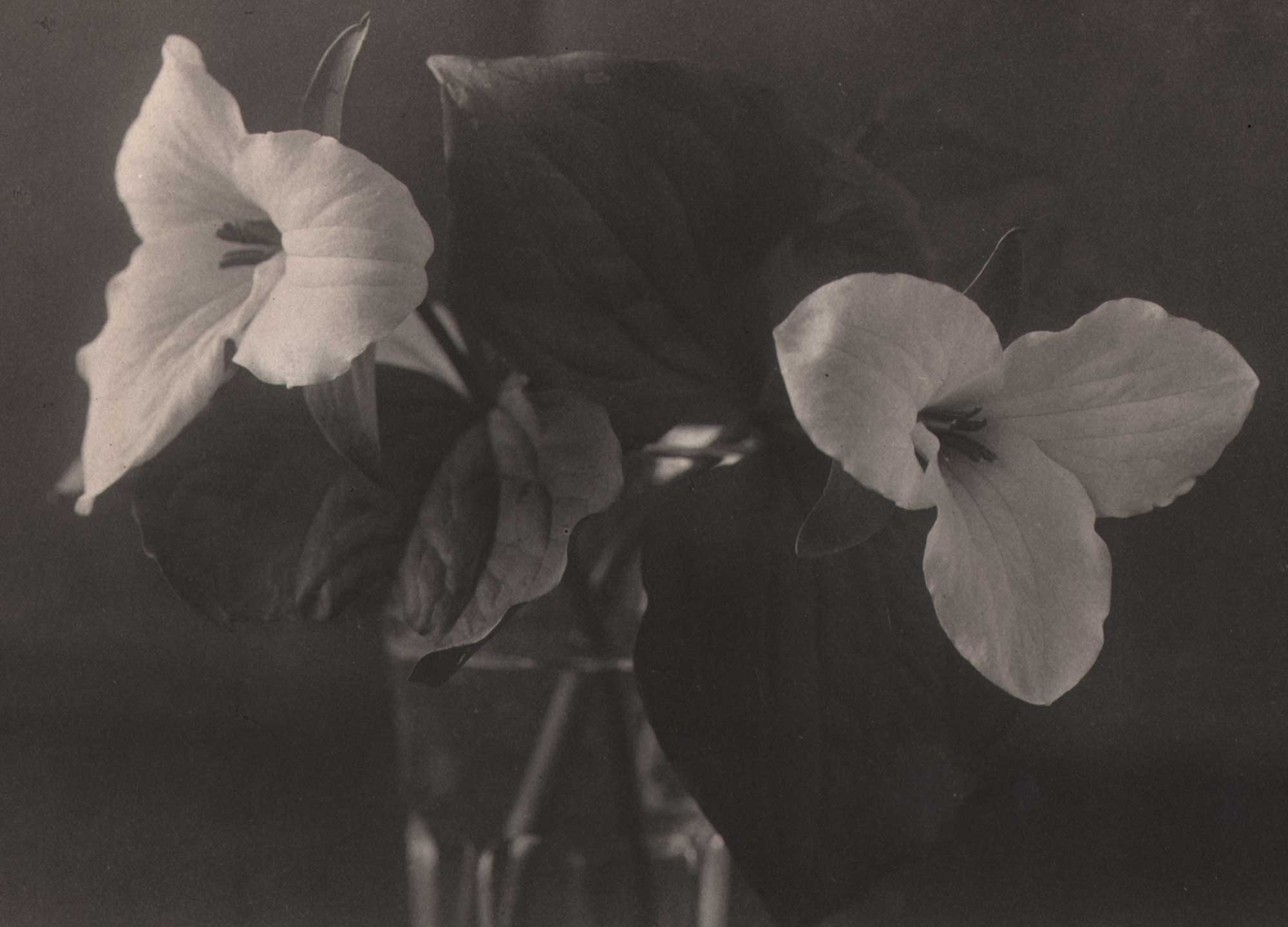
Trilliums: Trillium grandiflorum: Melanthiaceae”, 1906, Album-mounted platinum print, Alfred Wayland Cutting, American, 1860-1935, 12.5 x 19.2 | 27.8 x 34.5 cm. White Trillium blooms are arranged in a glass vase. From Wikipedia: “Trillium grandiflorum, the white trillium large-flowered trillium, great white trillium, white wake-robin or French: trille blanc, is a species of flowering plant in the family Melanthiaceae. A monocotyledonous, herbaceous perennial, the plant is native to eastern North America, from northern Quebec to the southern parts of the United States through the Appalachian Mountains into northernmost Georgia and west to Minnesota. There are also several isolated populations in Nova Scotia, Maine, southern Illinois, and Iowa.” From: PhotoSeed Archive

The Wayland Historical Society describes Cutting as someone who “always had his camera with him.” A lifelong bachelor, he was the sixth generation of Cuttings to live in Wayland, MA going back to  1713. Born in Boston, he spent 19 years of his life there as a bank teller after graduation from English High School. He then moved to Wayland for good around the turn of the 20th Century, devoting countless hours to his photography.

Flowering Apple Trees: Malus domestica”, 1906, Album-mounted platinum print, Alfred Wayland Cutting, American, 1860-1935, 16.0 x 20.5 | 27.8 x 34.5 cm. In an orchard, apple trees show off their flowers in Spring. Seen from a high angle, with a fence and roadway at right, this view was most likely taken on a farm in the greater Wayland, MA area. From Wikipedia: “An apple is a round, edible fruit produced by an apple tree (Malus spp.). Fruit trees of the orchard or domestic apple (Malus domestica), the most widely grown in the genus, are cultivated worldwide. The tree originated in Central Asia, where its wild ancestor, Malus sieversii, is still found. Apples have been grown for thousands of years in Eurasia before they were introduced to North America by European colonists. Apples have cultural significance in many mythologies (including Norse and Greek) and religions (such as Christianity in Europe).” From: PhotoSeed Archive

Historic New England, based in Boston, the oldest and largest regional preservation organization in the United States, holds the largest collection of extant photographs and other ephemera by Alfred Wayland Cutting: a body of work that commenced when he acquired his first camera, in 1881, to the early 1930’s. By 1927, this archive had already numbered short of 4000 examples.

Gathering Lilac Blooms between Poplar Trees: Syringa vulgaris & Populus”, 1906, Album-mounted platinum print, Alfred Wayland Cutting, American, 1860-1935, 19.0 x 15.5 | 20.4 x 17.0 | 27.8 x 34.5 cm. On a country road, most likely in or around Wayland, MA, a woman gathers lilac blooms from a large bush growing between two poplar trees. From Wikipedia: “Syringa vulgaris, the lilac or common lilac, is a species of flowering plant in the olive family, Oleaceae. Native to the Balkan Peninsula, it is widely cultivated for its scented flowers in Europe (particularly the north and west) and North America.”|  “Populus is a genus of 25–30 species of deciduous flowering plants in the family Salicaceae, native to most of the Northern Hemisphere. English names variously applied to different species include poplar, aspen, and cottonwood.” From: PhotoSeed Archive

Here are three insights into the working methods of Alfred Wayland Cutting, from research conducted by the late Ellie Reichlin, former curator of acquisitions at the Harvard Peabody Museum and then Director of Archives at the Society for the Preservation of New England Antiquities in Boston. From the exhibition brochure: The Old Life Silently Passed: Photographs by Alfred Wayland Cutting (1860-1935):

Cutting was an intensely serious photographic artist and craftsman, steeped in the precepts of art photography and pictorialism, which emerged in the late 1880s and early 1890s as a liberating alternative to the sharply detailed documentary styles that had dominated photography’s first four decades. 

He loved Wayland, Massachusetts, where his ancestral roots ran generations deep, with a devotion that verged on reverence.

For all the local significance of Cutting’s work, it would be a mistake to characterize him principally as a Wayland photographer, or as Wayland’s photographer, even though he-with Yankee disdain for the high-falutin’-might have protested efforts to intellectualize or magnify his accomplishments. He described himself unpretentiously as an “amateur or semi-professional.”

Icy Night, Holy Night

Dec 2024 | New Additions, Significant Photographers, Significant Photographs

No matter the temperature, may your Christmas be warm and bright.

“Icy Night” 1898, Alfred Stieglitz, American, 1864-1946, photogravure included within Camera Work IV, 1903, 12.9 x 16.0 | 20.5 x 29.7 cm. Presented here cropped to image with additional colored masks. Used as an advertisement for Goerz Lenses, the following copy accompanied the gravure: “The original of this celebrated picture, Icy Night,” exhibited in the International Exhibitions at London, Paris, Turin, Brussels, Hamburg, Philadelphia, etc., etc., was made in January, Eighteen Hundred and Ninety-eight, at one a.m., with a Goerz Lens, Series III., full opening, and an exposure of three minutes.” From PhotoSeed Archive

Cue the Sun

Nov 2024 | Color Photography, Composition, Fashion Photography, History of Photography, New Additions, Painters|Photographers, Significant Photographers

Sunlight is said to be the best of disinfectantsLouis Brandeis, U.S. Supreme Court Justice, 1913

Top: The Sun takes center stage: Detail: “La Perle Doucement S’ Éteint et la Danse S’ Arrête | The Pearl Slowly Fades Away and the Dance Stops” Pierre Dubreuil, Belgian (1872-1944) Photogravure: Chine-collé: published in Die Kunst in der Photographie: 1903: Lieferung 1 | First Issue-16.5 x 23.0 | 26.6 x 34.8 cm. A critic on this photograph from 1901:”Now the light gradually dies and with it the dance fades away, for dance is a child of the light. They have whirled around for the last time, their movements become more subdued and tired, and now they stand still. They hold hands and lean back, as if in delicious relaxation. They look long and deeply into each other’s eyes once more while the sun sets.” Bottom: The Sun clouded over: Believed to be the original source material compositionally for Dubreuil’s photograph above: Detail: “Strassenklatsch | Street Gossip” Alfred Stieglitz, American (1864-1946) Photogravure published in Die Kunst in der Photographie: 1899: Lieferung 5 | Fifth Issue-12.2 x 21.0 | 24.9 x 33.7 cm. In her book:  Stieglitz-A Beginning Light, author Katherine Hoffman comments about this photograph: “Another well-known Katwyk image depicts the prow of a boat at anchor, its boom, lower sail, and rigging forming varied triangles.  The prow of the boat points toward two women talking nearby at the water’s edge. Entitled, Gossip, Katwyk, the photograph focuses on narrative and formal elements.  The women stand firm, their hands on their hips, forming small triangles that balance the ship’s forms and one of the women looks toward the ship.  The strong horizontal elements of the beach, water, and sky, serve as a well-integrated backdrop for the women and ship.  The small lantern on the boat seems to light the image symbolically.” Both from PhotoSeed Archive

This Brandeis quote is widely cited today as referring to the benefits of openness and transparency-especially as it pertains to keeping democracy vital and thriving.

So what does this have to do with a blog dedicated to preserving, promoting and riffing on the history of artistic photography?

Well, unfortunately, not much at all. That is, if only we were to think of photography as a truthful medium- something that accurately records for posterity what is placed before it or “seen” by the camera. That evidence would be from an impartial machine, and honesty might prevail. But as we traverse the second decade of the 21st Century, technology is taking a brutal hammer to what our once (believing) eyes took for fact. The sunlight of truthfulness has gotten a bit dim of late, yielding, inevitably, to “progress”. Of course, arguments could be made that photography has lied ever since the invention of the medium. Longtime readers of this blog might remember how I wrote about unscrupulous “photographers” operating in the mid 19th century who would trick people into believing the camera itself could mesmerize them. Today, as of October 2024, when I first spotted it, the updated version of mesmerization is now done courtesy of AI. (artificial intelligence) Here’s an Orwellian example of that in what I will call the Ebay photographic caption from Hell that should help put things in perspective:

Left: The Rays of the Sun cover the Earth: Before Photography, the public consciousness was getting more familiar with scientific thought in the press. Detail: Gilt decoration of the Sun and Earth: volume cover: “Light: Its Properties And Effects” London: The Religious Tract Society, 1838. 18mo: 5.5” x 4.25”. Illustrated with 40 steel engravings, an 1839 reviewer wrote of this little book: It is written in a simple style, but introduces the reader to all the arcana of the science which it touches. The anecdotes of singular illusions and the explanations of them enliven it, and serve to impress the general principles and laws of light more distinctly upon the mind. And, as may be believed from the fact of its issuing from the Tract Society, it fails not to point the learner “To look thro’ nature up to nature’s God.” Right: “Camera Obscura”, unknown artist: full-page steel engraving from “Light”- Chapter XI: Lenses-The telescope-The microscope-Various Optical Instruments: 13.5 x 9.8 cm. A family peers into a very large Camera Obscura placed on a table. Cameras such as this would eventually be retrofitted to accommodate chemically altered sheets of writing paper placed within-part of the process of making Photogenic Drawings and early Calotypes. From: PhotoSeed Archive

This vintage photograph captures a momentous occasion in Yellowstone National Park in 1892. The image depicts a family who was taken by a tripod rigged. The photograph is in sepia tone and has a size of H18 3/10 cm x W21 5/10 cm. The image is produced using a photographic technique and features the Richardsons family. This collectible item is perfect for photography enthusiasts and collectors alike.

So far, kinda good, other than the “tripod rigged” mention and the fact no one really speaks of common snapshots of Victorians chilling in nature as a “momentous occasion”. It would soon become apparent that our new friend AI was hard at work to really sell this photo. The caption continues:

Top left: First mass market publication of a “Sun Picture”: pasted paper label: PATENT TALBOTYPE or SUN PICTURES. 5.8 x 7.1 cm. Affixed to verso of leaf: 22.6 x 28.6 cm. 1846. Contained in “Art-Union Journal”. Top right: The editors of the publication were keen to go into detail on how Fox Talbot’s “Sun Pictures” (calotypes) were made, refuting the notion they were done by some sleight of hand, and even gave a detailed account of how these photographs were made. Bottom: “Mount Edgcumbe House, Devon” William Henry Fox Talbot, English, (1800-1877) salted paper print inserted in June 1, 1846 issue of the Art-Union Journal, London. 15.7 x 20.0 cm pasted to leaf 22.6 x 28.6 cm. Extremely rare but heavily faded, with the main facade of the home clearly identifiable, this is one of a believed 6000 original Talbotypes published in the Art Union. Various other views were also supplied by Talbot for the publication, a commission unfortunately compromised by the fact all of the calotypes were believed to be insufficiently fixed and washed by Nicolaas Henneman’s overworked Reading printing establishment. From: PhotoSeed Archive

The Richardson Family was off on an expedition and there were no cell phones and there was no one out there and there were no Rangers and there were no Rescuers and nobody could save them if they where to call out and that’s what it was like in those days and they put their lives in front of nature and they didn’t think ahead of time to prepare if any natural occurrences would come along with bears and mountain lions.”

So yeah. What could possibly go wrong in our brave new world? I say bring on the sunlight. And lots of it. Call out the fakes. Push back. We here at PhotoSeed are big fans of transparency. Who wants to collect a “vintage” photograph with that kind of back story or an obvious fake of great, great grandma or grandad run through an AI filter? Well someone of course, and that’s cool too- whatever floats your boat and all that. But I digress.

“The Glorious Sun: Stays In His Course And Plays The Alchemist” : “Here is a Wonder, if You Talk of a Wonder” were phrases incorporated into the elaborately engraved title page to the very first issue of “Sun & Shade-A Photographic Record of Events”: July, 1888. Unknown American artist, possibly George Wharton Edwards, (1859-1950) credited with cover design for issues beginning around 1890. 30.5 x 24.1 | 35.2 x 27.6 cm. Published by the The Photo-Gravure Company of New York by Ernest Edwards, the publication, according to the volume “Imagining Paradise”, “grew from less than fifty subscribers to a monthly edition of four thousand copies” in its first year. “With emphasis on quality rather than quantity, the magazine transformed itself from its original concept of a “Photographic Record of Events” to an “Artistic Periodical”, and would feature many fine photogravure plates, mainly from photographs but also artwork. From: PhotoSeed Archive

Sunlight- as a kind of invisible chemical medium- was everything to the existence of early photography. Similar to AI today in that enabling it is just a few clicks on a computer keyboard, and may remain a mystery to unsuspecting viewers, people did not understand what a photograph  was or how they were made in the earliest version of the medium. Sunlight provided that answer, or at least a reasoning. The ever-present Sun overhead provided the means for these early efforts. In the 1830s, the Englishman William Henry Fox Talbot, a botanist among other passions, experimented by recording the shapes of things like leaves and lace, contact printing these on sheets of chemically altered writing paper. The results were known as “photogenic drawings”, or drawings produced by light. It’s no wonder promotion of early photography involved the iconography of our friend the Sun.

Top: The Eyes of the Sun: Sun iconography was incorporated like this example in the cover design to the important Austrian portfolio Amateur-Kunst, (Amateur Art) published in late 1891 by the Vienna publishing house Gesellschaft für Vervielfältigende Kunst. Detail: gray cloth over boards, three-point folder portfolio-January, 1891: Vol. III, No. 29: 49.8 x 36.6 cm. Middle: From around 1890, the Sun God Phoebus, (Apollo) one of the Olympian deities in Greek and Roman mythology, was prominently featured on covers for the publication “Sun & Shade, an Artistic Periodical” published by the N.Y. Photogravure Company from 1888-1896. Wood engraving: 35.2 x 27.6 cm. George Wharton Edwards, American (1859-1950) is responsible for the Art-Nouveau cover design, which also includes a plate camera at the upper right corner. Bottom: Detail: “Sun Artists Series Wrapper”. Multi-color wood engraving: October, 1889. 40.3 x 30.4 | 40.3 x 60.8 cm (outline of series title Sun Artists printed in gold ink) Featuring a design by English illustrator Laurence Houseman, (1865-1959) this rare example of a brown-paper wrapper for the first Number of Sun Artists originally contained four hand-pulled photogravures made from the original negatives taken by English photographer Joseph Gale, (1835-1906) as well as individual letterpress featuring an essay on this photographer’s work by George Davison. All: PhotoSeed Archive

Talbot’s Calotype process, patented in 1841 with earlier iterations being the basis for his groundbreaking positive-negative process of 1839, would be referred by him and other practitioners as “Sun Pictures”, or Talbotypes. The editors of London’s Art Union Journal exclaimed in June 1846, while presenting an original example of one of his Sun Pictures (see example above) that:

It will be remembered that we have from time to time called attention to these truly wonderful representations, in our notices of Mr. Talbot’s work, “The Pencil of Nature.” By the public these “sun-pictures” are still misapprehended-still “misnomered;” we shall accordingly, in this notice, show what they are not, and endeavour to explain what they are, as it is yet far from generally accepted that they result from the action of light alone, and are not produced by some leger-de-main [slight of hand] of Art.”

Top left: The Painted Sun: Detail: “Study of a Nude”, 1899, Charles Fondu, Belgium: (1872-1912) collotype from Sentiment D’Art en Photographie: Vol. 1, No. 4, Planche 3: 14.8 x 19.6 | 26.0 x 36.9 cm. From the volume “The Last Decade” published in 1984 by George Eastman House, this photograph is commented on: “Fondu’s woman, combination of femme fatale and omnipotent angelic female, is profiled against the sun. Like the sunflower, the sun was a popular symbol with art photography clubs. It represented photography’s necessary light as well as the inspiration, power and renewal associated with otherworldly presence.” (p. 4) Lower left:  “Family in an Explosion of Light” Emery Gondor, American (b. Hungary- 1896-1977) Linoleum cut: 1925 plate from 1923 block: 20.5 x 18.8 cm impression | 28.9 x 25.0 cm. Although better known as an artist, Emery Gondor was an accomplished photographer whose work appeared in some of the largest European newspapers (principally German) from the mid 1920’s into the 1930’s. He escaped the Nazi regime, emigrating to America in 1935. This plate from his unpublished folio: “Sehnsucht nach Licht” (Yearning for Light) : “8 original Linoleum cuts by Emerich Göndör”. Right: The Sun in etched form: Detail: “Folder: Die Kunst in der Photographie” Hermann Hirzel, born Switzerland, (1864-1939) 36.0 x 26.5 cm  Originally etched in 1896, Hirzel’s cover design showing a Faun playing his flute among a landscape of trees and the rising Sun was used in all issues from 1897-1903. Published between 1897-1908 by Franz Goerke in Germany, Die Kunst in der Photographie is one of the most important journals of photography ever published showcasing artistic photography from around the world. All: PhotoSeed Archive

The article continues and even gives the chemical formula for making sensitized Calotype paper that could be exposed in a camera obscura. (1.) Terminology developed rapidly from here. To differentiate in the public discourse from a painting or drawing made by hand, these new “photographs” would hence be referred to as being “From Nature.” The one constant of this wondrous invention was the Sun overhead. It alone was responsible for even making photography and photographs exist in the first place.

In the exhibition catalogue “The Last Decade” published in 1984 by George Eastman House, the symbolism of Sun imagery is discussed as part of an 1899 nude study by Belgian photographer Charles Fondu:“Fondu’s woman, combination of femme fatale and omnipotent angelic female, is profiled against the sun. Like the sunflower, the sun was a popular symbol with art photography clubs. It represented photography’s necessary light as well as the inspiration, power and renewal associated with otherworldly presence.” (p.4)

As a graphic device, the image of a Sun would be a great promoter for photographic achievement, and was common in print even through the first decade of the 20th Century. 

Top: The Setting Sun: “Adieux au Soleil | Farewell to the Sun” Pierre Dubreuil, Belgian (1872-1944) Photogravure: Chine-collé: published in Die Kunst in der Photographie: 1903: Lieferung 1 | First Issue-12.2 x 24.5 | 26.3 x 35.2 cm. In 1901, Fritz Loescher, in his essay On the Pictures of P. Dubreuil, comments on this photo: The farewell to the sun is wonderful in the combination of the most artistic calculation and the favor of the moment. The dark female figure, standing on the far edge of the seashore, stretching out her arms towards the departing sun, is like the embodiment of the longing for the light. And driven by the wind, the veil from the head also blows in the same direction, and the mood of this human soul is expressed in everything to the fullest.” From: PhotoSeed Archive. Bottom: My contemporary update from 2001: “Butterfly Wings”.On Lake Worth Lagoon in Palm Beach County Florida, the wings of the most beautiful butterfly is what came to mind while the wind lifted up the silk cape being held by Ballet Florida dancer Wendy Laraghy. This photo was from a series of portraits of Ballet Florida dancers in unconventional but truly believable South Florida settings and situations. The story promoted the fact the local company, based in West Palm Beach, was turning 15 years old. Photo by David Spencer/The Palm Beach Post

I hope you enjoy these examples of artistic photographs from nature, and have included a few of my own as modern comparisons. The contrast deliberate, my very own version of “Sun & Shade”: “Butterfly Wings” was taken in the “Sunshine State” while “Condemned” hails from the depths of an upstate New York Winter.

Left: The Sun: but quite hidden on a snowy day: “Condemned” :1984, from a gelatin silver print. By David Spencer for the Daily Orange. Some of the last students of Winchell Hall, on the campus of Syracuse University in New York state, hang out on exterior balconies for the last time. The first dormitory to be constructed on campus in 1900, Winchell Hall Dormitory for Women was replaced by the Schine Student Center. Right: Setting sail into the Sunset? “Off Tilbury” Ralph Rowland Rawkins, English: (1874-1951) Mounted platinum print, from the Hand Camera Postal Club Portfolio: 1904: 14.3 x 7.1 cm print | mounts: 14.6 x 7.3 | 14.9 x 7.7 | 30.4 x 25.2 cm. Rawkins, the honorary secretary for the Postal Club based in London’s Tufnell Park, took this photograph of a sailboat silhouetted against a hazy, sunny sky in September, 1904. From: PhotoSeed Archive

Even in our current digital age, the Sun, giver of all life, continues to make photography possible by giving complex machines the illumination necessary to record our everyday existences and its many hues, shapes and wonders. But it’s a layered argument, the Sun being symbolic as well. Take my last photograph in this post. It’s the winter of 1983 (2.) and my assignment for The Daily Orange student newspaper was to photograph the final residents of the old Winchell Hall dormitory on campus, soon to face the wrecking ball. A snowstorm, as was common on a Syracuse winter day back then, was in full force. Stage directing the scene from across the street while somehow convincing the students to  all climb out onto their respective room balconies was actually the easy part. What I didn’t anticipate were all the smiles that erupted, the finger pointing and general merriment the act of taking the photograph brought about. Sure, the old building was coming down to be replaced by a bright new shiny object, but these students had been forever immortalized in a photograph. And a truthful one at that: an unmanipulated moment where their futures were truly bright, and one where future dreams would surely include many bright tomorrows.

  1. Excerpt: The Talbotype.   Sun Pictures. The Art Union Journal, June 1, 1846 pp. 143-44.
  2. I may have actually photographed this scene in mid January, 1984. From the SU archives: “While in the process of being demolished to make room for the building of Schine Student Center, a fire, possibly arson, swept through Winchell in early February 1984 and hastened the venerable structure’s end. in early 1984.” Read more about the history of Winchell Hall.

1 2 3 5