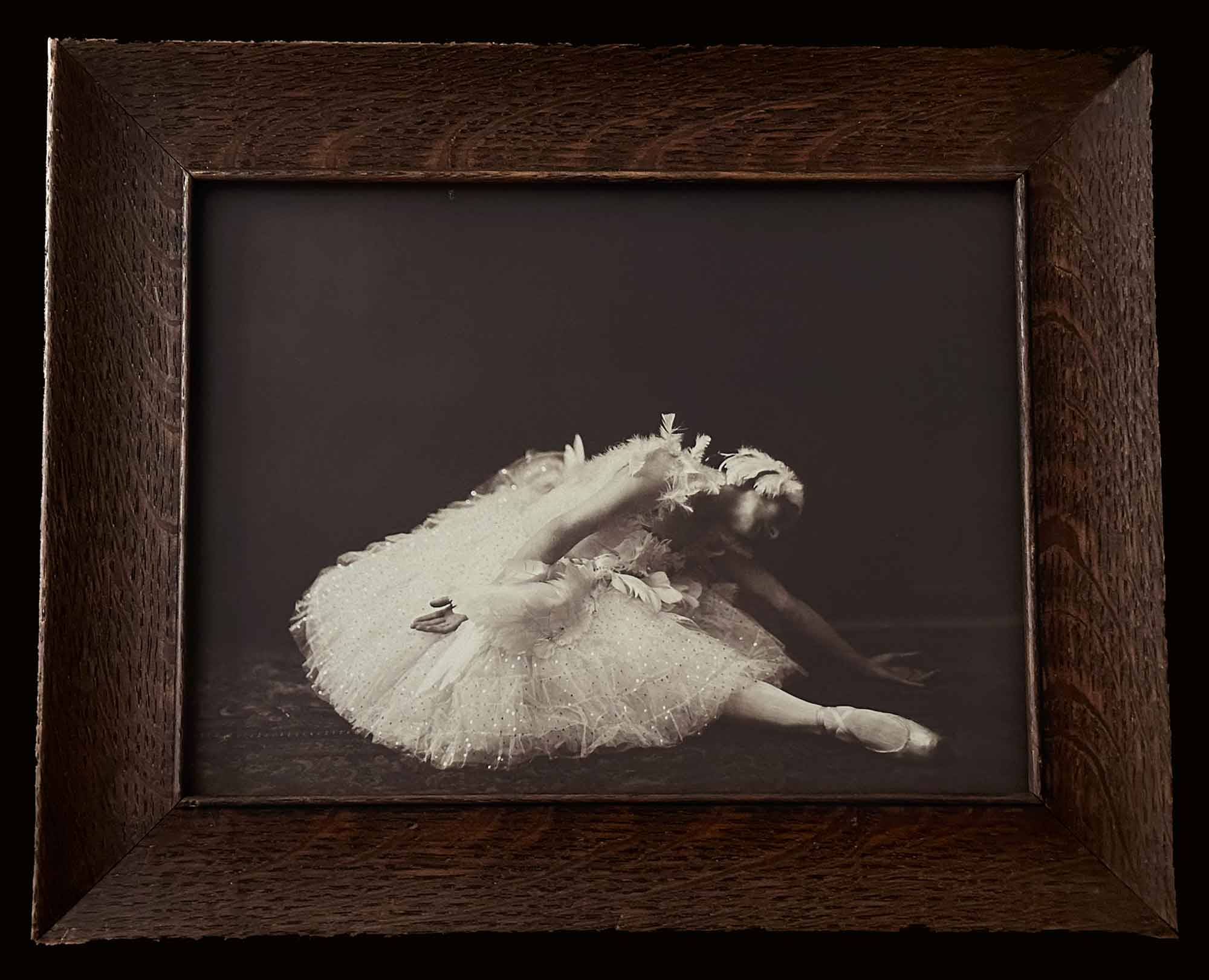
Anna Pavlova in “The Dying Swan”
“In 1905, Anna danced her most famous role, the solo work titled The Dying Swan, choreographed by Mikhail Fokine. Her performance exemplified the delicate preciousness of life (“Anna”).”—AJ Blankenship & Cheryl Rosario: “Remembering the Swan”
“On January 23rd, 1931, three weeks before her 50th birthday, she died of pneumonia. She held her dying swan costume on her deathbed, and spoke her last words: “Play the last measure very softly”.”—Remembering the Swan
Russian ballerina Anna Pavlova is shown in the last moments from the ballet, The Dying Swan, performed in 1919 in the Buenos Aires photographic studio of Frans Van Riel.
Anna Pavlova: 1881-1931
Anna Pavlovna Pavlova (born Anna Matveyevna Pavlova) was a Russian prima ballerina. She was a principal artist of the Imperial Russian Ballet and the Ballets Russes of Sergei Diaghilev, but is most recognized for creating the role of The Dying Swan and, with her own company, being the first ballerina to tour the world, including South America, India, Mexico and Australia.—Wikipedia (2026)
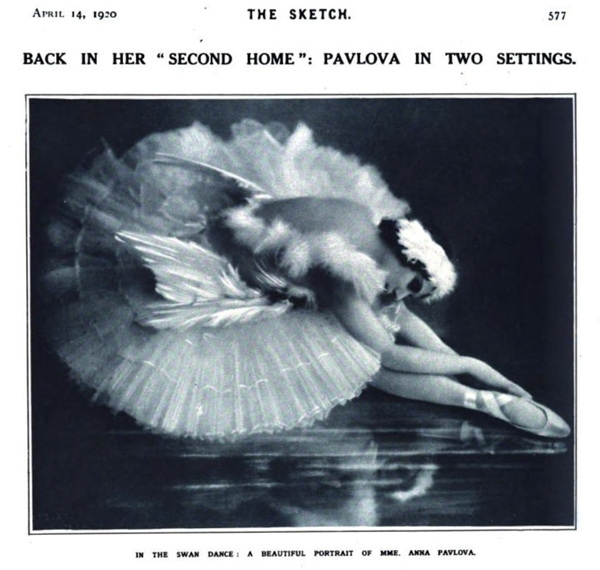
Anna Pavlova was about 38 years old when Frans Van Riel photographed her in his Buenos Aires studio performing the penultimate scene from “The Dying Swan”. This much better known variant from the sitting, (her dress appears to be slightly different) revealing Pavlova’s face while reaching for her pointe shoe, was published in The Sketch on April 14, 1920.
The Dying Swan (originally The Swan) is a solo dance choreographed by Mikhail Fokine to Camille Saint-Saëns’s Le Cygne from Le Carnaval des animaux as a pièce d’occasion for the ballerina Anna Pavlova, who performed it about 4,000 times. The short ballet (four minutes) follows the last moments in the life of a swan, and was first presented in St. Petersburg, Russia in 1905. The ballet has since influenced modern interpretations of Odette, heroine of Tchaikovsky’s ballet Swan Lake, and has inspired non-traditional interpretations as well as various adaptations.—Wikipedia (2026)
Frans Van Riel: 1879-1950
He was born in Rome in 1879. From a young age, he was involved in the arts. In Rome, he studied painting until arriving in Buenos Aires in 1906, where, after settling in, he worked as an illustrator for the newspaper La Prensa. In 1913, he opened his own photography studio located at the corner of Viamonte and Florida streets, and in 1918, he founded “Augusta,” the first local magazine specializing in art.
In 1924, he decided to move his studio to a larger space and simultaneously open Argentina’s first art gallery established for that purpose. Inaugurated with President Marcelo T. de Alvear in attendance at 659 Florida Street, this space soon became a meeting place for artists, intellectuals, and other prominent figures of Buenos Aires’ elite. Its galleries housed the Friends of Art Association, the magazine Ver y Estimar (See and Appreciate), the Institute of Modern Art, and Buenos Aires’ first independent theater. Frans van Riel died in 1950. The photographic studio closed and since then the gallery passed into the hands of Fran van Riel Jr., who ran it for more than forty years until passing the baton to his daughter Gabriela, continuing the family legacy to this day.—Museum of Modern Art of Buenos Aires (2026)