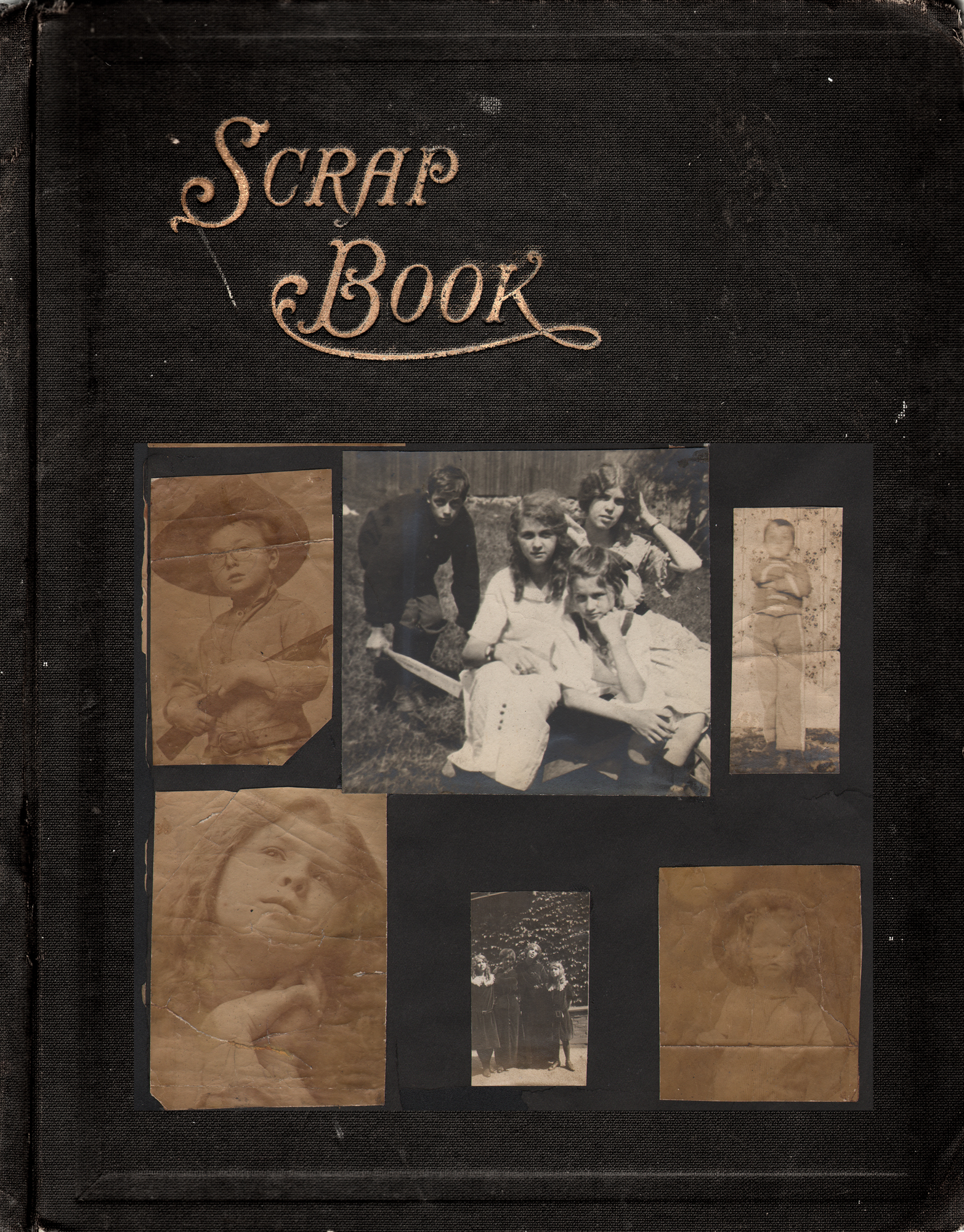
Cover Detail: Marcellus Family Scrap Book Photo Album, ca. 1920’s, 32.0 x 25.5 x 3.0 cm, black cloth album featuring hundreds of Marcellus family (Marselis) photographs dating 1870’s-1920’s who settled in the Bronx, New York State. The four children of Isaac N. Marselis (born Philadelphia, PA ca. 1866) & Lena M. Brown, (born E. Hampton, CT ca. 1867) were all accomplished child models as well as artists and dancers. Inset Album Leaf Group: At top center in wheelbarrow, ca. 1910, gelatin silver print, 10.7 x 11.5 cm on album leaf, 30.8 x 23.4 cm: L-R: Victor H. Marcellus: 1898-1968, Irene L. Marcellus: 1900?-1959, Virgillia Marcellus: 1893-after 1962), Violette Rita Marcellus: 1902-1979. Other photographs believed to show Victor with toy rifle at upper left, two photos of Irene at bottom and grouping of three female siblings with their mother at bottom center. From: PhotoSeed Archive
In June of 2024, I first posted to this blog some wonderful photos of Lucy the Elephant pasted within a scrapbook I purchased earlier that year. The series of photos of Lucy— Summer Wanderings & Roadside Wonders—included a woman waving while peering out of the pachyderm’s eyeball. Long story short: I now know who this person is, and a whole lot more about the lives depicted within that scrapbook.
Photo albums and scrapbooks featuring photographs can be some of the most rewarding and difficult to research. The latter is often because these artifacts not already sent to the landfill after the passing of the last generation depicted within are often a complete mystery to marketplace collectors. Almost without exception, it’s because the photographs themselves invariably lack subject names or locations. AI image searching software can sometimes help, but as I often tell my wife with a gleam in my eye, there cannot possibly be another old photo of 19th U.S. President Rutherford B. Hayes floating around just because the algorithm detects yet another wizened gent sporting an impressive beard. Hence my advice in this area of collecting: Always. Trust. Your. Eye.
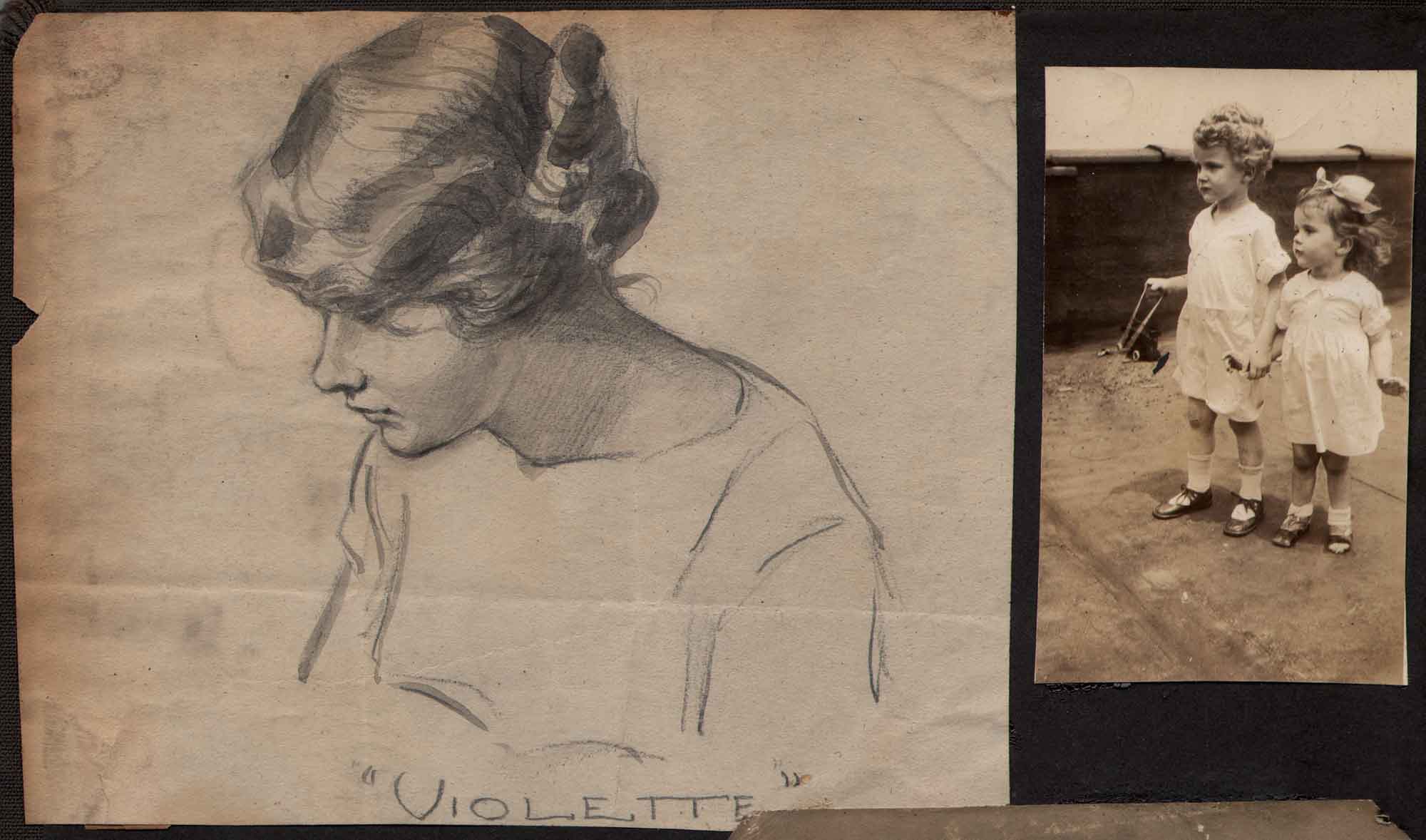
L: Violette, ca. 1915-20, graphite and watercolor on paper, unknown American? artist, inside front scrap album cover, 32.0 x 25.5 | 13.6 x 16.5 cm. This profile artist’s study shows Violette Rita Marcellus, whom The Sun newspaper of New York City on 13 July 1919 reported: “Violet Marcellus, who is Harrison Fischer’s favorite model, has made her stage debut in “The Greenwich Village Nights” at the Greenwich Village Theatre.” Violette listed her profession as showgirl on the 1920 US Census and married the following year to Garner Benson Mann, 1887-1962. R: Photo believed to be children of Violette’s sister, Irene Marcellus, (Copeland) dated July 4, 1931 on verso: L: Peter Copeland, 1927-2007 & Doris Irene Madden, 1929-2005. From: PhotoSeed Archive
For example: how is it possible that in the present a young woman described in 1916 as “the Most Famous Living Child Model”—someone who graced the covers of more than 200 magazines and was “said to be known to more than 50 million people in the United States”— is virtually unknown today? (1.) A scrap/photograph album this archive purchased several years ago from the Bronx dealer who rescued it from a Long Island thrift shop never answered this question. At least not at first. Turns out the answer, after several weeks of digging and careful removal of several snaps, is former child model turned Ziegfeld Follies dancer and actress Irene Marcellus. (born Marselis, around 1900) The subject of this post is a scrap album who I believe belonged to Irene’s older sister, Virginia Marcellus. (Virgillia Marcellus Laing: 1893-after 1962) She assembled the album from hundreds of Marcellus family photos as well as several original pieces of artwork sometime in the late 1920s, as best as I can deduce.
My research uncovered Irene sitting for famed American artists James Montgomery Flagg and Howard Chandler Christy, although no works are actually known to identify her, and the important American photographers Arnold Genthe, Alfred Cheney Johnston, Edward Thayer Monroe and Edwin Bower Hesser. But then our story gets much better. It turns out Irene, her siblings and even mother were all celebrated models and dancers in their own right.
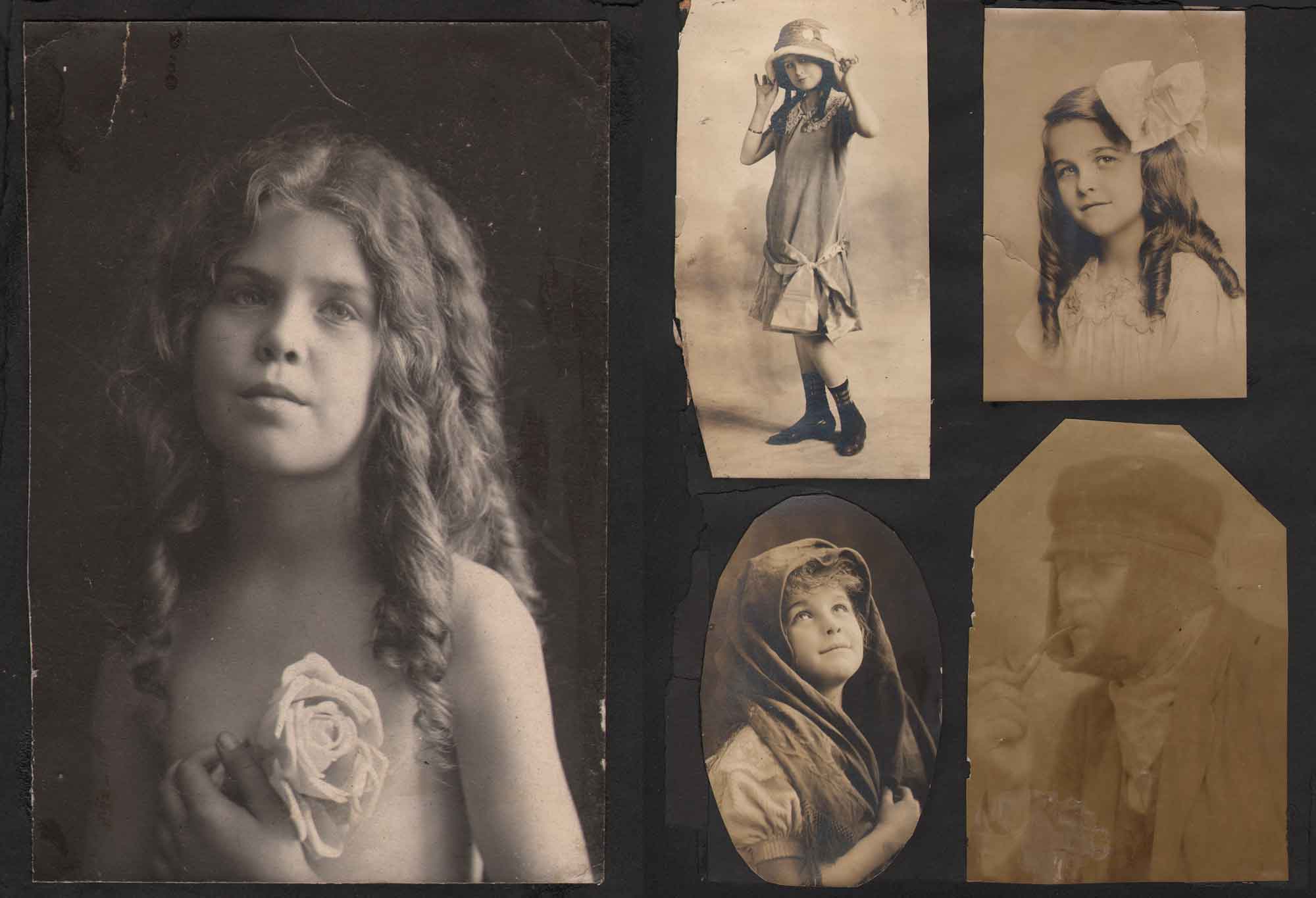
L: Virgillia or Irene Marcellus Holding a Rose, ca. 1900-1910, unknown American? photographer, gelatin silver print, 14.2 x 9.5 cm on album leaf 30.8 x 23.4 cm. An artist’s model from the age of two years old, Irene Marcellus went on to be a dancer in the Ziegfeld Follies by the early 1920’s; a silent movie actress and acclaimed sculptor while still a teenager. This photo may show Irene (or older sister Virgillia) around the age of ten, perhaps taken as a study photograph for a painting. R: Grouping of photographs show Irene Marcellus on separate album leaf, 30.8 x 23.4 cm. Gelatin silver prints, ca. 1910. The photo at lower right shows an unknown man posing while smoking a pipe, possibly Irene’s father, Isaac N. Marselis. (b. 1866) From: PhotoSeed Archive
Unsurprisingly, Irene, still a teenager, who was reputedly said to speak Italian, French and Spanish because of long hours spent posing in the company of international artists as early as two years old, (2.) also became an artist—a sculptor. Later, in the early 1920’s, Hollywood director Marshall Neilan recruited her for silent films, although her roles remain uncredited: the immediate years following for her and younger sister Violet ending in breathless newspaper coverage of a most unusual nature. Specifically, when Hindu author “Prince” Sarath Kumar Ghosh died in 1920, his estate of less than $5,000 named Irene and Violet Marcellus as two of its three beneficiaries.
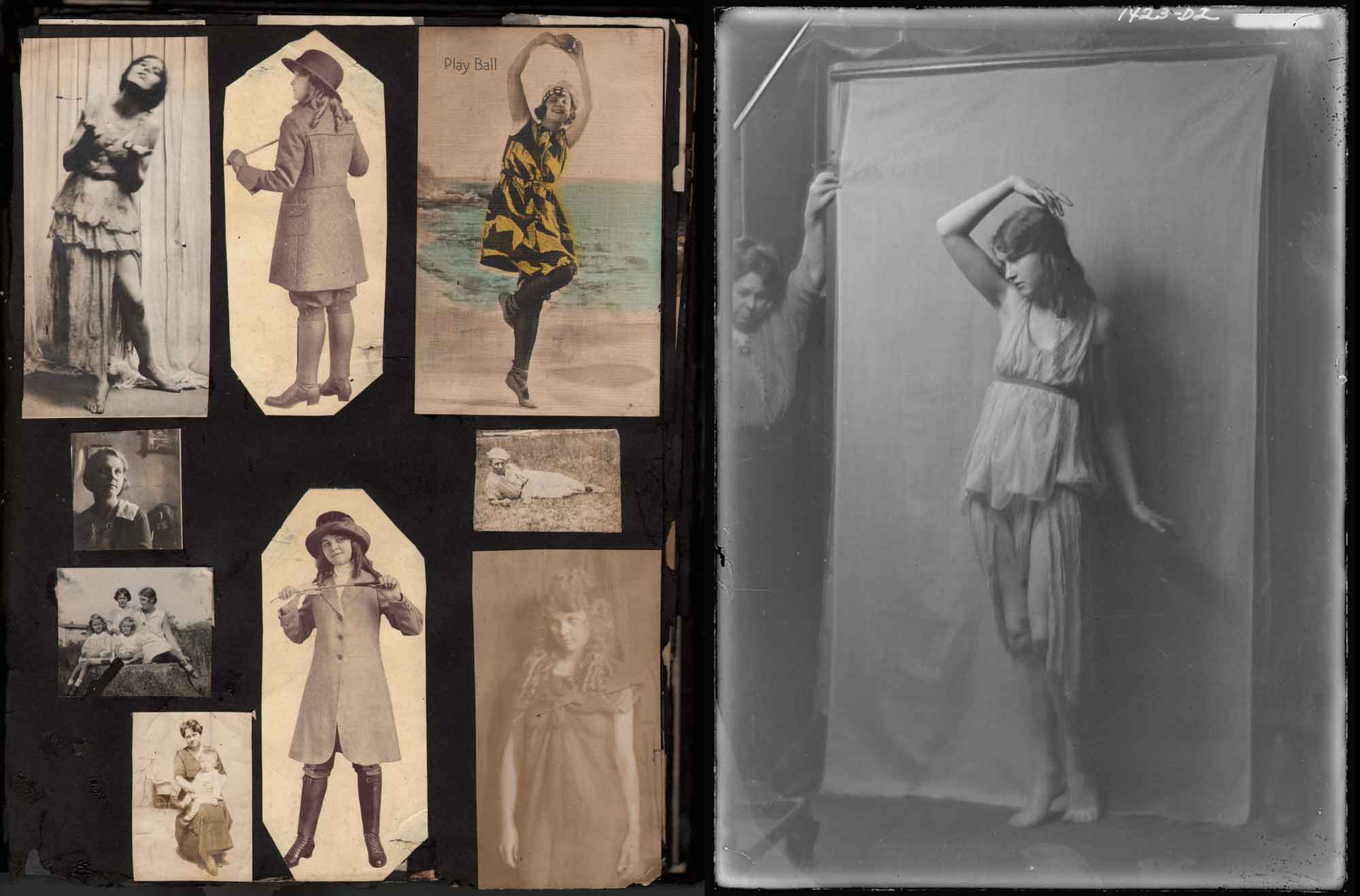
L: Album Leaf, Marcellus Family Album, ca. 1915-25, various photographers, featuring gelatin silver, halftone reproductions and hand-colored photographic post card, 30.8 x 23.4 cm. The larger photographs feature Irene Marcellus and perhaps her younger sister Violette, and portrait of Irene at lower right, possibly by Arnold Genthe. R: Irene or Violet Marcellus Posing, 1918, Arnold Genthe, American, born Germany 1869-1942, digital file from 5 x 7 in. glass plate negative. Besides Genthe, Irene and Violette were photographed by other famous photographers including Alfred Cheney Johnston, Edward Thayer Monroe and Edwin Bower Hesser. From: Genthe photograph collection, Library of Congress, Prints and Photographs Division
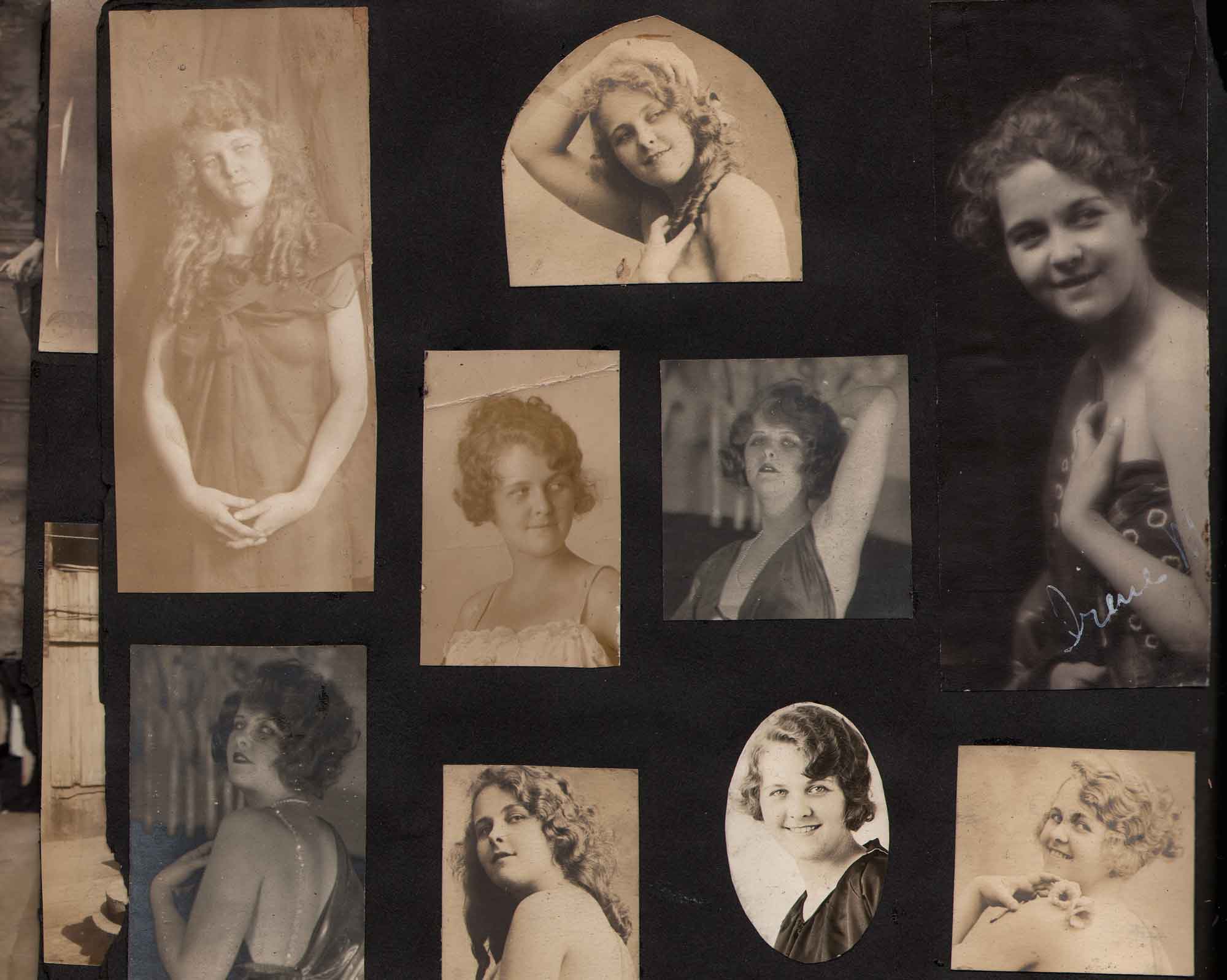
Scrap Album Leaf Featuring Irene Marcellus, ca. 1915-20, detail: various gelatin silver photographs by unknown photographers, black paper album leaf, 30.8 x 23.4 cm. Born around 1900, Irene was profiled in a 1916, Daily Standard Union, Brooklyn, N.Y. newspaper article: “Irene Marcellus won her first recognition in a painting of a slumbering child. Her mother was a model of more than ordinary ability and took Irene with her when she herself posed. She induced her baby daughter to feign sleep and the irresistible curly head and chubby arms won her immediate recognition.” Photo at upper left may be by Arnold Genthe. She has signed photo at upper right: Irene. From: PhotoSeed Archive
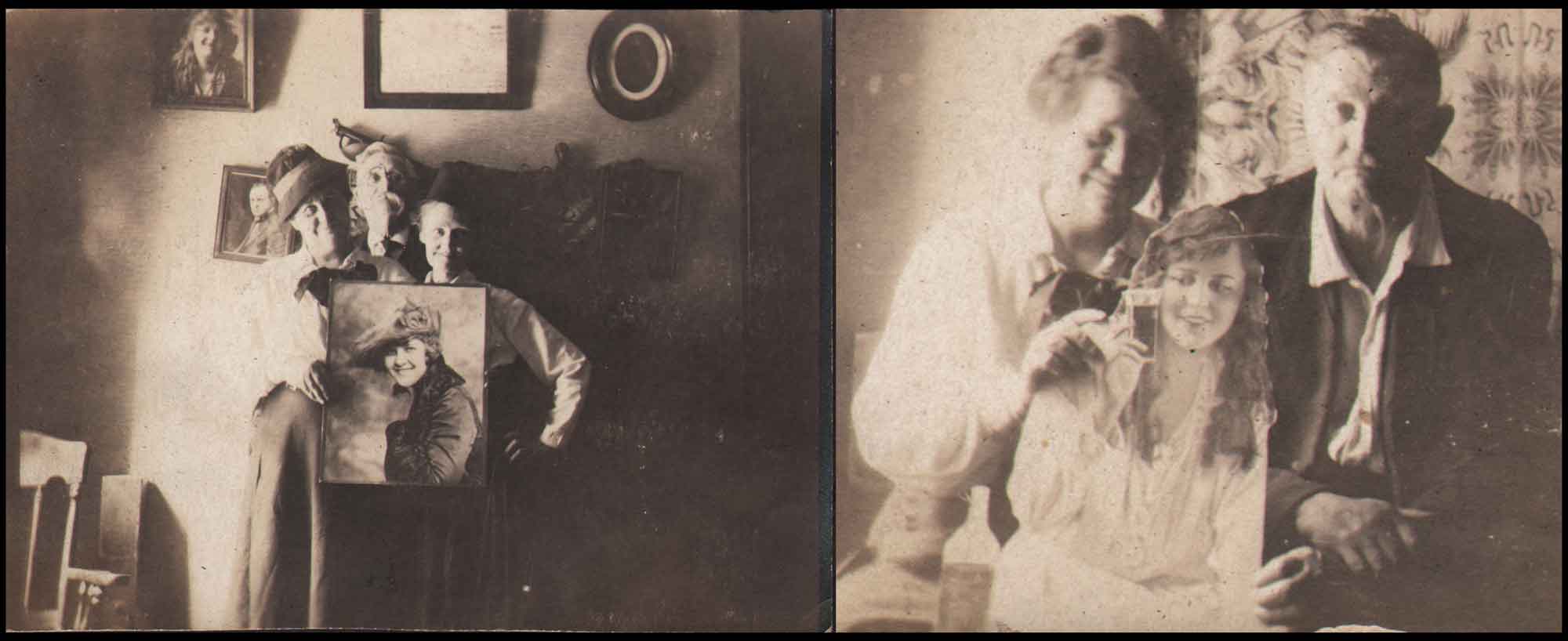
L: Proud Mother Marcellus, ca. 1920, gelatin silver print, 7.7 x 10.2 cm on album page 30.8 x 23.4 cm. Wearing her own hat in a humorous show of solidarity, Lena May Brown (Marcellus), holds a framed photograph believed to show daughter Irene Marcellus wearing a more elegant chapeau. The others are likely family members, perhaps her sister at right and husband. R: On another album leaf, a similar candid photo, 7.6 x 10.1 cm, with a proud Lena and possibly husband Isaac now showing off a cardboard display of daughter Irene Marcellus holding up a glass. From: PhotoSeed Archive
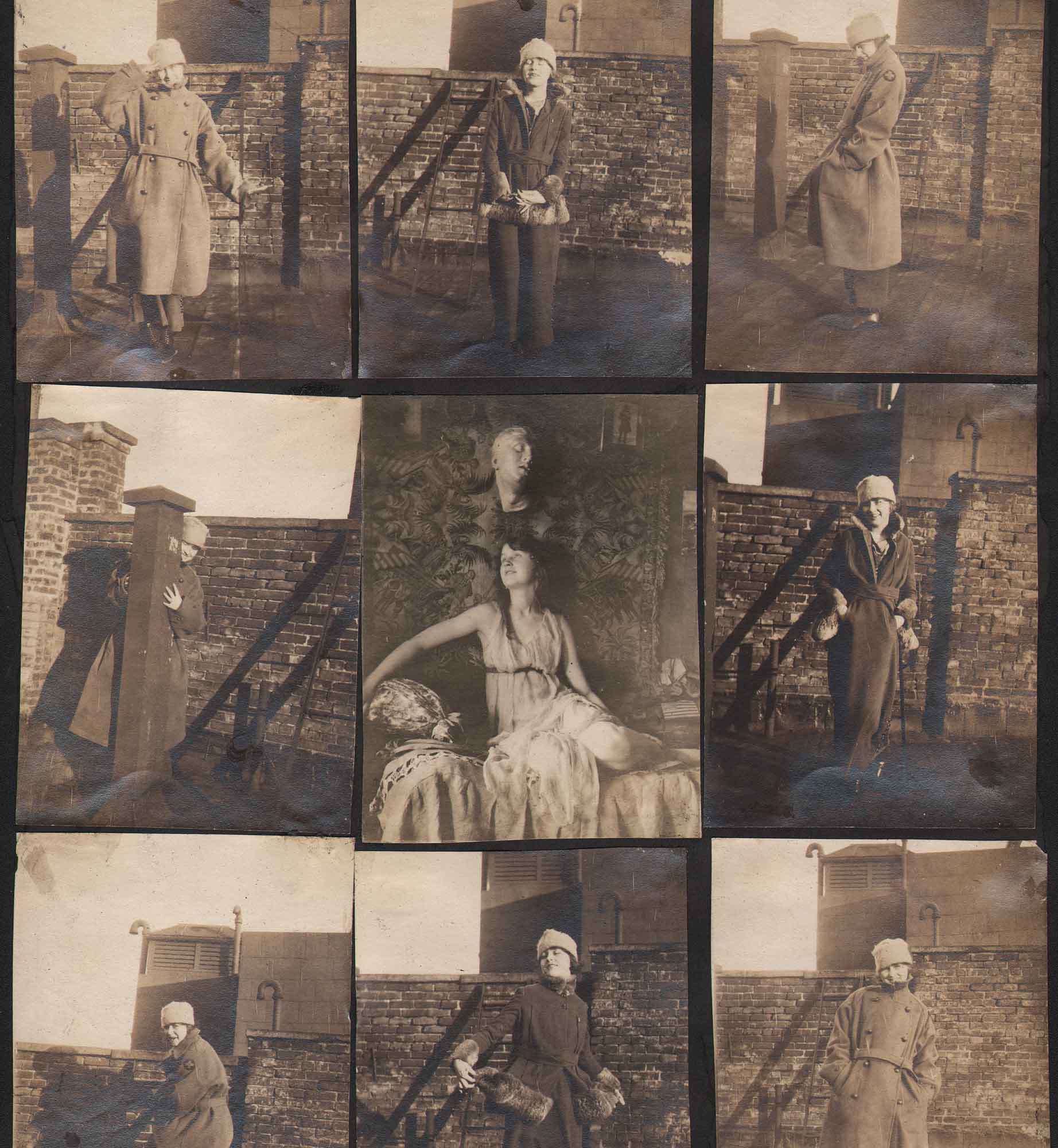
Scrap Page: Violette Marcellus Posing, ca. 1915-20, various gelatin silver prints, 10.1 x 7.6 cm by unknown photographer on leaf, 30.8 x 23.4 cm. This series of nine photographs show the artist’s model and dancer Violette Marcellus posing on a rooftop. At center, she sits before a tapestry backdrop and suspended bust. Besides being previously described in this post as Harrison Fischer’s favorite model in a 1919 article, Violette and sister Irene were members of the Helen Moller Dancers taking part in Miss 1917, a short-lived Broadway musical revue known today as George Gershwin’s introduction to musical theatre. From: PhotoSeed Archive
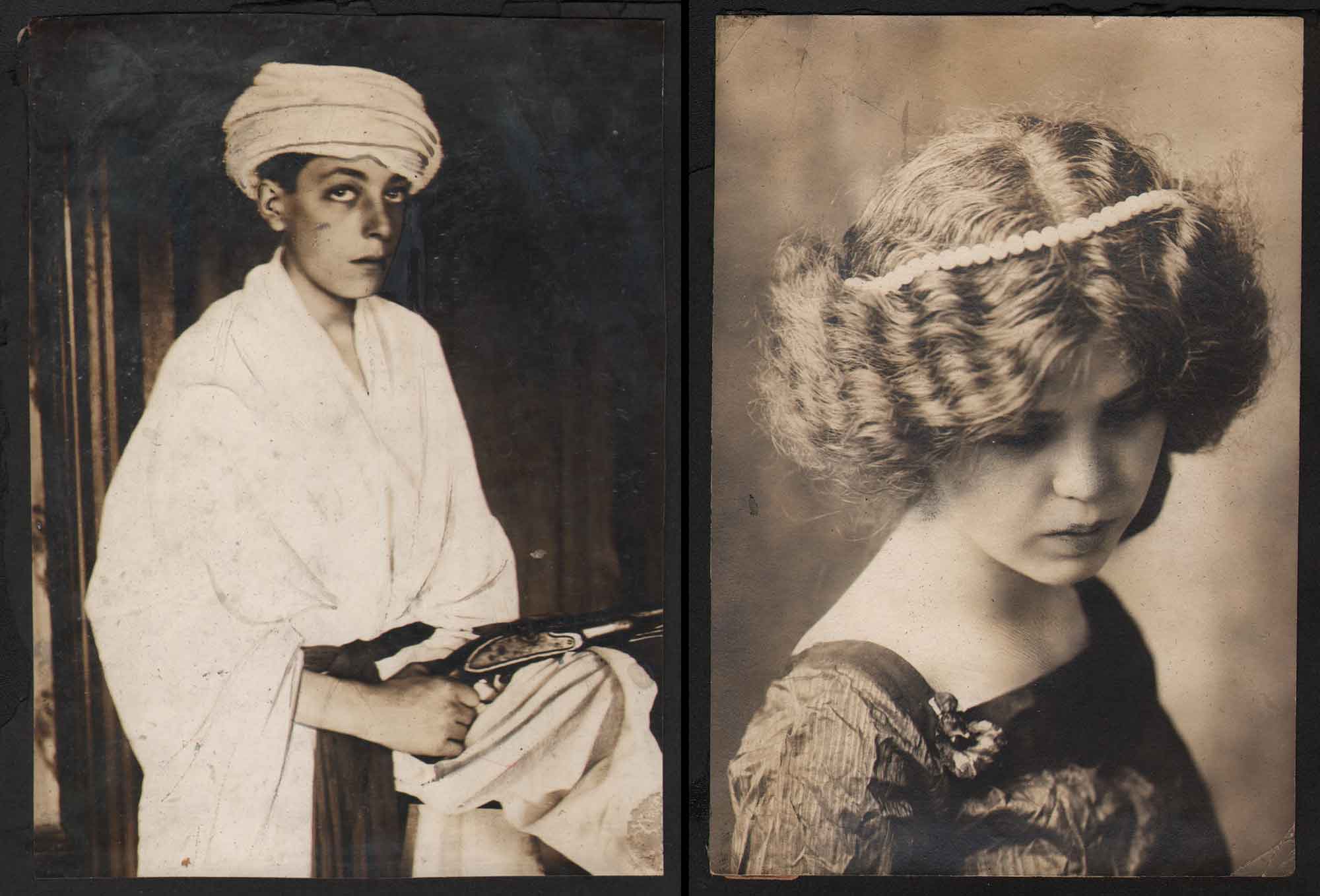
Young Models All, L: Victor Marcellus Posing in Turban with Pistol, 1915 or before, gelatin silver print by unknown N.Y. World photographer, 14.0 x 10.4 | 30.8 x 23.4 cm. The second born of the Marcellus family siblings, Victor H. Marcellus, 1898-1968, was also a child model who went on to serve in the U.S. Navy. The verso of this photo, which may have been used as part of a story by the World on the Marcellus “Most model” family, includes first publication notice in 1915: Victor Marcellus: 1st pub mag(azine) Nov 7/15. R: Virgillia Marcellus Artistic Study, ca. 1905-10, unknown American? photographer, gelatin silver print,14.5 x 9.9 | 30.8 x 23.4 cm. Known as Virgie to her sister Irene, Virginia “Virgillia” Marcellus, 1893-after 1962, was the first born Marcellus sibling. She was an artist’s model from a young age and became an interpretive dancer by 1919, the year she married Arthur Everard Laing, 1897-1980, a writer. They later had two children, Bruce and Leone. In the 1930 U.S. Census she was living with her parents in Queens, N.Y. with artist as listed occupation. By 1962, “Mrs. Laing” is mentioned as children’s librarian at the Chester, CT public library. From: PhotoSeed Archive
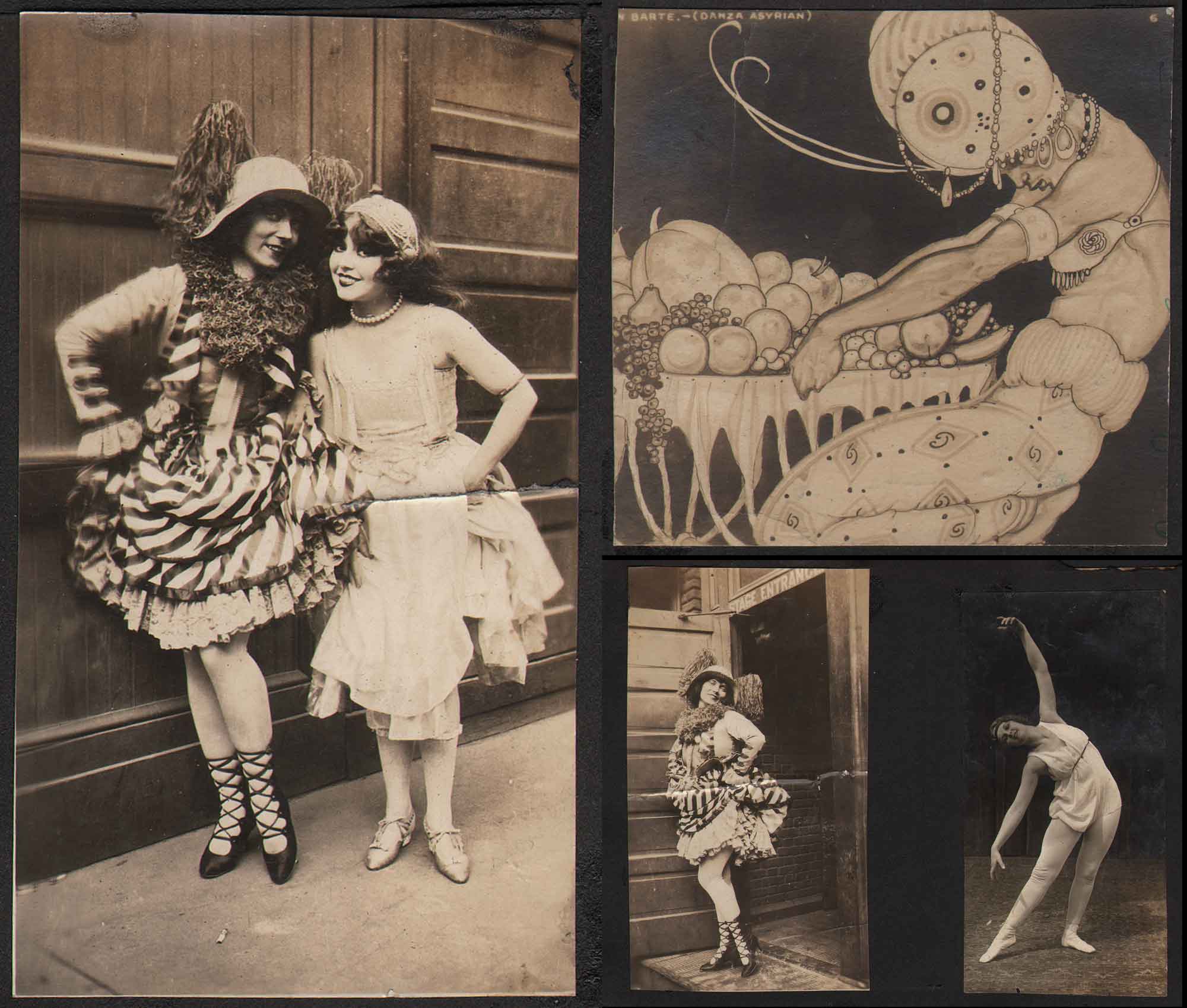
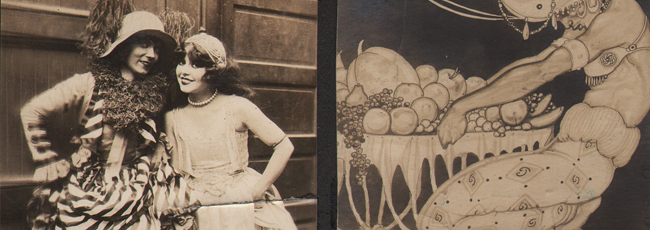
All About Dance, L: An unidentified dancer at left strikes a pose next to a fellow performer believed to be Irene Marcellus. Playbill identifies Irene as having been a performer for the Greenwich Village Follies of 1919, the Ziegfeld Midnight Frolic of 1920 and the Ziegfeld Follies of 1921 and 1922. Gelatin silver print from this period by unknown photographer, 10.3 x 6.0 cm. R: This illustration by an unknown artist of an Assyrian Dancer (…Barte.-(Danza Asyrian, 6.) postmarked Nov. 1919 was made into a rppc and mailed to Irene Marcellus when she was living in Greenwich Village. It may have had something to do with her run that year as part of the Follies. 8.0 x 8.3 cm. LR: Now standing outside a stage door, this is the same performer seen at far left. (10.3 x 5.9 cm) At right, a young woman believed to be Irene Marcellus exercises in a print dated 1917 on verso with notation in graphite Physical Culture—perhaps a dance class promoted and rebranded by the New York City Department of Education as Physical Education. (9.8 x 5.0 cm) From: PhotoSeed Archive
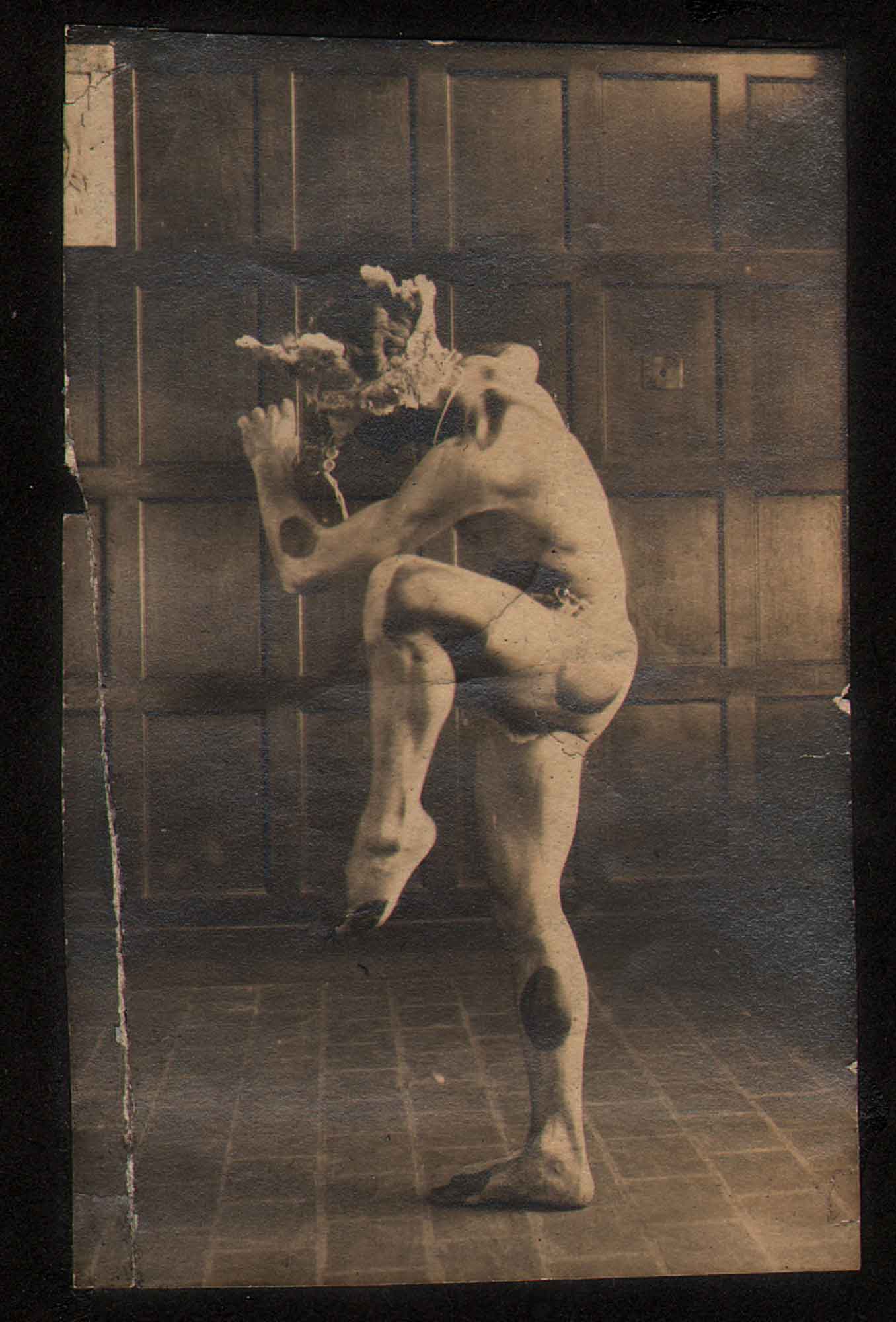
Nijinsky? This gelatin silver snapshot (8.7 x 5.5 cm) of a performer balancing on one foot is thought to be Russian Ballet dancer and choreographer Vaslav Nijinsky. (1889-1950) The image, notated in graphite on the verso: West 46ST. New York City | Cookie (sp?) was glued into the Marcellus album next to the Assyrian Dancer illustration seen with this post. The US premiere of the Ballets Russes production of the L’après-midi d’un faune, (Afternoon of a Faun) ballet, which took place at the Century Theatre in New York City on January 17, 1916, originally had Léonide Massine in the role of faun. He was replaced by Nijinsky by early April, leading the Ballet Russe in “A Tour of America” from Oct. 1916 to Feb. 1917. Nijinsky’s ground-breaking role as the faun was made famous in a series of photographs taken in 1912 by Adolph de Meyer and published in a limited edition collotype folio in Paris in 1914. A potential clue as to why this photograph appears in the Marcellus album may be the result of the intersection of Irene Marcellus and sister Violet with American ballet dancer and choreographer Adolf Bolm, then dancing with the Ballet Russe. In 1917, Bolm, working with Nijinsky as part of the second part of a two-part American tour, injured himself and had to recuperate in the US, where he stayed and later choreographed for the New York Metropolitan Opera. As reported in the NY Times on Oct. 15, 1917 under Theatrical Notes: “The Misses Irene and Violet Marcellus of the Moller Dancers have been engaged for the ballet which Adolf Bolm is staging In the Century revue. “Miss 1917.” From: PhotoSeed Archive
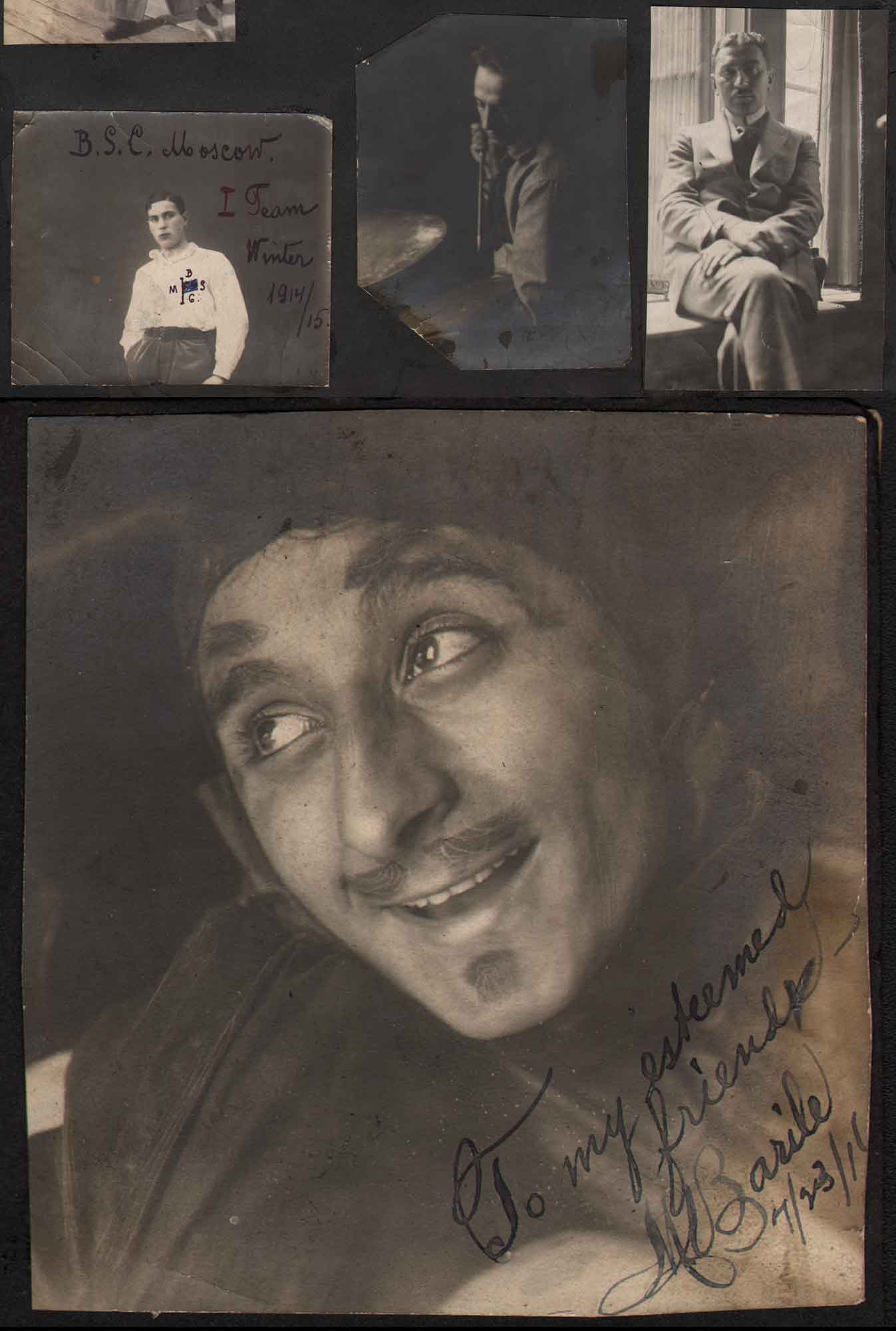
Random Album Snaps by Unknown Photogs, Top L: ca. 1915? gelatine print, 6.8 x 8.0 cm, Man with striking resemblance to Russian Ballet dancer Vaslav Nijinsky, with inscription: “B.S.C. Moscow, I Team, Winter 1914/15. (“M.B.S.C.” hand-drawn as shirt emblem may refer to British or Moscow Sports Club active before First World War.) Top Middle: Unknown man holding handle—perhaps of a letterpress—inscribed in graphite on verso Luigi. (8.7 x 6.7 cm) Top R: Well-dressed gentleman seated before window. (no inscriptions—9.5 x 6.0 cm) Bottom: Photograph of man with embellished face makeup signed: To my esteemed friends— —Barile 7/23/16. Difficult to identify, but one possibility may be Xavier J. Barile, 1891-1981, an American painter, graphic artist, illustrator and art teacher born in Italy who opened his own art school in New York City in 1919. (8.6 x 8.0 cm) From: PhotoSeed Archive
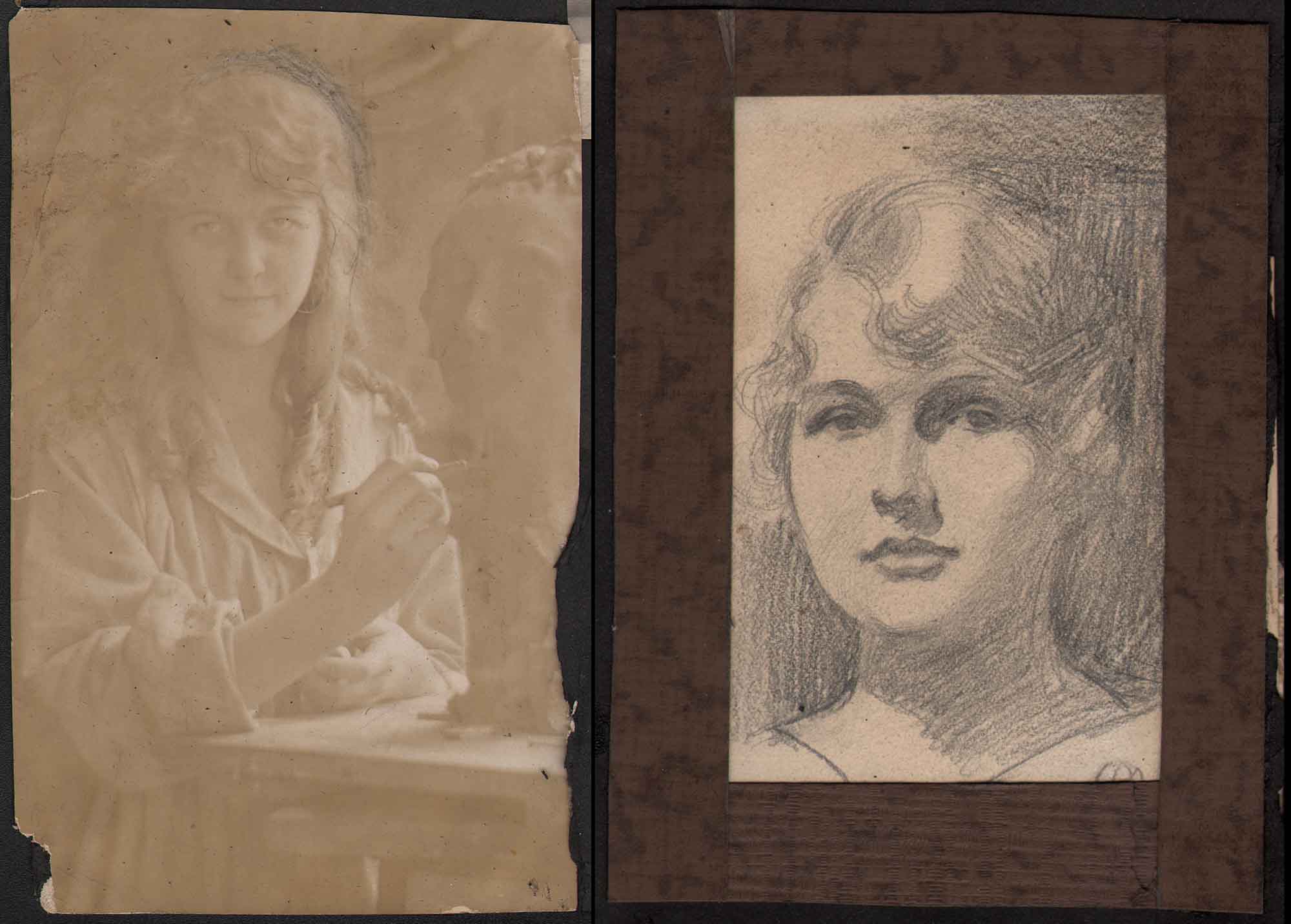
Artist & Subject, L: Irene Marcellus shown sculpting a clay bust, ca. 1915-20. Unknown American? photographer, gelatin silver print, 13.5 x 8.4 cm. From a 1916, Daily Standard Union, Brooklyn, N.Y. newspaper article on Irene: “While posing for a picture that required her to keep her arms outstretched she played with a bit of clay to keep her mind occupied. With one hand she had modeled a tiny figure of Venus that was so well proportioned and exhibited so great an originality that she was encouraged to continue her work. She took some clay home and making herself some tools of wire hair pins and penholders, continued to model. …Artists and painters who have seen her work declare that she is unquestionably one of America’s rising sculptors.” R: Portrait of Irene Marcellus, 1918, with monogram in lower right corner obscured by brown paper frame dated 18. Possibly done by a family member—Virgillia? as monogram incorporates stylized M—this graphite on paper portrait with overall dimensions 13.9 x 10.2 cm is pasted next to a photograph of Virgillia in album. From: PhotoSeed Archive
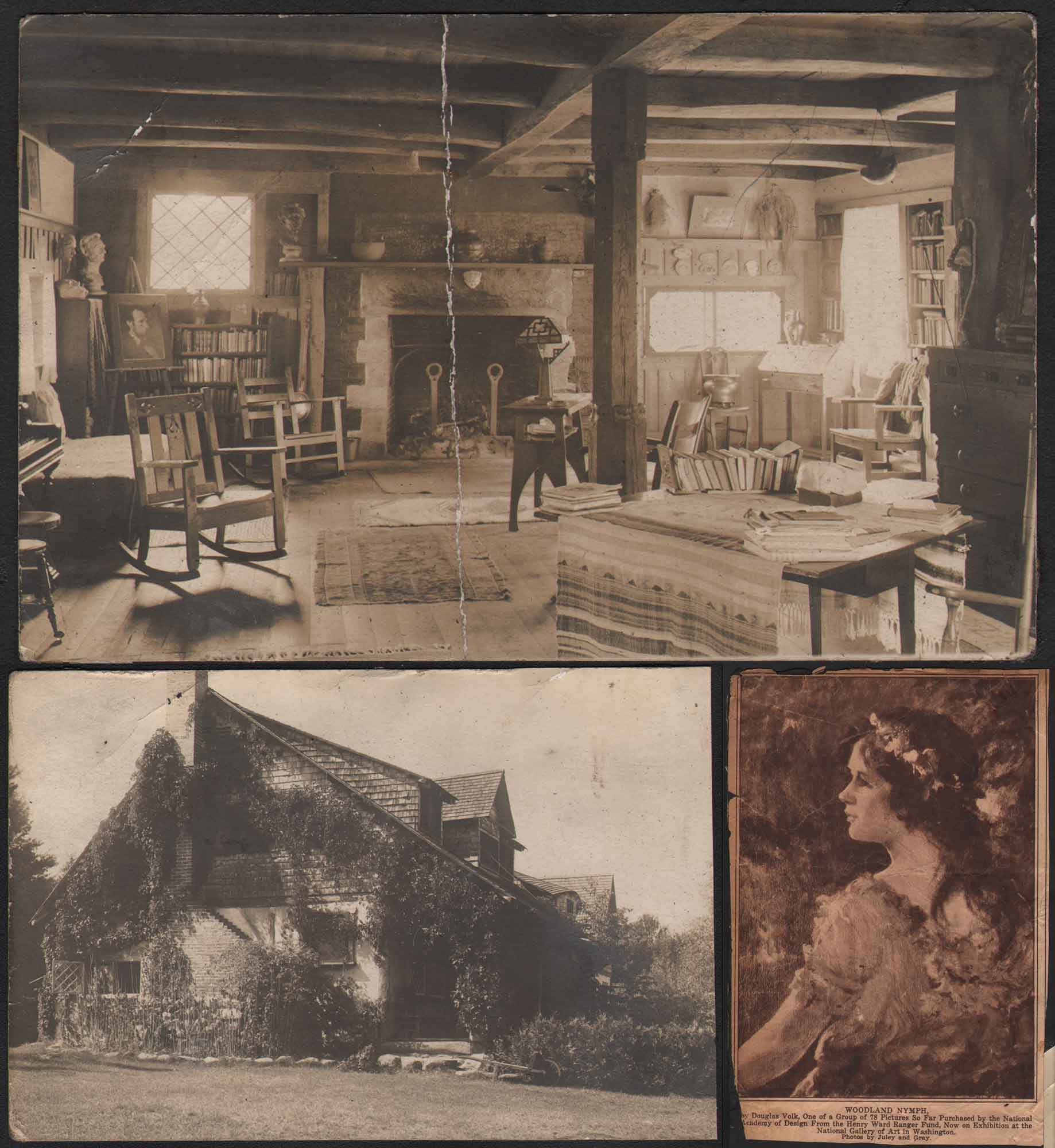
Top: Rambling Timbers Living Room at Hewnoaks, ca. 1915-18, gelatin silver rppc, 8.7 x 13.7 cm. Aspiring artist Irene Marcellus furthered her artistic education by spending a summer at Hewnoaks, the artists retreat in Lovell, Maine owned by American artists Douglas Volk and wife Marion Larrabee Volk. Rambling Timbers began as a 19th-century farmhouse before the Volks “transformed it into a Tudor Revival-style summer home in 1901.” Still used as an artist’s retreat in the present day, “Rambling Timbers features a large, airy living room with a working fireplace (seen here) that is favored by residents as an informal gathering place and is often used for events and other receptions.” Notice the busts of Abraham Lincoln by Volk at left background and Lincoln’s death mask perched atop a shelf nearby. The framed oil portrait by Volk of Abraham Lincoln displayed on an easel in the photo was painted in 1908 and reworked in 1917 before being sold as part of the WWI relief effort to Thomas B. Clarke on Feb. 2, 1918. Now in the collection of the National Gallery of Art, this view was most likely taken before that sale. Bottom Left: Rambling Timbers Exterior at Hewnoaks, ca. 1915-18, gelatin silver divided-back AZO rppc, 8.7 x 13.0 cm. This postcard was sent to Virgillia Marcellus, then living in the Bronx, by her sister Irene, who wrote: “Dear Virgie, This is our home this summer. Best wishes to all. Irene“. The Volks renovations to Hewnoaks “introduced latticed windows, hewn wooden lintels, and a stucco exterior. Somewhere between 1904 and 1912, they added the dining room and kitchen wings. By 1904, Swedish-born woodcarver Karl Von Rydingsvard had added intricate Arts and Crafts-style carvings of natural motifs to the exterior.” Bottom Right: Now held by the Smithsonian in Washington, D.C., the oil on canvas work Woodland Nymph was painted by Douglas Volk around 1904. This Sunday rotogravure reproduction clipping was pasted in the Marcellus scrapbook, perhaps giving a clue that a Marcellus family member— Virgillia?— posed for the work. From: PhotoSeed Archive
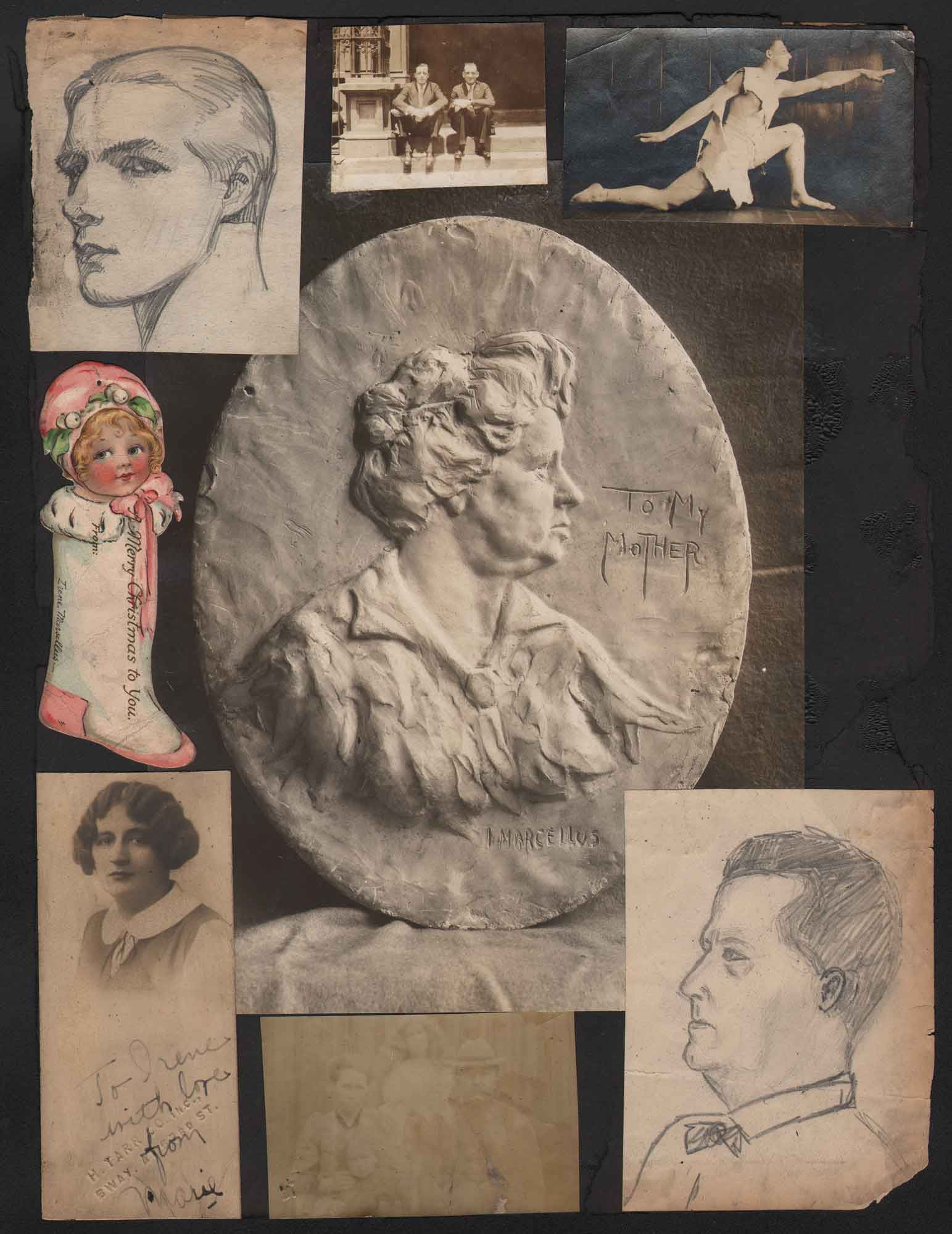
Sculpture and Sketches, ca. 1915-25, various gelatin silver prints, graphite on paper sketches and commercially-printed lithographic reproduction on album page, 32.0 x 25.5. Dominating the central focus of one scrapbook leaf is this photograph taken of a plaster medallion plaque of the mother of daughter-artist Irene Marcellus signed and dedicated to her. (Lena M. Brown, (born E. Hampton, CT ca. 1867) Two other paper sketches in opposite corners are by an unknown artist; the photo at bottom middle is believed to show Irene with big sister Virgillia and her parents; the performer at top right rehearses in the same space as the Nijinsky photograph in this post; the lithographic stocking cutout “Merry Christmas to You” is surely a bit of a joke, as it was drawn by someone with a similar name: Irene Marsellus. See another example of Irene’s sculpture: “War“, executed in 1915—part of a sculpture competition on the same theme held by the Friends of Young Artists that year in New York City. Digital copy by Bain News Service of glass plate negative now held at the Library of Congress. From: PhotoSeed Archive
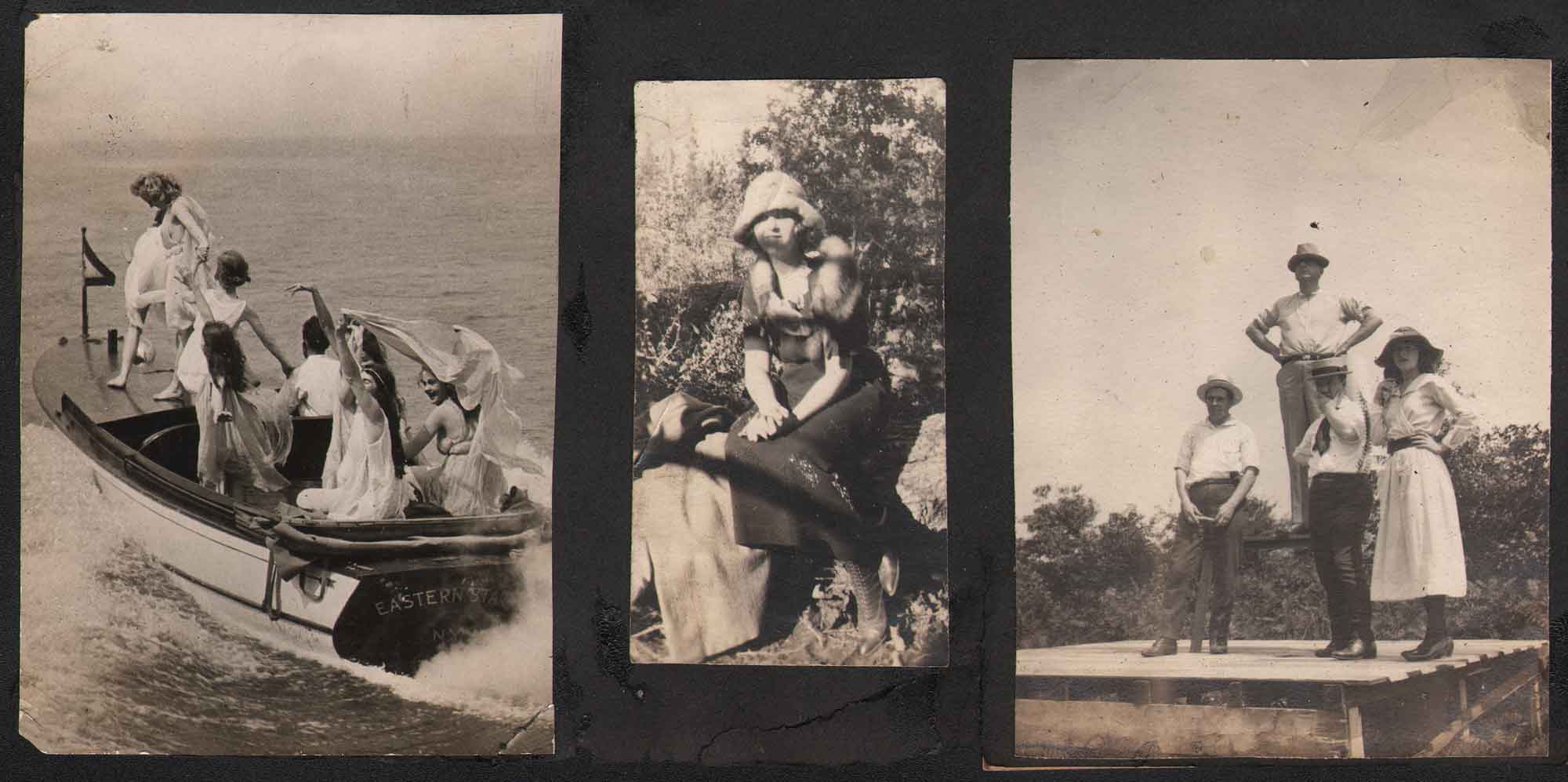
Going for a Ride & Lost Silent Film Set, L: 1916, gelatin silver print, Francis Herbert Kellar, American, 1888-1934, 10.7 x 7.8 cm. Performers believed to be members of the Helen Moller Dancers, of which Irene and Violette Marcellus were members, go for a ride aboard the Eastern Star, a runabout. She won the time prize in the New York-Albany race according to the August, 1914 issue of Power Boating magazine. In her 1918 book Dancing with Helen Moller, Moller’s philosophy of dance stresses: “dancing is Greek plus American adaptability and creativeness.” M: 1921: Irene Marcellus on the now lost 1921 silent film set for Bob Hampton of Placer, set at Glacier Park in Montana. She is not listed in the film credits and probably appeared in background scenes. Gelatin silver print, unknown photographer, 8.5 x 4.5 cm. R: Irene Marcellus stands at right on a platform with others, most likely on the Bob Hampton of Placer film set in Montana. Ca. 1921, gelatin silver print, unknown photographer, 10.1 x 7.9 cm. From: PhotoSeed Archive
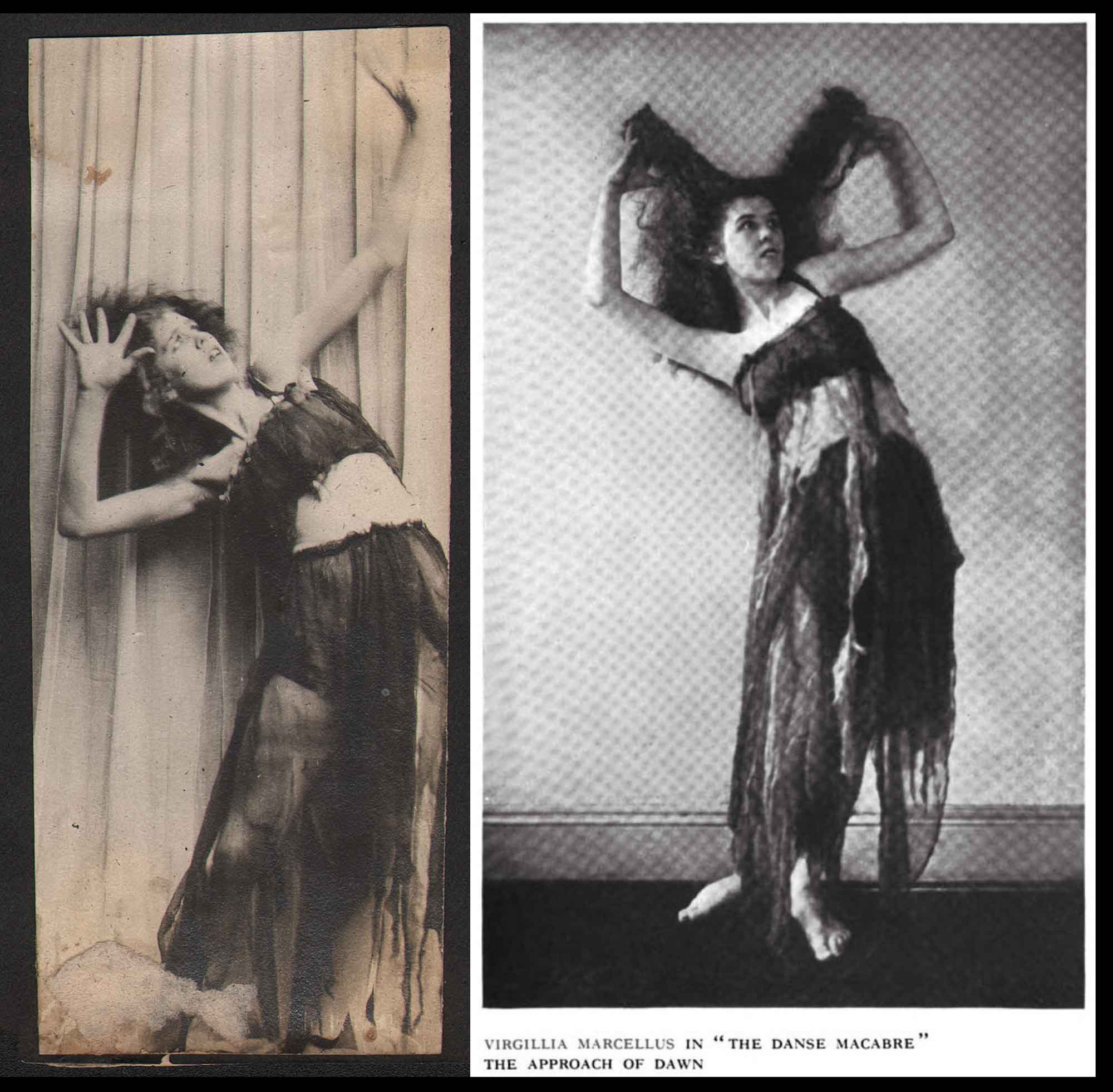
Virgillia Marcellus: Interpretive Dancer, L: Virgillia Marcellus Dancing, 1919, unknown American? photographer, gelatin silver print, 12.2 x 4.9 cm. From: PhotoSeed Archive. R: Virgillia Marcellus In “The Danse Macabre” The Approach of Dawn, halftone plate, The Lotus Magazine, April, 1919. This photograph accompanied the article “Individualism in the Dance” written by American author Arthur Everard Laing, 1897-1980, Virgillia’s husband. He wrote: “Miss Marcellus states that her interpretations are purely instinctive almost impulsive and that practically no study is devoted to the aesthetic effect She has said that no two interpretations of same theme are alike in detail.” (p. 193) The first photo is believed to be an outtake from the same photo session. Marcellus danced at least until 1926, with a review that year in The Billboard on April 10 exclaiming: “The Valkyrie, a short, swift dance with music by Richard Wagner, is next. Virgillia Marcellus is the dancer, and she displays talents worthy of more important work.” (Credit: web)
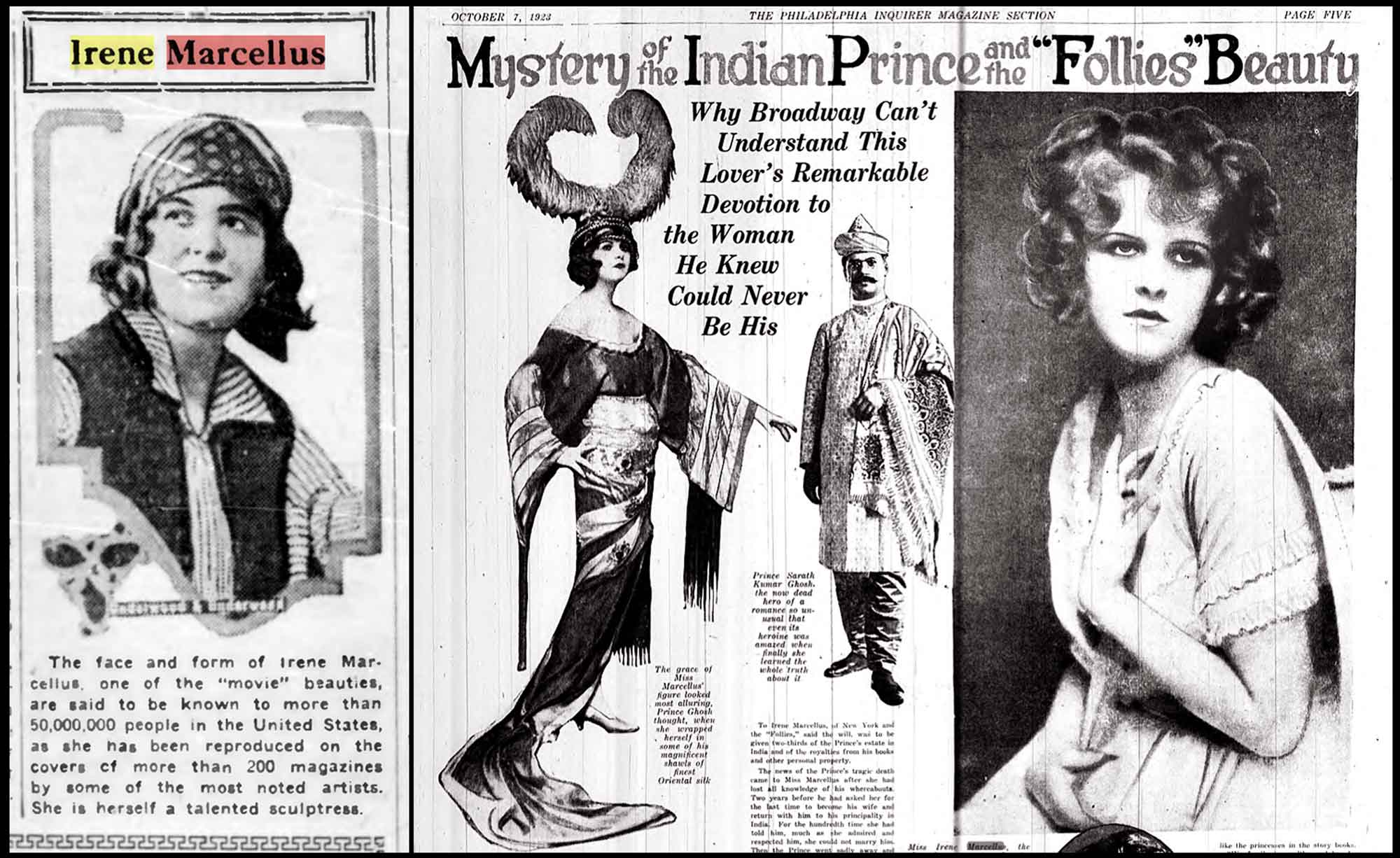
Irene in the News, L: In 1921, this photo of Irene Marcellus and publicists copy appeared in newspapers around the US: “The face and form of Irene Marcellus, one of the “movie” beauties, are said to be known to more than 50,000,000 people in the United States, as she has been reproduced on the covers of more than 200 magazines by some of the most noted artists. She is herself a talented sculptress.” (The Evening Gazette, Port Jervis, N.Y. Jan. 29, 1921) R: Mystery of the Indian Prince and the “Follies” Beauty was the headline for this full-page article in The Philadelphia Inquirer Magazine Section on Oct. 7, 1923 profile on Irene. Hindu author “Prince” Sarath Kumar Ghosh had left his estate, worth less than $5,000 to her and sister Violet and one other beneficiary when he died in 1920. The “Prince”, according to another breathless 1923 article in the Buffalo Sunday Courier had declared Irene: “Possessed a “Flawless, Flower – Like Beauty.” “He met her when she was 15, and was playing host at Lavish Parties in His Gramercy Park Apartments.” The large photograph at right in the Inquirer article was by American photographer Edward Thayer Monroe, 1890-1974. (Credit for both: Web)
By May, 1925, The New York Times reported terms of this will when it was officially filed for probate, the language contained within suggesting the sisters “abandon their present work of posing as artist’s models in the nude and use their respective legacies to fit themselves to earn their livelihood in other manner.”
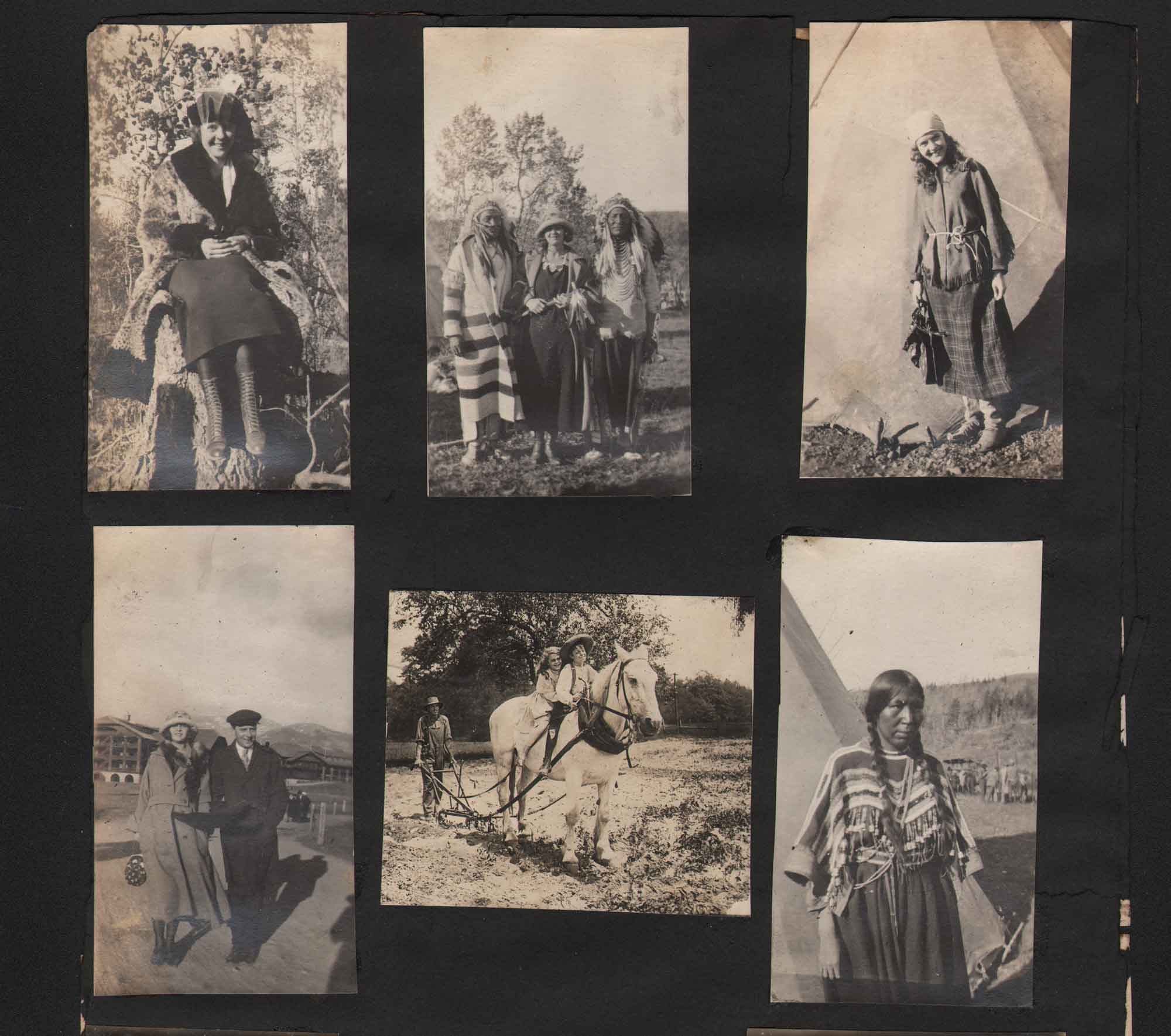
Filming Out West, gelatin silver prints, ca. 1920-21 on album leaf 30.8 x 23.4 cm. For at least several years beginning in late 1920, Irene Marcellus was under contract with Hollywood film director Marshall Neilan. Four of these six photos were taken on the set for the now lost Neilan 1921 silent film Bob Hampton of Placer, set at Glacier Park in Montana. Members of the Blackfeet Tribe were used as substitutes for Sioux in the film—a lead-up to the Battle of the Little Big Horn. UL: Irene sitting on a stump wearing a fur coat, 10.5 x 5.9 cm. UM: Irene holds ceremonial pipe between two Blackfeet Tribe members, 10.5 x 6.0 cm. UR: Actress Marjorie Daw grins for the camera with a tipi behind her, 1920, 10.2 x 5.9 cm. LL: Irene with unknown person—with what appears to be a hotel complex (Glacier Bay?) behind them, 10.5 x 5.9 cm. LM: Unknown: perhaps from another film? Two children on a white horse pulling a plow, 7.1 x 8.2 cm. LR: Blackfeet woman in front of tipi, 10.4 x 5.9 cm. The roles played by Marcellus in Neilan productions are uncredited. She did appear in a Christmas promotional photograph in December, 1920 with Wesley Barry, who played Dick in Bob Hampton of Placer. The press reported Irene’s first film would be The Lotus Eater, a 1921 film starring John Barrymore with Colleen Moore. In an Oct. 1920 issue of The New York Star, an article on how Marcellus was recruited by Neilan was described in How Picture Stars Are Made Over Night: …Mr. Neilan, who has acquired the title of ‘The Columbus of the Movies’ as a result of the many persons he has brought out as stars, while attending a roof show in Manhattan spied Irene Marcellus in a group of beauties behind the footlights. “In five minutes Mr. Neilan was behind the scenes being introduced to Miss Marcellus, Do you want to be a star in motion pictures? asked Mr. Neilan. I would be most delighted, replies Miss Marcellus. “What salary do you want,” asked the producer.”The amount was named and he voluntarily doubled it. From his pocket he drew an old envelope, wrote the terms on the back, obtained the signatures of Miss Marcellus, the stage manager as witness, and then signed his own name. In just about the time it takes to tell the deal was closed. …From musical comedy beauty to star of the twinkling cinema is a big leap, but the judgment of Marshall Neilan has never failed, as evidenced in the cases of such present day favorites as Wesley “Freckles” Barry, Marjorie Day, Colleen Moore and others.” From: PhotoSeed Archive
Follies indeed. Facts are few after this period, although Irene is known to have furthered her artistic education—thanks to a photographic postcard in the album sent to Virginia (whom she called Virgie) —by spending a summer presumably studying with American artists Douglas Volk and wife Marion Larrabee Volk at Hewnoaks, their artists retreat in Lovell, Maine. Windfall or not, Irene later married and had two children by 1930. She died a widow in 1959, with Violet, (born Violette) also raising children and living a further twenty years.
The Marcellus sisters had a male sibling, Victor H. Marcellus, 1898-1968, who also modeled. Several album photos show a little boy wearing an oversized hat while beating on a snare drum as well as holding a toy rifle that is most likely him, and a later photo showing him holding a pistol, taken by a N.Y. World photographer and dated 1915. He ended up in the Navy later, serving on the U.S.S. New Jersey, his name pasted on a piece of scrap paper next to ship-side views in the album.
As it happens, another photograph bearing the verso stamp of the World newspaper pasted towards the end of the album is perhaps most significant. The “Model” family (at) home, written in ink, describes a photograph showing a mother and three daughters as well as Victor Marcellus in their parlor, her eldest Virginia standing at an easel. In February 1921, the Norwich (CT) Bulletin wrote: “The papers have been featuring the “most model” family—Mr. and Mrs. Isaac Marcellus and their daughters. Virginia, Irene and Violette of New York, models and stage favorites.”
There are other surprises in the album, notably a small, beautifully-composed snapshot of a male dancer stretching backstage or in a rehearsal space, believed to be Russian Ballet dancer and choreographer Vaslav Nijinsky (1889-1950) He is dressed in the role for the Ballets Russes production L’après-midi d’un faune ,(Afternoon of a Faun) made famous in a series of 1912 photographs by Adolph de Meyer.
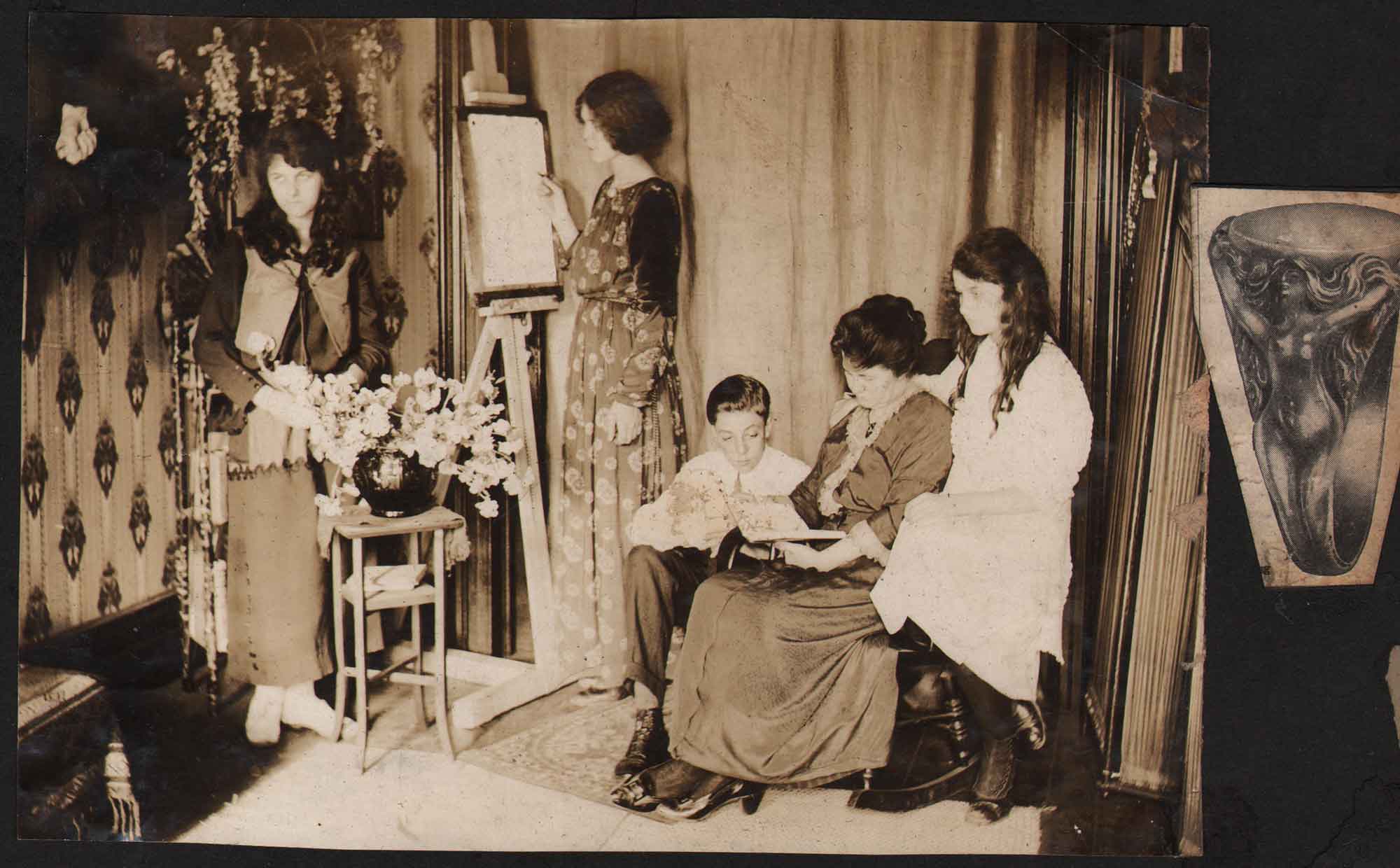
The “Model” Family at Home, ca. 1915, Gertrude A. Brugman, born Holland, 1875- , gelatin silver print, 11.8 x 17.0 cm. The Marcellus family were deemed worthy of newspaper coverage because of all family members had or were models for artists and photographers. This photograph was taken in the parlor of their Bronx home. Left to right: Irene, Virgillia at easel, Victor kneeling next to his mother Lena May (Brown) Marcellus and Violette at far right. The photo has stamps on verso for Brugman, an independent photographer (220 W. 14th St.) who was born in Holland, and the Art Dept. of the N.Y. World newspaper. An article about the family later appeared in Lena’s hometown paper, the Norwich (CT) Bulletin, in 1921: “The papers have been featuring the “most model” family—Mr. and Mrs. Isaac Marcellus and their daughters. Virginia, Irene and Violette of New York, models and stage favorites.” From: PhotoSeed Archive
Occasionally, landfill and thrift store finds like this album reveal a backstory of our shared cultural history by the family itself. A rare survivor indeed, and one worthy of preservation for the new insights it brings to the present by those who lovingly assembled it. I know I will be looking for more.
- Background: 1. Column: Women Who Lead The Way: By Marie Dille: “Irene Marcellus, the Most Famous Living Child Model”, The Daily Standard Union, Brooklyn, N.Y. Jan. 12, 1916; 2. “You’ve Seen Her Often; Know Her Name, The Ada Evening News, Ada, OK, Feb. 9, 1921.
- Ibid: “Irene Marcellus, the Most Famous Living Child Model”