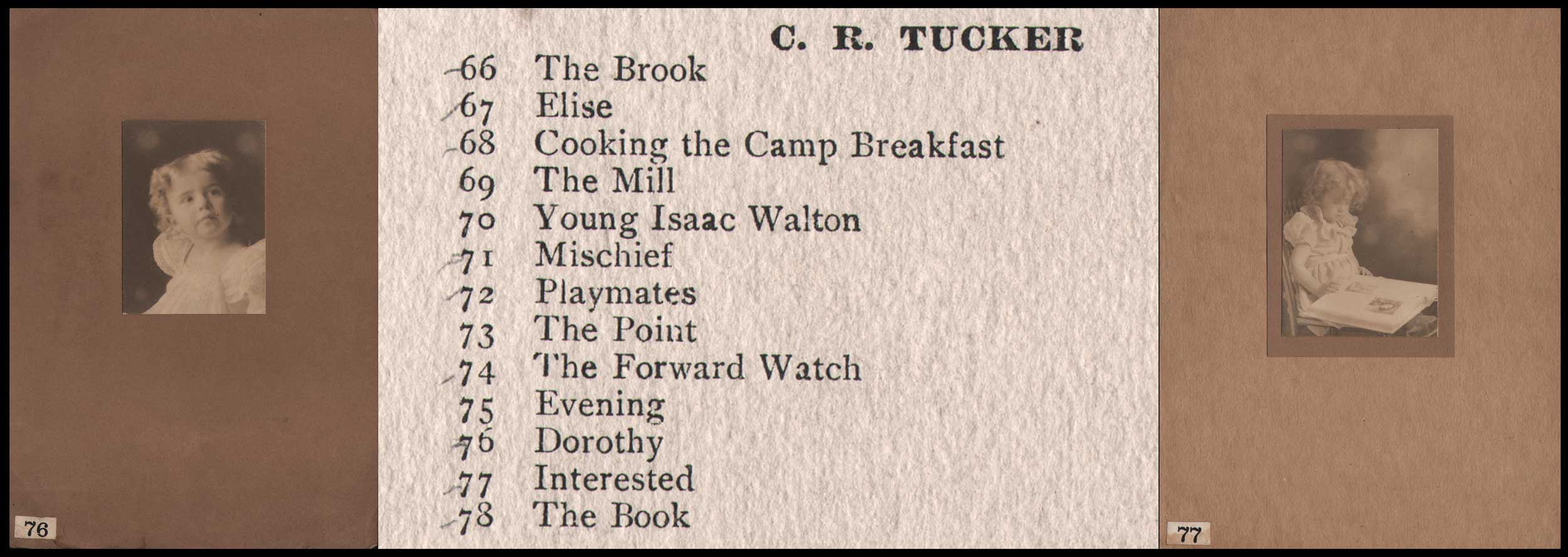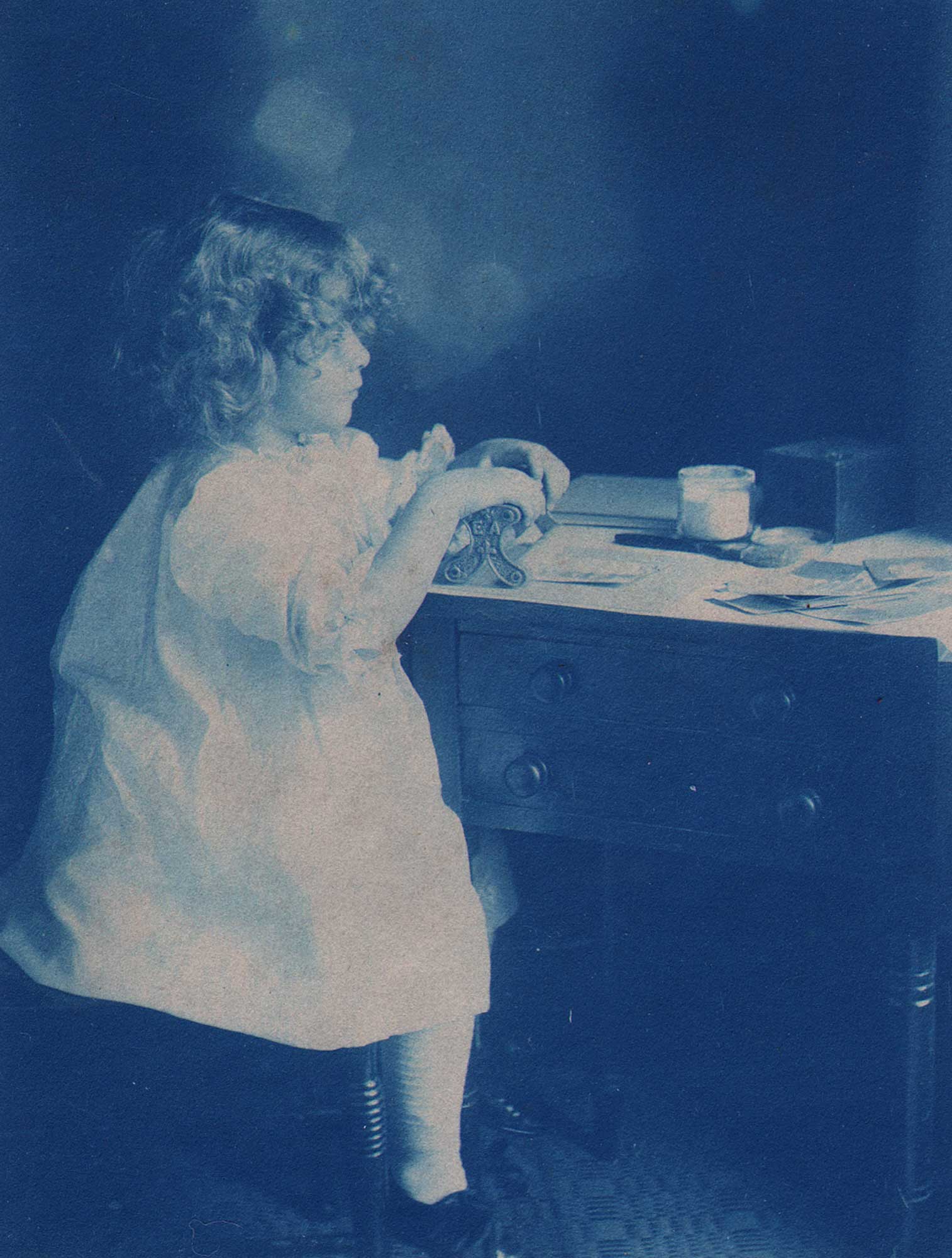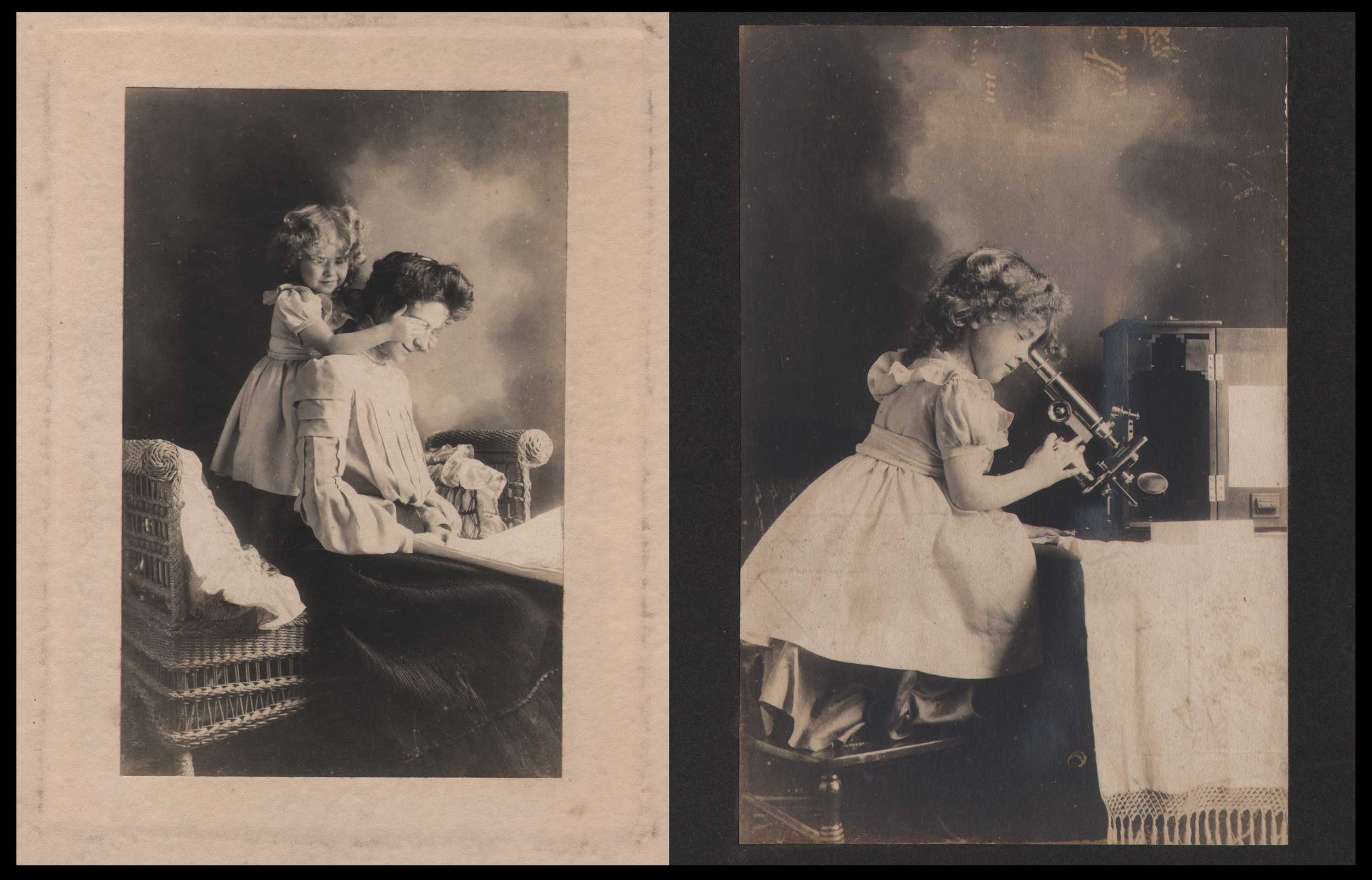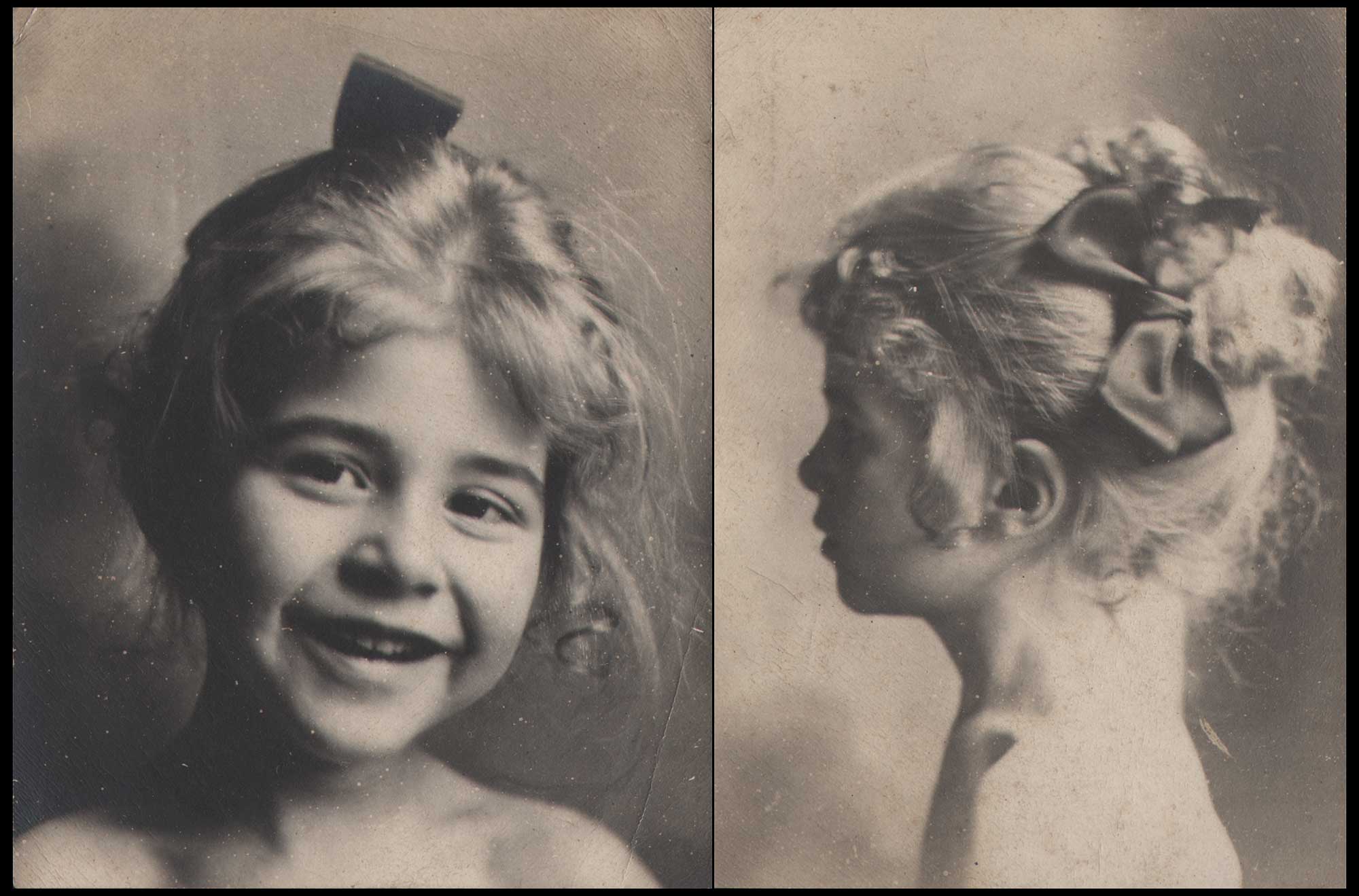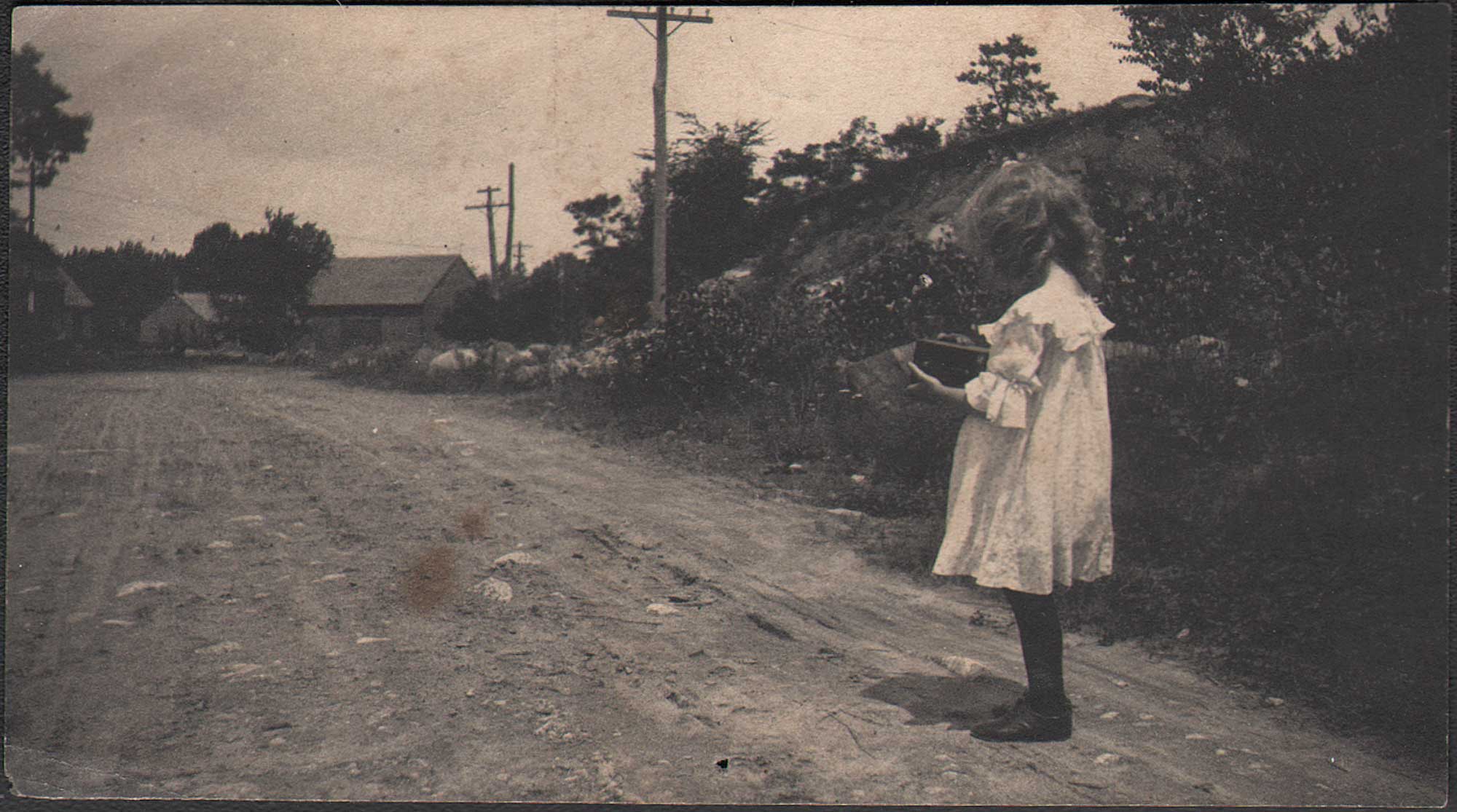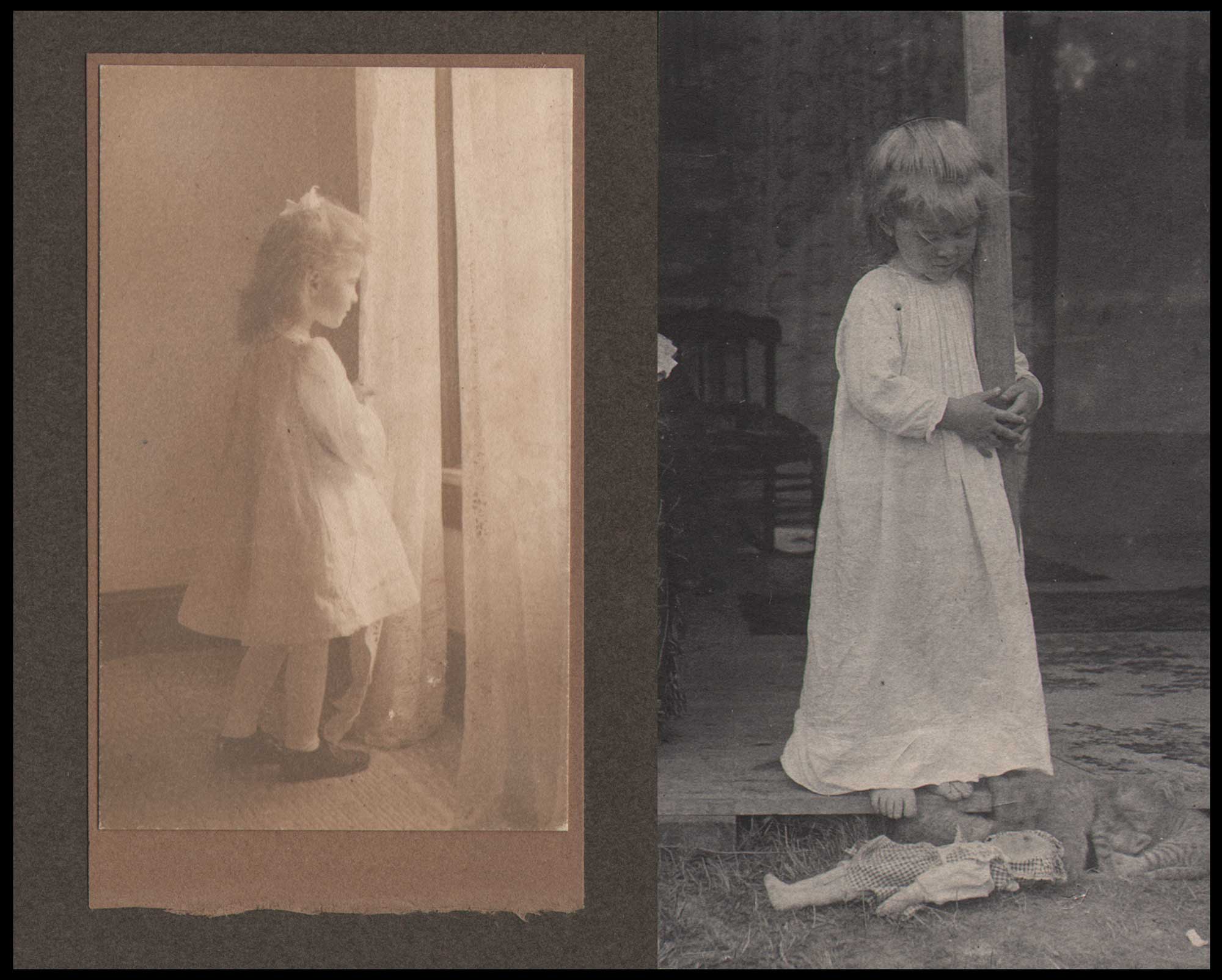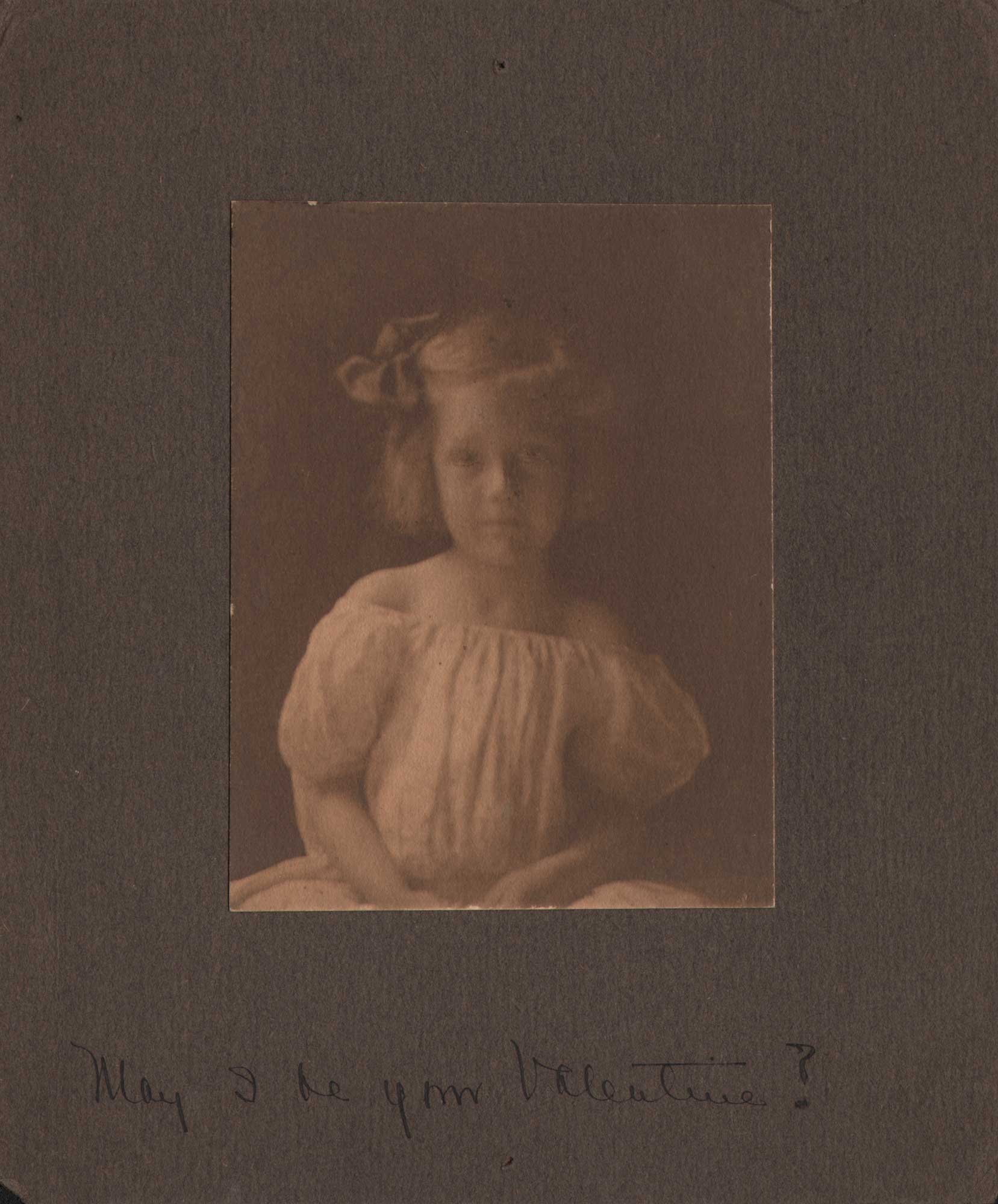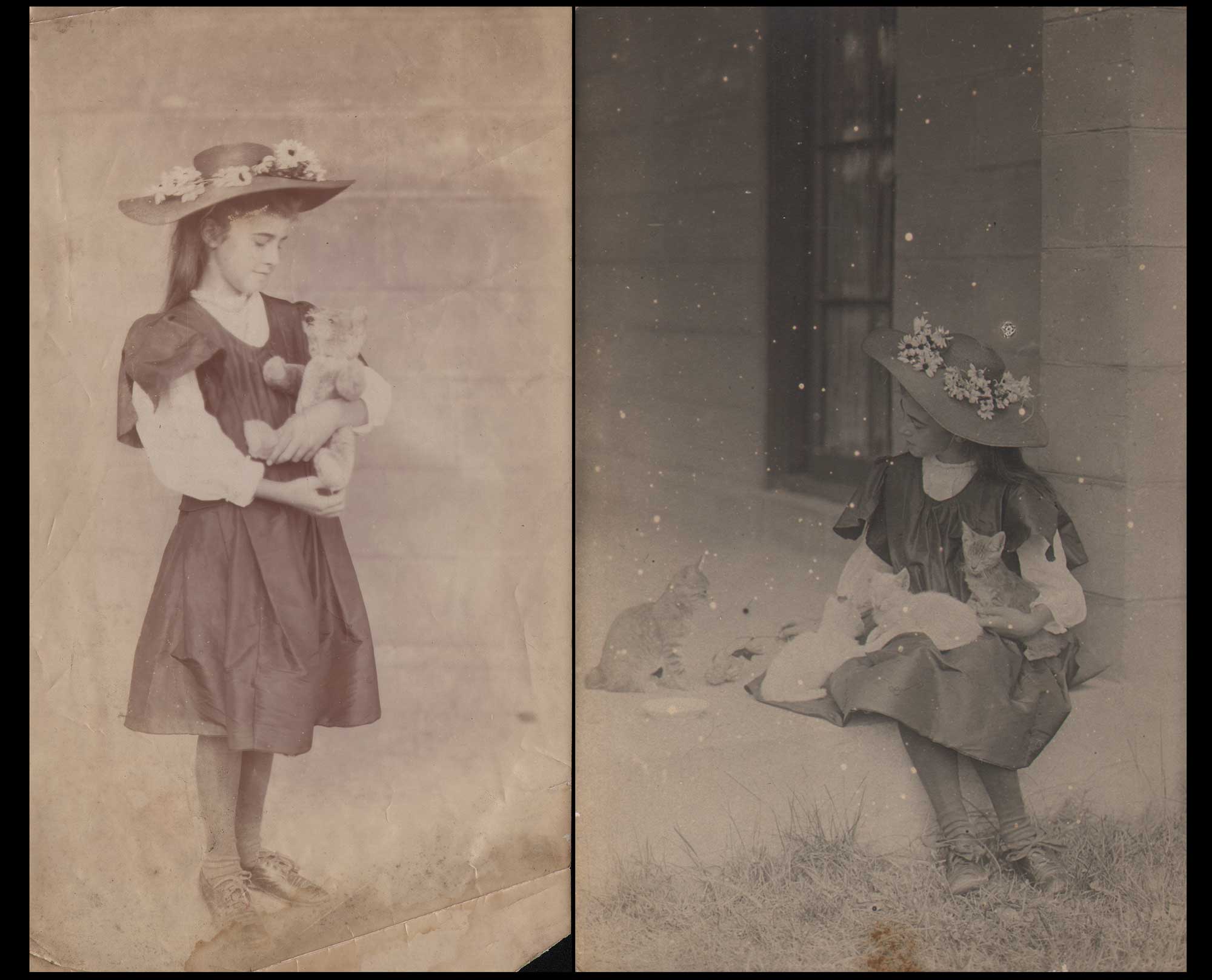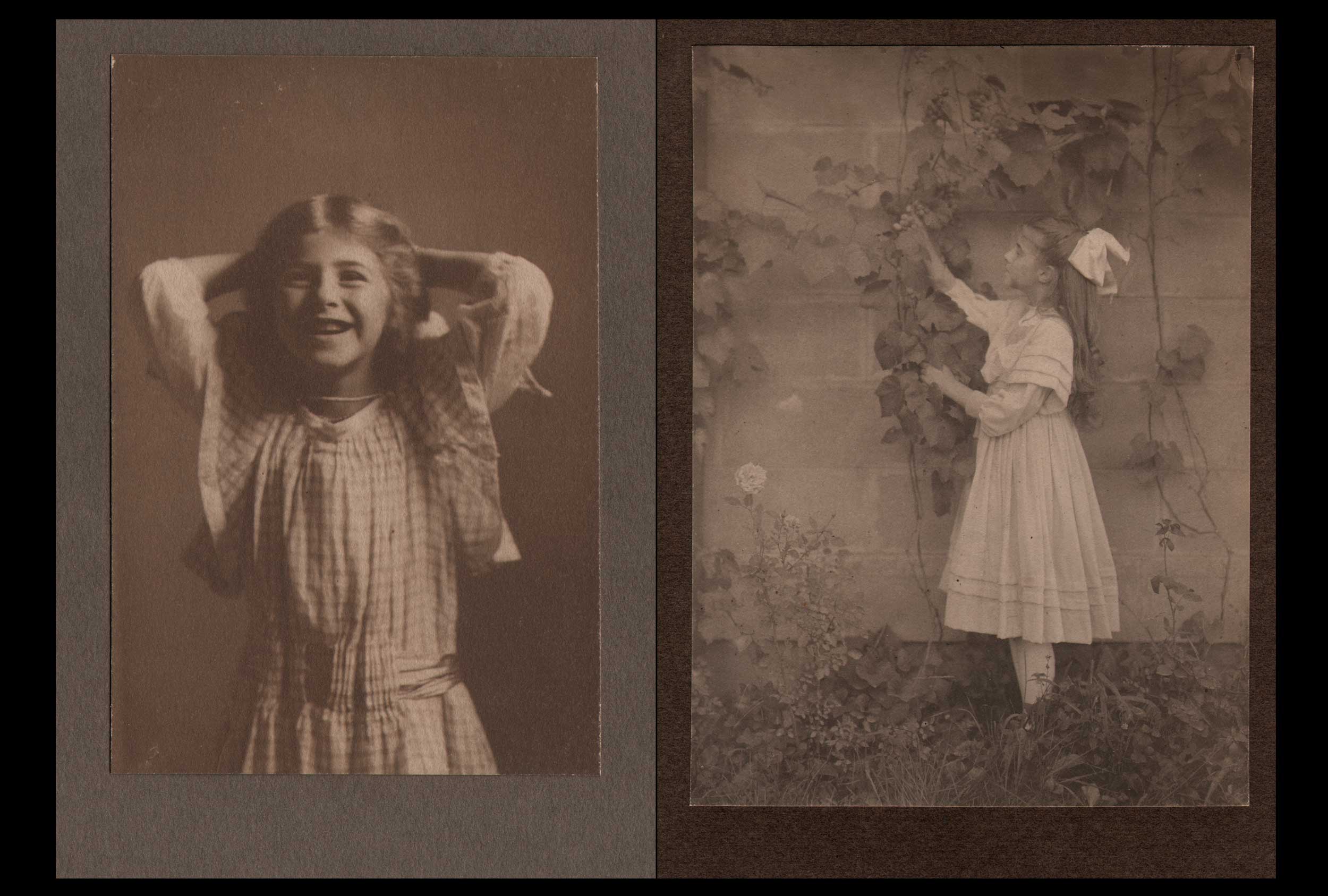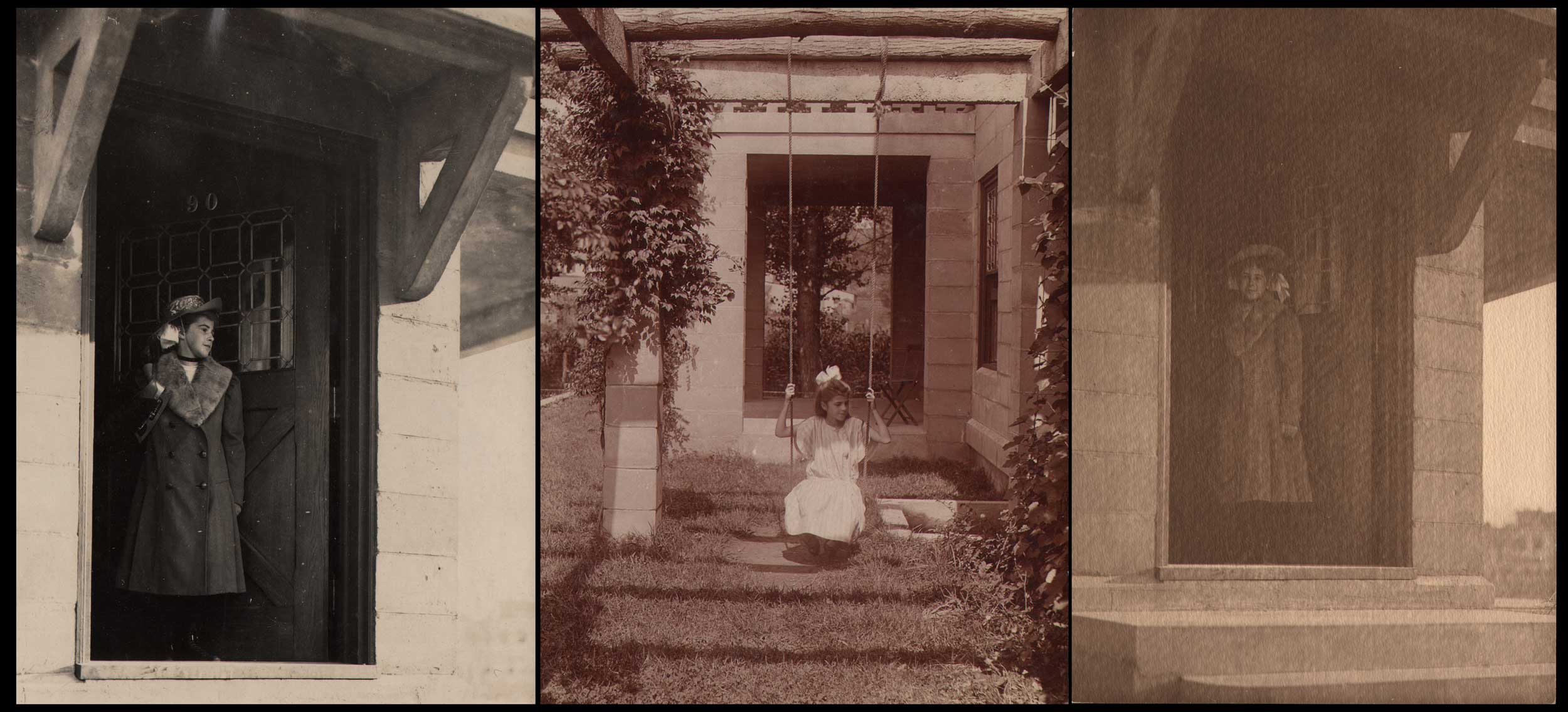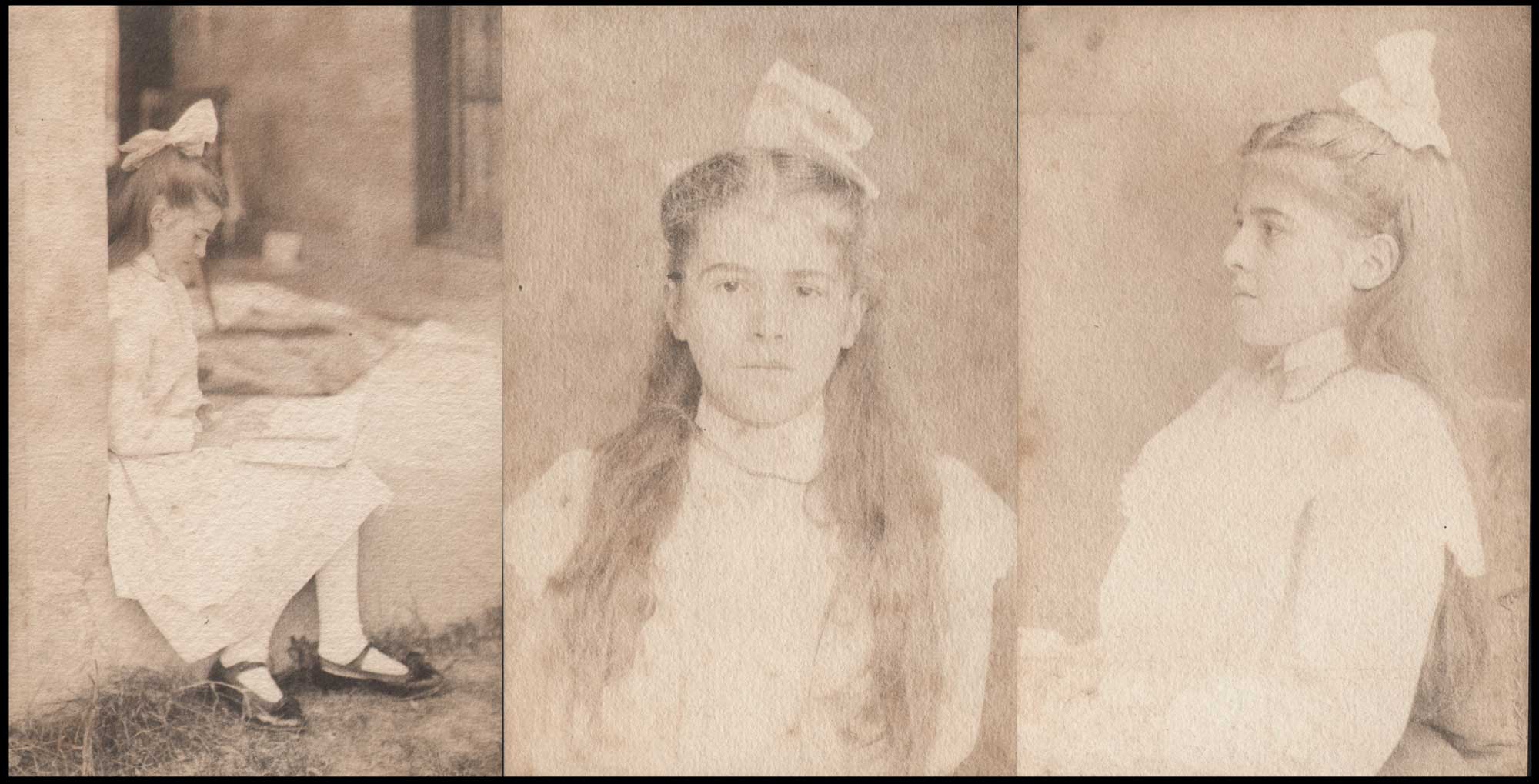
Featured Entries from the Photoseed Blog

Childhood Photography
20 Entries

Revealed: C.R. Tucker: Restless Wanderer with a Camera

Jun 2025 | Archive Highlights, Childhood Photography, Documentary Photography, New Additions, Unknown Photographers

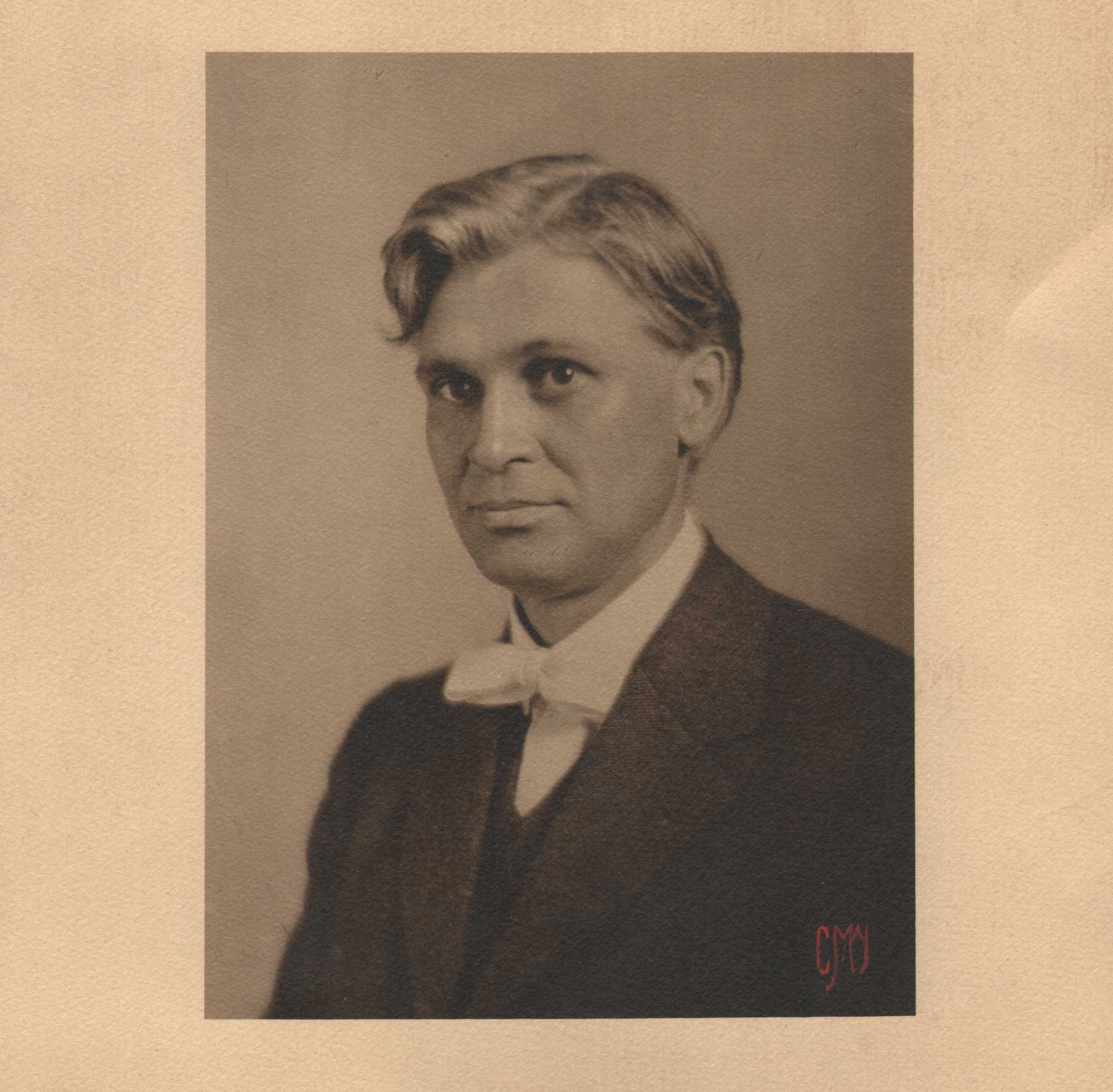
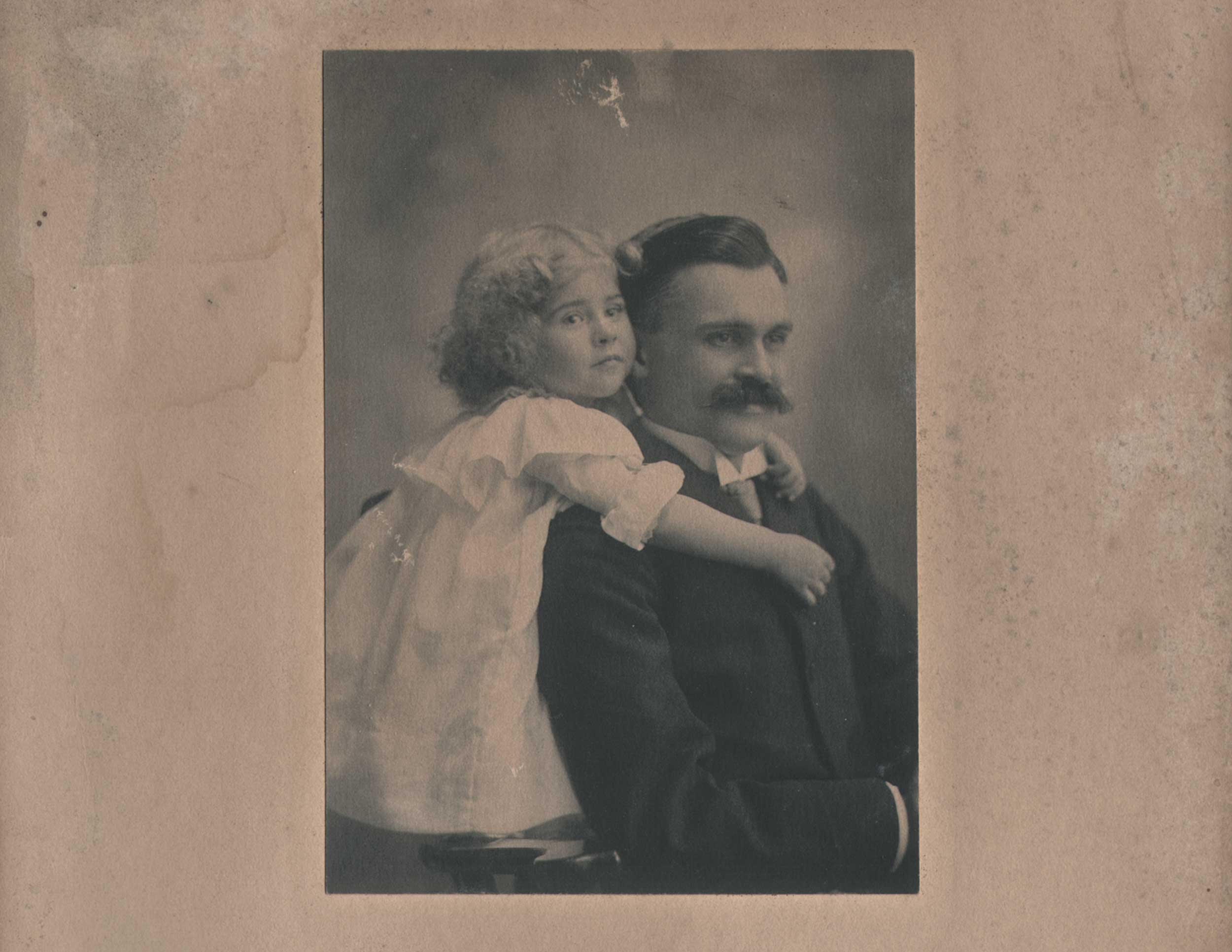
“Portrait of Charles Rollins Tucker”, Chester Moulton Whitney, American: 1873-1949, Bromide print mounted within folder, ca. 1910, 18.9 x 13.9 | 29.6 x 22.7 cm | 31.1 x 47.4 cm-opened. This formal portrait of C.R. Tucker was taken during the time he was teaching physics at Curtis High School on Staten Island. In addition to sharing a love for amateur photography, Whitney and Tucker were good friends and their family socialized together. Several surviving photos show Whitney’s young son playing with Tucker’s daughter Dorothy at the Tucker home in New Dorp. Both natives of MA and public school teachers, the Alden Letter from 1949 mentioned Tucker had spent a week with “Mr. Whitney” at his summer home in Boothbay Harbor, ME in August of that year, the same year Whitney passed. From: PhotoSeed Archive

This is the first of a two-part blog post: Revealed: C.R. Tucker: Restless Wanderer with a Camera. It uncovers a life once lost to history: the fascinating story of public school educator and amateur photographer Charles Rollins Tucker, 1868-1956. Our post concludes with an in-depth historical timeline of Tucker’s life. For fifteen years, since acquiring an archive of his work, I’ve been wanting to do a deep-dive into the life of American amateur photographer C.R. Tucker. Perhaps the most important role of this website is to uncover the past lives of anonymous photographers, whose life details have been entirely lost to history. It’s not that he was some lost genius behind the camera, say in the mold of the acknowledged masters of the medium: those have already been, and continue to be, documented and celebrated in the historical canon. In this vein, and to its credit as a medium that continually fascinates by revealing secrets with a bit of digging, Tucker’s photographic life story- began around the time he graduated high school in 1887- can give all of us a relatable way to see how a hobby born 138 years ago can be a life-long journey of exploration rather than a short term dalliance.

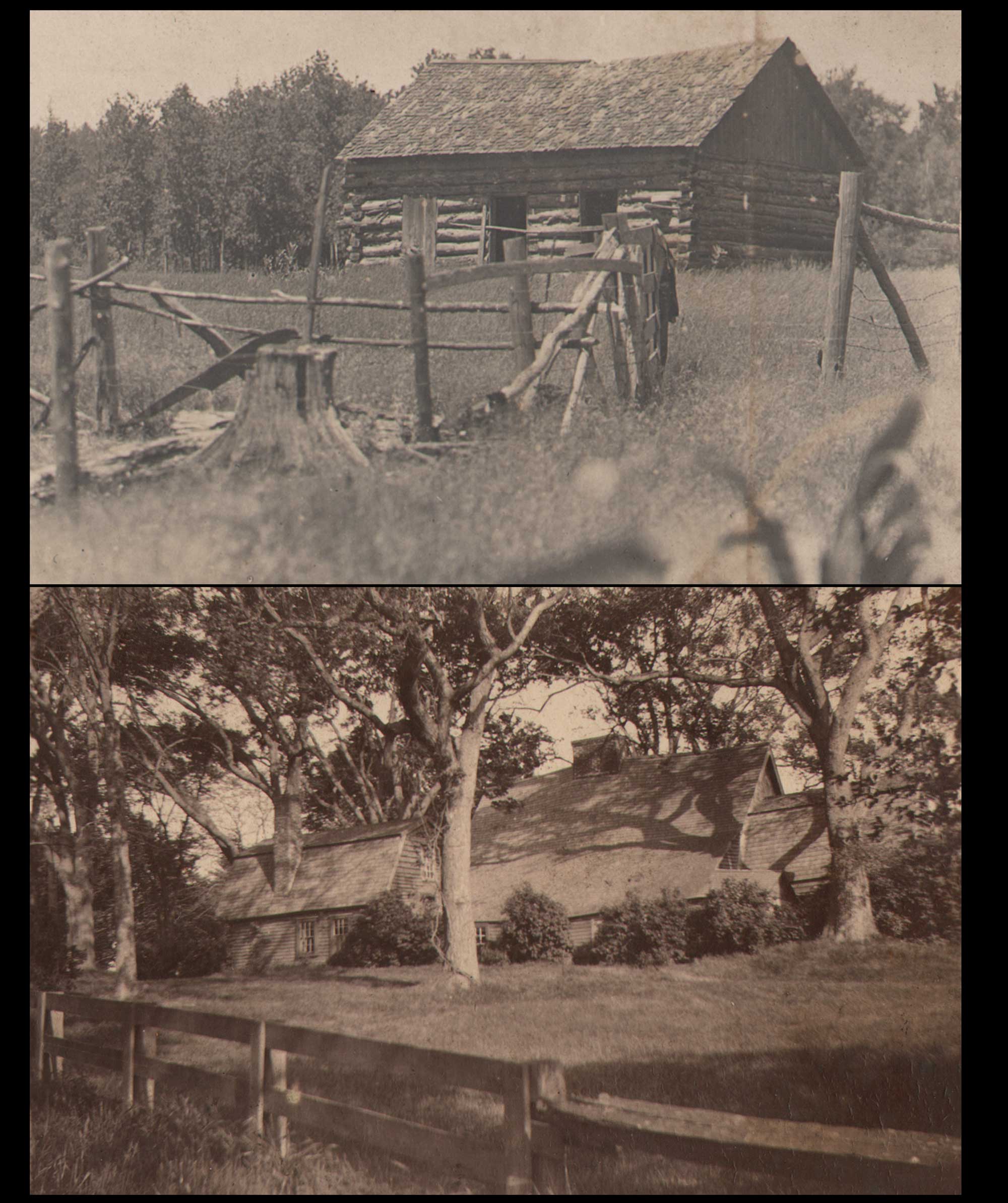
New & Old. Top: “My Old Log House in WI”, ca. 1908, gelatin silver rppc post card, photo credit to C.R. Tucker’s mother Myra Tucker on verso, 8.3 x 13.4 cm. Amateur photographer C.R. Tucker lived in this Wisconsin log cabin for five years, from about 1873-1878 before going back to New England at 10 years of age to complete his schooling. Bottom: “Fairbanks House”, C.R. Tucker, American: 1868-1956, albumen print on card, ca. 1885-1890, 8.8 x 10.9 | 10.0 x 15.1 cm. Dating to 1641, this is the oldest surviving timber-frame house still standing in North America. From: PhotoSeed Archive

The fact that so much photographic history has been lost, an area I expound upon in the second part of this post, makes the rare opportunity to examine but one of these early lives in greater detail based on the remains of that photographic record- water staining, mildew and the effects of improper storage on some of these images seen here being besides the point- an anomaly I wanted to celebrate.

What drove my interest further in discovering and piecing together C.R. Tucker’s life story was that his own career of someone who made his living- not in photography- but as a public school educator for about 45 years- is a realistic example of what dedicated amateurs faced in the early years of the medium, particularly during the Pictorial era of artistic photography.

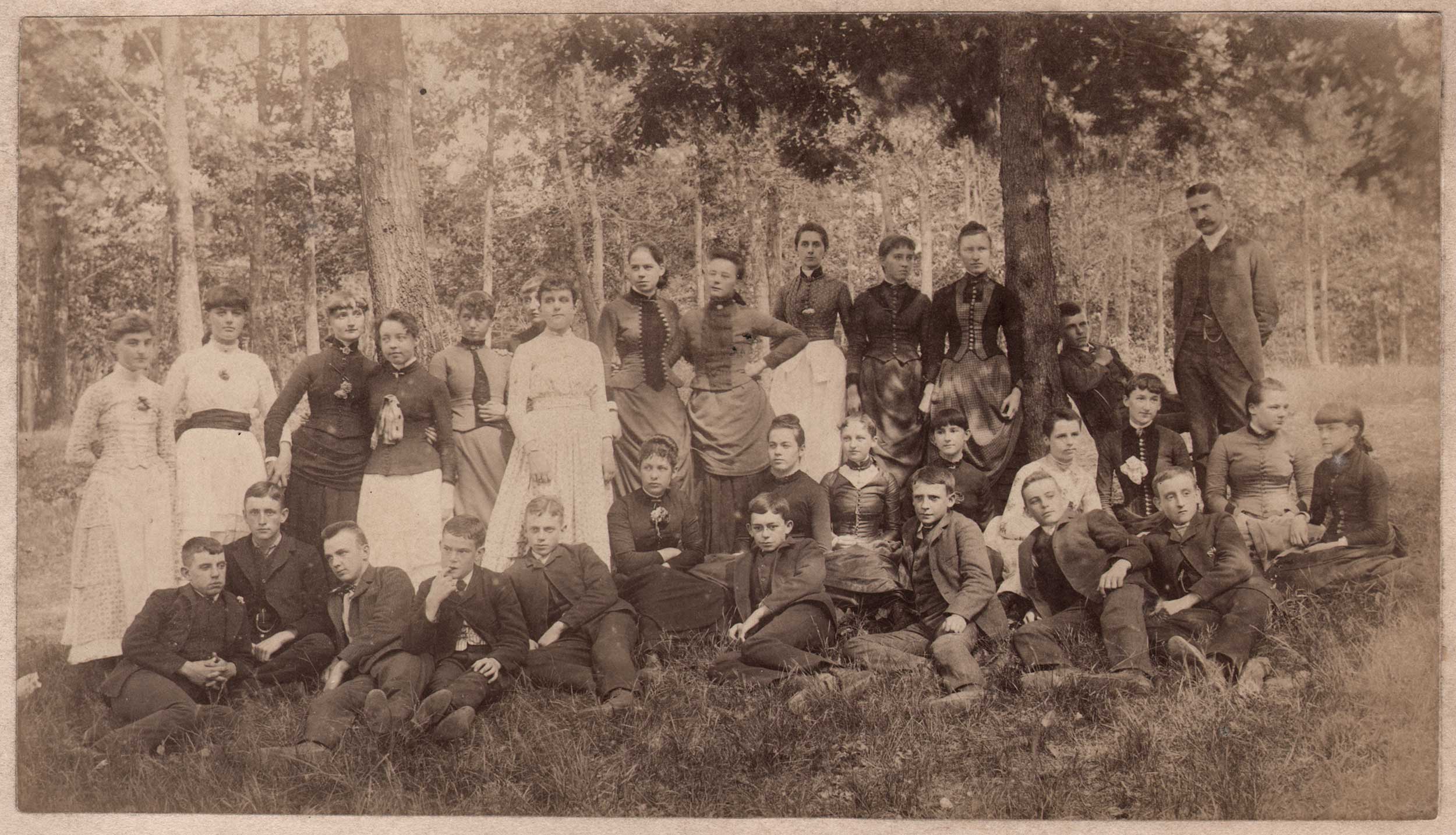
“Stoughton, MA High School Students”, 1887, silver albumen print- 11.0 x 19.4 | 20.4 x 25.4 cm on card mount.This group photograph, thought to have been taken by C.R. Tucker, (American: 1868-1956) includes several classes, as the 1887 graduating class was only 15 students. Based on a guess, this archive thinks Charles Tucker is shown in the front row, third from left. Another possibility? The student seated on a chair leaning against the tree to the left of the teacher standing at back row right. In September, 1887, Tucker would matriculate at Tufts College, in the “Philosophical course”. From: PhotoSeed Archive

This main hurdle of course, was cost. Beyond the simplified “you press the button, we do the rest” mantra, which of course revolutionized the massive participation in making photography a popular hobby, required a good bit of money. Think: home dark rooms, a more expensive plate camera, mounting supplies, postage fees for entering competitions, subscriptions to photographic magazines, etc. etc. And this of course did not include the most valuable component: the cost of someone’s free time to be deliberate and open to learning about photographic process and technique needing plenty of time to perfect and master.

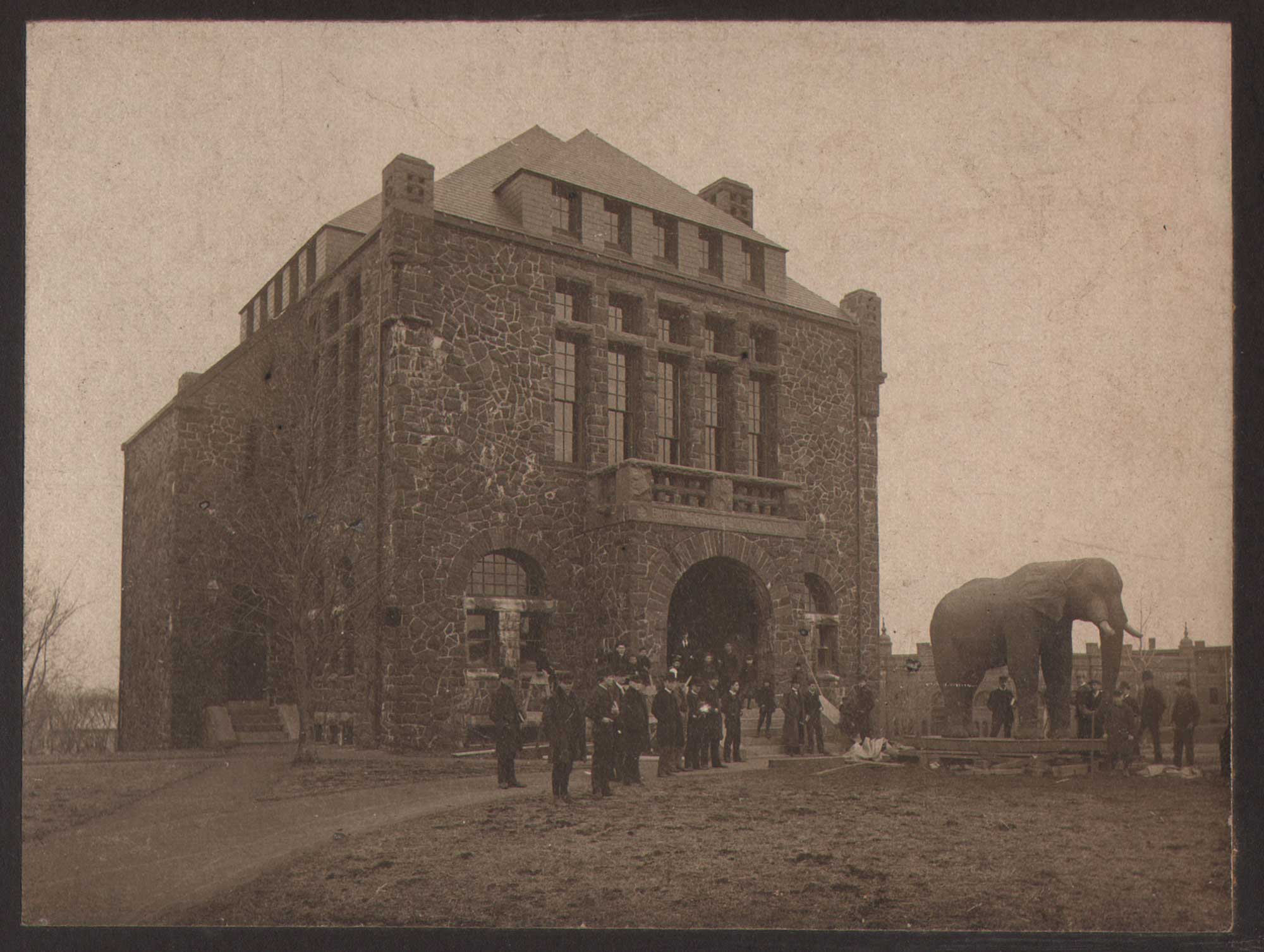
“Moving Jumbo into Barnum Museum, 1889” (title assigned by Tufts University Archives- see variant: ID: tufts: UA136.002.DO.00823 ): Attributed photographer: Charles Rollins Tucker, American, 1868-1956, 1889: mounted brown-toned gelatin silver print on cabinet card: 8.3 x 11.0 cm | 10.8 x 13.2 cm. This rare photograph taken on April, 3 1889 shows the famed circus elephant Jumbo, (died 1885) once owned by circus showman P.T. Barnum. The taxidermied pachyderm was in the process of being moved inside the brand new Barnum Museum of Natural History on the Tufts College campus in Medford, MA, where it was placed on display. From: PhotoSeed Archive.

Fortunately, C.R. Tucker had the perfect mind and circumstance to take this all on, and his love for history made him an ideal vessel to create historical documents that are the very definition of photographs themselves. That mind? He was a scientist in practical terms but historian at heart. Born in Canton, MA in 1868, and one of only two to graduate from his small town Massachusetts high school in 1887, he went on to receive both his bachelors and masters degrees from Tufts College outside of Boston. These were entirely complimentary for an advanced amateur photographer for that era: in 1891, a bachelors in the speciality of chemistry and physics and in 1894, a master of arts degree.

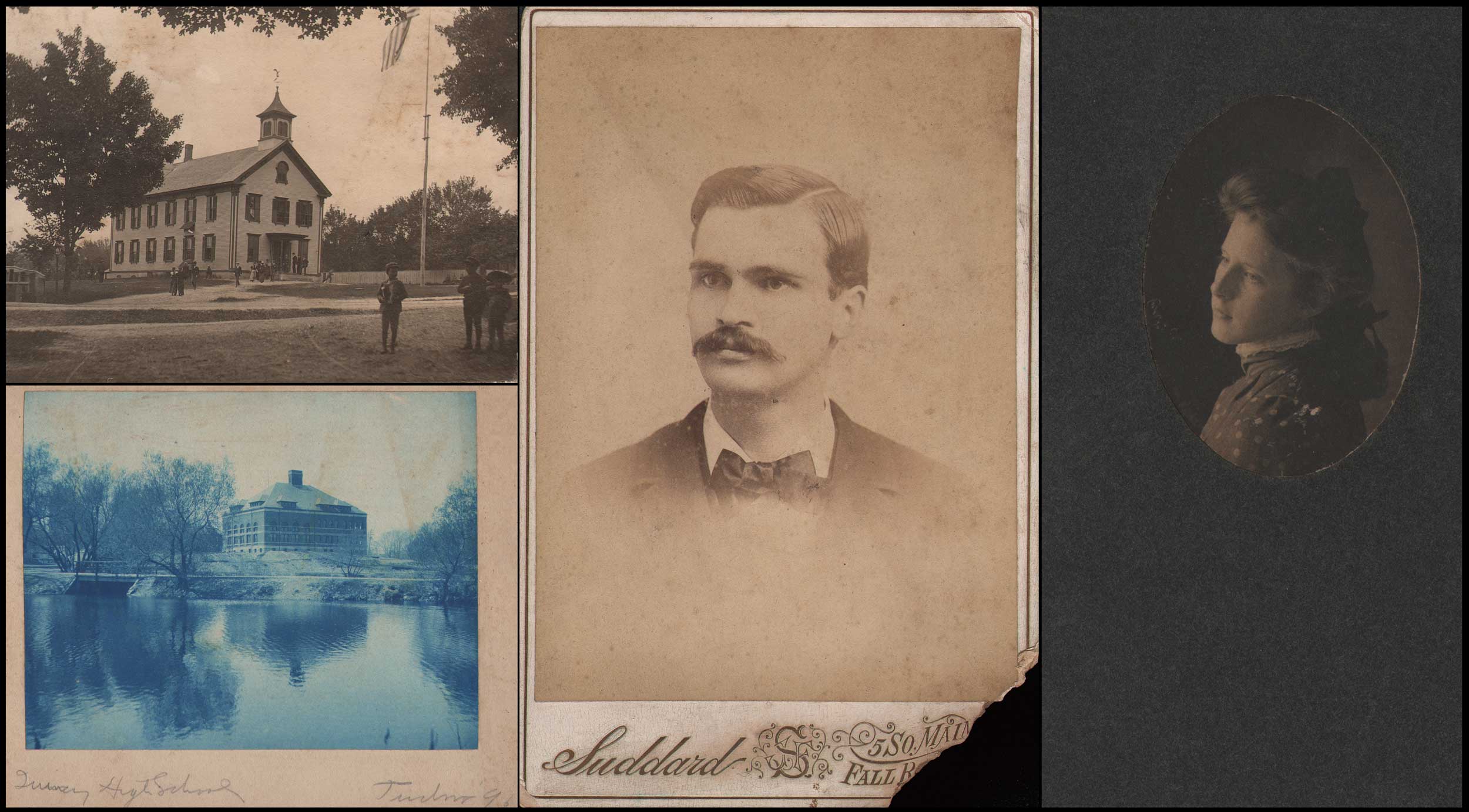
Early School Days: UL: “West Boylston High School”, ca. 1895, mounted gelatin silver print, 7.9 x 10.7 cm. LL: “Quincy High School” 1896, cyanotype print on cabinet card: 9.4 x 11.9 cm | 12.7 x 15.3 cm. Far Right: “Pratt Institute Girl”, ca. 1898-1900, mounted gelatin silver print, 6.9 x 5.0 | 18.1 x 13.1 cm. All: C.R. Tucker, American: 1868-1956. Center: “Cabinet Card of C.R. Tucker”, Studio of J.F. Suddard, Fall River, MA, ca. 1890-1895, mounted albumen print, 13.8 x 9.8 | 16.6 x 10.7 cm. Some of early school assignments for Tucker were as principal at West Boylston High School, submaster at Quincy High School and as an assistant instructor in physics at Pratt Institute, where this mounted student portrait was an early effort at photographing students. All: PhotoSeed Archive

These degrees and his love of people-especially children- would serve him well in a fruitful career as a teacher in public education for the next 45 years.

Through many fits and starts since acquiring the “C.R. Tucker Trove” of photographs,  I’ve been able to piece together a truly fascinating life: a quintessentially American life at that- glued together by the love of his family and fueled by his own expansive, inquisitive mind.

Beginnings, Wanderings & Jumbo the Elephant

C.R. Tucker’s father George was a farmer and his mother Myra a homemaker. Although its assumed the Tucker family did not possess generational wealth based on the occupation of his father, pastures back then seemed greener in the American West, literally: especially for a farmer. With this in mind, when Charles was only four years old, he and his family traveled in a “prairie schooner”, better known as a covered wagon, in search of fortune to Missouri. That dream got detoured however, and the family pivoted north, to the state of Wisconsin. There, Charles found himself living in a log cabin for five years in the mid 1870s. Miraculously, a photograph of that log cabin survives to this day, and can be seen with this post. How many family’s in the 21st century can say their forebears grew up in a log cabin along with an actual picture to prove it?!

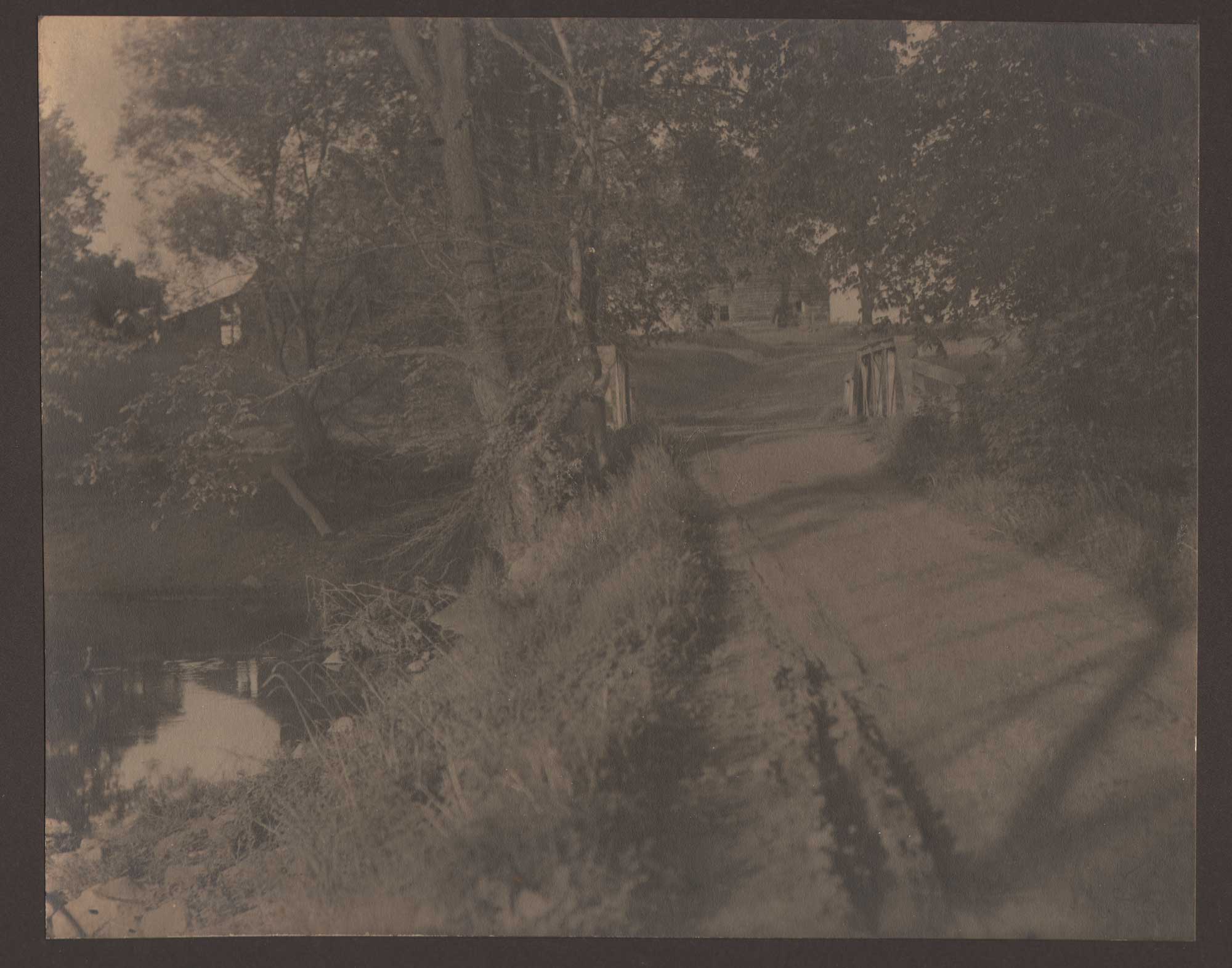
“Country Lane”, ca. 1905-1910: printed 1916, mounted bromide print, C.R. Tucker, American 1869-1956. 23.1 x 29.3 | 35.5 x 43.2 cm. Tucker enjoyed landscape photography, and this view of a dirt road with river or pond at left and buildings obscured in background may have been taken on Staten Island, N.Y., a locale where farms and open space were the norm versus the heavy populated landscape it is in the 21st Century. This mounted print is from a series of photographs bearing the artists signature and date 1916 at lower right corner that are believed to be from earlier negatives. The uniformity of the brown cardstock mounts indicates they were intended as exhibition prints. From: PhotoSeed Archive


Personal history obviously made quite an impression on Charles. In keeping with the idea of “home”, an early cabinet card believed taken by him in the late 1880’s, when he was still in high school or early in college, shows the oldest known American home- then or now- in existence: the Fairbanks House in Dedham, MA. Even then, as an impressionable newcomer to photography, he must have known of its significance, one worthy of his early efforts behind the camera. In contrast to his old childhood log cabin, the Fairbanks house, dating to 1641, is the oldest surviving timber-frame house in North America.

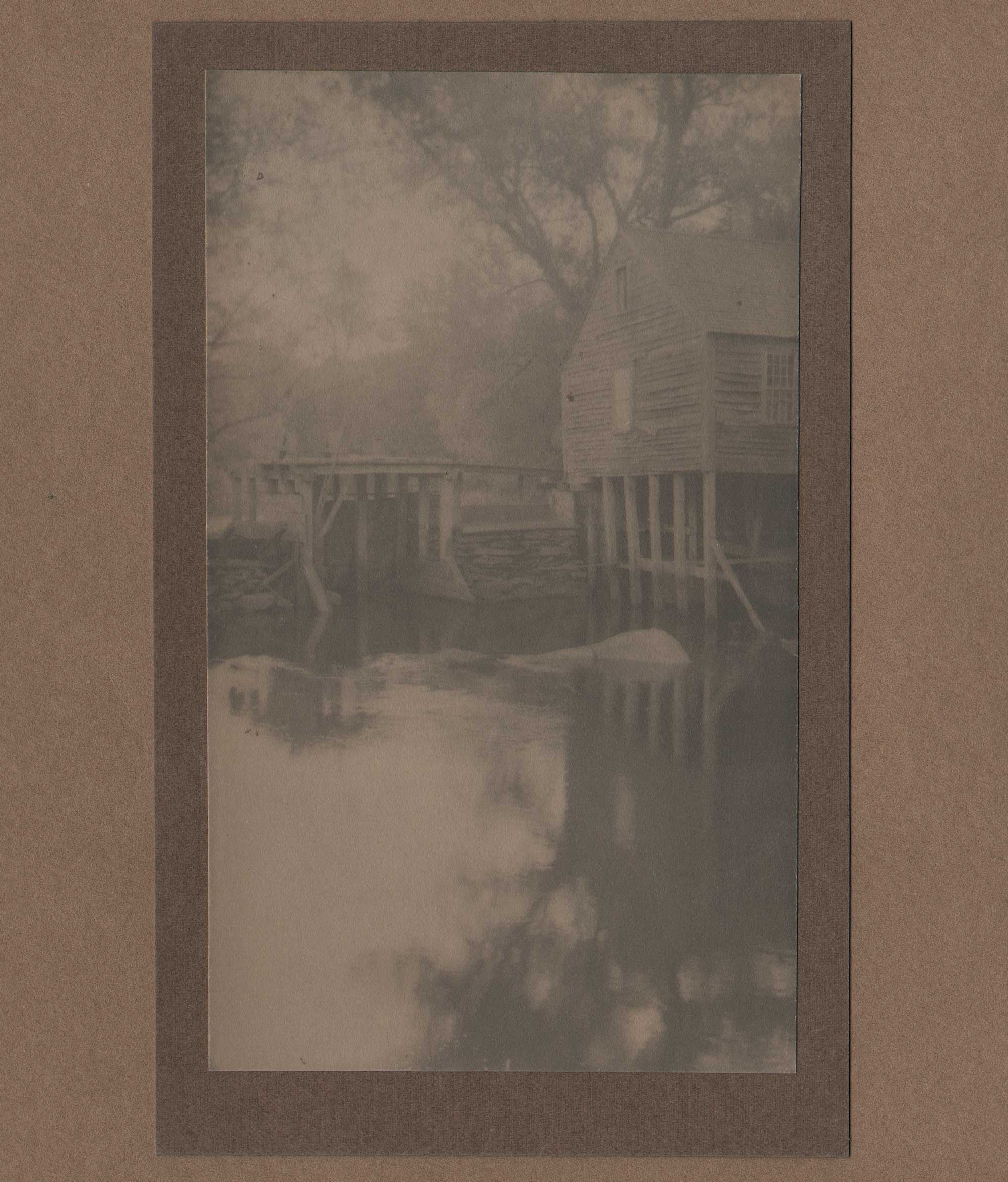
The Old Mill”, ca. 1906, mounted platinum print, C.R. Tucker, American 1869-1956. 16.4 x 9.7 | 18.6 x 11.4 | 29.3 x 22.9 cm. This is a variant, with orientation reversed, of a bucolic waterscape study titled “The Mill” by the artist & published in the June, 1906 issue of the Photo-Era. At the time, Tucker was a member of The Postal Photographic Club of the United States. The location of the photo is the Old Mill on Crescent Street in West Bridgewater, MA. A later photograph of this mill, now believed lost and taken around 1915 can be seen here. From: PhotoSeed Archive

In the Spring of his sophomore year at Tufts, April, 3, 1889, an opportunity featuring a different kind of home crossed paths with Tucker’s amateur photography skills. This took the form of the the newly built Barnum Museum of Natural History on campus. For the future secretary of the brand new Tufts Camera Club, Charles Tucker got to record history in photographing a unique specimen of the circus impresario Barnum: his former colossus, the now stuffed Jumbo the Elephant.  Mounted on a platform before being moved and placed on exhibit inside the new museum, Several of Tucker’s photographs, including the one with this post, were quickly turned into crude woodcuts: used to illustrate an article written by Tufts graduate and Boston Daily Globe reporter Julien C. Edgerly for the April 4, 1889 edition. In March, 2015, I used this original brown-toned, gelatin silver print of Jumbo mounted as a cabinet card to illustrate a news story on how Ringling Bros. and Barnum & Bailey Circus was going to retire their performing pachyderms. Alas, other than a small photo not held by this archive of the artist’s dorm room, no other currently identified photographs taken by the college student-in the capacity of his camera club membership or otherwise- are known to survive.

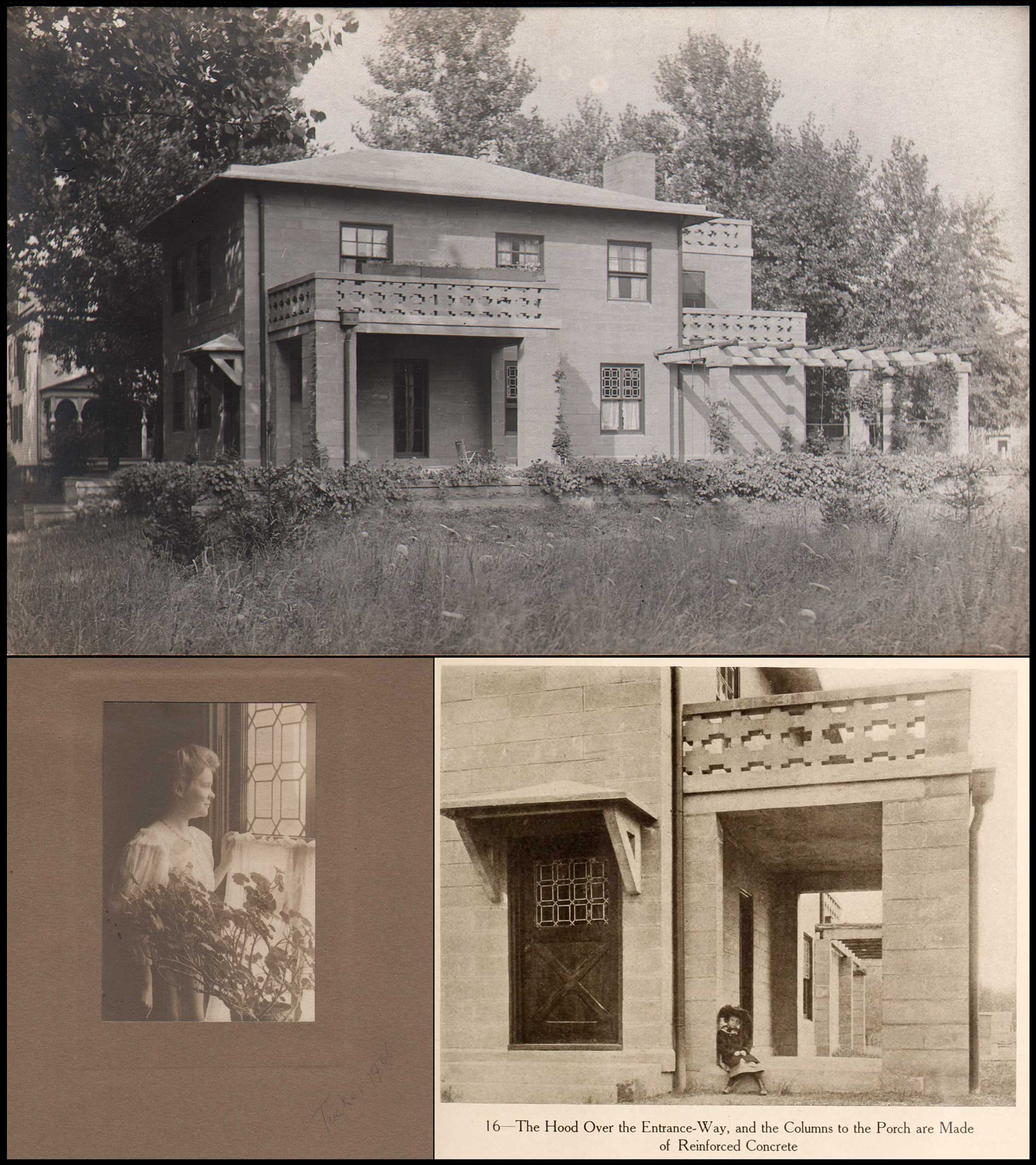
Top: First home owned by Tucker Family: “90 Third St. New Dorp, Staten Island”, ca. 1910, probably C.R. Tucker, American, 1868-1956, unmailed, divided back CYKO gelatin silver rppc, 8.6 x 13.7 cm, from: PhotoSeed Archive. LL: “The Window”, 1906, mounted platinum print, C.R. Tucker, American, 1868-1956, 9.9 x 6.6 | 31.4 x 16.5 cm. From: PhotoSeed Archive. LR: “Dorothy Tucker seated on Veranda”, 1906, halftone published as illustration: “Some Modern Concrete Country Houses” in August, 1906 American Homes and Gardens magazine. The artist’s wife, Mary Carruthers Tucker, peers out the first floor dining room window the same year the family moved in, the concrete home’s second owners. Built ca. 1904-05, the revolutionary structure, now demolished, was designed by important American architect Robert Waterman Gardner, who pioneered reinforced concrete in residential construction.

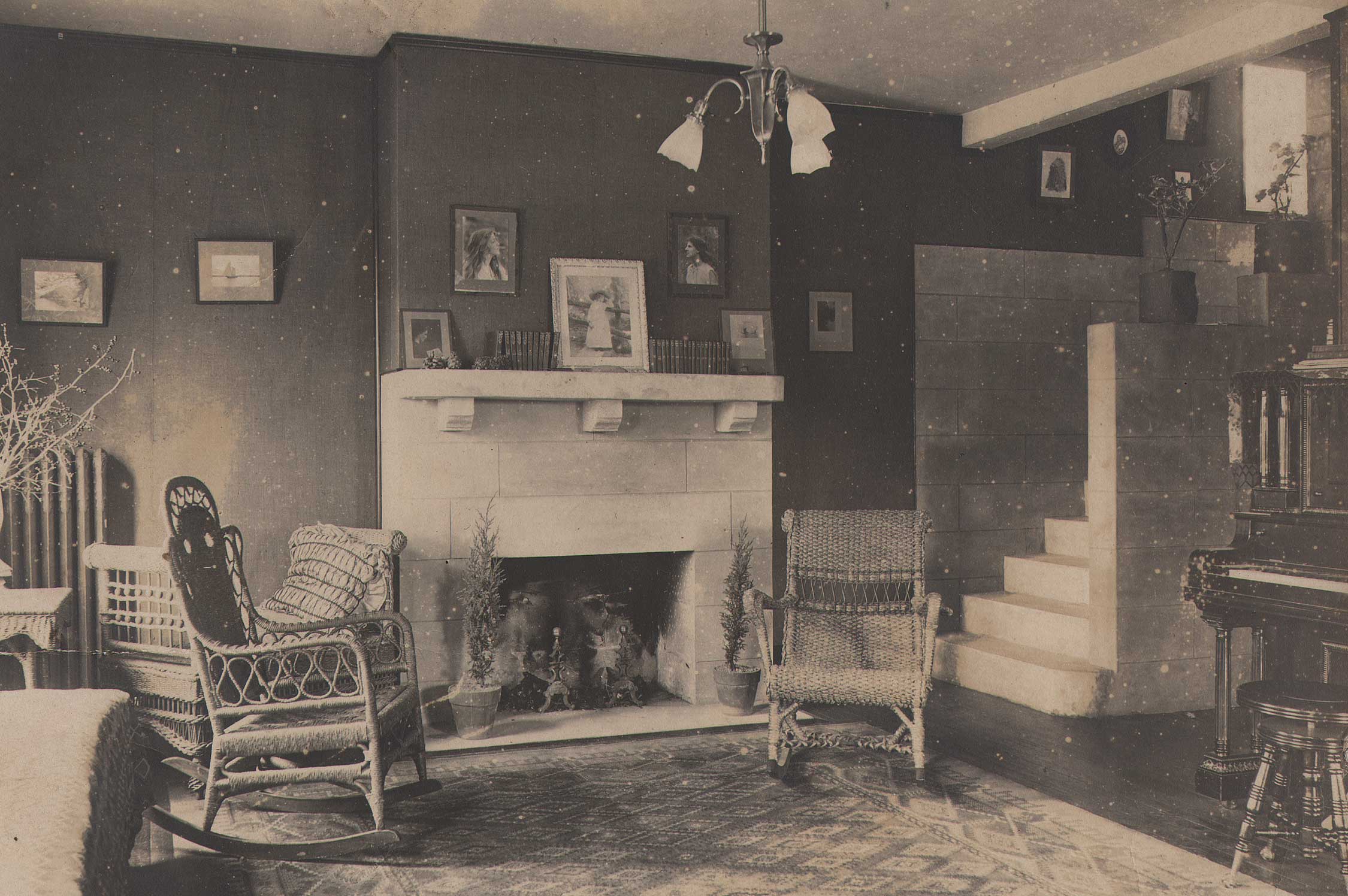
The artist’s work adorns the walls: “Living Room: 90 Third St. New Dorp, Staten Island”, ca. 1906-10, unmounted gelatin silver print, shown slightly cropped, C.R. Tucker, American, 1868-1956, 20.0 x 20.0 cm. This interior study shows the decorated Tucker family living room of their revolutionary concrete home. Photographs by the artist are on far wall, including original prints now held by this archive. Far left: “Cathedral Ledge and Echo Lake, North Conway, NH”; center, perched on fireplace mantle: framed photo of artist’s daughter Dorothy; either side of this on wall: framed profile portraits of Curtis High School students; far right, perched on mantle: “At Point O’ Woods Long Island”, from 1899. From: PhotoSeed Archive

But what of another future home, this time for the family residence of an older C.R. Tucker? A futuristic one of course, the perfect manifestation for someone who then made his living as a high school physics teacher. A revolutionary structure built ca. 1904-05, this abode was built entirely of concrete, owned by Tucker and his wife Mary as its second owners when purchased with the aid of a mortgage in 1906.

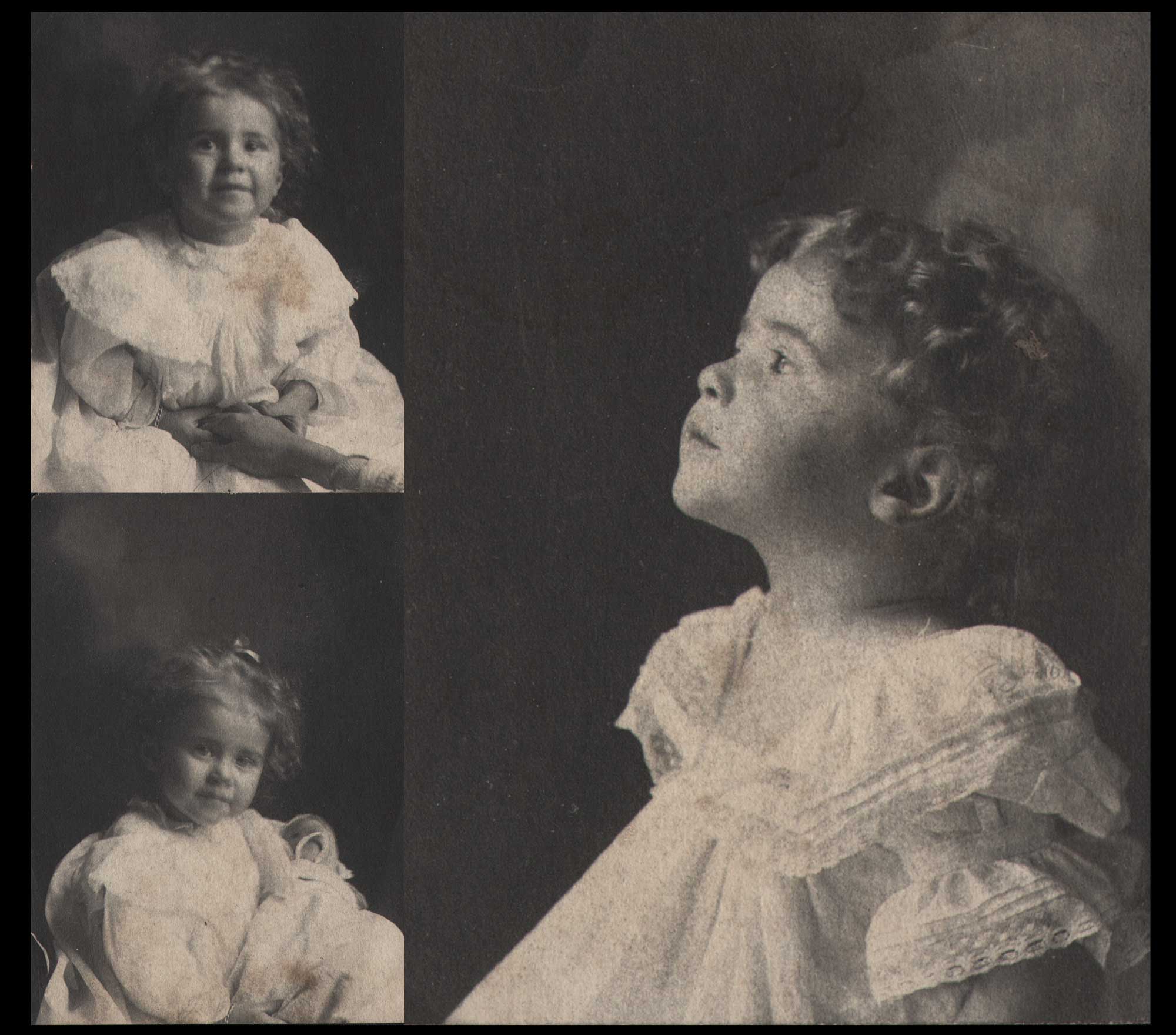
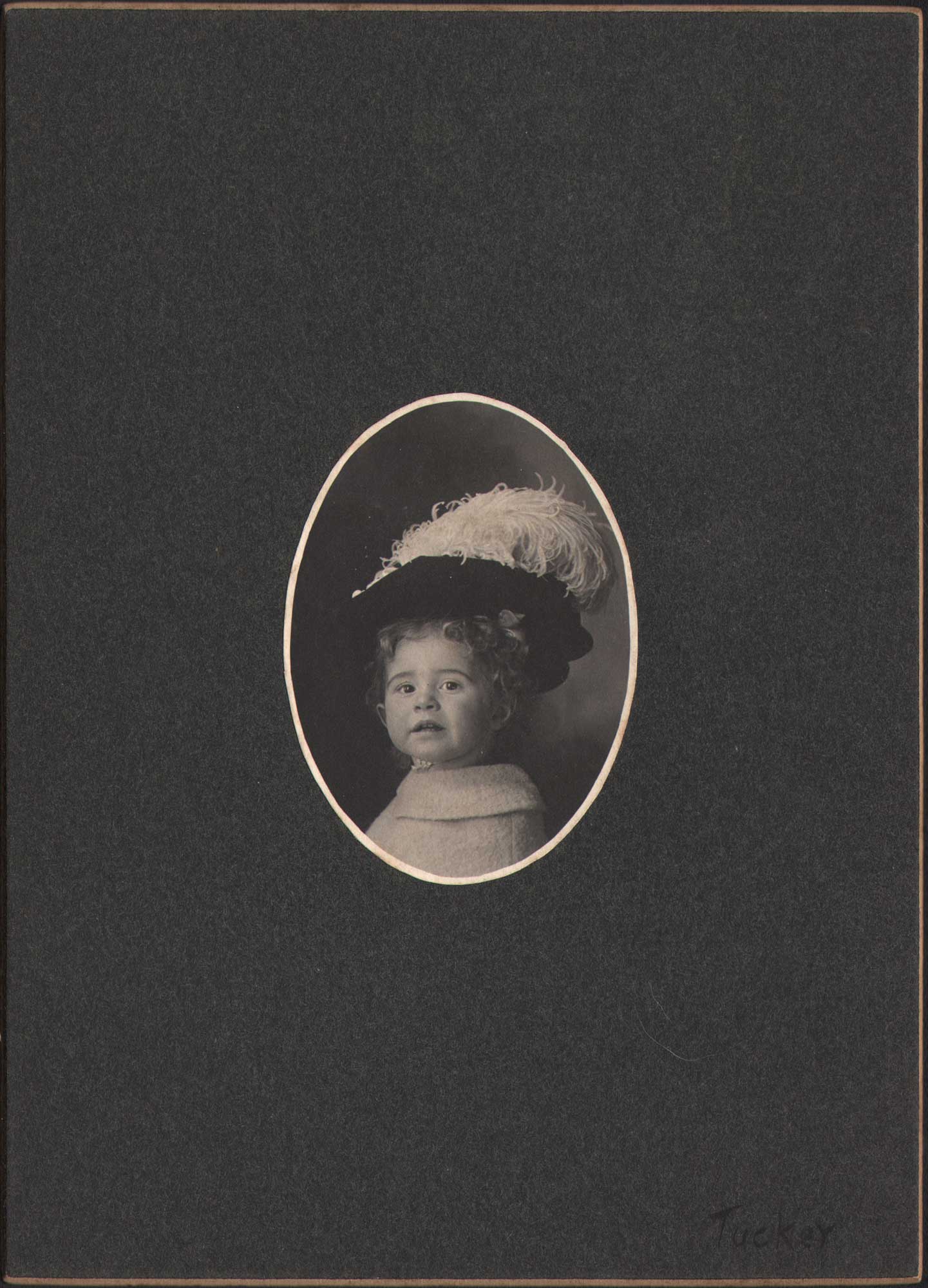
Designed by the important American architect Robert Waterman Gardner, who pioneered using reinforced concrete in residential construction, the home brought me down more than one rabbit hole in my research. Recently, with the evidence of several interior photographs of the home I purchased included with the Tucker “trove”, a wonderful discovery was made. This was an August, 1906 article (begins: p. 88) showcasing the residence in American Homes and Gardens magazine. Delightfully, who would show up in several of the uncredited halftone photographs published with this article? Tucker’s daughter Dorothy, a little over six years old, sitting by herself, unidentified, perched on the edge of the ground level veranda.

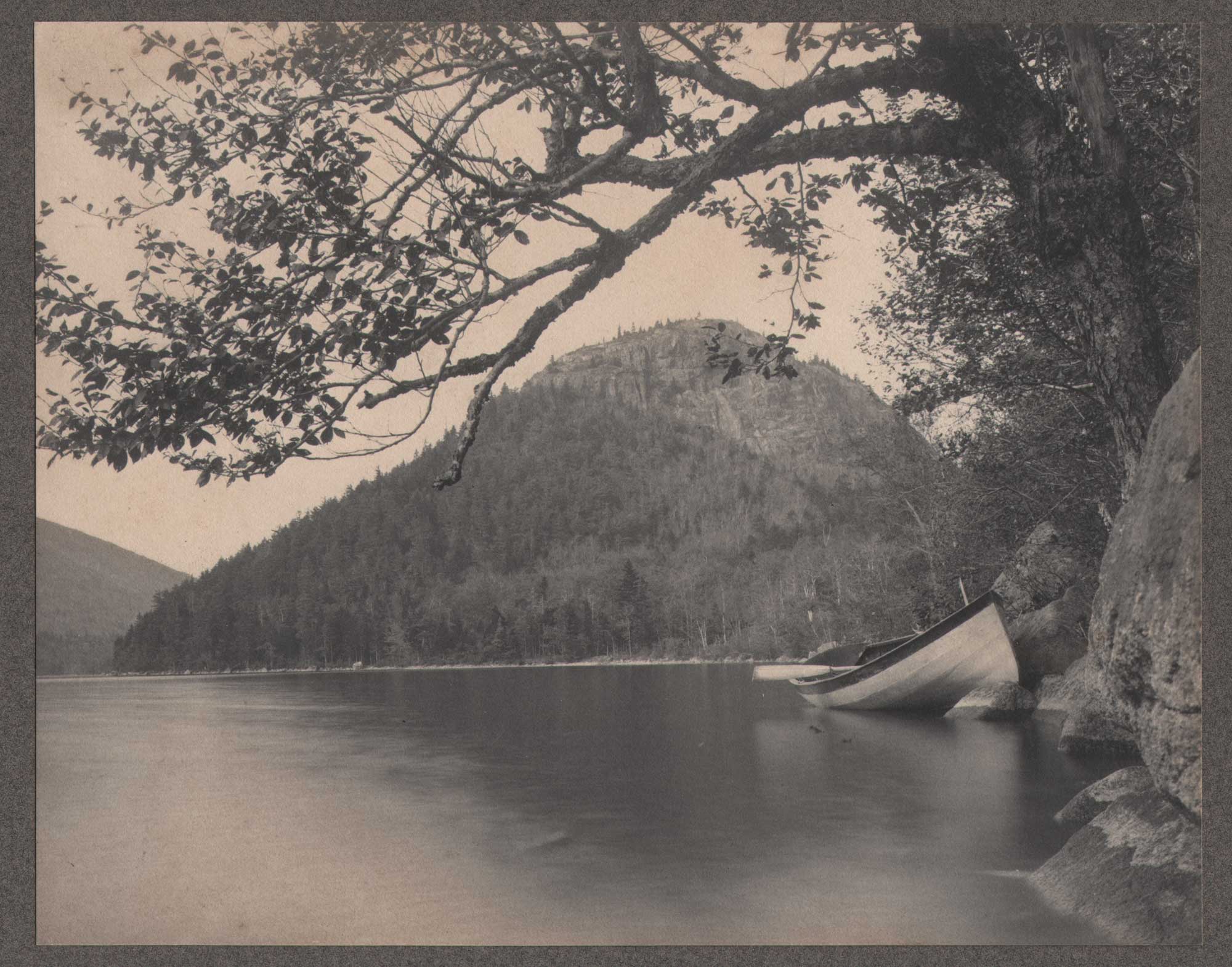
“Cathedral Ledge and Echo Lake, North Conway, NH”, ca. 1900-05, tipped platinum print to card mount, C.R. Tucker, American, 1868-1956, 15.2 x 19.1 | 25.3 x 30.4 cm. A large rowboat with protruding oar frames this serene lakeside study. This archive is fairly confident the view shows the rock outcropping of Cathedral Ledge overlooking Echo Lake in New Hampshire. A framed example, perhaps this print, hung on the dining room wall of the artist’s concrete Staten Island home- seen in previous photo above. From: PhotoSeed Archive

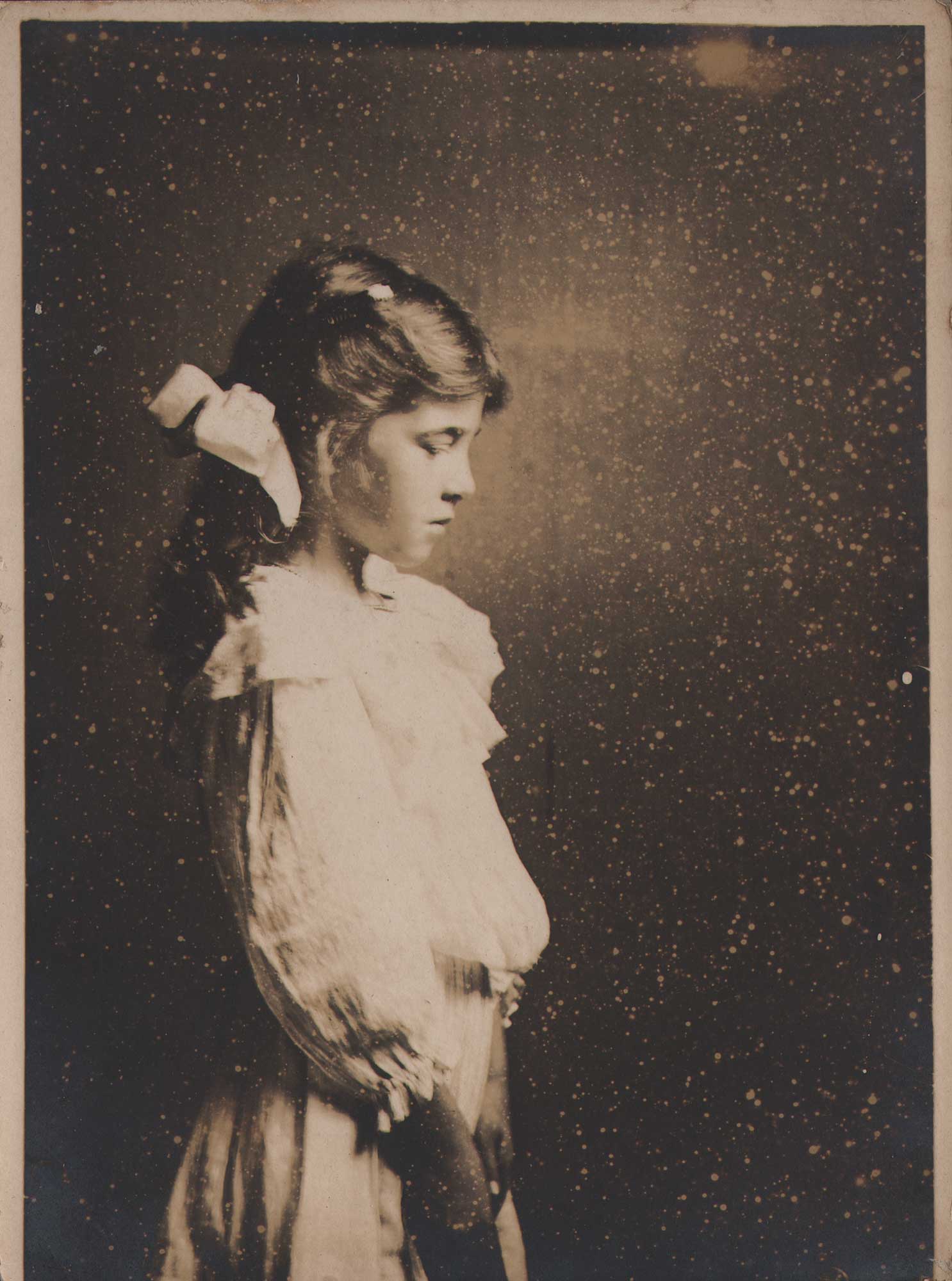
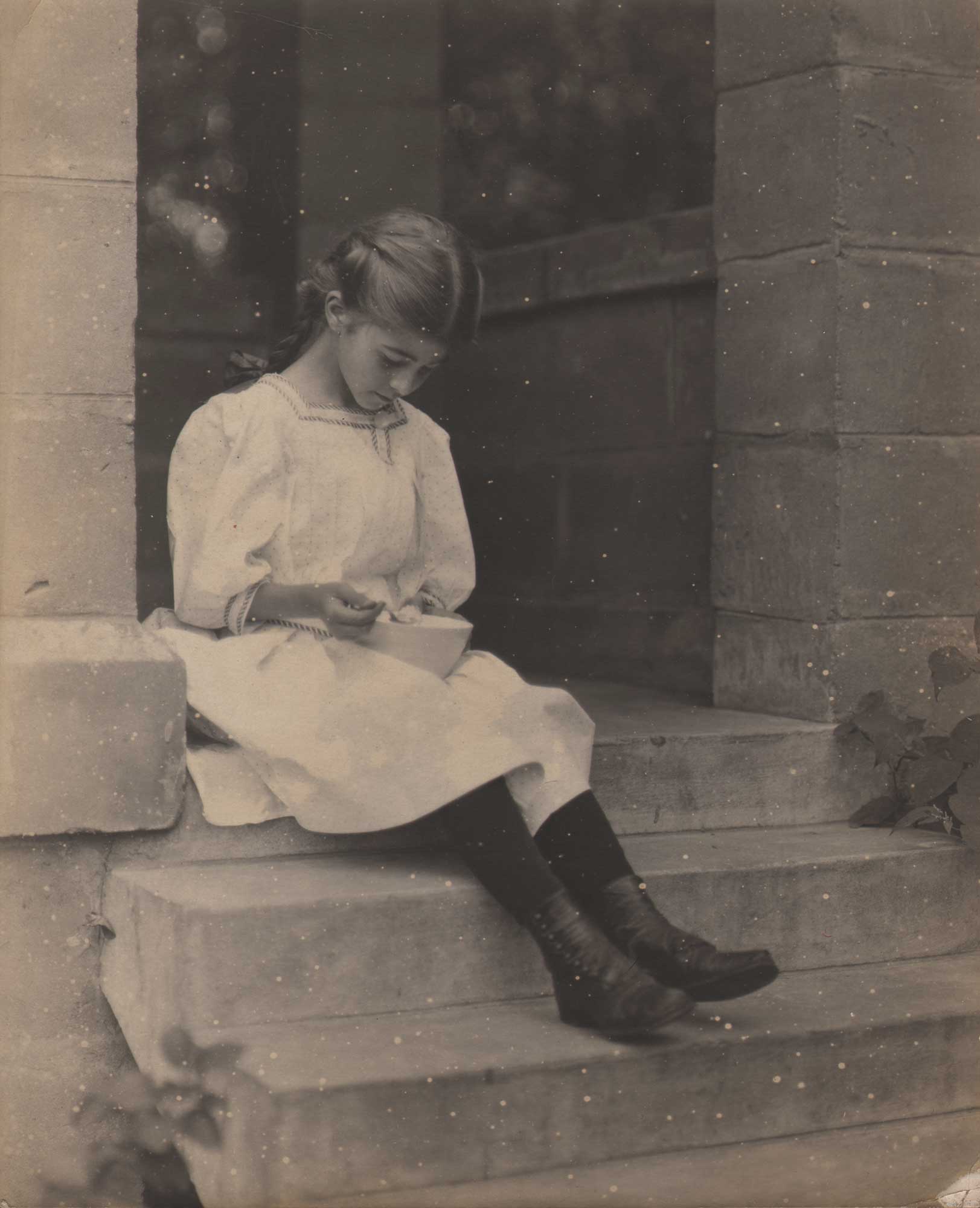
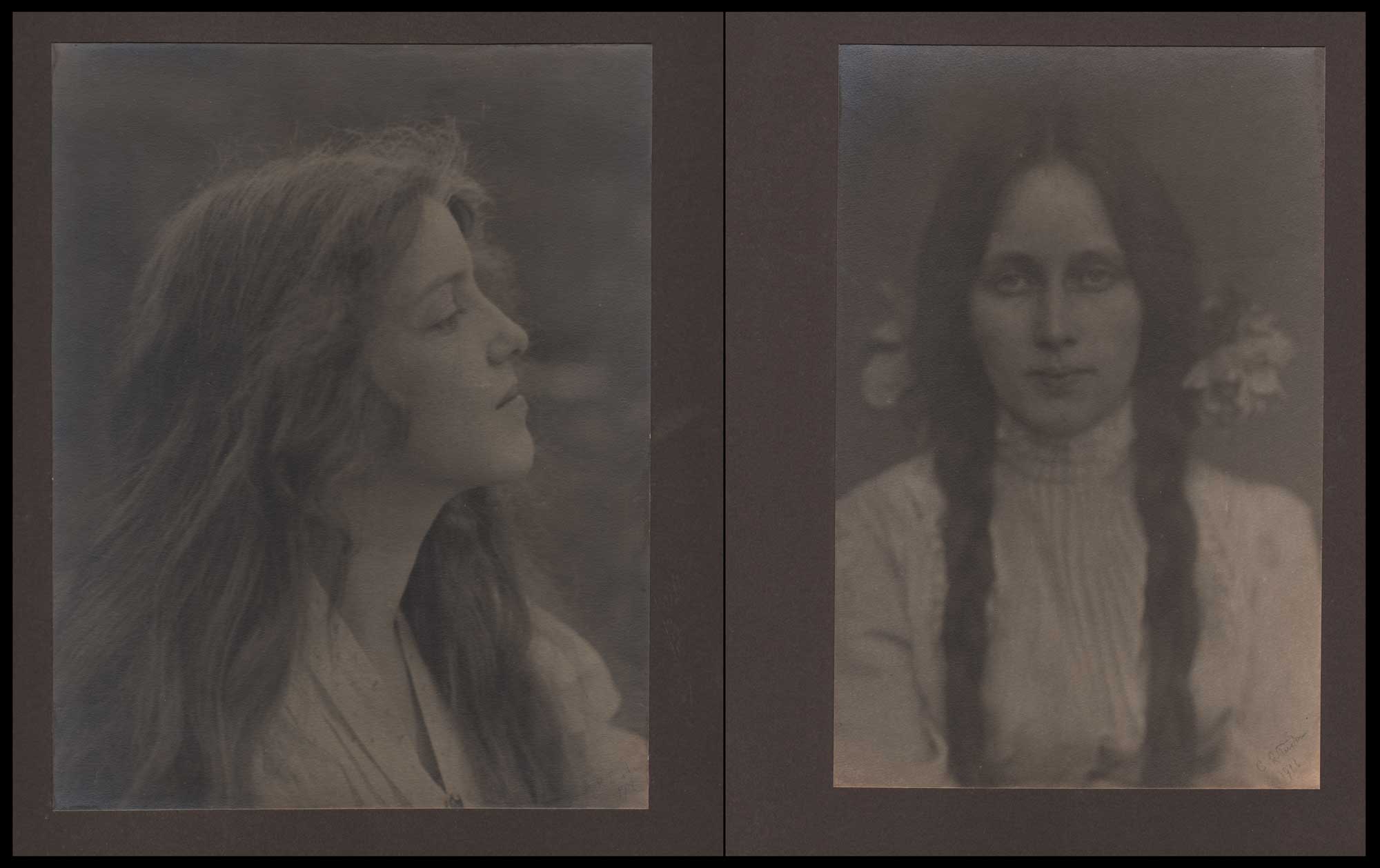
Left: “Curtis High School Girl”; Right: “Girl with Braids”, both ca. 1905-1910: printed 1916, mounted bromide prints, C.R. Tucker, American 1869-1956. Left: 27.2 x 21.3 | 43.2 x 35.5 cm, Right: 26.7 x 17.6 | 43.2 x 28.4 cm. These prints are from a series of photographs bearing the artists signature and date 1916 at lower right corner, and are believed to be from earlier negatives. The uniformity of the brown cardstock mounts indicates they were intended as exhibition prints. Another extant unmounted print of “Curtis High School Girl” seen here includes the name Eloise Poulin (?) crossed out-perhaps the name of the subject. This particular portrait was displayed with others over the fireplace mantle of the artist’s New Dorp home: From: PhotoSeed Archive

Located in the New Dorp area of Staten Island, N.Y. but unfortunately now demolished, the magazine lay claim at the time of publication that it was “the first building of this character to be constructed in New York City.” Historians of early concrete homes will find new things to ponder, and the article and published floor plans gave me further insight into the location and backdrop for many of the Dorothy and Tucker family photographs included in the larger archive.

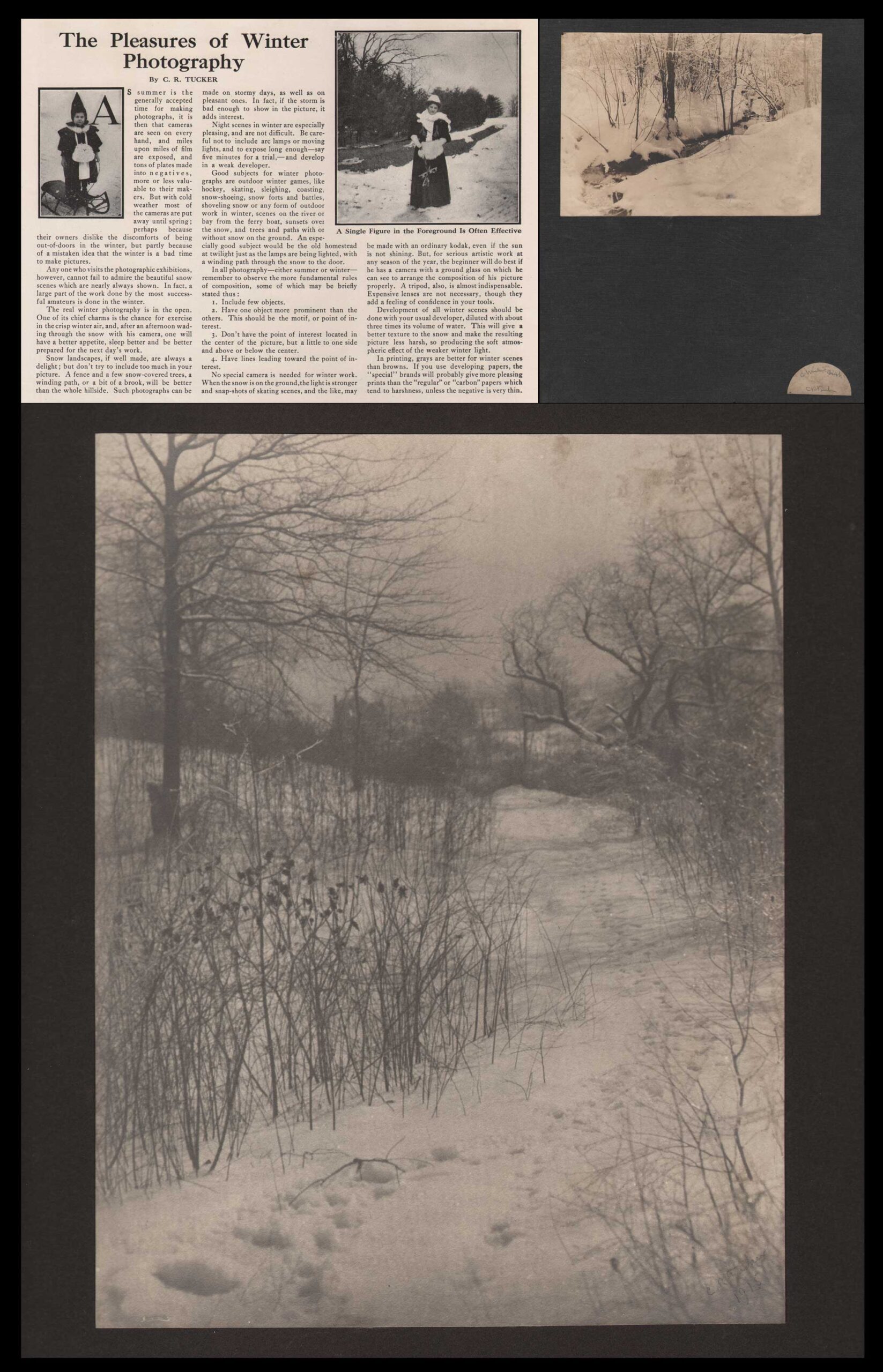
Author and Practitioner: Left: “The Pleasures of Winter Photography by C.R. Tucker”, in: Suburban Life, December, 1907. Excerpt: from first page of article: “Snow landscapes, if well made, are always a delight; but don’t try to include too much in your picture. A fence and a few snow-covered trees, a winding path, or a bit of a brook, will be better than the whole hillside.” Two halftones, believed to show the photographer’s daughter at left and wife Mary, are shown. The four-page spread included at least one other photo by the author. Examples of the aforementioned brook and path: Right: “A Winter Brook”, Bottom: “Snowy Path”, both ca. 1905-10, C.R. Tucker, American 1869-1956. Brook: mounted POP print: 11.8 x 16.8 | 31.0 x 24.5 cm; Path- signed and dated 1915: mounted bromide print, 29.5 x 22.9 | 43.2 x 35.5 cm. From: PhotoSeed Archive


A Public School Teaching Career Informed from the Age of 10

There he matriculated in an old red school house – Seems to have garnered a good deal out of it, too- 1949

…but wherever Charles Tucker is his heart and his camera capture children. Wherever he is he is the sun to which the children, like sunflowers, turn.  -The Alden Letter, 1950

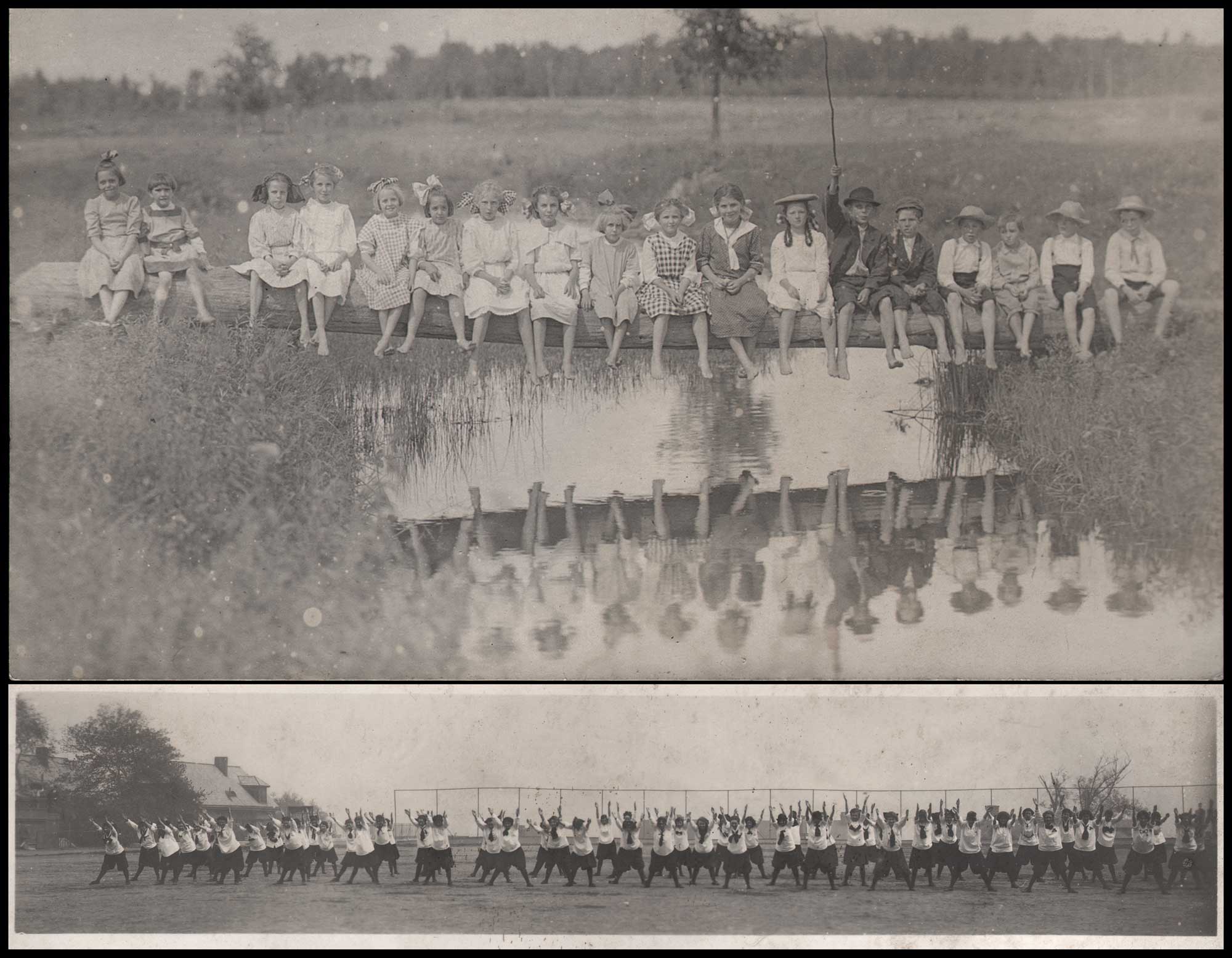
Children & Students- a Favorite Subject: Top: detail: “Sunday School Picnic, Spencer Wisconsin”, 1908, Bottom: “Young Women Exercise at Curtis High School”, ca. 1910, both: unmounted gelatin silver prints, C.R. Tucker, American 1869-1956. Top: 9.8 x 14.0 cm, Bottom: 5.0 x 25.2 | 7.4 x 33.2 cm, Top: water reflections of a group of Sunday school students lined up on a log give this photo an extra dimension: the photographer and his wife traveled to WI during summer months to visit relatives. Bottom: Curtis students wearing “romper” style gym outfits exercise on a field at the Staten Island school. “Bloomers”, “Middy” blouses and loose scarves made up the uniforms. Both: PhotoSeed Archive

Principal of Procter Academy, Provo, Utah, for one year; Principal of West Boylston, MA, High School; Submaster in Quincy, MA High School; Working in the Educational Department at the YMCA (Springfield, MA Training School); Assistant instructor in physics at Pratt Institute, Brooklyn, N.Y.; Physics teacher at Stapleton High School in New Brighton on Staten Island; Physics teacher at the brand-new Curtis High School on Staten Island; long-time professor of physics at Manual Training High School in Brooklyn, N.Y. These teaching assignments made up the bulk of C.R. Tucker’s 45-year public teaching career, and could be looked on as a testament to his being a pragmatist in what surely were the fickle ministrations over the decades of an ever changing series of administrations.  But what can be assumed through it all, as evidenced by the above 1950 quote, is that the children and young adults he taught made it all worthwhile for him.

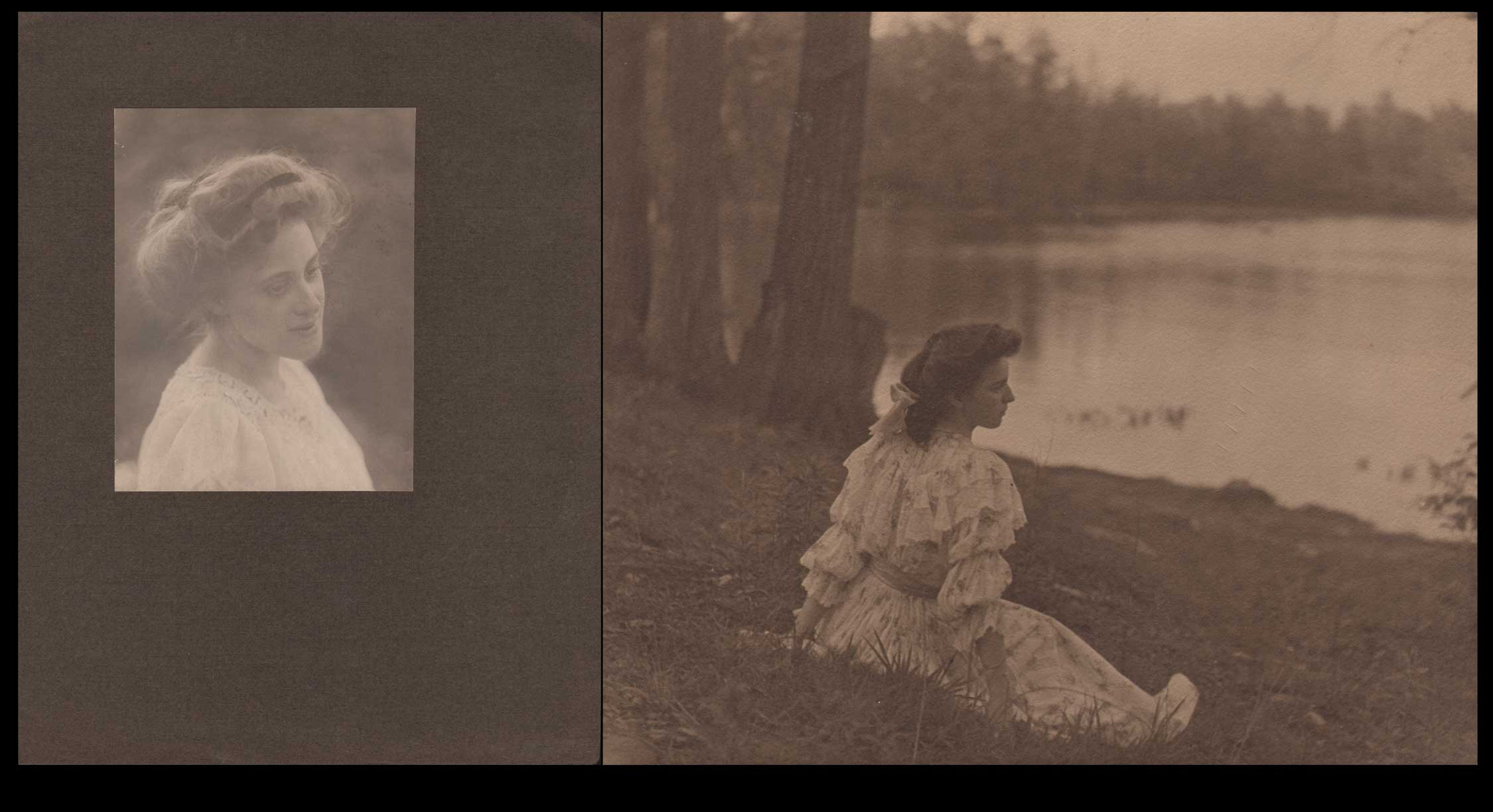
Female Studies: Left: “A Head”, 16.8 x 13.1 cm | 33.2 x 25.5 cm, Right: “Curtis High School Girl”, 18.2 x 21.2 cm, 1909 at left; ca. 1905-10 at right, mounted and unmounted platinum prints, C.R. Tucker, American 1869-1956. The profile portrait at left of an unknown, older female subject retains a portion of its original Postal Camera Club label on verso, indicating author, title and sequence- #1, for August, 1909 club’s portfolio. Right: This pleasing study of an unknown young woman resting before a lake is a warm brown platinum print: the photographer additionally printed it as a bromide print in 1916, probably for exhibition. Both: PhotoSeed Archive

Reportedly warm in personality: a proven public speaker with the capacity for humor in telling a good story, he cuts a dashing figure in surviving photographs. Wearing an ever-present silk cravat but with the contradiction of tousled hair in throwing off the look in several surviving photographs, Tucker at the end of the day was a realist. To wit, in his 1956 obituary, his good friend E. Huling Woodworth, the deputy governor general of the General Society of Mayflower Descendants, quoted Tucker that he went to New York City in the promotion of his teaching career: “simply because they paid me more money”. Around 1920, the amateur photographer seemed to have had enough however. Looking back much later in life, he said: I tried teaching for 45 years; decided I couldn’t do it, and when they told me they would rather pay me than have me around, I bought a Vermont farm, but I kept on teaching, to try to pay farm expenses; I am now living on the interest of what I lost, trying to be a farmer”.

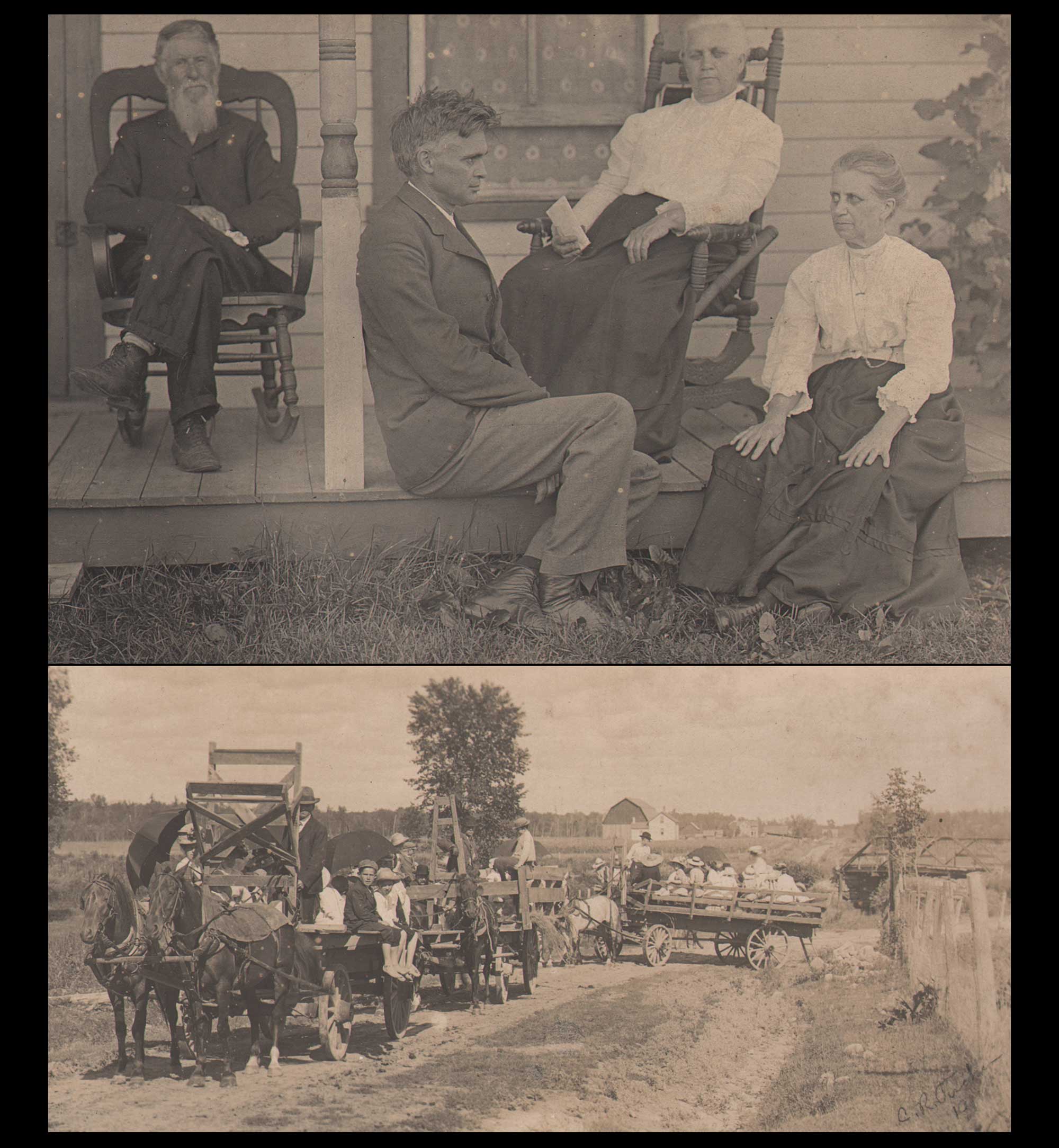
Mother & Son: Top: “Royalton, Wisconsin Family Group”, Bottom: “Wisconsin Sunday School Outing”, 1908 (top) and ca. 1908, printed 1910?, both: rppc gelatin silver postcard & bottom: unmounted gelatin silver print: Top: 8.4 x 13.1 cm, Bottom: 6.6 x 15.7 cm, C.R. Tucker, American 1869-1956. The photographer, seated at center, and mother, Myra F. Tucker: 1848-1927, seated at right, look towards each other. Myra’s sister, Susan A. Talbot Phillips, 1848-1922 sits behind them, along with her husband Sewall A. Phillips: 1839-1912, at far left. Sewall had been a member of the WI State Assembly and worked as a teacher. Bottom: three large horse-drawn wagons ferry a large group of children and adults during what is believed to be a Sunday school outing, possibly in Spencer, WI. The print is signed and dated at lower right corner. Both: PhotoSeed Archive

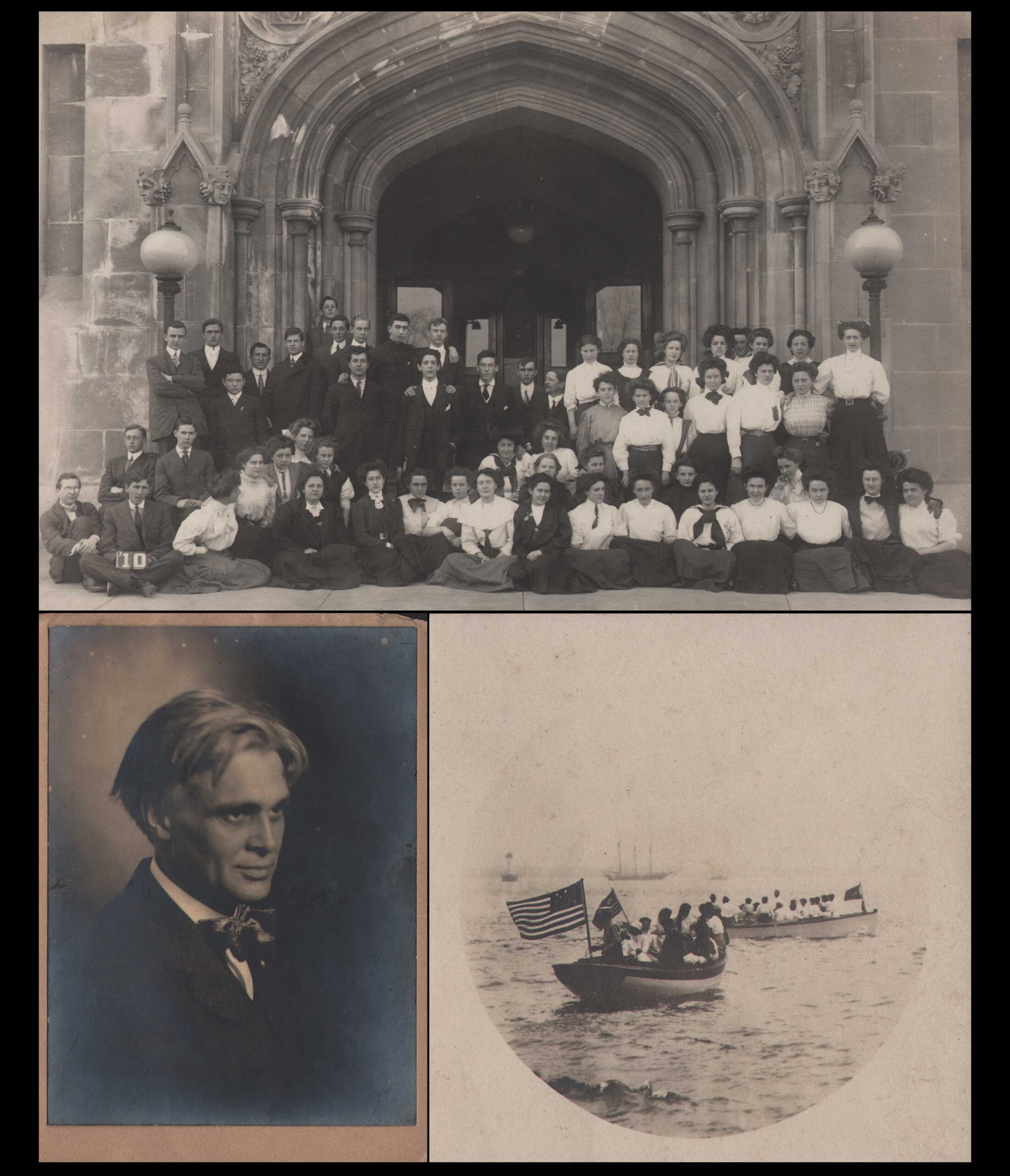
Curtis High School: Top: “Class of 1910: Curtis High School”, Bottom left: “Portrait of Charles Rollins Tucker”, Bottom right: “Around Staten Island”, all: ca. 1910, unmounted and mounted gelatin silver prints, probably C.R. Tucker, American 1869-1956. 18.7 x 24.1 cm, portrait: 13.2 x 9.8 | 14.7 x 10.4 cm, boats: 6.0 cm roundel on 9.3 x 7.2 cm photographic paper. Note student seated in front row at far left holding #10 sign. This signifies these are Curtis High School students, class of 1910. A vibrant community school in the 21st Century, it first opened in 1904, with Tucker teaching here until 1914, when he was put in charge of the Tottenville Annex. A formal, tousled-hair (self-portrait?) portrait shows the artist with his ever-present silk cravat. The dates 1910-1915? are written in unknown hand on mount verso. Small, open steam launches, with boat at foreground flying an American flag, make their way in the waters around Staten Island in a student outing, taken about 1910. All: PhotoSeed Archive

And all the while, the photographic evidence taken in promotion of his hobby, both inside and outside that teaching career, was most important to him. He used his amateur camera to photograph some of his students, even going as far as displaying mounted examples in his own home, and became, in effect, an in-house yearbook style photographer. For Curtis High School especially, Tucker photographed students and teachers alike. He also recorded events, like a class boat trip and sporting scenes: a panoramic showing a a long line of young women exulting in exercise- part of an outdoor gym class.

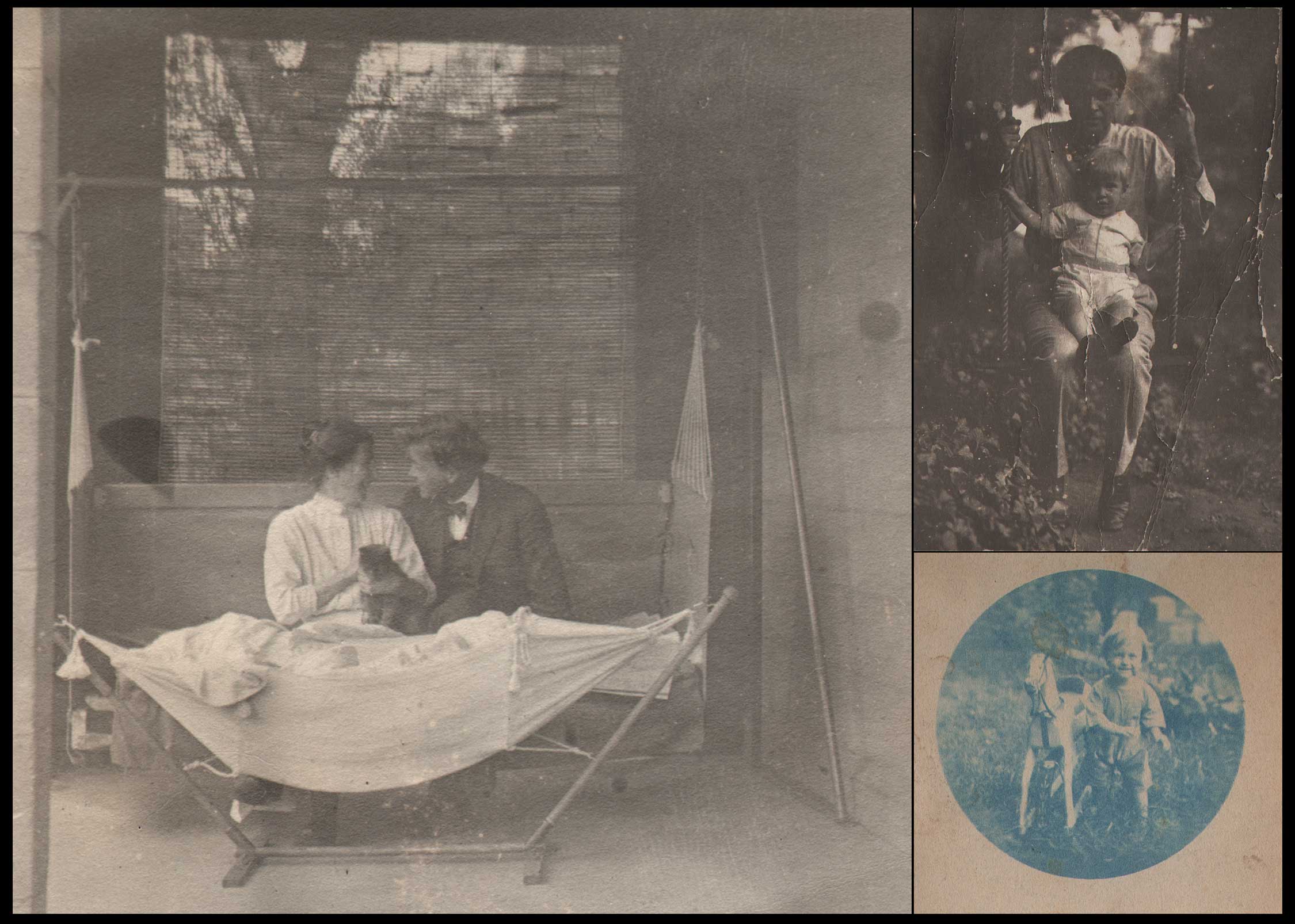
Tucker Family in New Dorp: Left: “Charles, Mary & Robert Tucker on Porch”, Right: “C.R. Tucker with son John Robert on Swing”, bottom right: “”Giggle Jerry!”, porch: 1914, swing: 1914, Jerry: ca. 1915-16; unmounted gelatin silver prints and cyanotype rppc, all: attributed to C.R. Tucker, American 1869-1956, and daughter Dorothy Tucker. L: 13.0 x 13.9 cm, swing: 9.5 x 6.8 cm, Jerry: 6.3 roundel on 13.7 x 8.2 cm card. The Tucker family home at 90 Third St. in the New Dorp section of Staten Island welcomed the second born, John Robert Tucker, 1914-1991, in March, 1914. The newborn lies in a hammock on the porch while the photographer and his wife, holding a cat, fawn over him. At right, Tucker goes for a swing with son John Robert (?) on his lap while his third child, Stephen Jeremiah “Jerry” Tucker, 1915-2001, plays with his rocking horse at bottom right. A second cyanotype rppc of this image gives title as Giggle Jerry! on recto and photo credit to his sister Dorothy on verso. All: PhotoSeed Archive

Preserved decades later by his son Stephen “Jerry” Tucker, and subsequently purchased by this archive many years after his passing, these mounted and unmounted photographs-some printed in platinum- are beautiful pictorialist records of early 20th Century American High School life. Some of the hand-written titles on the versos of just some of these mounted and unmounted photographs: “Curtis High School Girl”;  Curtis High School Girl in Costume of a Play”; “Apple Blossoms”: a genre photograph celebrating Spring featuring a student wearing a long dress ornamented by sunflowers; “Curtis HS Elocution Teacher”, and many others.

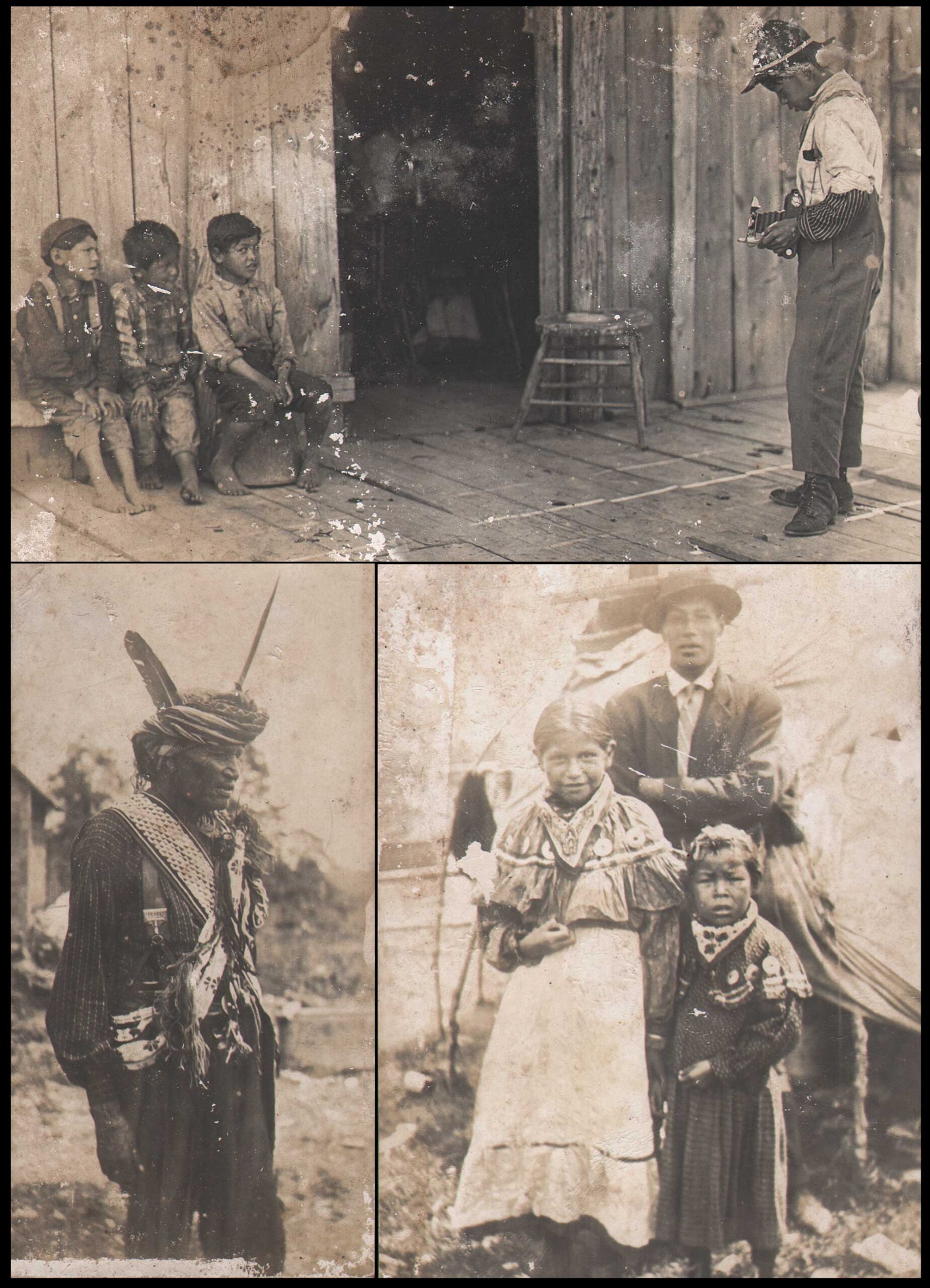
Exploring Native-American Cultures: Top: “Man Photographing Seated Children”, LL: “Native-American Man”, LR: “Native Family Group”, all: ca. 1910-15, unmounted gelatin silver prints, attributed: C.R. Tucker, American 1869-1956. Top-LL-LR: 10.9 x 15.9 cm, 9.9 x 4.9 cm, 10.2 x 6.8 cm. Tucker was known to give public lectures on Pictorial Photography in 1908 and, pertaining to this grouping of photographs in 1916: an illustrated lecture for children described as “A Visit to the Wisconsin Indians”. Although degraded by the elements and digitally cleaned up here, these were found with the larger Tucker archive: photos he is thought to have made during  frequent visits to Wisconsin to visit in-laws. Given the sad history of forced assimilation by the US Government by which Native-American children were placed in American Indian boarding schools throughout WI (and the greater US) it cannot be ruled out the top photograph may have been taken at such a school: the subjects in the other photographs not so much because they wear native clothing. Other photographs not shown depict a sweat lodge. All: PhotoSeed Archive

Mayflower Descendant & Later Life

“I had a lot of fun tracing ancestry back to counts and no-accounts, especially the early American families. I found 6 Mayflower ancestors (John Alden was one) 11 Revolutionary ancestors, one Indian, one witch (hanged in Salem, 1692). The Ball and Adams families (whence President Washington and the Adams)”. –Charles Rollins Tucker


In the late 1930’s and through the early 1950’s, Tucker was living in Brooklyn and active as the Vice-President of The Alden Kindred of New York City and Vicinity. As a long-descended related “cousin” of Mayflower passenger John Alden, the Alden Kindred was then, and is still today, an active Mayflower descendant society named after English pilgrims John and Priscilla Mullins Alden. Before the untimely passing of the photographer’s wife Mary in 1940, Tucker and his wife would host chapter meetings in their home. Later, in the pages of the Alden Kindred “Gossip”, a newsletter reporting on the happenings of the society as well as the private accomplishments of its members, the musings regarding “cousin” Tucker were duly reported.

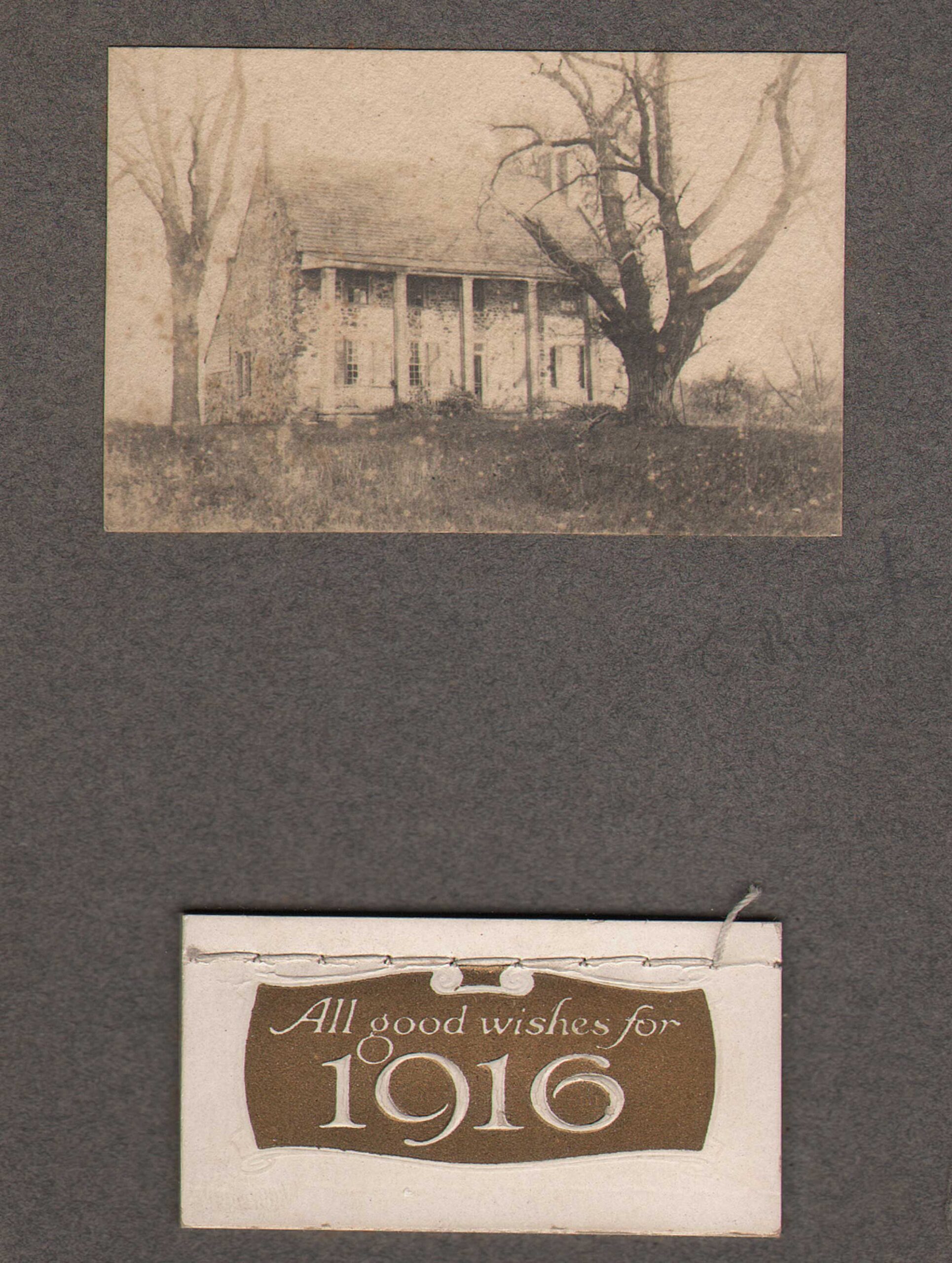
American History Preserved: “Conference House: Tottenville, Staten Island”, ca. 1905-10, mounted platinum print for 1916 calendar, C.R. Tucker, American 1869-1956. 4.4 x 6.7 | 13.9 x 8.8 cm. A Staten Island resident with a passion for American History, it’s not surprising Tucker would photograph one of the oldest buildings on the island. Also known as the Billopp House, it was here on September 11, 1776 that a meeting was held by Benjamin Franklin, John Adams, Edward Rutledge and others with Lord Howe, commander in chief of British forces in America, in an unsuccessful attempt to halt the American Revolution. A landmark and museum today, the home is shown in the early 20th Century when columns supported a long front porch- no longer present. Signed on the mount by the artist, the 1916 calendar may have been a promotion for the South Shore Savings and Loan Association, of which the photographer was president of that year. From: PhotoSeed Archive

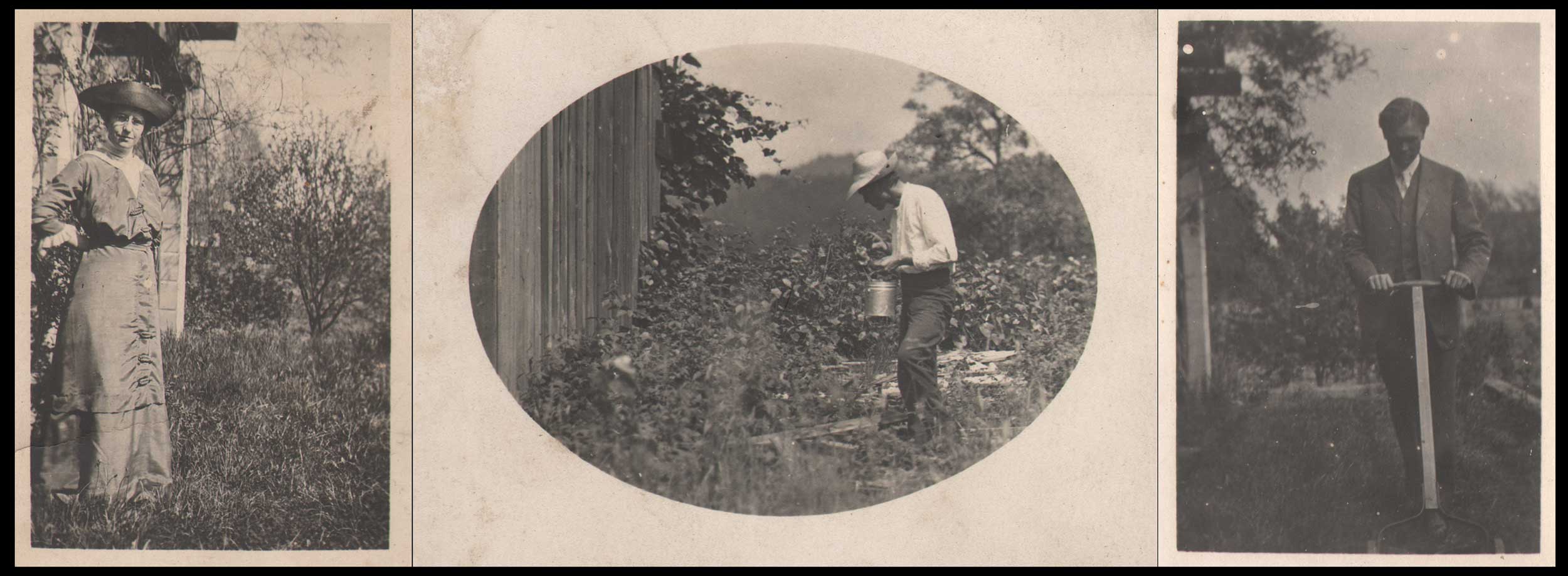
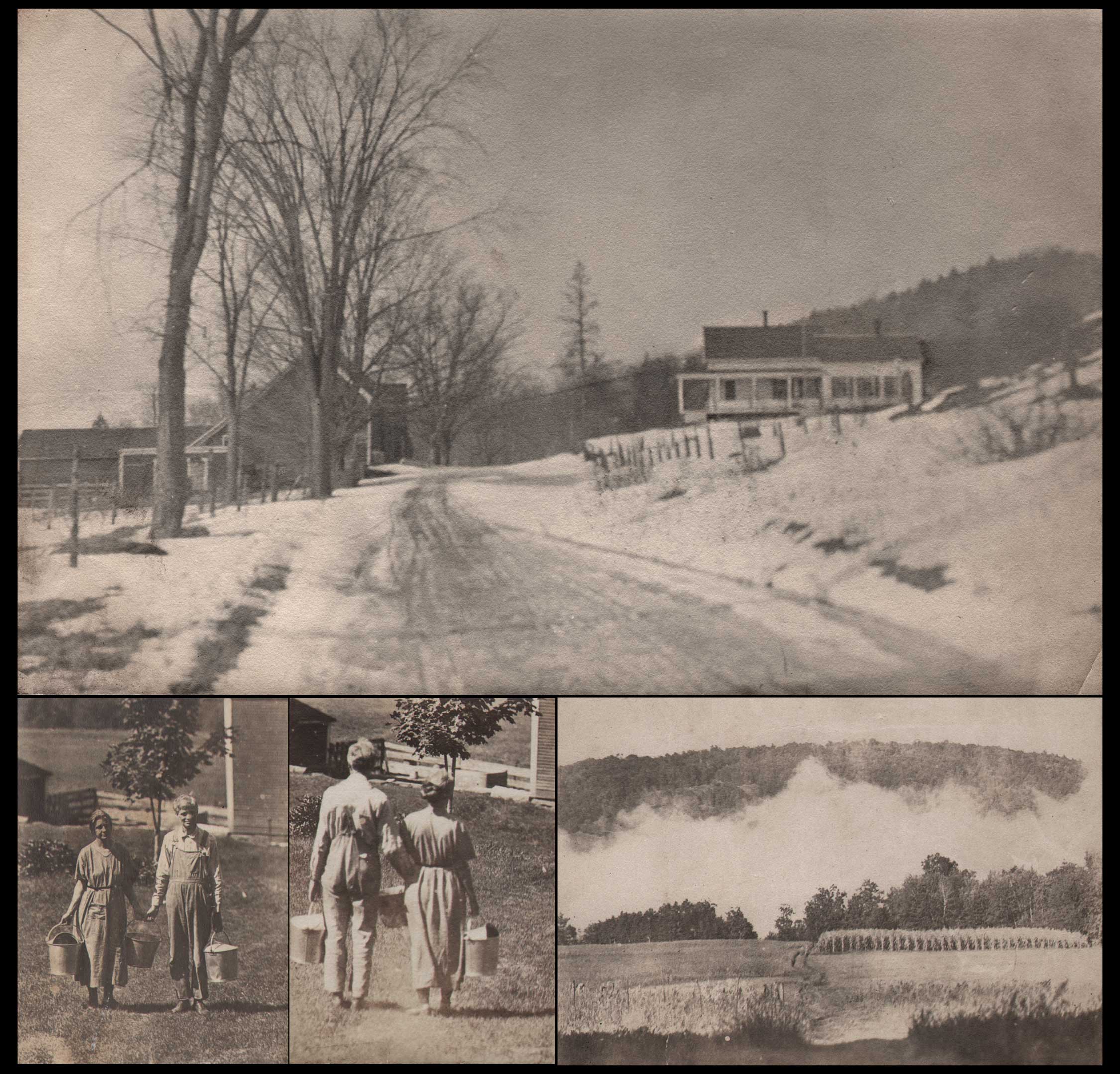
Farming Home in Vermont: Top: “Tucker Farmstead, Randolph, Vermont”, LL: “Charles & Mary Tucker with Buckets on Farmstead”, LR: “When the Mists have Rolled Away”, all: 1920’s, unmounted gelatin silver prints, attributed: C.R. Tucker, American 1869-1956. Top-LL-LR: 16.6 x 25.9 cm, 6.7 x 4.8 & 5.7 x 4.2 cm, 6.6 x 8.8 cm. The Tuckers are believed to have purchased this 125-acre farm, (seen at top photo) located in Randolph, VT, before 1920. The Farmhouse at upper right was enlarged, based on another photo, with a large covered porch. Two fun photos show Charles and his wife Mary, probably holding galvanized metal maple sugar buckets, both coming and going. This pleasing scenic view is believed to be from VT and may be a view from the farm- the title written on the print verso most likely referring to the 1874 composition of the same name by composer James Gowdy Clark. Due to his own retirement from public teaching around 1939, the damaging effects of the 1938 hurricane and the passing of his wife in 1940, Tucker sold the farm in the early 1940’s. All: PhotoSeed Archive

Here’s one example, from a 1949 “Gossip” article with the headline: Charles Rollins Tucker, (Expert with the Camera) showing that even at 80 years of age, the photographer was still passionate for a hobby believed to have begun in his high school years:

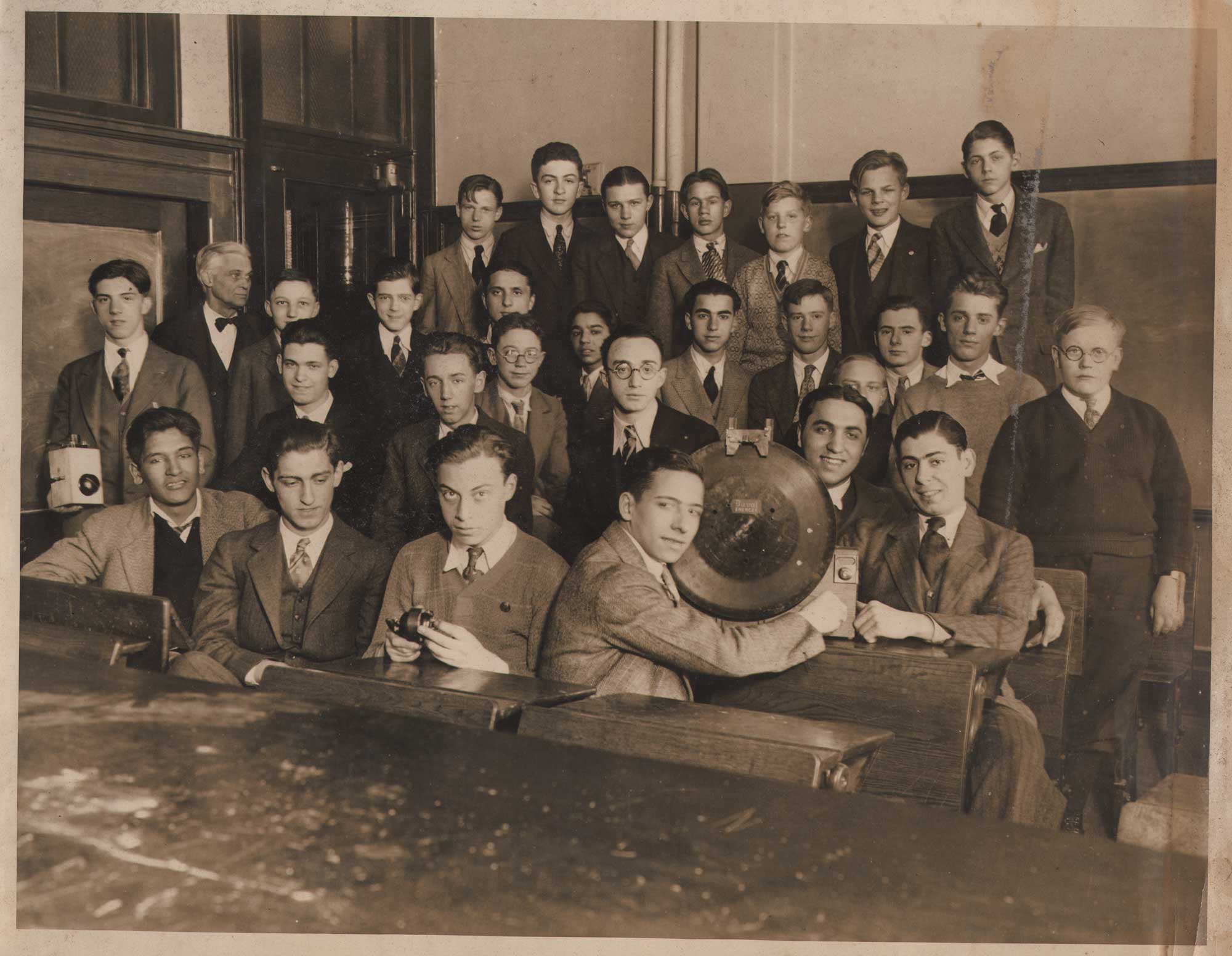
The Latest Technology: “Manual Training High School Students Show off Radio”, ca. 1930, unmounted gelatin silver print, unknown photographer, but perhaps C.R. Tucker, American 1868-1956. 25.5 x 33.1 | 27.9 x 35.6 cm. The photographer spent many years teaching at this Brooklyn school, from about 1917-1939. Here he stands in third row at far left looking away from the camera. The group may have been a radio club at the school, and the students display at front right an early radio stamped “Duval Energee” above center of large disc. Duval Radio Products Corp. marketed “radio electron tubes and batteries” under the Duval Energee name beginning around 1927. From: PhotoSeed Archive

Now C.R.T’s. color photographs have carried his reputation along the eastern coast from Key West through Maine. He estimates that he has 3,000 slides. He is expert in catching the significant moods of flowering plants and of little children in their own habitat. His slides in Art League exhibits “steal the show”.

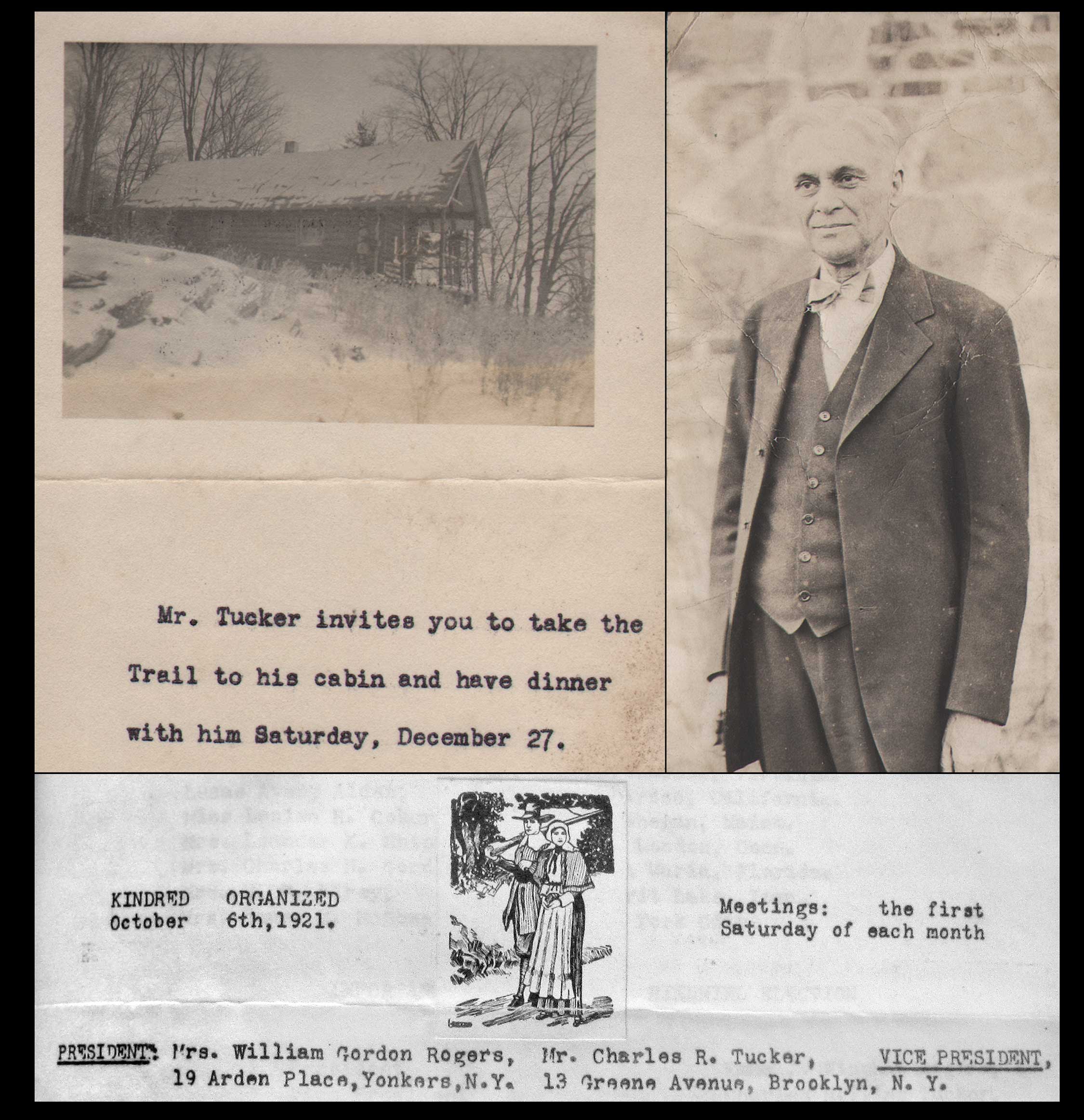
Later Years: Top Left: “C.R. Tucker Dinner Invitation”, ca. 1945-50, Right: “Portrait of C.R. Tucker”, ca. 1935-40, both: POP and gelatin silver print, attributed: C.R. Tucker, American 1868-1956. Bottom: Detail: “Alden Kindred Gossip Newsletter”, Dec. 1934. Invite: 5.6 x 7.9 | 15.2 x 10.0 cm, portrait: 8.6 x 4.5 cm. After retirement and the early passing of his wife, Tucker typically spent the months of May and October in this mountain cabin at Aldenwood in western North Carolina in route to wintering in Mt. Dora, Florida. The owner, E. Huling Woodworth, was a good friend and  deputy governor general of the General Society of Mayflower Descendants, whom Tucker met through his role as Vice-President of The Alden Kindred of New York City and Vicinity. The photographer claimed he had “found 6 Mayflower ancestors (John Alden was one) 11 Revolutionary ancestors, one Indian, one witch (hanged in Salem, 1692). The Ball and Adams families (whence President Washington and the Adams)”. Here, a detail of the Gossip, the newsletter of The Alden Kindred, lists him as Vice-President, which he held from around 1933-50. Photos: PhotoSeed Archive, newsletter: Wisconsin Historical Library Archives, Madison, WI.

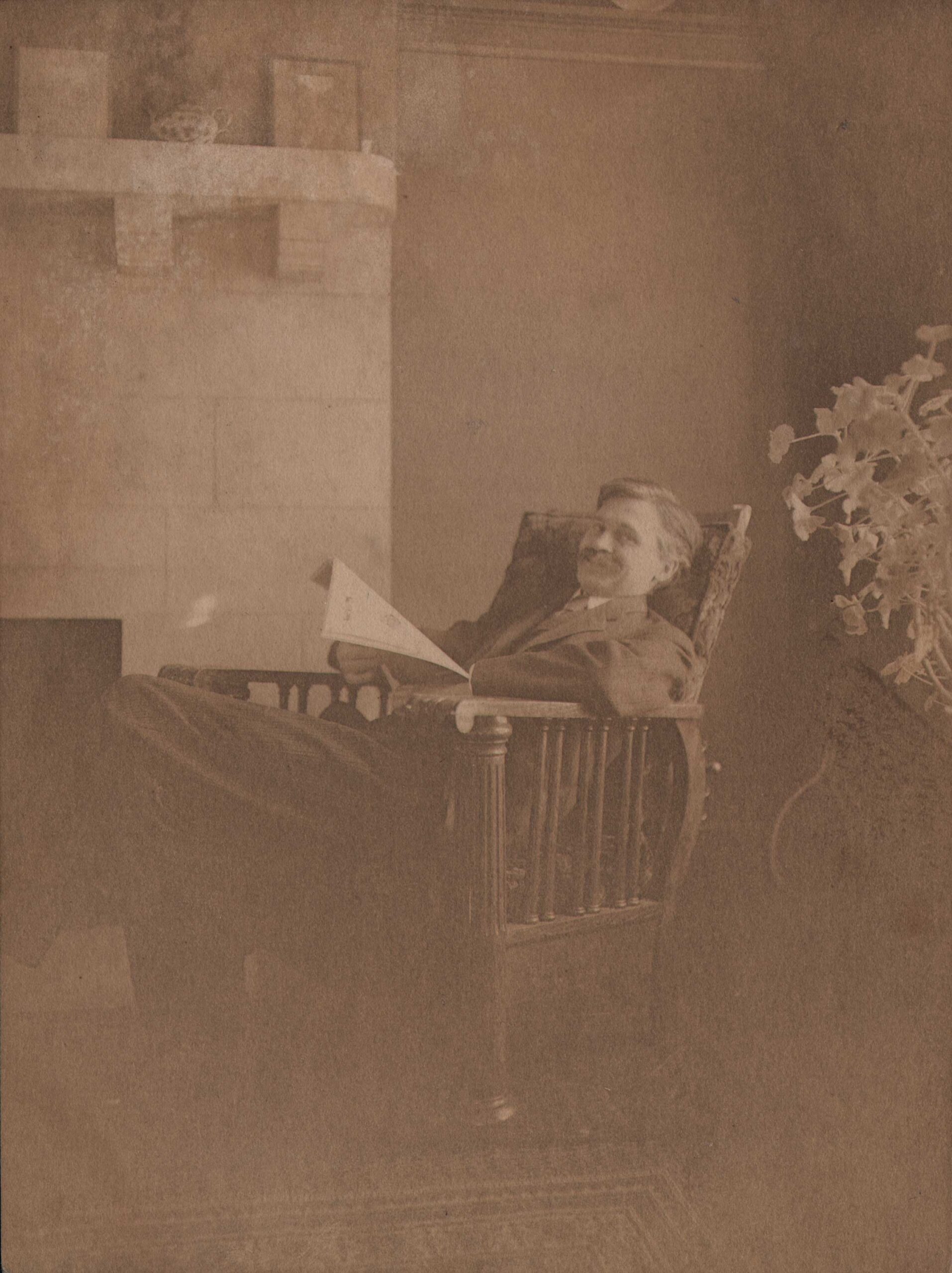
Finis: “Dad in Living Room at New Dorp”, (sic) ca. 1906, unmounted platinum print, C.R. Tucker, American 1868-1956. 19.7 x 14.7 cm. The artist smiles at the viewer while reading from a favorite dining room chair, taken around the same time he and wife Mary and first-born Dorothy moved into their modern Staten Island concrete home in 1906. Charles Rollins Tucker’s life was a series of wanderings- a game of musical chairs in which he wore many hats, made many friends, taught many children, and fortunately for us, made a photographic record throughout. A description in his 1956 obituary seems appropriate with this last photograph of the artist, in the sense he would pass on much later in one of those chairs, albeit figuratively, something his known demeanor of “lovableness and gentle humor” might have allowed him a chance to wink back at us from the future, as he “went to sleep in his chair, in his tiny little home” the last time. From: PhotoSeed Archive

From the same article, the invocation of Shakespeare as poet ultimately defined him, his optimistic view of life made relevant from all its ordinary moments, and here, with photographic evidence for the ages:

Mr. Tucker loves people, but does not need them to keep himself happy and busy.- Shakespere climaxes him as “seeing good in everything”.


Historical Timeline: Charles Rollins Tucker: 1868-1956

1868: Born in Canton, MA on December 18. (source: Tufts College Yearbook) A major discrepancy exists: his headstone indicates 1869, and his 1956 obituary details in the Middleborough Gazette stated he died at 87 years old.

1880: Charles, 11, living with family in Hubbardston, Worcester, MA. His father George is a farmer and mother Myra a housekeeper. (George Lewis Tucker: Jan. 16, 1843-May 19, 1907) (Myra F. Tucker: 1848-1927)

1887: Graduates from Stoughton High School, Stoughton, MA. In his class of 15 students, he was one of only two who graduated. In 1892, his younger brother Lewis L. Tucker, would not graduate.

– Matriculates at Tufts College, Medford, MA in September, in the “Philosophical course”.

1889-90: At Tufts, he is Secretary of the Camera Club in his junior year and member in his senior year; Secretary and treasurer of Reading-Room Association, 1889-90; member of the Sketch Club as a sophomore; member of the tennis club earlier.

1890: He’s the Vice-President of the 1891 Junior class at Tufts; self-quotation listed in yearbook: “He has a lean and hungry look; such men are dangerous. -Shakspere“. As a junior, during the annual Prize Speaking and Reading ceremony at College Hall on June 10, he gives the speech: “Plea for the Old South Church”, by Phillips. First delivered in 1876 by Wendall Phillips, the speech saved the Boston landmark church from destruction, affirmingTucker’s interest in preserving and advocating for American history.

1891: Graduates Tufts with bachelors degree, Ph.B. in chemistry and physics.

– As principal of Somerset, MA High School, he began teaching pupils in 15 subjects, in the one-room school located on Pierce’s Bluff off of South Street.

1892: Principal of Procter Academy, Provo, Utah, for one year.

1894: Receives his Master of Arts from Tufts College.

1895: Principal of West Boylston, MA, High School.

1896: Submaster in Quincy, MA High School.

1897: Working in the Educational Department at the YMCA (Springfield, MA Training School)

1898: In September, becomes an assistant instructor in physics at Pratt Institute, Brooklyn, N.Y. 

– Marriage to Mary Carruthers on July 29 in Manhattan, New York.

1899: Daughter Dorothy born in Stoughton, MA on August 27.

1900: US Census: living with wife Mary and daughter Dorothy at 73 Clifton Place in Brooklyn.

– Family moves to 4 Wall Street in New Brighton on Staten Island.

1903: Tucker listed as a teacher in the High School Department at Public School 14 located at Broad and Brook Streets in Stapleton, Borough of Richmond, Staten Island. He most likely had been teaching here before 1903. (source: Directory of Teachers in the Public Schools 1903)

– Becomes a member of the Staten Island Institute of Arts and Sciences as well as the Natural Science Association of Staten Island.

1904: Transfers, from PS 14, to the brand new (George William) Curtis High School, where he continued teaching physics. Opened in February, Curtis was the first high school built on Staten Island. (source: notice: School: Devoted to the Public Schools and Educational Interests”, issue for December 25, 1903)

1905: His name appears on the Curtis High School teaching roster published in The Journal of the Board of Education of the City of New York. His yearly salary in 1905 is $1960.00, with a proposed increase for 1906 to $2042.50. His address continues to be 4 Wall Street in New Brighton.

Receives an honorable mention in the Photo Era Portrait Competition.

1906: In October, Tucker and his wife take out a mortgage for a revolutionary home made entirely of concrete in New Dorp, Staten Island at 90 Third Street from Eleanor Gardner, believed to be the lender. Built ca. 1904-1905, it was designed by Robert Waterman Gardner, 1866-1937, president of the New York Society of Craftsmen, an architect who pioneered using reinforced concrete in residential construction. The Tucker’s were the second owners of the home after the first, W.J. Steel. 

His photograph “The Mill”, taken in West Bridgewater, MA, is published in the June issue of the Photo-Era. It showed he was a member of The Postal Photographic Club of the United States. The accompanying article outlined the club was founded in early 1885, with membership strictly limited to 40 all residing east of the Ohio River.

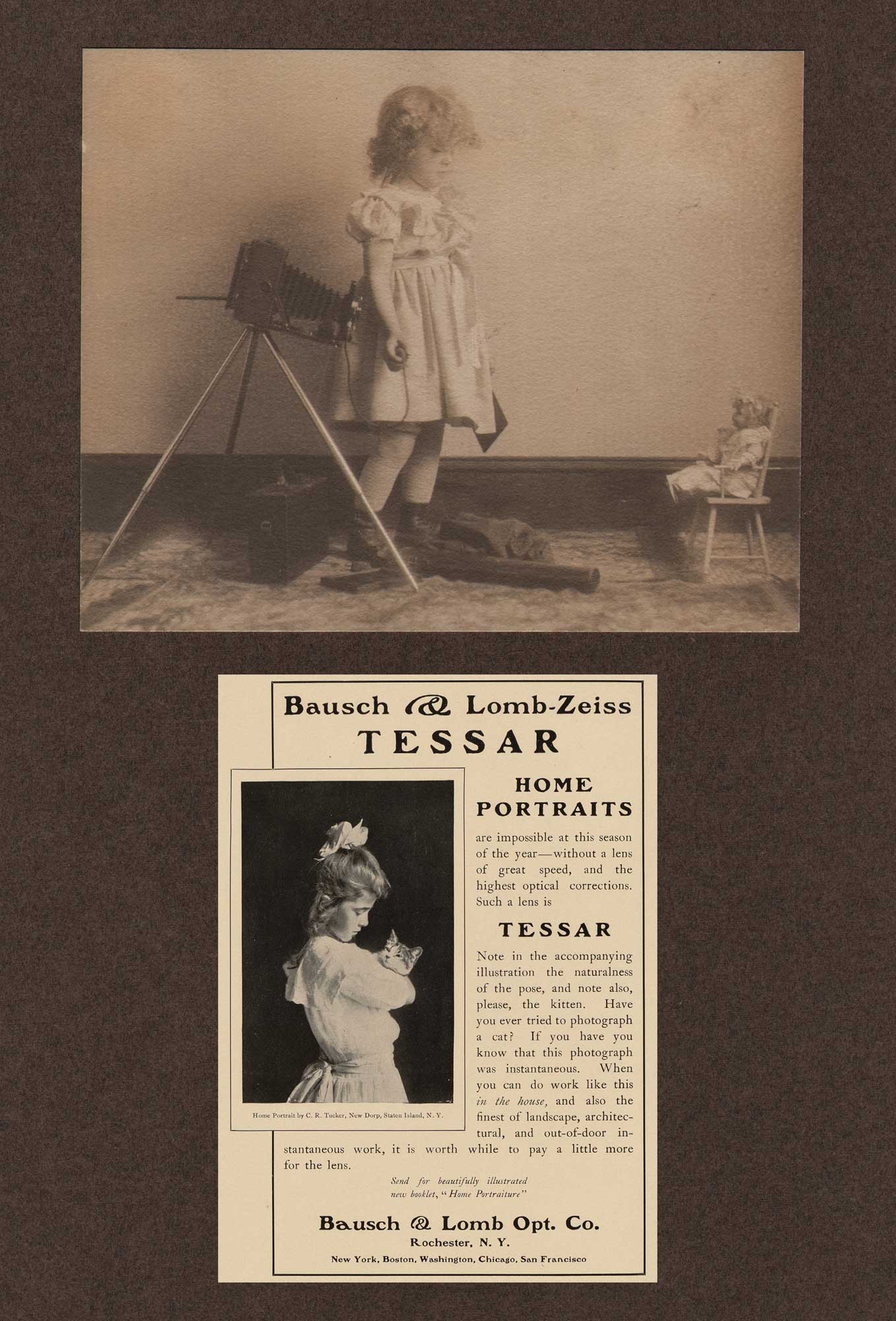
1907: In January, a portrait of his daughter Dorothy holding a cat appears as part of an advertisement for Bausch and Lomb-Zeiss Tessar lenses “Home Portraits” in Camera Work XVII.

– Tucker now listed as member of the Postal Camera Club, with a history first dating to 1900 and a roster from around the country, including California.  One of his award-winning photographs for the club,  Day Dreams”, held by this archive, was widely discussed and published in 1907.

– Writes article: The Pleasures of Winter Photography”, for the December issue of Suburban Life Magazine.

1908: Gives a New York City public schools lecture: “Pictorial Photography” in November and December at Public Schools 62 and 63.

1910: American Photography magazine reports C.R. Tucker is a member of: “A New portfolio club has been organized among the advanced workers in the territory east of the Ohio River and north of Washington, D. C.” (other members include: W. H. Zerbe, C. F. Clarke, S. B. Phillips, Miss Katherine Bingham, H. W. Schonewolf and others) “Membership is by election after circulation of samples of work, and only those of marked ability are desired.”

1911: In what was probably a recalibration of the earlier 1910 portfolio club, The Photo Era announces the formation of: The New Postal Photographic Club: C.R. Tucker of New Dorp is a member: “A New pictorial Photographic Album Club has just been started. It has not yet been christened, but a vote is now being taken to determine its title.”

The album is making its first round and the prints contained therein show most painstaking efforts to put it on a parity with any similar club of the country, and when we take into consideration the active and pictorial workers of this club, we feel justified in predicting its success.”

1914: Tucker’s first son,  John Robert Tucker, (1914-1991) is born on March 3 on Staten Island.

– Listed as being in charge of the Tottenville Annex of Curtis High School, and an assistant teacher of physics. Continues to live at 90 Third St., New Dorp, S.I. with the telephone # 922-J Tottenville (Ext. of P.S. 1)

1915: His second son, Stephen Jeremiah “Jerry” Tucker, (1915-2001) is born on April 24th in Vermont.

– At the Tottenville Annex, Tucker heads up the Junior Audubon (Society) Class. An article published by the Macmillan Co. states: “This class has no stated meetings, we are informed by Charles H. Tucker, (sic) the leader, but makes the study of birds a part of the regular work in biology, using the Educational Leaflets as a text-book, and paying especial attention to the economic value of the birds studies.”

1916: The January issue of The Museum Bulletin of the Staten Island Association of Arts and Sciences lists a free illustrated lecture for children by Tucker: “A Visit to the Wisconsin Indians.” A later issue stated 100 people attended.

– While continuing to teach public school, Tucker is listed as President of the South Shore Savings and Loan Association, at No. 11 Sixth Street in New Dorp, Staten Island. The bank commenced business in 1915. The presidency of the bank was taken over by A.J. Grout in 1917, and he assumed that position through at least 1928.

1917: Charles and Mary Tucker sell house at 90 Third St. in April to Dr. Abel Joel and Grace Grout. The home was later purchased in 1922 by the Catholic Diocese for use as Our Lady Queen of Peace Rectory. The present rectory building was built in 1951 and is red brick. It’s assumed the Tucker’s concrete block home was leveled to build the present structure. From the history of the rectory: “Instead, he negotiated with Doctor Grout whose home was situated on Cloister Place and Third Street, but whose property flowed around the corner onto New Dorp Lane. The Grout Home was to become the rectory and the wooded land became the site of the church and school.

– Dorothy Frances Tucker listed in Tufts College Jumbo Yearbook as matriculated and pursuing her AB degree. Lists being from New Dorp (Staten Island) and graduate of Curtis High School.

– Its believed around this time Tucker joined the faculty of Manual Training High School in Brooklyn, N.Y. as professor of physics, with his 1956 obituary stating he retired from the school about 1939.

1920: Dorothy receives her Bachelor of Arts degree as a member of the Jackson College for Women at Tufts College on June 21 at the 64th Annual Commencement.

1925: On the New York State Census, Charles occupation is listed as teacher. He lives at 13 Greene Ave. in Brooklyn along with daughter Dorothy, also a teacher, and two younger sons.

1929: Mentioned in Alden KindredGossip” that he was teaching at the Manuel Training High School of Brooklyn, N.Y. At the time, The Gossip was a publication of  The Alden Kindred of America, a Mayflower descendant society named after pilgrims John and Priscilla Mullins Alden.

– Additionally mentioned in the “Gossip” this year- pertaining to his photo skills:  The Green Mountain Club has awarded a second prize in a photographic contest to our Cousin C. R. Tucker of Brooklyn and Randolph, Vt. The scene is a delightful section of Lake Mansfield and Nebraska Notch with a cross section of mountain region which is almost impossible to catch with a camera and keep the picture clear in perspective. Both in composition and development very careful thought had been given and the prize was well deserved.”

1932: Writes poem:

Freedom  

When the city’s narrow street

Meets the broad highway and gives

Glimpse of space and sky and cloud

Beyond the noisy throngs that crowd,

That is momentary joy.

But when at last my sentence here shall end

Free from this ceaseless shirl of work

and care

(Another waits to better fill my place)

I can forever leave this noisy race,

That will be lasting joy.

1933: Living at 13 Greene Ave. Brooklyn. During this time and much later, Tucker was the Vice-President of The Alden Kindred of New York City and Vicinity.

1934: Charles and Mary Tucker living at 108 South Elliott Place, Brooklyn.

1935: Notice in the Alden Kindred Gossip that Charles Tucker had retired from his teaching job in New York City: “Extra! Extra! Charles Rollins Tucker has retired and does not expect to teach in New York City any longer. The family is moving to Vermont immediately, where their address is “Route 2, Randolph”. Mr. Tucker writes that they will miss the Alden meetings and often think of us on the first Saturday of the month, and shall look eagerly for “GOSSIP”.  Bon voyage; bon repose.” (note: his obituary stated he worked until around 1939)

1936:  From the “Gossip”: In August, Mr. and Mrs. Charles Rollins Tucker drove to Ann Arbor, Mich.,via Saratoga, Howes Caverns, Niagara Falls, through Ontario to Detroit, and back by way of Toledo, the Cleveland Fair, Adirondacks, Ticonderoga, Brandon Pass, & c. Son Bob enrolled at the University of Michigan as a senior. The Tuckers will live In Ann Arbor during the Winter, leaving Randolph September 15th. Before going, they were to visit their daughter, Dorothy Tinkham, mother of 2 children, at Rock, Mass.” (Rock Village was located in the town of Middleborough)

1939: Is reported from obituary to have retired from his public school teaching career.

1940: US Census: Tucker living with wife Mary and son Jerry in Randolph, VT

Mary Carruthers Tucker dies in Boston.

1943: (approx.) Starts Wintering in Mt. Dora, Florida. (one address printed in the Gossip was 916 Grandview Ave.)

1949: The following overview of the life of Tucker appeared in the May issue of The Alden Letter, No. 47:

CHARLES ROLLINS TUCKER, (EXPERT WITH THE CAMERA.)

In the 28 April, 1949 issue of Mount Dora Topic ( Mount Dora, Lake Co., Fla.) Mabel Norris Reese has expressed something of the lovableness and gentle humor which characterize our Alden Kindred official member, Charles Rollins Tucker.

The author quotes from Mr. Tucker: “I tried teaching for 45 years; decided I couldn’t do it, and when they told me they would rather pay me than have me around, I bought a Vermont farm, but I kept on teaching, to try to pay farm expenses; I am now living on the interest of what I lost, trying to be a farmer”.

It was like Charles Tucker to say nothing of the heartbreak when Death took his companionable wife, while they were still Vermonters. Nor is there mention of the 1938 hurricane which crashed through their precious capital, in sugar maple groves.

Nothing of the anxious loneliness while World War II held son, Jerry, for 4 years in the Pacific.

Miss Reese notes that Charles was born in Canton, Mass.; at 4 years, with his family traveled in a prairie schooner to Missouri; shortly afterward moved on to Wisconsin for 5 years in a log cabin; at 10 returned with the rest of the Tuckers to Massachusetts.

There he matriculated in an old red school house – Seems to have garnered a good deal out of it, too- He went to Tufts College and a bachelor degree in 1891. But “not satisfied with being a bachelor, I took another college year to be a Master.”

Charles began teaching pupils in 15 subjects, in a one-room Mass. school; continued teaching as principal of an academy In Utah; went to New York City – “simply because they paid me more money”: stayed there for the rest of his teaching life, as a high school instructor.

As to Charles Tucker’s avocations, he says regarding genealogy: “I had a lot of fun tracing ancestry back to counts and no-accounts, especially the early American families. I found 6 Mayflower ancestors (John Alden was one) 11 Revolutionary ancestors, one Indian, one witch (hanged in Salem, 1692). The Ball and Adams families (whence President Washington and the Adams)”.

Now C.R.T’s. color photographs have carried his reputation along the eastern coast from Key West through Maine. He estimates that he has 3,000 slides.

He is expert in catching the significant moods of flowering plants and of little children in their own habitat. His slides in Art League exhibits “steal the show”.

Mr. Tucker loves people, but does not need them to keep himself happy and busy.- Shakespere climaxes him as “seeing good in everything”.

He spent last October alone in Aldenwood, N.C. a mountain cabin – in a wide spread community of 14 houses, 90 souls and 5 surnames: McCall, Anderson, Devore, Hogshed, Owen. They were 17 miles from a grocery store, 25 miles from a movie – One day the community jammed a mountain schoolhouse to see for the first time an outside world interpreted to them by Chas. Tucker.

For 6 years Mr. Tucker has spent his winters in Florida. Last Dec. 18 he was quietly reading away his 80 anniversary when he heard whispers and stifled giggles: The door flew open, and there a host of children were shouting, “Нарру Birthday, Mr. Tucker!” The head ones were bearing a table radio, which the younglings had “chipped in” to get for their most beloved friend. When Mr. Tucker centers a group of little people, one is minded of a scene in Galilee 2,000 years ago.

Mr. Tucker generally comes back to Middleboro, Mass. in a leisurely trip – This year he is trying to reach Aldenwood, N.C. while the shrubbery, delayed by unseasonable cold spells is in top bloom. Two years ago he and son Jerry took 2300 miles of mountain and valley loveliness into their trailer home of 21 days – Throngs of people have gone along with them.

The children of C.R. and Mrs. Tucker could not but be fine also- S. Jerry, after his 4 years of Pacific war service is with the N.H. Cattle Breeding Ass’n, John Robert is in U.S. Testing Co., Hoboken, N.J., Dorothy, the oldest, retired from Harvard U. library work to be a wife and mother on a Middleboro, Mass. farm. At an annual meeting of Alden Kindred in Duxbury a few years ago we heard this proudest grandfather ever, presenting a lovely first grandbaby as “Miss Priscilla Alden, Barbara Standish” – I think her real name is Barbara Tinkham – and that now other grandchildren have carried on the Alden Standish lines.  (pp. 295-7)

1951: Attends 60th reunion of his class at Tufts College, renamed Tufts University in 1955.

1956: Charles Rollins Tucker passes away near Middleboro, Mass., on Monday, May 28.

Obituary: The Alden Letter: No. 132, June, 1956

CHARLES ROLLINS TUCKER, former Vice-President of the Alden Kindred of New York City and Vicinity, went to sleep in his chair, in his tiny little home near Middleboro, Mass., on Monday, May 28 1956, and never woke up. His funeral service was conducted by a Congregational minister the following Thursday, and Burial was in Maplewood Cemetery, Stoughton, Mass. Survivors include a daughter, Mrs. Roland Tinkham of Middleboro, two sons, Jerry Tucker of Susquehanna, Pa. and Robert Tucker of Teaneck, N.J., three grandchildren and at least one great-grandchild. His wife, the late Mary (Carruthers) Tucker, died in 1940.

Mr. Tucker would have been 88 in December and was born at Canton, Mass. He graduated from Tufts College in 1891 and attended the 60th reunion of his class in 1951. He held the degree of Bachelor of Arts and also Master of Arts.

After teaching in Utah some years, he returned East and was in YMCA work for a short time and taught at Pratt Institute in Brooklyn, N.Y. He then entered the New York City public school system and served as teacher and principal on Staten Island. But the major portion of his teaching career was as professor of physics at Manual Training High School in Brooklyn, N.Y. He retired about 1939.

For many years, he retained a summer home on a 125-acre farm at Randolph, Vermont, where several of the New York Kindred visited him. He was an ardent hiker and had several times hiked the entire Long Trail of Vermont, from Massachusetts to Canada. After retirement, he gave up the Vermont farm and he and Mrs. Tucker went to live with their daughter at Middleboro. Mrs. Tucker soon died, and Mr. Tucker established a little summer home near his daughter’s house. He spent his winters in Florida, except for one winter sojourn in Phoenix, Arizona, and the last two winters when he stayed in Massachusetts. For several years, in going to and from Florida, he spent the months of May and October at ALDENWOOD, the mountain cabin of the Huling Woodworths in western North Carolina. He took thousands of color photographs and gave slide showings in Florida, Arizona, South Carolina, Georgia, North Carolina, Pennsylvania, New Jersey, New York, Vermont, New Hampshire, and Massachusetts. Many people have had many hours of enjoyment from his beautiful slides and the sweet whimsicality of his accompanying comments. He will be sorely missed by many.

Alden Letter is indebted to Huling Woodworth, his host at Aldenwood, for the outline of Mr. Tucker’s life quoted above. June 8, ’56.  E.A.P.  (Eudora Alden Philip-editor) note: E. Huling Woodworth was the deputy governor general of the General Society of Mayflower Descendants who compiled the “Mayflower Register” of descendants. He died in 1964.

Listening to Ukraine

Feb 2022 | Childhood Photography

Like others around the world, our hearts are broken for the beautiful citizens of Ukraine. Their determination in the present war is just, and it is our belief their future will reaffirm what is rightly theirs: a democratic country they can always call home; a place where living in peace and harmony with neighbors is a given; and one where their children will always be safe in knowing the love of parents and dreams of listening to a just future are always close by and achievable.

Please consider a donation to the Save the Children Ukraine Crisis Relief Fund.

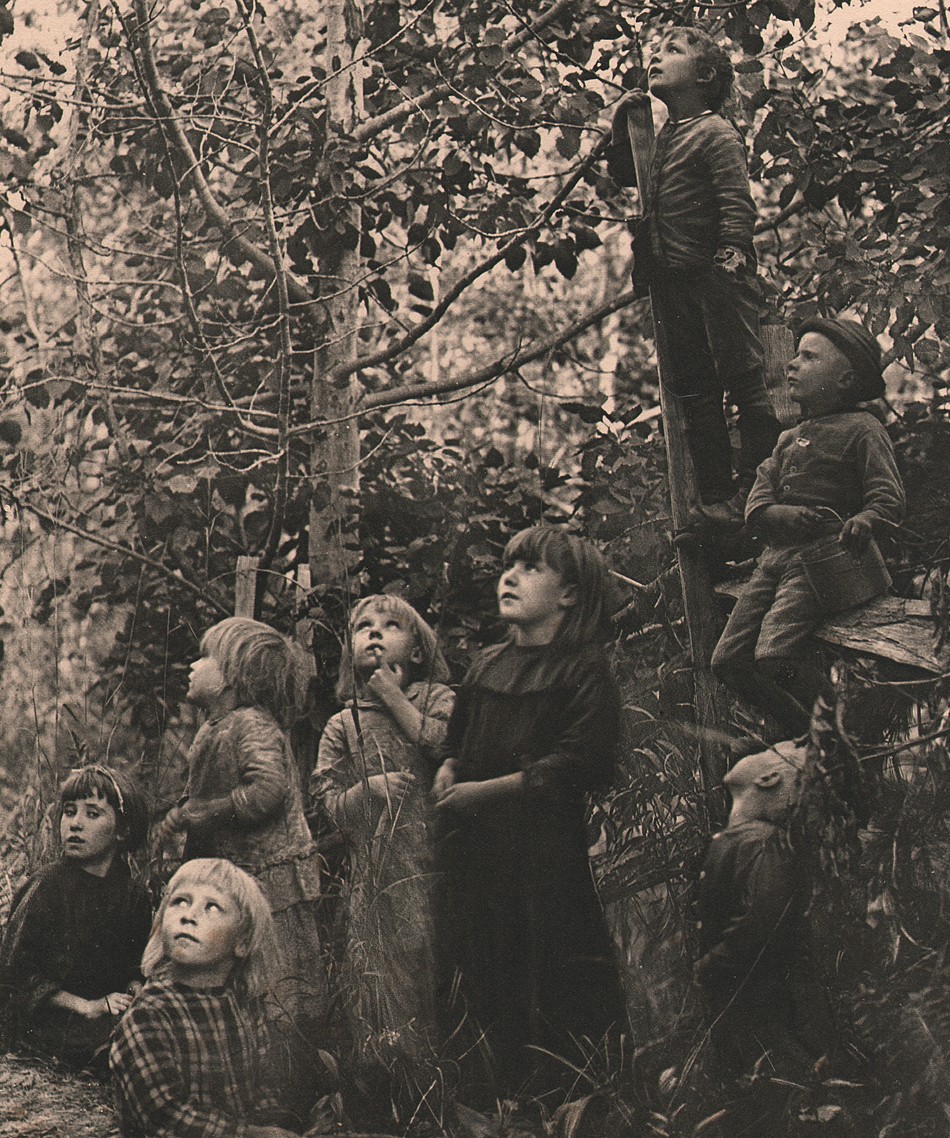
Detail: “Listening to the Birds”. John E. Dumont, American (1856-1944) 1892 signed print (Copyright 1885) : Photogravure: Chine-collé: 33.5 x 25.1 | 40.7 x 34.0 cm. This fine genre study by Dumont of eight children shows them gathered outdoors near a fence and gazing skyward while listening and gazing at birds nesting or flying overhead. The photograph went on to win multiple prizes and medals, including a prize at the prestigious and groundbreaking 1891 Vienna Salon, the first international exhibition where photographs were accepted and judged solely on artistic merit. From: PhotoSeed Archive

The New Decade Roars In

Jan 2020 | Childhood Photography, Painters|Photographers, Photography

Summer Streams Wide & Small

Jun 2019 | Alternate Processes, Childhood Photography, Color Photography, Documentary Photography, Journals, New Additions, Painters|Photographers, Scientific Photography, Significant Photographers, Significant Photographs, Unknown Photographers

Herein a summer interlude, if you will, of still, trickling and gushing streams from years past. And if they inspire and beckon for the present, find your own peace or wonderment in the mountains, valleys or pastures of summer wherever your own stream flows.

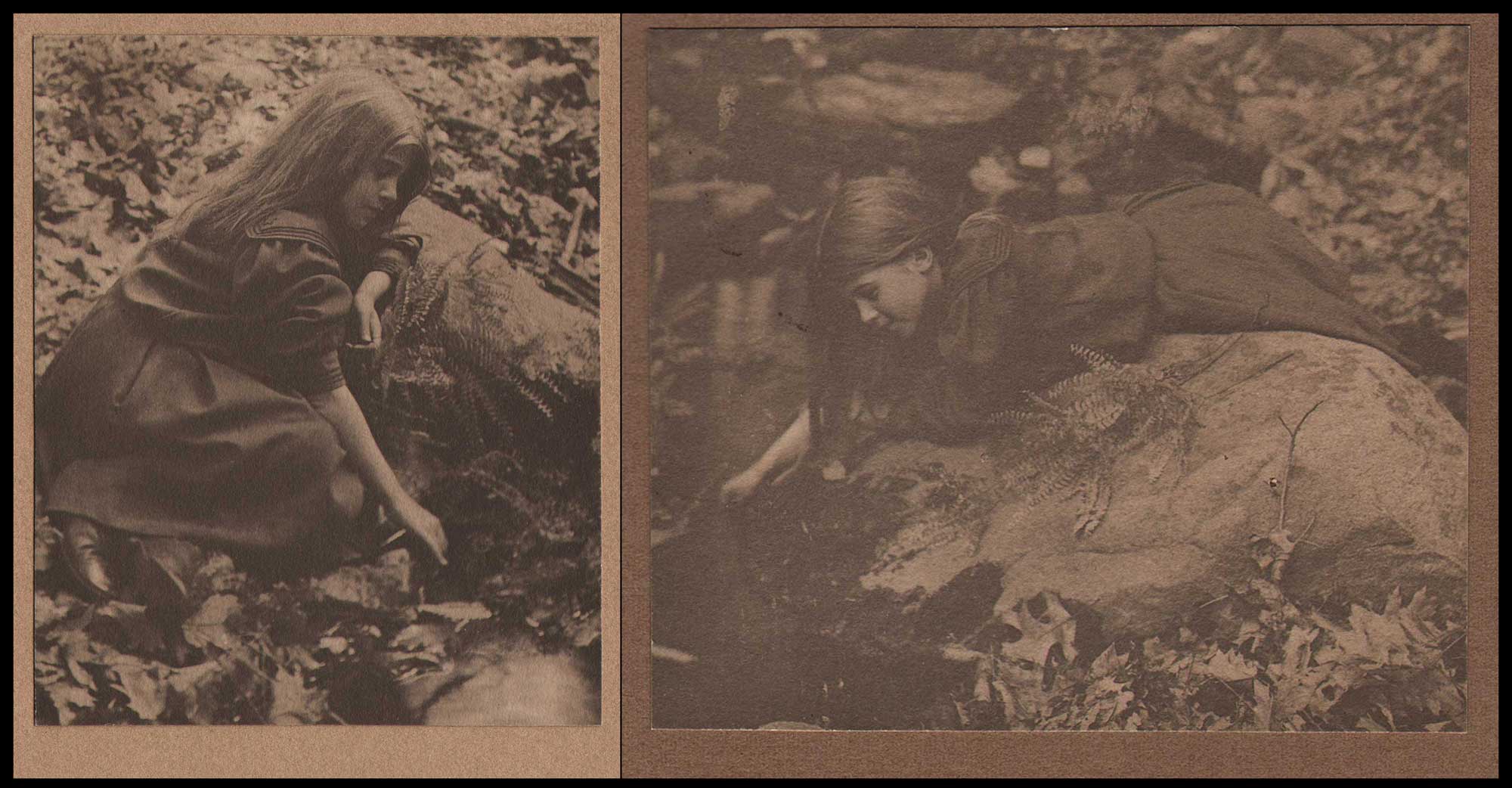
“Dorothy Tucker Gathering Ferns”: Charles Rollins Tucker, American (b. 1868): ca. 1910: mounted brown-toned platinum print: 9.4 x 7.7 cm | 31.2 x 16.0 cm. Born in August, 1899, Dorothy Tucker, a constant photographic subject for her father, then a high school physics teacher at Curtis High School on Staten Island, New York state, holds a spray of freshly-picked ferns while investigating the edge of a stream in the woods. From: PhotoSeed Archive

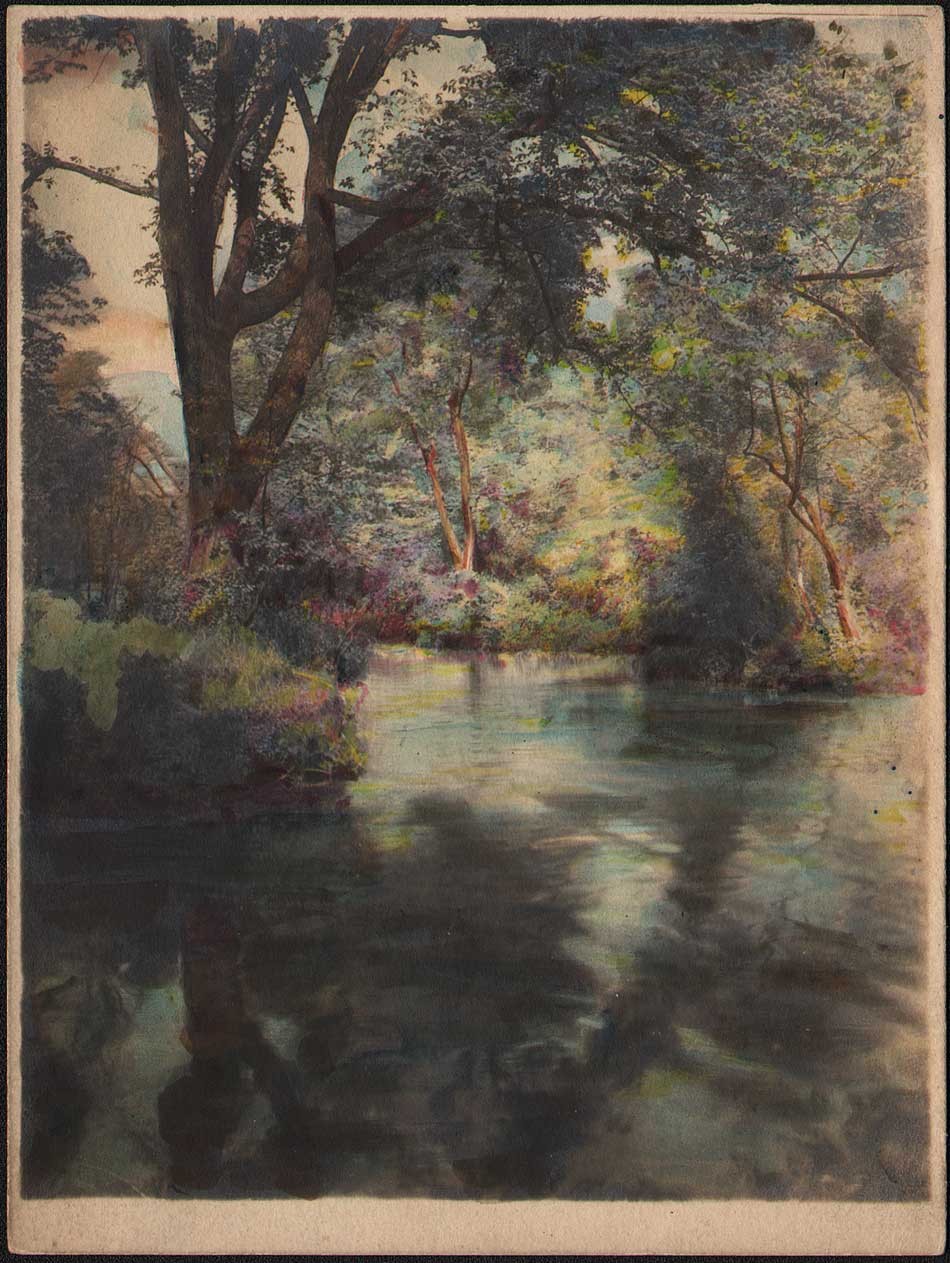
“Stream or Pond at Prospect Park”(Brooklyn, New York): ca. 1910-20: Unknown Brooklyn photographer: hand-colored gelatin silver print: 11.7 x 8.9 cm | 12.4 x 9.3 cm: From: PhotoSeed Archive

“Before Retiring”: ca. 1910-20: Margaret Bauks, British- (possibly Margaret Florence Bauks: b. 1872?) : hand-colored gelatin silver print: 11.6 x 15.9 cm | 27.8 x 22.8 cm: From: PhotoSeed Archive

“A Stream of Savoy”: ca. 1927: this print exhibited 1935: Frank Roy Fraprie, American (1874-1951): vintage Bromide print: 24.0 x 18.6 cm | 30.5 x 25.4 cm: As noted in the 1946 American Annual of Photography, (p. 170) Fraprie had been taking photographs in June of 1926 in Eastern France. The area, located in the Haute-Savoie, or Upper Savoy, is a mountainous region of spectacular beauty which includes Lake Annecy, one of France’s largest freshwater lakes.  Photographic historian Christian Peterson’s biography of Fraprie gives some background on this important photographer and editor: “Fraprie was the most influential author/publisher of American pictorial photography during the period following the Photo-Secession. From the 1910s to the 1940s, he wrote books and countless articles on all aspects of pictorialism. He edited photographic monthlies and annuals for nearly the entire first half of the twentieth century. In addition, he created his own highly successful pictorial photographs and exhibited them extensively.” From: PhotoSeed Archive

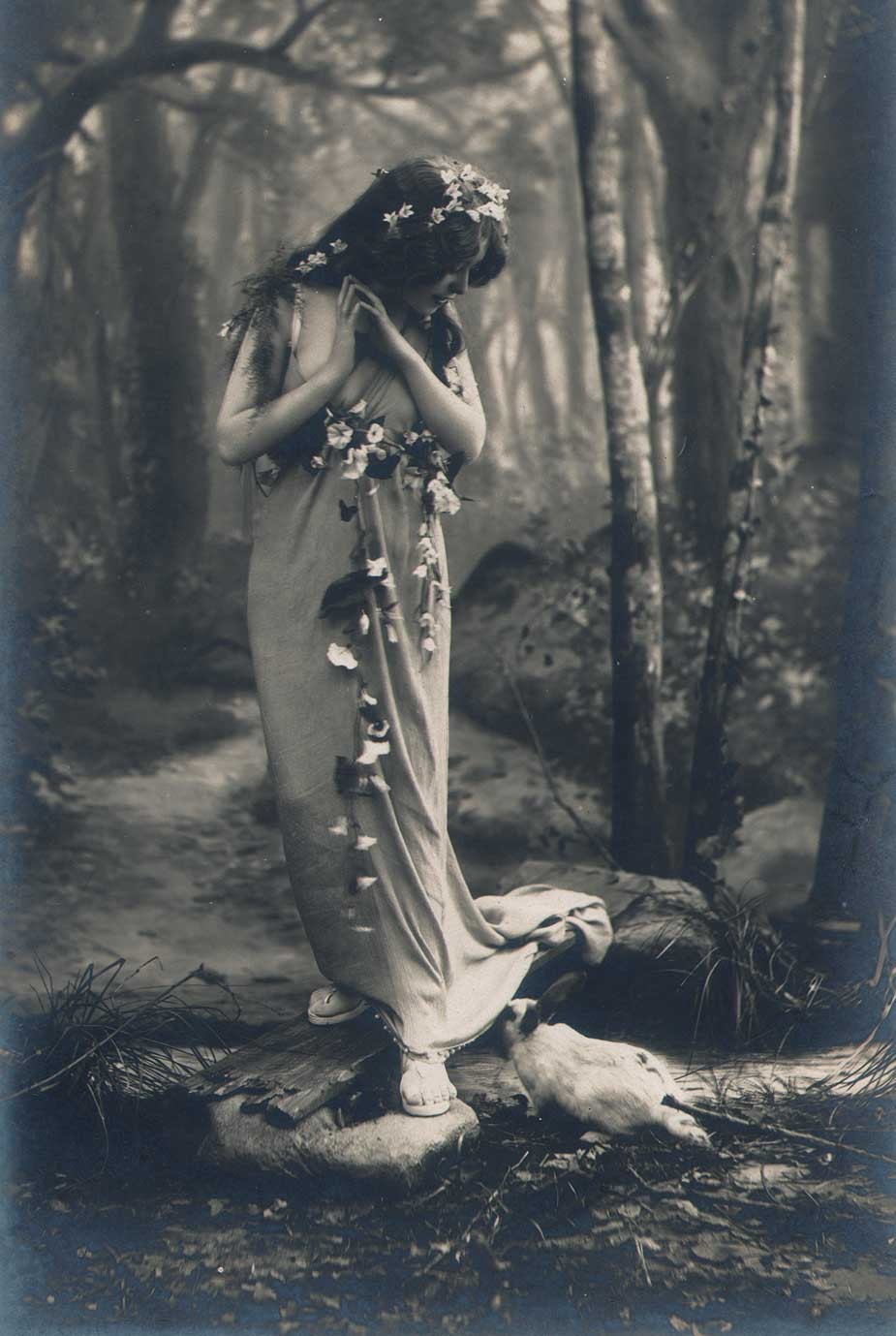
Detail: “Les Fleurs Dans Le Bois” : Léopold-Émile Reutlinger: French (1863-1937): vintage Bromide photograph, ca. 1905. 22.3 x 14.1 | 34.0 x 24.2 cm. Featuring a painted backdrop and wood board placed over a “stream”, this studio photograph features a white rabbit investigating the Belle Epoque era model identified from other variants as “Miss Doll”.(proper identification of this model would be of interest as she has remained a popular subject seen in countless vintage postcards, many hand-tinted) This example was printed by the Milan atelier Maison Tensi and included as a full-page plate in the February, 1905 issue of “La Fotographia Artistica”, a French/Italian photographic journal. From: PhotoSeed Archive

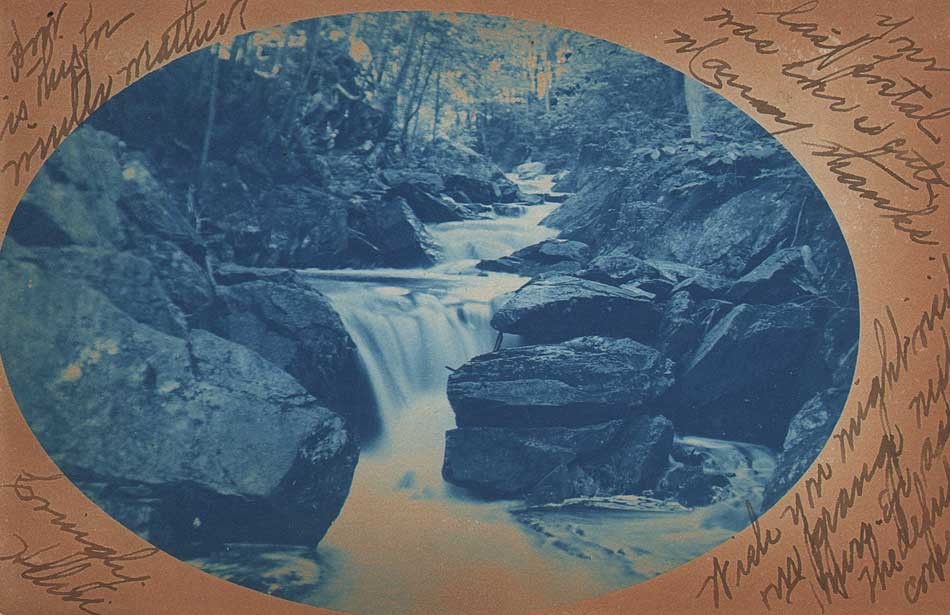
“A Rocky Brook” (New England?) : ca. 1906: Unknown American photographer: vintage cyanotype rppc: 8.9 x 13.8 cm. This idyllic cascading waterfall may depict the Minnewawa Glen in Marlborough, New Hampshire. Signed on the recto: “Lovingly Helen” in the lower left corner, it’s postmarked November 15, 1906 from Marlboro, N.H. addressed to Miss Nettie A. Hastings of East Sullivan, N.H. From: PhotoSeed Archive

“John Robert Tucker Skinny Dipping”: Charles Rollins Tucker, American (b. 1868): ca. 1915: unmounted platinum print: 3.8 x 5.2 cm. Born in March, 1914, John Robert Tucker, was the second of three children born to the former Mary Carruthers and photographer Charles R. Tucker. Here, the young boy plays in a woodland stream, with the photograph most likely taken in New England. John, according to his 1941 marriage certificate, was an electrical engineer by training. He died in 1991 in La Habra, Orange County, CA. From: PhotoSeed Archive

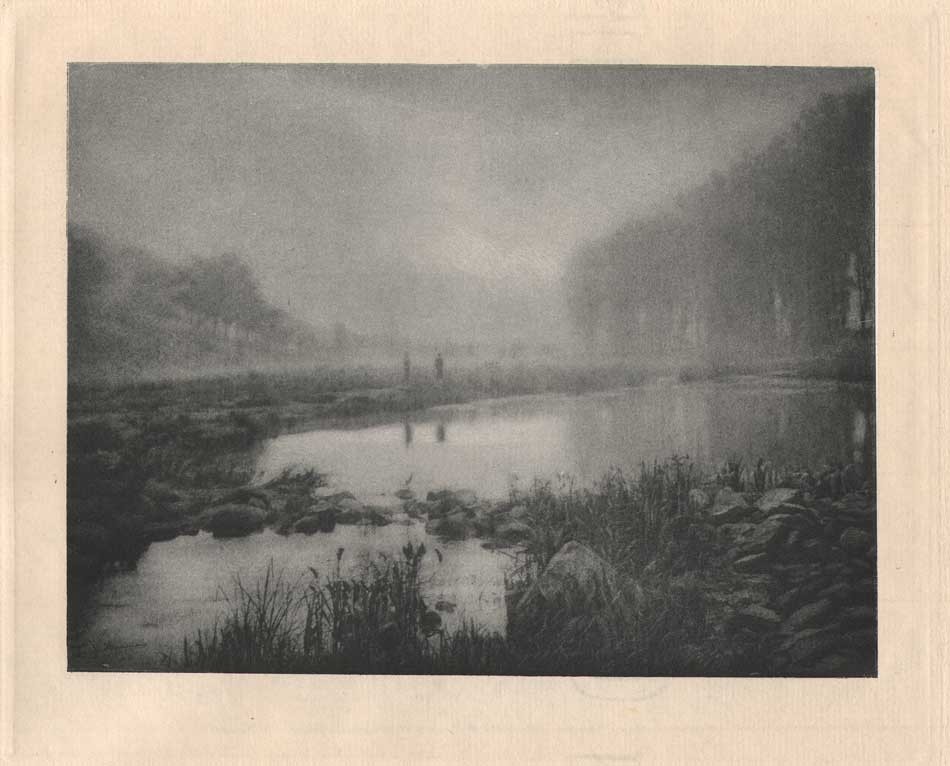
“Brume après la Pluie”: (1906) 1908: Gustave Marissiaux, Belgian (1872-1929) Photogravure on Van Gelder Zonen laid paper: 13.4 x 17.6 | 28.4 x 39.9 cm. Plate XXVI from Marissiaux’s tour-de-force gravure folio “Visions D’Artiste” comprised of 30 plates dating 1899-1908. Translating to “Mist after the Rain”, two figures in the distance stand looking out over an enlarged pond or stream located in “La Terre Wallonne” as identified in the portfolio index: more commonly known today as Wallonia- the southern region of Belgium. From: PhotoSeed Archive

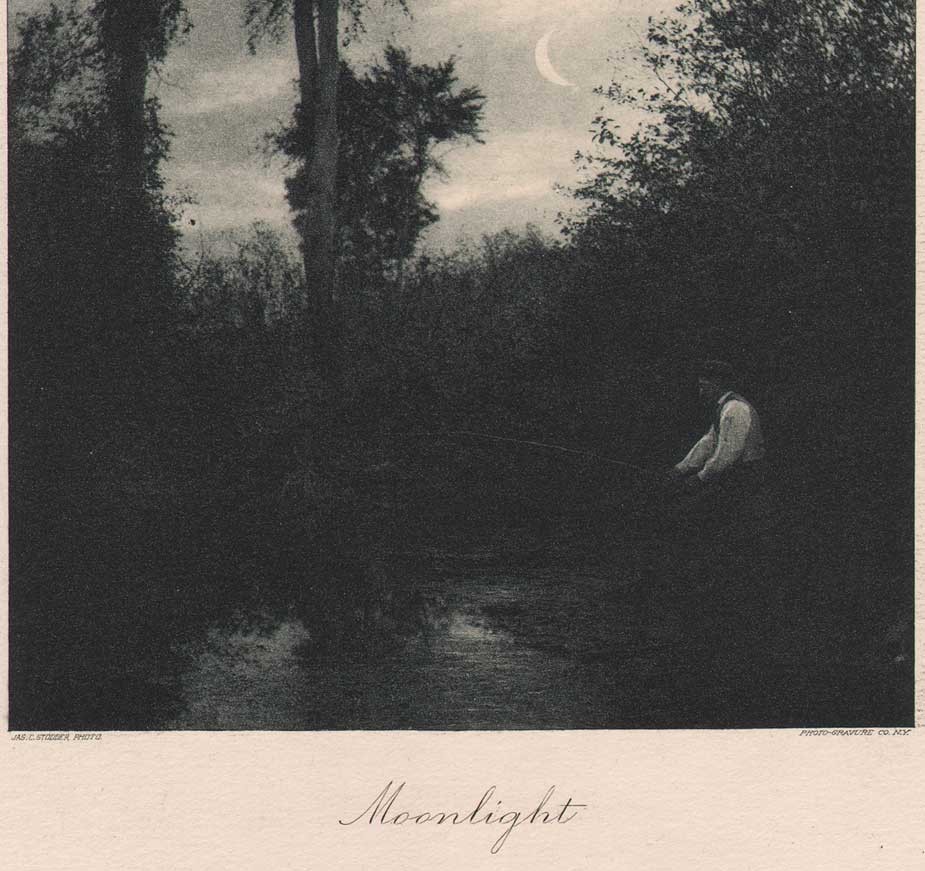
Detail: “Moonlight”: James C. Stodder, American: (1838-1917). 1890. Hand-pulled photogravure published in periodical “Sun & Shade”, New York: November, 1890: whole #27: N.Y. Photogravure Co.: 18.3 x 11.9 | 35.0 x 27.4 cm. A crescent moon rises above a wooded landscape at dusk while a gentleman fishes from the banks of a pond or stream. Stodder graduated from Rensselaer Polytechnic Institute in 1859 and moved to Bangor, Maine, where he first learned the wet-plate process of photography. A lawyer, he was son of a Boston jeweler, (obit) and financially well off. In 1876, he accompanied famed Hudson River School painter Frederic E. Church to the Mount Katahdin region of Maine. From: PhotoSeed Archive

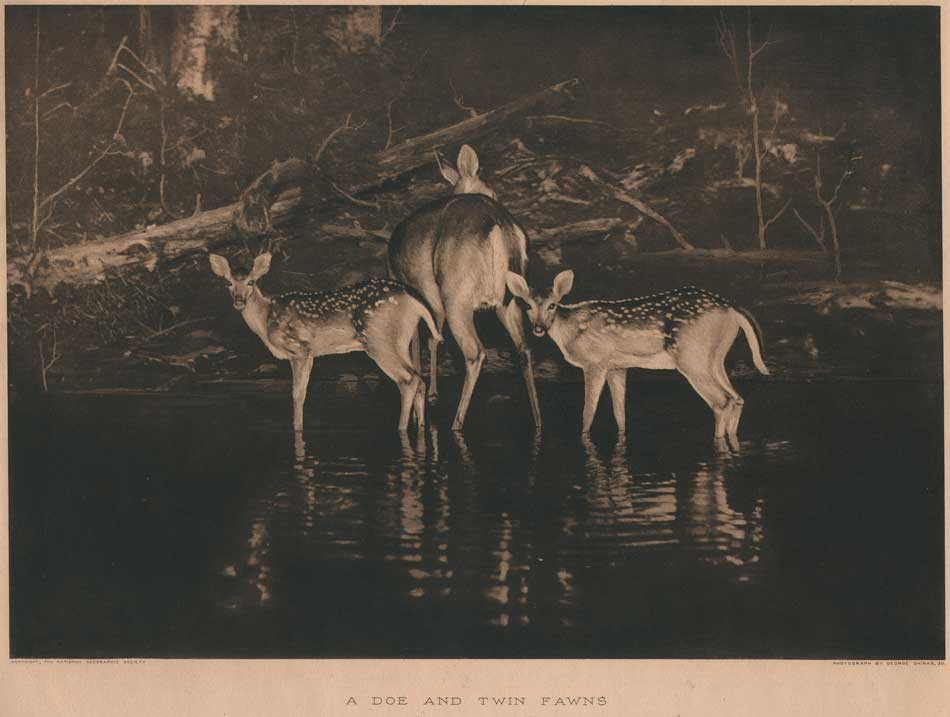
“A Doe and Twin Fawns” (taken 1896) 1916: George Shiras 3rd, American (1859-1942) Vintage photogravure published by the National Geographic Society, Washington, D.C. : 21.2 x 30.3 | 40.5 x 50.8 cm. A pioneer of using flashlight photography to record wildlife in their natural environments at night, Shiras used the method of “Jacklighting”, a form of hunting using a fixed continuous light source mounted in the bow of a canoe to draw the attention of wildlife: in this case three deer, while then utilizing magnesium flash-powder to freeze the scene in-camera. His series of twelve midnight views, including “A Doe and Twin Fawns”-also known as “Innocents Abroad” would earn Shiras international acclaim and many important awards. A one-term Congressman for the state of Michigan, (his father George Shiras Sr. was a former Justice of the U.S. Supreme Court) he was also an important naturalist who helped placed migratory birds and fish under Federal control. (The eventual 1918 Migratory Bird Treaty Act had groundings in legislation Shiras introduced to Congress in 1903 as the first comprehensive migratory bird law not voted on.) For additional background, see article by Matthew Brower in the journal History of Photography, Summer,2008: “George Shiras and the Circulation of Wildlife Photography”. From: PhotoSeed Archive

Detail: “A Corn Roast” Oliver Patterson Watts, American: (1865-1953). 1892. Hand-pulled photogravure published in periodical “Sun & Shade”, New York: June, 1892: whole #46: N.Y. Photogravure Co.: 14.7 x 23.2 | 34.6 x 27.4 cm. The index for the issue of Sun & Shade in which this photograph appears states: “Mr. Watts writes us that while wandering with his camera along “The Green,” a favorite picnic ground near Thomastown,(sic) Maine, he came upon this group of boys roasting corn and potatoes. At the sight of the camera they immediately grouped themselves, anxious to be “took.” The negative was made with a Scovill Favorite Camera, Waterbury lens, with an exposure of five seconds on a seed plate. It was developed with Pyro and Sodium Carbonate.” Dr. Oliver Patterson Watts was born in Thomaston, Maine, and graduated from Bowdoin College in 1889. Interestingly, in 1890, Potts and Dr. Julius Stieglitz, the brother of Alfred Stieglitz, were fellow scholars in chemistry at the newly opened Clark University in Worcester, MA. He later entered the University of Wisconsin in 1905 and took charge of the Carnegie Research on Electrolytic Iron under Dr. Charles F. Burgess. According to an Oct. 2009 article on Potts for the online resource Plating & Surface Finishing, the most important of his fifty-nine papers on plating and corrosion is probably “Rapid Nickel Plating,” presented before the Electrochemical Society in 1915. From: PhotoSeed Archive

“Mutu Bridge”: Donald Mennie, Scottish (1875-1944) 1922: Vintage unmounted bromide print: 24.2 x 34.6 cm. This picturesque Chinese river scene first appeared as a full-page plate variant in the 1914 volume “My Lady of the Chinese Courtyard” (between pp. 254-5) by author Elizabeth Cooper and then as Plate #7 “Mutu Bridge” in the photographer’s ca. 1914 work “Picturesque China: A Series of Vandyck Photogravures illustrating Chinese Life and Surroundings”. From: PhotoSeed Archive

Detail: “Stepping Stones” George Bacon Wood Jr., American: (1832-1909). 1894. Hand-pulled photogravure published in periodical “Sun & Shade”, New York: January, 1894: whole #65: N.Y. Photogravure Co.: 20.5 x 11.7 | 34.9 x 27.5 cm. The index for the issue of Sun & Shade in which this photograph appears states: “To the meditative woman crossing the brook with careful steps upon the projecting stones, Oliver Wendell Holmes’ words, in his “Professor at the Breakfast Table,” can be appropriately applied: “The wisest woman you talk with is ignorant of something that you know, but an elegant woman never forgets her elegance.” With no eye to see her, as she crosses the woodland stream, the figure in the picture appears reposeful, full of thought, and unconsciously elegant in pose. This is a charming photograph from nature, simple, truthful and artistic.” From: PhotoSeed Archive

“Derniers Rayons Dans la Forêt”: Guglielmo Oliaro, Italian: (1874 -1936) vintage Bromide photograph, ca. 1900? 1907: 16.6 x 22.5 | 23.5 x 32.7 cm. Translating to “Last Rays In The Forest”, this bucolic scene at dusk features a rushing stream and footbridge bisecting a a silhouetted line of Pollarded Willow trees. From Turin, amateur photographer Dr. Guglielmo Oliaro was very interested in the arts, founding a medical publishing house that survives to this day: From the InterFairs online resource: “Minerva Medica was the brainchild of a Turin GP (General Practitioner -ed.) Dr. Guglielmo Oliaro, a scientist with a passion for literature, art and music. It was on December 8 1925 that Dr. Oliaro got together with a small group of partners to set up the original company, Tipografia Editrice Minerva based in Turin. The creation of that company was a response to the growing success both in Italy and abroad, of Minerva Medica, a weekly journal for the general practitioner that first came out in 1909. Edizioni Minerva Medica S.p.A. was set up as a limited company by Dr. Guglielmo Oliaro on June 9 1934, for the purpose of supplying the Italian medical profession with text-books and scientific journals.” This example of Oliaro’s work was printed by the Milan atelier Maison Tensi and included as a full-page plate in the April, 1907 issue of “La Fotographia Artistica”, a French/Italian photographic journal. From: PhotoSeed Archive

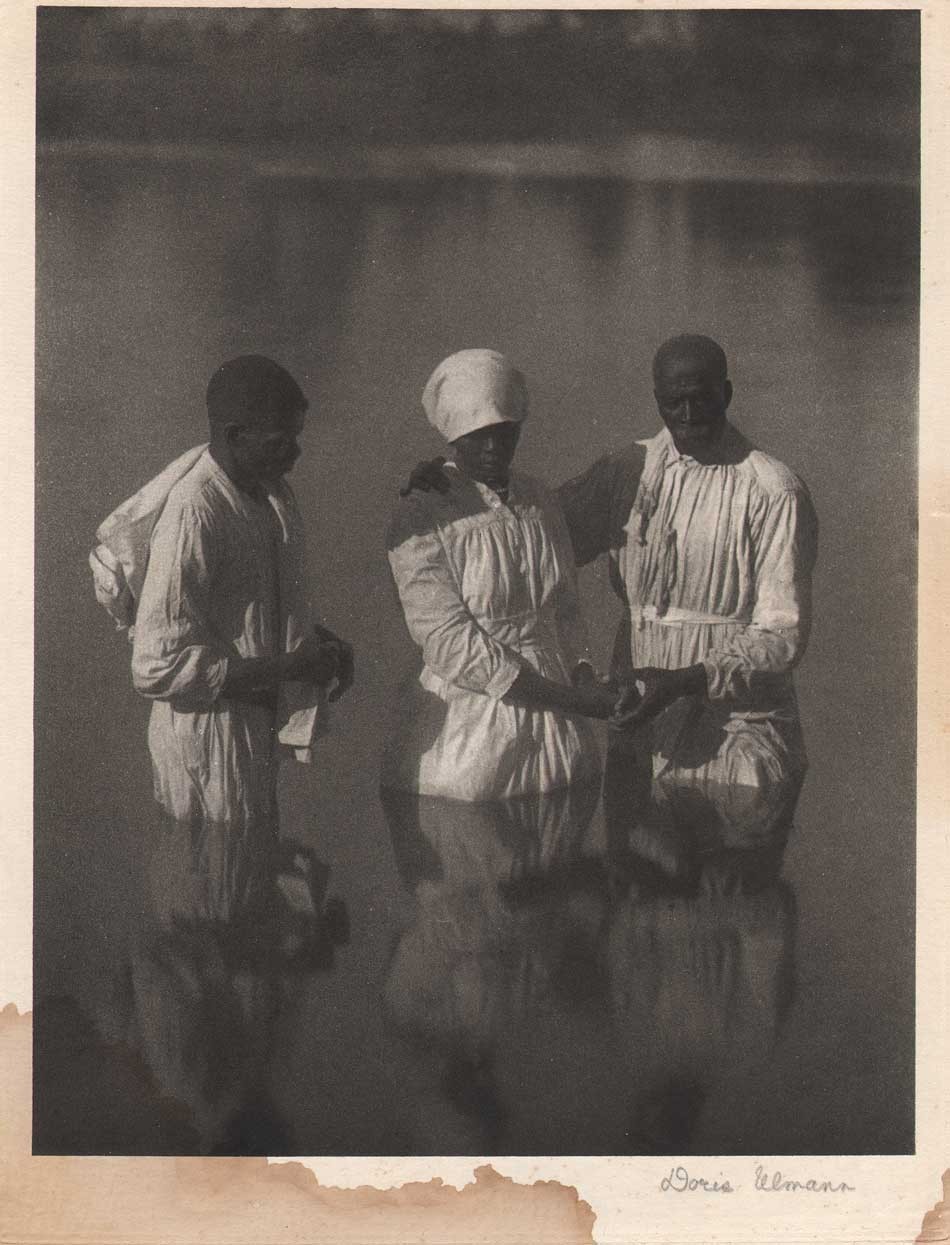
“Baptismal Scene” : Doris Ulmann, American: (1882 –1934) 1933: Signed, hand-pulled photogravure included as additional loose plate from deluxe edition of “Roll, Jordan, Roll”: 21.3 x 16.4 | 28.3 x 20.7 cm. In a rather interesting coincidence, this particular example of a summer stream showing a well-known river baptism by Ulmann has been partially immersed by moisture along the lower margin. From p. 116 of the volume: “A candidate for admission into the church must first be baptized. The Methodists have water sprinkled on their heads, but Baptists must be publicly immersed. These “baptisms” attract large crowds of onlookers. The candidates all arrive at the “pool” dressed in long white robes, which are carefully put away after the ceremony to serve as their shrouds some day. When they are assembled, the preacher and the leader, also dressed in white robes, lead the first candidate down into the water, where he is dipped three times, once in the name of the Father, once in the name of the Son, and once in the name of the Holy Ghost. As he is lead up out of the water, all his sins are left behind, drowned and buried in a watery grave. His soul is cleansed white as snow and he is ready to be received into full church membership. Unless he “falls” into sin and gets “turned out” of the church, he will some day be received into fellowship with God’s holy angels up in heaven.” The following review of Roll, Jordon, Roll comes from Steve Watson and was included on the Amon Carter Museum of American Art website, first published in 2016: Photographer Doris Ulmann came from an affluent white New York City family. She took teacher training with photographer Lewis Hine at the Ethical Culture School and subsequently studied psychology and law at Columbia University. She also studied photography with Clarence H. White, a founding member of the Photo-Secession movement known for teaching the Pictorialist style. Ulmann collaborated with novelist Julia Peterkin on a book project titled Roll, Jordan, Roll(New York: R.O. Ballou, 1933). The book focuses on the lives of former slaves and their descendants on a plantation in the Gullah coastal region of South Carolina. Peterkin, who won the Pulitzer Prize for her novel Scarlet Sister Mary (Indianapolis: Bobbs-Merrill, 1928), was born in South Carolina and raised by a black nursemaid who taught her the Gullah dialect. She married the heir to Lang Syne, a 2,000-acre cotton plantation, which became the setting for Roll, Jordan, Roll. Ulmann began photographing there in 1929. Roll, Jordan, Roll is titled after the spiritual written by English Methodist leader Charles Wesley in the 18th century which became well-known among slaves in the United States during the 19th century. Appropriated as a coded message for escape, by the end of the American Civil War it had become known through much of the eastern United States. In the 20th century it helped inspire the blues, and it remains a staple in gospel music. Roll, Jordan, Roll was illustrated with 90 photogravure plates made from Ulmann’s large-format negatives. Although they comprise an amazing ethnographic study, today Ulmann’s Pictorialist aesthetic seems a strange choice for making documentary images. The hazy, soft-focus photographs lend a sentimental, nostalgic impression that belies the underlying exploitative history of her subjects. From: PhotoSeed Archive

“Niagara Falls”: attributed to Arthur Hammond, American: born England: 1880-1962: hand-colored gelatin silver print mounted to album leaf, ca. 1930-1940: 19.2 x 24.2 | 25.0 x 32.7 cm. To conclude our post is a view of the ultimate Summer Stream: a view showing the Niagara River’s Horseshoe Falls from the Canadian side. From a personal album of nearly 100 photographs attributed to Hammond dating from around 1910-1940. Born in London, photographer Arthur Hammond arrived in America at Ellis Island in New York Harbor on July 31, 1909 and established himself with his own studio in Natick, MA outside Boston by 1912. In 1920, he authored the foundational book “Pictorial Composition in Photography” and became a leading voice for pictorialism in America through his position as associate editor of American Photography magazine that lasted 30 years from 1918-1949. From: PhotoSeed Archive

By the Stream

Paul Laurence Dunbar (1872-1906)

By the stream I dream in calm delight, and watch as in a glass,
How the clouds like crowds of snowy-hued and white-robed
maidens pass,

And the water into ripples breaks and sparkles as it spreads,
Like a host of armored knights with silver helmets on their heads.

And I deem the stream an emblem fit of human life may go,
For I find a mind may sparkle much and yet but shallows show,

And a soul may glow with myriad lights and wondrous mysteries,
When it only lies a dormant thing and mirrors what it sees.

Goodbye, Sagamore Farm

Oct 2018 | Alternate Processes, Childhood Photography, New Additions, Painters|Photographers, Scientific Photography

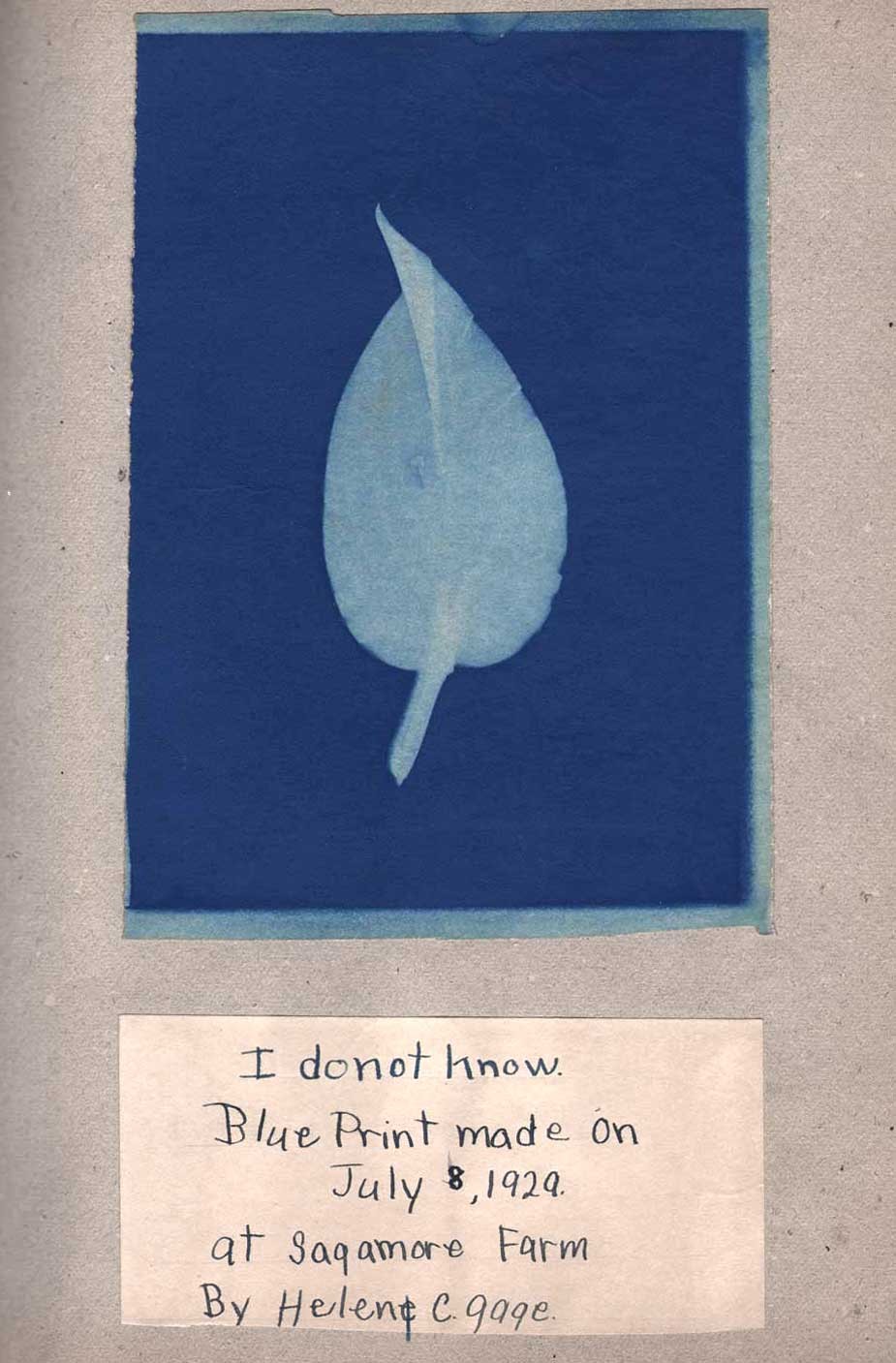
I recently trekked to the New Hampshire seacoast to investigate the origins of two cyanotype photogram albums recently posted to this site. There, botanical specimens gathered by Helen Chase Gage when she was a child on her family’s country estate known as “Sagamore Farm” in Rye, New Hampshire were compiled during the summer months of 1929 and 1930.

At Odiorne Point State Park in Rye, New Hampshire, remnants of foundation walls belonging to “Sagamore Farm” can be seen in this view looking west towards the seacoast photographed October 1, 2018. Helen Chase Gage (Miller) 1917-1982 was a schoolgirl when she roamed near here during the summers of 1929 & 1930 collecting botanical specimens used to make two albums of cyanotype photographs. The estate, a grand sixteen-room summer home built in 1892 by Dr. William Duncan McKim, (1855-1935) was purchased by Helen’s parents in 1918 and eventually condemned and demolished by the US Federal Government in 1942 with other homes in order to build Fort Dearborn, which provided a coastal defense for the United States on the Atlantic seaboard during and after the World War II era. Photo by David Spencer for PhotoSeed Archive.

A surviving photograph of “Sagamore Farm” located in Rye New Hampshire, the summer country home where schoolgirl photographer Helen Chase Gage made her cyanotype albums during the summers of 1929-30. A sixteen-room home originally built in 1892 by Dr. William Duncan McKim, (1855-1935) it’s described in the 1994 volume Footprints in Time: A Walk where New Hampshire Began as: “This was a large house with two matching sides separated by a porte cochere (a carriage drive-through) which went through the house to the large barn behind.” Notice the stone wall in front of the home, indicating the presence of farm fields that criss-crossed the future Odiorne Point State Park property. Photo courtesy Seacoast Science Center.

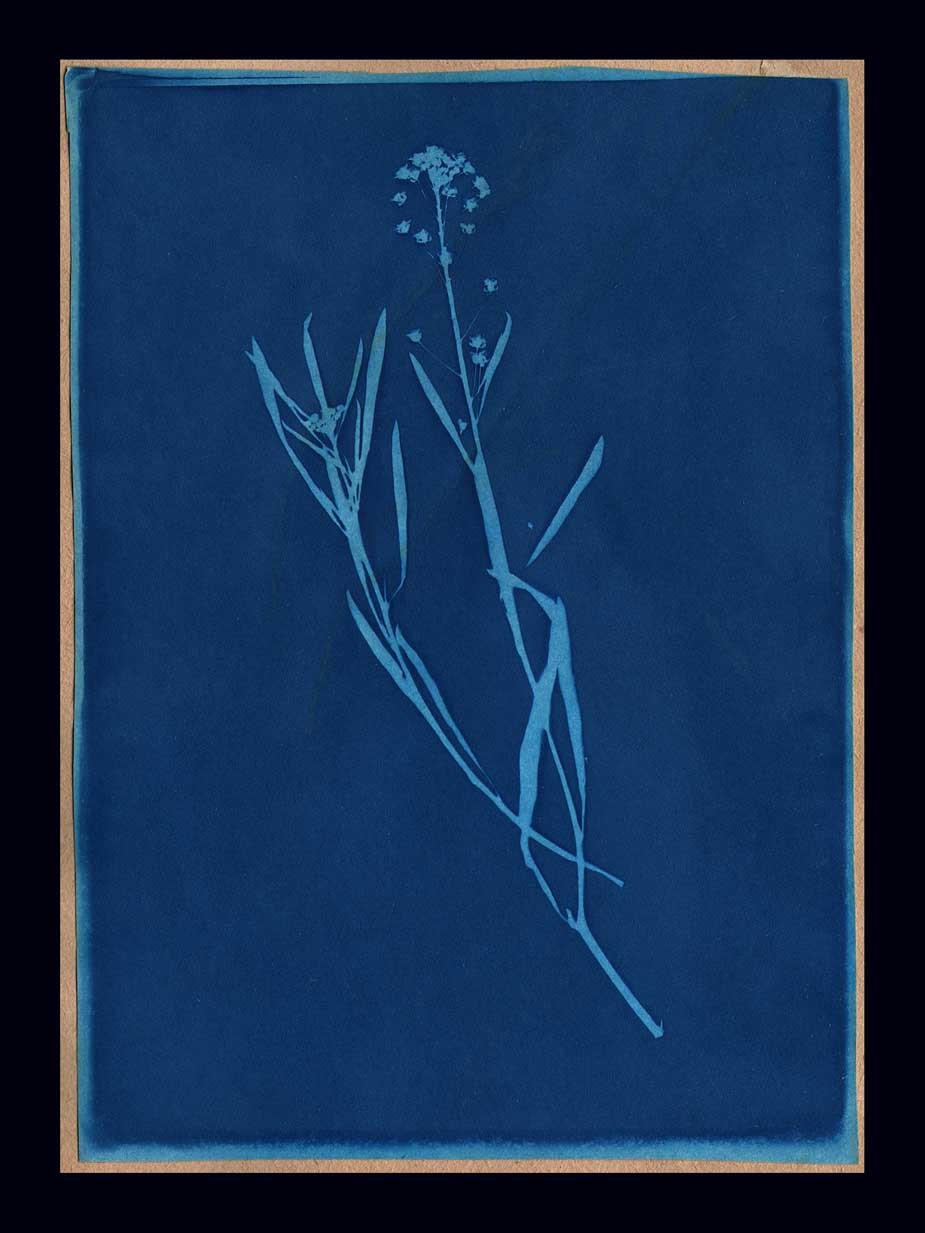
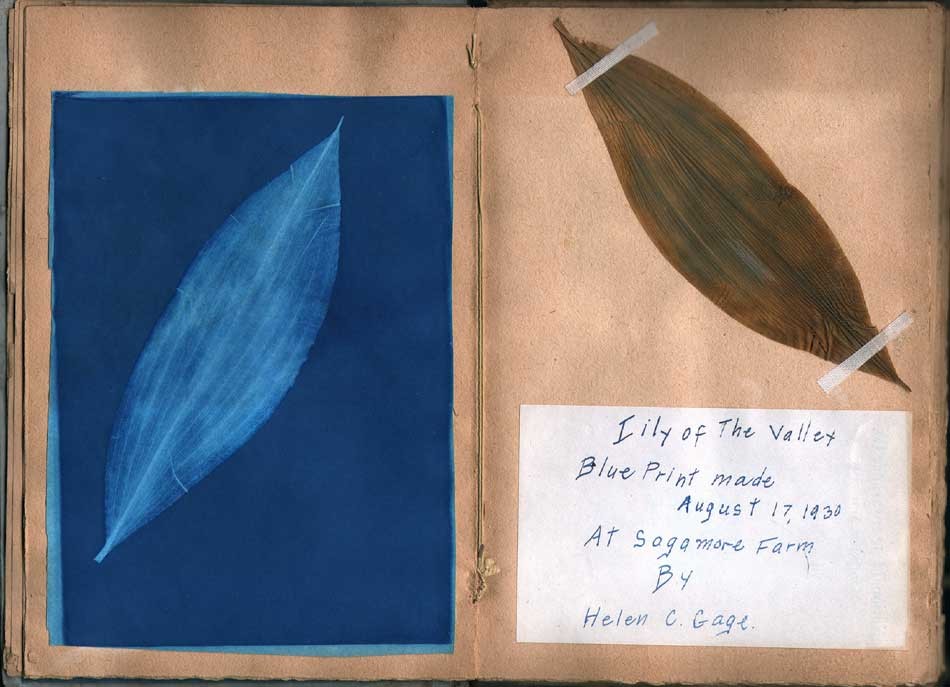
“Sweet Alyssum” (Lobularia maritima) Helen Chase Gage- American: 1917-1982; Cyanotype: 1930: (18.0 x 12.9 | 21.6 x 14.6 cm) Inscribed on opposite album page: Sweet Alyssum Blue Print made August 17, 1930 At Sagamore Farm, N.H. By Helen C. Gage. From: PhotoSeed Archive

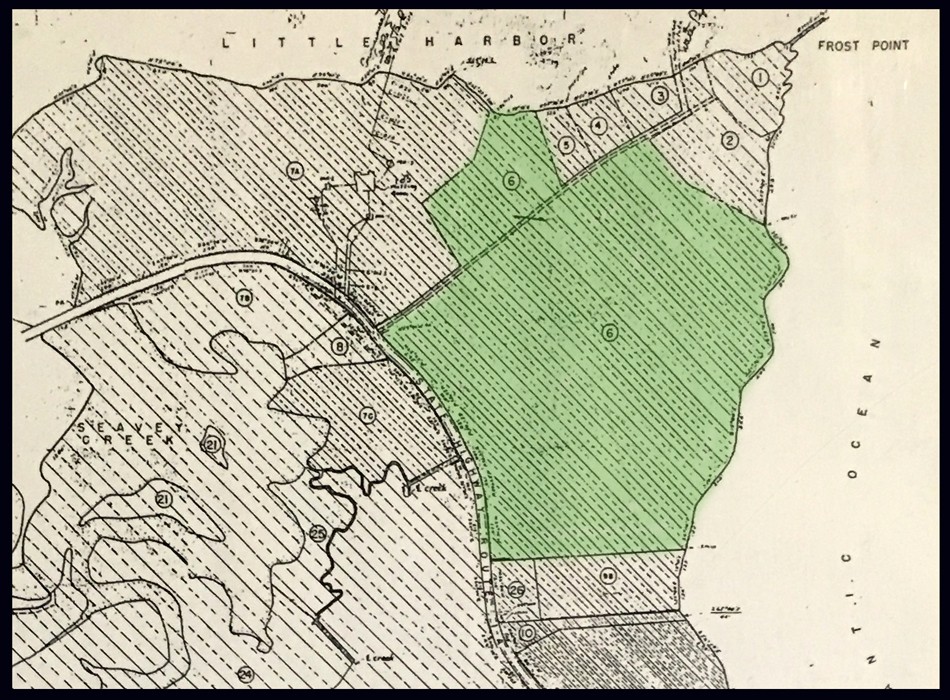
Known today as Odiorne Point State Park, Helen’s family summer home was located on land at Frost Point at the mouth of the Piscataqua River and Gulf of Maine. In 1942 during World War II, the US federal government appropriated nearly 265 acres making up the future park boundaries through eminent domain, including the Sagamore Farm estate and other properties owned by 24 families. (11 homes are said to have been demolished) This was done in order to build Fort Dearborn, a coastal outpost manned by large gun emplacements designed to protect the nearby Portsmouth Naval Ship Yard on the Piscataqua.

This ca. 1942 US War Department map shows the future area of Odiorne Point State Park in Rye, New Hampshire. Using the color green, this website has shaded the parcel belonging to photographer Helen Chase Gage’s family- 43.6 acres. The US Government appropriated nearly 265 acres owned by 24 families through eminent domain in order to build Fort Dearborn, which took three years to complete. Graphic courtesy Seacoast Science Center.

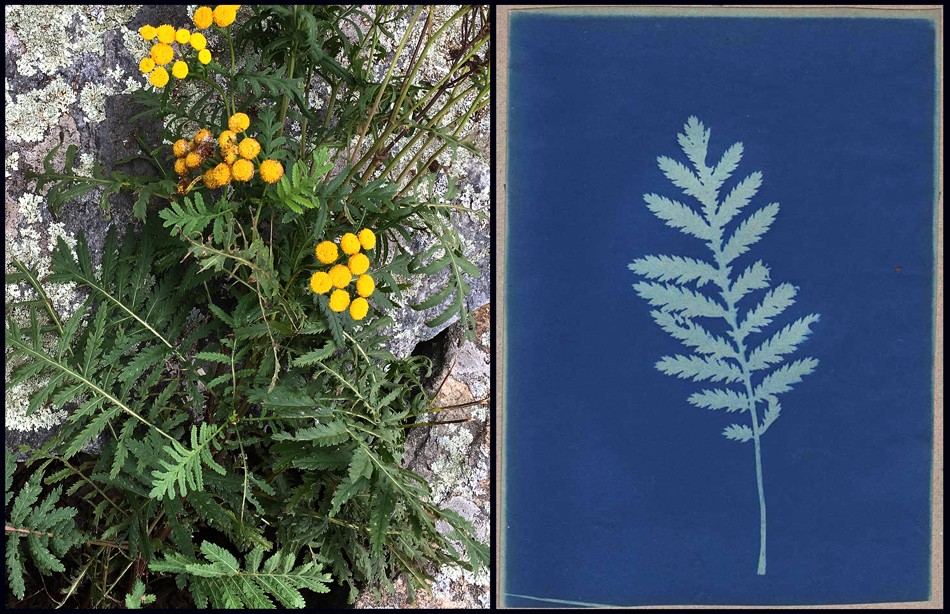
Left: Tansy flowers in bloom at Odiorne Point State Park in Rye, New Hampshire photographed October 1, 2018. Photo by David Spencer for PhotoSeed Archive. Right: “Tansy” (Tanacetum vulgare) Helen Chase Gage- American: 1917-1982; Cyanotype: 1929: (17.6 x 12.5 | 30.0 x 22.8 cm) Inscribed on same album page: Tansy: Blue Print made on July 17, 1929 at Sagamore Farm By Helen C. Gage. From: PhotoSeed Archive

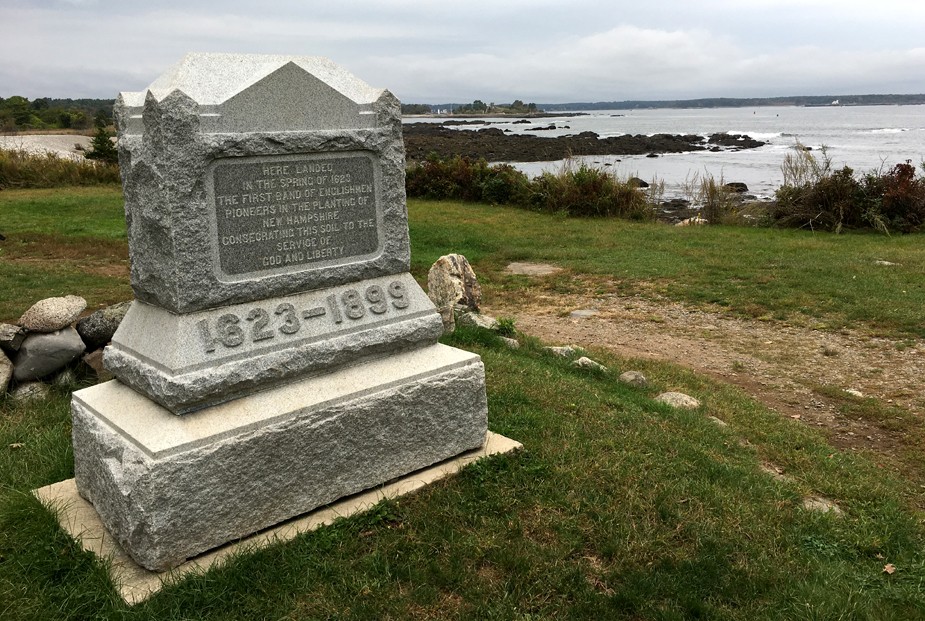
This granite marker on the coastline at Odiorne Point State Park marks the location in the Spring of 1623 where English immigrant David Thomson (1593-1628) of Plymouth, England established the first European settlement on land that would become the future American state of New Hampshire. Originally installed in 1899, the marker was eventually moved but re-installed and re-dedicated in its’ original spot in 2007: “Here Landed In the Spring of 1623 The First Band of Englishmen. Pioneers in The Planting of New Hampshire. Consecrating This Soil to The Service of God and Liberty. Photographed on October 1, 2018 by David Spencer for PhotoSeed Archive.

The area is rich in American history: at Odiorne Point within the present-day state park, a large granite marker (installed 1899 |rededicated 2007) marks the location in the Spring of 1623 where English immigrant David Thomson (1593-1628) of Plymouth, England established the first European settlement on land that would become the future American state of New Hampshire.

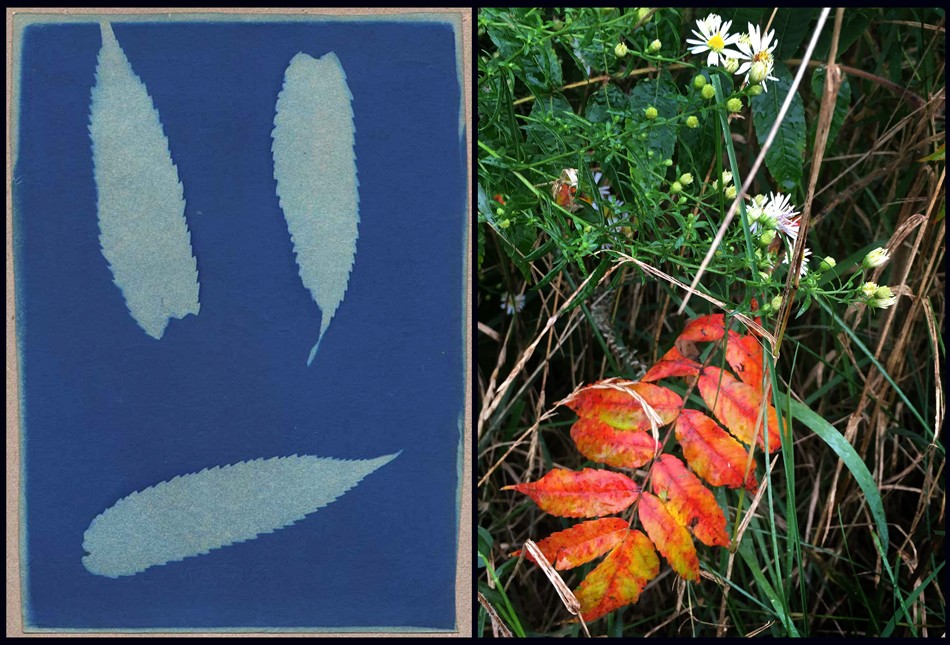
Left: “Sumack” (Rhus coriaria?) Helen Chase Gage- American: 1917-1982; Cyanotype: 1929: (18.0 x 13.0 cm | 21.6 x 14.6 cm) Inscribed on album page: Sumack: Blue Print made on July 23, 1929 at Sagamore Farm By Helen C. Gage. From: PhotoSeed Archive. Right: Sumac leaves from a shrub showing off their fall colors at Odiorne Point State Park in Rye, New Hampshire photographed October 1, 2018. Photo by David Spencer for PhotoSeed Archive.

Helen Chase Gage hand-drawn calling card inserted within 1930 Blue Print album of botanical specimen photograms: Helen Chase Gage- American: 1917-1982: This hand-made album is shown opened with the front pastedown made from blue art paper extending full width of opened volume. Overall dimensions: 23.0 x 30.0 cm : Calling card: 7.6 x 15.1 cm. Helen Chase Gage spent her early childhood at 2 Avon Road in Bronxville, New York but assembled this album and another in 1929 at Sagamore Farm in Rye, New Hampshire. From: PhotoSeed Archive

“Larkspur” (Scientific name: Delphinium; Family: Ranunculaceae) Helen Chase Gage- American: 1917-1982; Cyanotype: 1930: (17.7 x 12.6 cm | 21.6 x 14.6 cm x2) Inscribed on opposite album page: Larkspur: Blue Print made August 10, 1930 At Sagamore Farm By Helen C. Gage. This representative album spread from Helen’s 1930 collected cyanotypes is unusual because the original collected botanical specimens are featured as part of the volume. Thirty-one individual prints are included within the album closed by means of cloth ties, seen at far right of frame. From: PhotoSeed Archive

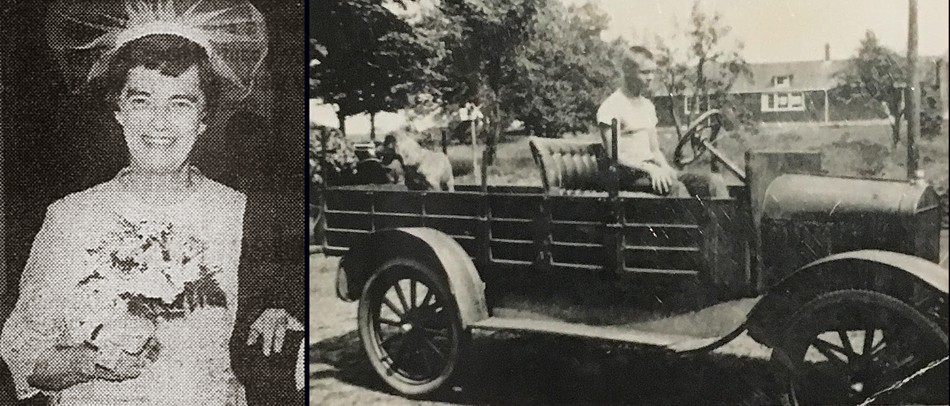
“Big Sister, Little Brother” Left: This cropped photograph of Helen Chase Gage Miller accompanied her 1970 wedding announcement in the Bronxville (New York) Review Press and Reporter newspaper. A graduate of Bronxville High School and Pratt Institute in Brooklyn earlier in life, she also attended Ursinus College. Later, the young photographer is known to have worked at Lord and Taylor, a department store in New York City, and was a member of the Reformed Church in Bronxville, the Anne Hutchinson Chapter of the Daughters of the American Revolution and the League for Service. Right: In 1935, Helen’s younger brother Edward Augustus Gage (1919-2007) is shown behind the wheel of a 1918 Model T Ford depot wagon, along with his dog Ski at rear, in a photograph believed to have been taken near the family’s summer property in Rye. The caption for this photograph which appeared in the volume “Footprints in Time” states: “Edward Gage later played an important role in trying to get the government to sell Odiorne land back to its pre-war owners.” His 2007 obituary mentions he was a pilot and flight instructor in World War II and finished in the Naval Reserves at the rank of lieutenant commander. Trained as a lawyer, in 1970 he was appointed to serve as judge of the Exeter District Court in New Hampshire until his retirement in 2003. Photo courtesy Seacoast Science Center.

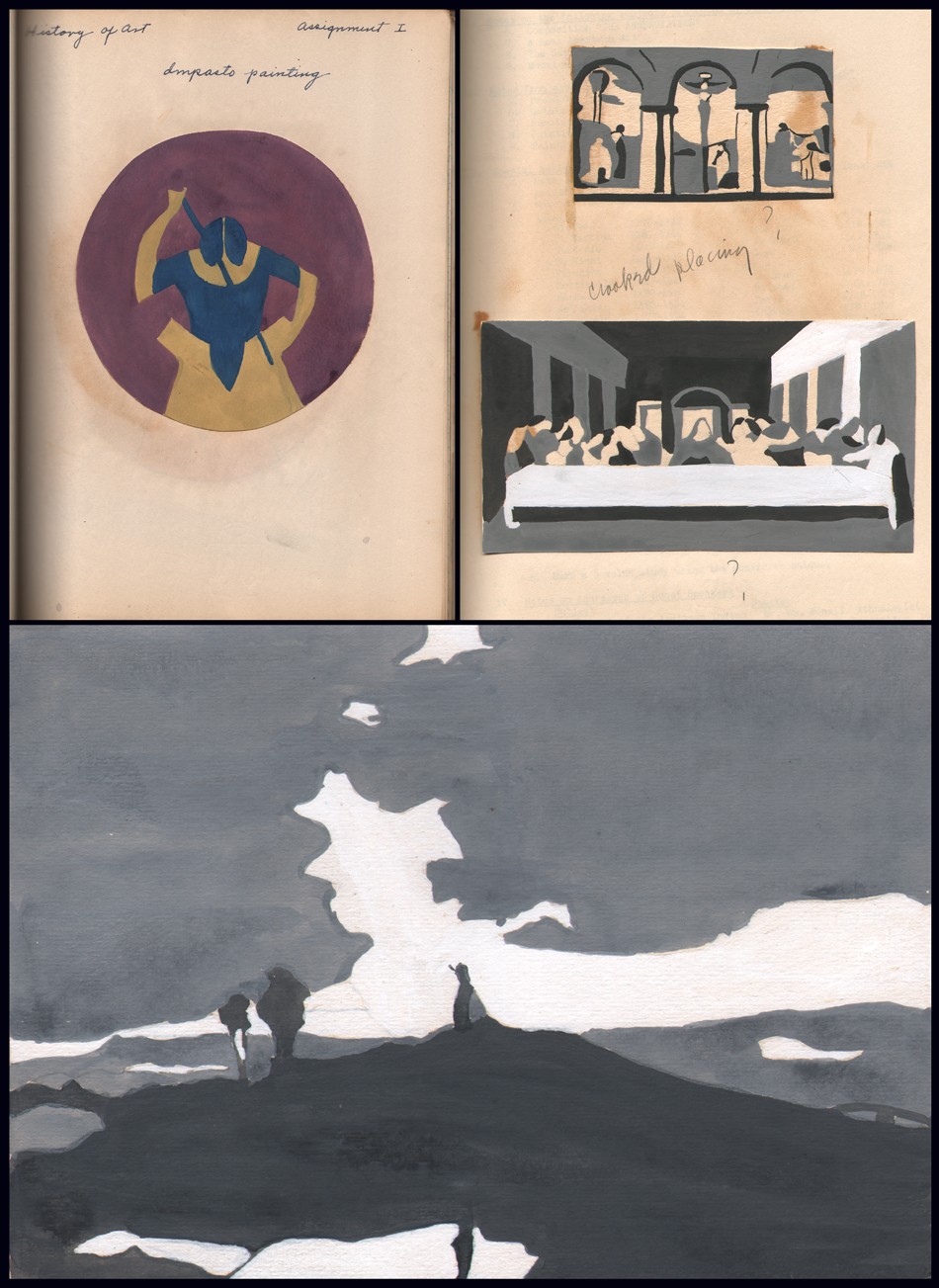
The pursuit of art was evident for Helen Chase Gage after early childhood. Although it’s not known if she pursued it in any professional capacity later in life, Helen did attend Pratt Institute-School of Fine and Applied Arts in Brooklyn, New York from 1939-40, graduating in June, 1940. Above are several examples of original artwork by Gage used in her Art History course she was enrolled in as part of a series of lessons on painting presented by school Director James C. Boudreau kept in a notebook held by the PhotoSeed Archive. Top left: a tondo (13.8 cm) female form frontal view by Helen Chase Gage as an example of Impasto painting done using tempera paint. Top right: tempera study (5.5 x 9.5 cm) by Helen Chase Gage of the fresco “Pazzi Crucifixion” by Pietro Perugino; bottom: tempera study (8.4 x 15.9 cm) by Helen Chase Gage of Leonardo Da Vinci’s “Last Supper”. Bottom: tempera study (12.9 x 18.1 cm) by Helen Chase Gage of a painting by English artist Joseph Mallord William Turner titled “A Heath Scene” in the Gage notebook. From: PhotoSeed Archive

Jumping to the present day, the focal point of the park is the Seacoast Science Center, a non-profit marine science education organization. When I visited on October 1st recently, I had the pleasure of speaking with the center’s president Jim Chase, who gave me a brief history of the property and was helpful with directions to the area where Sagamore Farm was once located. He told me of the park’s efforts in clearing out some of the invasive plants on the property and about one of Seacoast’s more popular activities- BioBlitz, described as a “daylong species scavenger hunt…..where families explore alongside scientists and field experts to find and record data on as many different species in the Park as possible in one day.”

“Lily of The Valley” (Convallaria majalis) Helen Chase Gage- American: 1917-1982; Cyanotype: 1930: (18.1 x 13.0 cm | 21.6 x 14.6 cm x2) Inscribed on opposite album page: Lily of The Valley: Blue Print made August 17, 1930 At Sagamore Farm By Helen C. Gage. This representative album spread from Helen’s 1930 collected cyanotypes is unusual because the original collected botanical specimens are featured as part of the volume. Thirty-one individual prints are included within the album. From: PhotoSeed Archive

At dusk, waves crash on a rock outcropping at Hampton Beach, New Hampshire on September 30, 2018. Located twelve miles south of the present day Odiorne Point State Park along New Hampshire Route 1A, the popular summer destination spot for tourists is known for its’ scenic beauty on the New Hampshire coastline, which measures in at 18.57 miles, the shortest ocean coastline of any US state. (or 235 miles of “estuarine shoreline!) Attractions and geographical proximity such as this give ample reason for visitors to visit both locales. Photo by David Spencer for PhotoSeed Archive

“I Do Not Know” Helen Chase Gage- American: 1917-1982; Cyanotype: 1929: (18.0 x 12.5 cm | 30.0 x 22.8 cm) Inscribed on same album page: I do not know.: Blue Print made July 8, 1929 At Sagamore Farm By Helen C. Gage. Perhaps one of the most interesting cyanotypes in both albums is this unidentified leaf specimen-endearing because the young artist who collected it was just being honest with her knowledge and told us so. As I’ve mentioned previously with these overall works, a few of the specimens may not be “right” botanically and possibly misidentified in some cases. Your expertise is welcomed! From: PhotoSeed Archive

Feeling like a kid myself, I used my phone to show Jim one of the many fine botanical specimens Helen had made into a cyanotype from the 1930 album and realized she could have been rightly called one of the first BioBlitz scavenger hunters. As I left and walked outside the Seacoast Center, I found confirmation for Helen’s love of place on the New Hampshire seaboard all those years ago: a large group of school children getting ready to set out on their own happy discoveries.

David Spencer- October, 2018

A Special Place Indeed: a poignant reminder of the property where Helen Chase Gage collected her plant specimens in order to make precious blue prints so many summers ago yields some new opportunities in the form of fall leaves and Goldenrod resting on this granite bench dedicated to the memory of the McKim and Gage families inside Rye’s Odiorne Point State Park where “Sagamore Farm” once stood. Photographed October 1, 2018 by David Spencer for PhotoSeed Archive

Afterword

An interesting segment from New Hampshire Public Radio from 2016 reports on how Odiorne Point State Park in New Hampshire was developed in the aftermath of World War II. The voice of Helen’s younger brother Edward Gage, (1919-2007) who went on to become a lawyer and spent decades trying to reclaim his family’s property is included in the report.  To the credit of the park in not glossing over the loss to the Gage family and others-specifically the namesake Odiorne family who had owned property here since the 1660’s, signage outlining this history can be seen inside the Seacoast Science Center:

“In 1942,when the U.S. government took over Odiorne Point, homeowners were given short notice to vacate their beloved vacation homes and, in the case of the Odiornes, a farm that had been in their family almost three hundred years.

After the war, a debated legislative technicality at the federal level prevented Odiorne Point landowners from regaining their property. In ensuing years, discussion over what would become of the land covered the full range of development and preservation schemes.

In the end, thanks to preservation activist Annette Cottrell and the interest of New Hampshire Park Director Russell B. Tobey, the state-owned land became a park. The park is now the site of the Seacoast Science Center.

The story of Odiorne Point continues. Visitors and students from around the world are making new use of the park through the Seacoast Science Center and its educational programs. This little point of land seems destined to make more history.” 

Additional Reading

-Footprints in Time: A Walk where New Hampshire Began. Compiled by Howard S. Crosby, Wendy W. Lull, and Richard T. MacIntyre: Arcardia Publishing, 1994 

-Writer Anna Soper contributes additional scholarship on these albums in her article These Stunning Botanical Images Are Blueprints of the Past  found on the Atlas Obscura website published October 8, 2019.

The Beautiful Beyond

Sep 2017 | Childhood Photography, Documentary Photography, PhotoSeed

PhotoSeed celebrates the life of one of its profound influences on the recent passing of my father Charles Edward Spencer 1925-2017.

“Charlie Spencer and WWII Classmates” : unknown English photographer: gelatin silver K(odak) Ltd postcard ca. 1940: 13.8 x 8.7 cm : The author’s father, about 15, is seen at far left striking a pose in Workington, on the west coast of Cumbria England (Cumberland county) during the early part of World War II. Born in Holyoke, Massachusetts in 1925 to English parents who sought their fortune in the United States, the American Depression forced the family back to their native Newcastle upon Tyne by 1933. A favored German aerial target during the war because of its important shipbuilding industry, Charlie was evacuated along with over 800,000 English school age children from Newcastle and other large English cities beginning in late 1939 as part of the British government’s Operation Pied Piper, which eventually displaced 3.5 million people in the UK. Late in the war, he returned to Newcastle, (Benwell) reuniting with his parents Charles and Jane (Garland) Spencer and graduating there from Atkinson Road Technical School. An American by birth, he soon found himself serving in the U.S. Army of Occupation in Germany, where he was a reporter for the Stars and Stripes newspaper among other duties. His first eight years in America had certainly made an impression however, and he returned to the states for good in early 1949 aboard the troop ship USNS General Maurice Rose. Settling in the greater Bridgeport, CT area, he went on to become an advertising and sales promotion specialist for the General Electric Company in their small appliance division for fifteen years and later in the same capacity with other business ventures in CT. Married 61 years to Ann, he passed away in September, 2017. Note: girl in photograph is daughter from Workington family with whom Charlie stayed with during his billet. After Workington, he was billeted with another family in Siddick England. From: Authors personal family archive.

The call would come, I had convinced myself, for years. But it waited patiently. I reassured myself I was prepared, but for naught. When it did, from my brother Will, it was from his childhood voice over 50 years gone: punctuating his cries through the distance, he gasped for breath: “Dad did not wake up” he somehow forced through his cracking voice, cries and tears. My own response immediate: a shuddering to my core equal to his-helpless feelings not revisited since my toddler days-cries my father was now unable to comfort as he did throughout my entire life the finality of it all.

But goodness had shined its light, in this most profound form of sudden loss: my dad was now truly free of any miseries real for him in the physical present, and ones our family perceived in him during his long and noticeable decline. Vanquished. He was now free, and on his journey to the beautiful beyond.

David Spencer-

1 2 3 4